
Brave vs Courageous vs Bold: 3 Key Differences That Matter
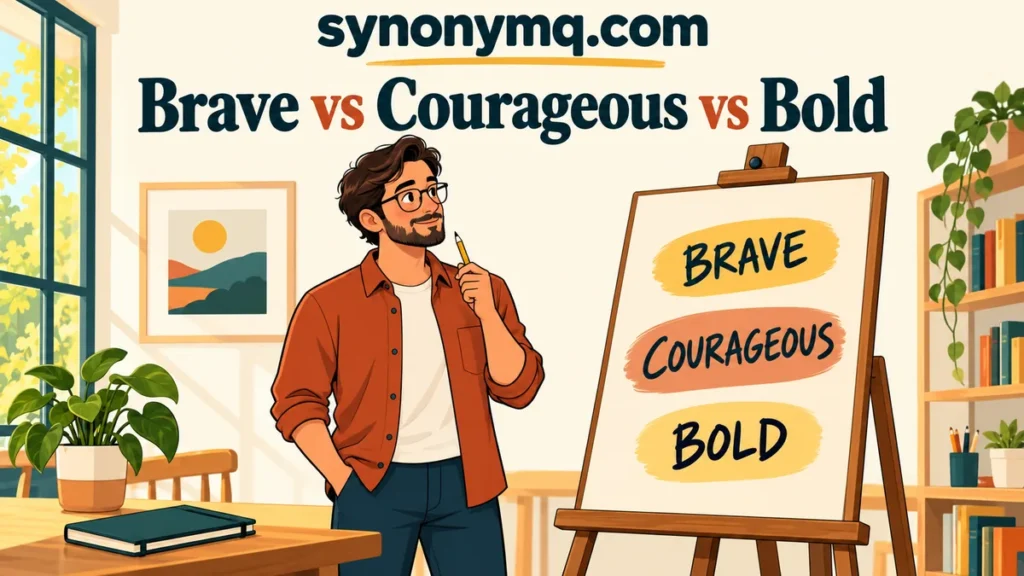
Brave vs courageous vs bold: brave and courageous describe facing danger or difficulty with courage. Bold can mean daring, but it also describes striking colors and heavy type. Choose by the action, the role of fear and the surrounding words.
- Praising courage: choose brave or courageous.
- Highlighting a daring move: consider bold.
- Describing noticeable design or heavy lettering: use bold.
Brave vs Courageous vs Bold at a Glance
The useful distinction is what each word emphasizes. These words do not form a ladder from slightly brave to extremely brave, and they do not describe three separate kinds of person.
| Word | Main emphasis here | Original example | Watch for |
|---|---|---|---|
| Brave | Courage when something is difficult, frightening or dangerous | It was brave of Noor to admit the mistake. | The person may still feel afraid. |
| Courageous | Having or showing courage | Noor made a courageous admission. | It overlaps closely with brave; it is not limited to moral courage. |
| Bold | Daring action; in another sense, a noticeable appearance | The team proposed a bold redesign. | A daring idea is not necessarily a successful one. Bold lettering is a different sense. |
Oxford lists brave as a synonym of courageous. That overlap matters more than a rigid rule assigning one word to physical danger and the other to moral decisions.
1. Brave and Courageous Can Describe the Same Act
A person can be brave during a rescue, an uncomfortable conversation or a painful experience. Courageous can describe those situations too. Neither word requires a dramatic public achievement.
Direct Swap: “It was a brave decision to report the missing records.” → “It was a courageous decision to report the missing records.”
These are Near-Synonyms in this sentence. Both praise the courage involved. Choose brave for straightforward praise; choose courageous when you want the sentence to dwell on the person’s courage.
The American Heritage usage note associates courageous with strength rooted in principle or purpose. This is a useful shade of meaning, not a rule excluding brave from principled actions.
Brave does not mean free from fear
“She was frightened, but she spoke up” can describe a brave or courageous action. Calling her fearless would change the emphasis: fearless stresses being without fear.
For praise of someone’s action, brave is often enough. Use fearless when the absence of fear is the point you intend to make. Do not infer a person’s private feelings simply from a calm expression.

2. Bold Can Highlight Daring Rather Than Courage Alone
A bold proposal might replace an entire exhibition layout instead of moving a few signs. The word draws attention to the scale or daring of the change. Whether the proposal works is a separate question.
Compare the same decision with two descriptions:
- A courageous decision: the writer praises the courage needed to make it.
- A bold decision: the writer emphasizes its daring or willingness to depart from the usual approach.
Both descriptions can fit one decision. Use the reason for your praise to choose. If someone risks criticism to report a problem, brave or courageous makes that courage clearer than bold alone.
Is bold always a compliment?
No. Merriam-Webster records both daring and presumptuous senses of bold. “That was a bold request” might express admiration, surprise or disapproval, depending on the situation.
A bold person can be courageous, outspoken or unusually willing to take a chance. The surrounding sentence must show which quality you mean. “A brave man” and “a bold man” need not make the same claim.
If you mean someone gained confidence or the ability to act, the alternatives to empowered address that different emphasis.

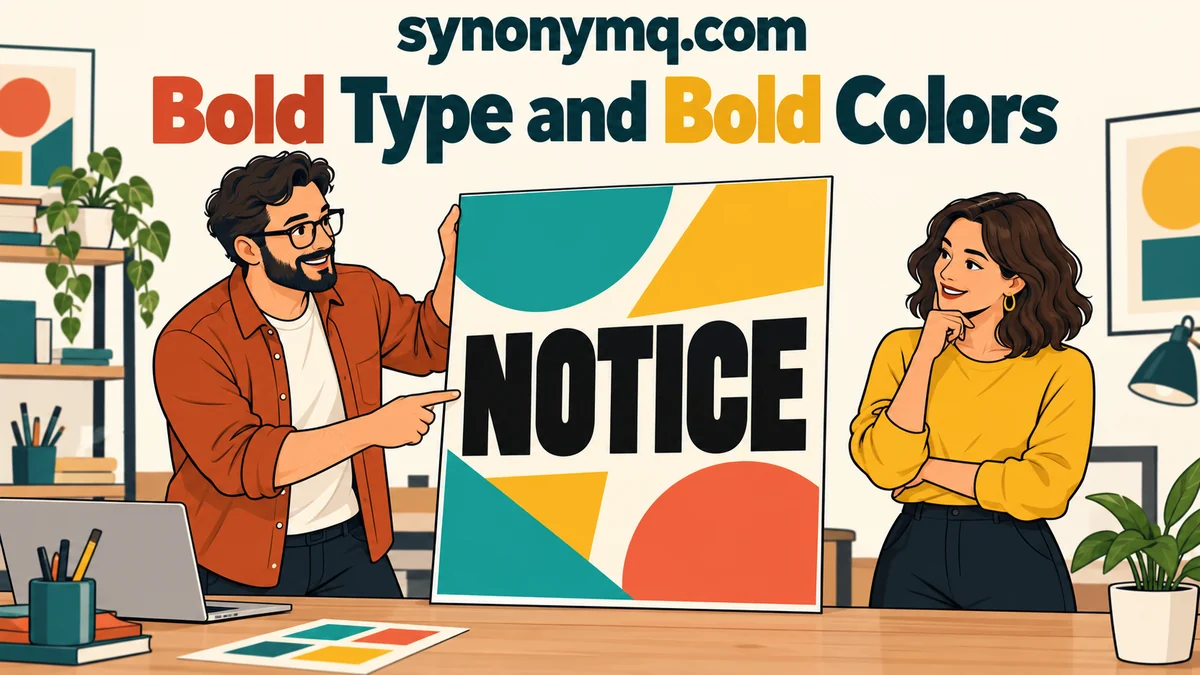
3. Bold Also Describes Colors, Patterns and Type
In “a bold red pattern,” bold describes a striking appearance. In “print the heading in bold,” it refers to heavier lettering. Neither sentence is praising courage.
- Design: “The poster uses bold colors.”
- Typography: “Set the deadline in bold type.”
- Food: “The sauce has a bold flavor.” Here, bold describes a strong, distinctive quality.
For an ordinary design instruction, keep bold rather than replacing it with courageous. Brave also has a recorded showy sense, but that does not make “brave type” a clear substitute for bold type.
“A courageous design” can praise the decision to attempt a design. “A bold design” can describe its visual impact. The adjective changes what the reader is being asked to notice.
Synonyms and Alternatives: Test the Whole Sentence
A direct grammatical swap can still change the meaning. The labels below apply to the stated example, not to every use of the word. No alternative here is presented as an exact synonym across all senses.
| Alternative | Relationship | Sentence replacement | Substitution and effect |
|---|---|---|---|
| Courageous for brave | Near-Synonym | a brave admission → a courageous admission | Direct Swap. Both praise courage; courageous gives that quality explicit emphasis. |
| Daring for bold | Near-Synonym | a bold proposal → a daring proposal | Direct Swap. Keeps the emphasis on venturing beyond a safe or usual approach. |
| Fearless for brave | Near-Synonym | a brave explorer → a fearless explorer | Direct Swap. Adds an emphasis on being unafraid; use only if that is intended. |
| Assertive for bold | Contextual Alternative | a bold negotiator → an assertive negotiator | Swap With Adjustment. Change a to an; emphasizes expressing a position confidently. |
| Adventurous for bold | Contextual Alternative | a bold traveler → an adventurous traveler | Swap With Adjustment. Change a to an; emphasizes seeking new experiences. |
| Striking for bold | Contextual Alternative | a bold pattern → a striking pattern | Direct Swap. Describes visual impact, not a person’s courage or a font’s weight. |
Keep brave when courage alone is the point. Choose a more specific alternative only when its extra implication helps: fearless for absence of fear, assertive for expressing a position, or striking for appearance.
Grammar: Courage, Brave the Rain and Fixed Expressions
Courage is a noun; courageous is an adjective
Courage names the quality. Courageous describes a person or action. For that meaning, write “She is courageous,” not “She is courage.”
Requires Rewrite: “She was courageous during the discussion.” → “She showed courage during the discussion.”
Courage is a Related Word, not an adjective you can drop into the same slot. “Bold versus courage” therefore compares different grammatical forms; bold versus courageous is the adjective comparison.
Brave can also be a verb
Brave also means to face or endure something courageously. In “They braved the rain to deliver the parcel,” braved is the past-tense verb.
Requires Rewrite: “They braved the rain.” → “They faced the rain courageously.”
You cannot replace that verb with the adjective courageous: “They courageous the rain” does not work. Use a verb such as faced and, if needed, the adverb courageously.
Keep the wording of established expressions
Put on a brave face means appearing confident or cheerful despite how you feel. Keep brave in this expression; “put on a courageous face” loses the familiar idiom.
Likewise, “in bold” is an instruction about type. “In courageous” cannot replace it. Read the whole phrase before treating the words as synonyms.
Brave, Courageous and Bold: Urdu Meanings
The Urdu glosses below describe people or courageous behavior. They are starting points for understanding, not interchangeable translations for every English sentence.
| English word | Urdu gloss | Source and scope |
|---|---|---|
| Brave | بہادر، دلیر | Cambridge English–Urdu: courage in a person or action. |
| Courageous | حوصلہ مند | Cambridge English–Urdu: showing courage. |
| Bold | بیباک | Cambridge English–Urdu: the daring or brave sense. |
For “bold type” or “bold colors,” return to the English visual sense. A translation used for a brave person does not explain how lettering or a pattern looks.
How This Page Was Checked
Definitions and grammatical forms were checked against Oxford, Merriam-Webster and American Heritage. Urdu glosses were checked against Cambridge English–Urdu entries. The English examples are original illustrations, not quotations from real events.
The alternatives table also draws on Merriam-Webster’s entries for daring, assertive, adventurous and striking. Recommendations apply to the example sentences shown.
Frequently Asked Questions
Is it better to be brave or courageous?
Neither word ranks above the other. Both can praise the same action. Choose by context rather than treating courageous as a higher level of bravery.
Is there a difference between brave and bold?
Brave emphasizes courage in facing difficulty or danger. Bold can emphasize daring or an unconventional approach. It also describes noticeable colors, strong flavors and heavy type.
What’s the difference between bold and courageous?
Courageous praises courage. Bold can describe daring, presumption or appearance. A bold decision can be courageous, though the words emphasize different things.
Are brave and fearless the same?
They overlap, but fearless emphasizes being unafraid. Someone can be brave while frightened. Use brave to praise facing difficulty; use fearless when the absence of fear matters.

Naveed Akhtar writes every guide on SynonymQ. He is an SEO content writer with ten years of article-writing experience, working on the question a thesaurus never answers: which of these words belongs in this sentence, for this reader. Every page cites the dictionary entries it draws on and the date they were read.