
Afraid vs Scared vs Terrified: 5 Sentence Fixes
Afraid vs scared vs terrified is a choice about meaning, strength and grammar. Afraid and scared describe fear; terrified makes it intense. Scared fits before a noun. “I’m afraid” can also soften bad news without expressing fear.
When “I’m afraid” softens bad news
You ask for two tickets. The clerk checks the screen and says, “I’m afraid the evening show is sold out.” Nothing frightening has happened. The clerk is introducing a disappointing answer politely.
Merriam-Webster’s entry for afraid includes concern or regret about an unwanted situation. That meaning explains why a straight synonym swap can go wrong.
- “I’m afraid we cannot change your seats.” A softened refusal.
- “I’m scared we cannot change your seats.” The speaker sounds worried about the consequences.
- “I’m terrified we cannot change your seats.” The speaker sounds extremely frightened, which is unlikely to fit a routine booking reply.
For a polite refusal, use I’m afraid. Avoid I’m terrified because it introduces intense fear instead of courtesy. In a service email, “Unfortunately, those seats are unavailable” is another clear option.
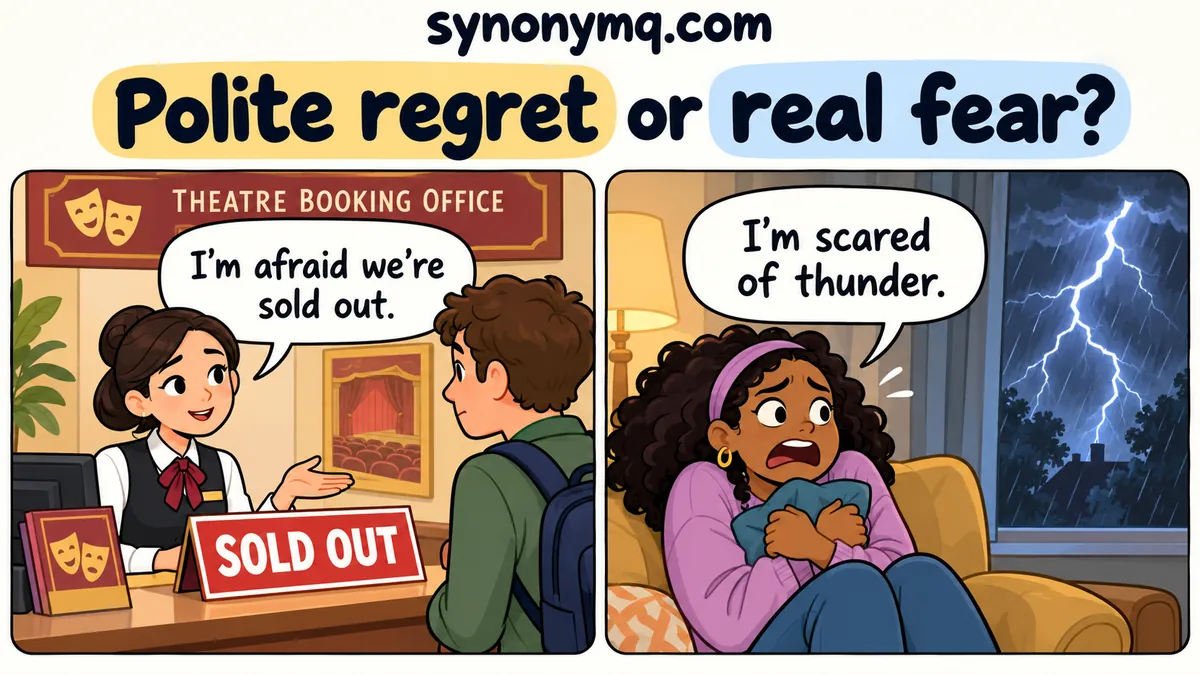
Context still matters. “I’m afraid the roof will collapse” can express a real fear. Look at what follows the phrase before deciding whether the speaker is apologising, worrying or describing danger.
How much fear does the word suggest?
Afraid and scared overlap closely when they describe fear. Scared has a more conversational feel. Terrified explicitly raises the intensity, as Oxford’s definition confirms.
| Word | What it communicates | Original example |
|---|---|---|
| Afraid | Fear or concern; strength comes from the context | “I’m afraid of stepping onto that loose board.” |
| Scared | Fear in a conversational voice | “I’m scared of stepping onto that loose board.” |
| Terrified | Intense fear | “I’m terrified of stepping onto that loose board.” |
The third speaker sounds much more frightened. The first two sentences do not establish a reliable difference in severity. Someone who says “I’m afraid” may be deeply frightened, even without choosing a dramatic word.
These are Near-Synonyms in the fear sense. Replacing afraid with scared in the board example is a Direct Swap. So is terrified grammatically, but it makes a stronger claim.
For a modest concern before a school performance, scared may be enough. Choose terrified if overwhelming fear is what you intend. The stronger word is useful when accurate; it is distracting when added merely for emphasis.
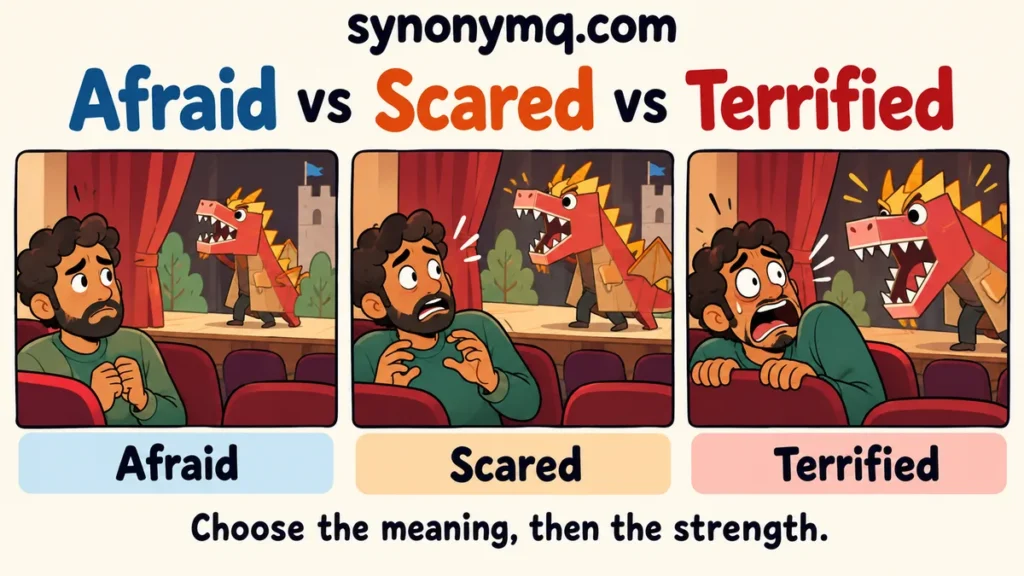
Do not treat the featured cartoon’s expressions as a measured scale. Afraid does not always mean mild fear, and scared does not occupy a fixed middle step. Expressions such as “scared stiff” can convey intense fear too.
Afraid vs Scared vs Terrified: Five Sentence Fixes
Try correcting each sentence before reading the explanation. Some need a grammar repair; the final one needs a change in meaning. A word can be a close synonym and still fail in a particular sentence.
1. Put afraid after a verb
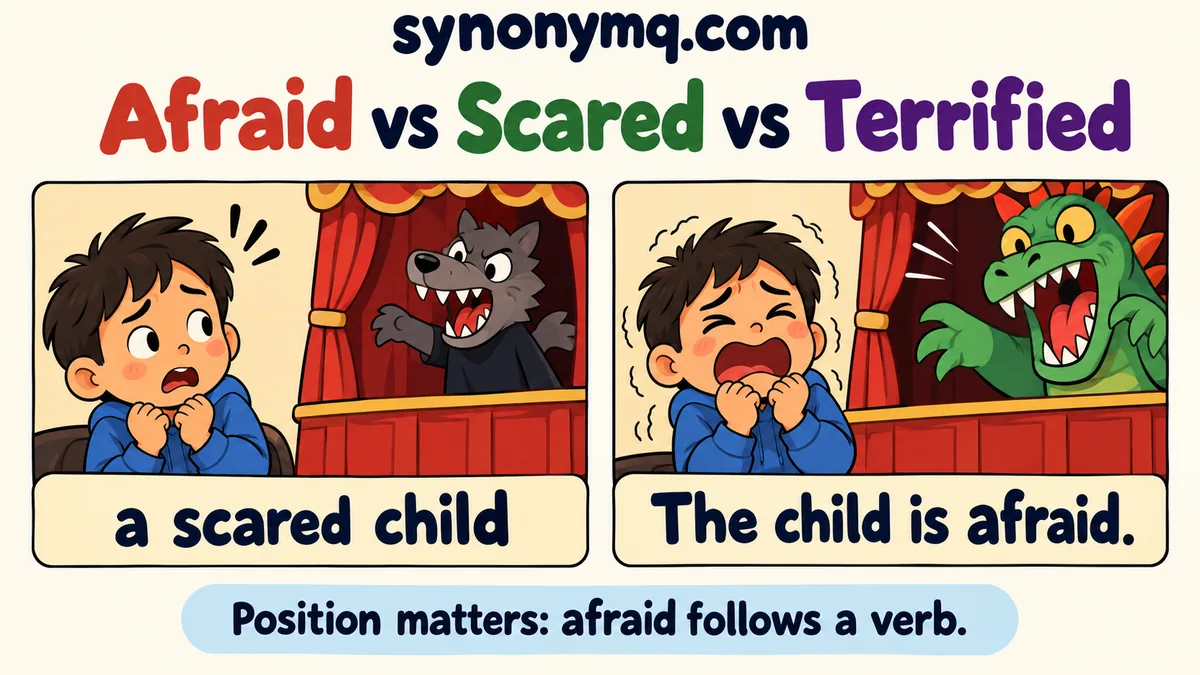
Change: “An afraid child waited beside the stage.”
To: “A scared child waited beside the stage.”
Afraid normally follows a verb, as in “The child is afraid.” Before the noun, scared or frightened fits. This is a Swap With Adjustment: changing afraid to scared also changes an to a.
Oxford labels afraid “not before noun”. That restriction matters more here than the small difference in tone between afraid and scared.
2. Give the adjective a verb
Change: “I afraid of the mask.”
To: “I am afraid of the mask.”
Afraid is an adjective, not the verb in this sentence. Add am. The same pattern works with “I am scared” and “I am terrified”; changing the adjective does not remove the need for the verb.
3. Name the feared thing with of
Change: “She is afraid from the barking dog.”
To: “She is afraid of the barking dog.”
Use of for the thing she fears. This does not mean afraid can only take of: “She is afraid for her brother” expresses concern about someone else’s safety or welfare.
4. Use scared by for the cause of a fright
Change: “We were afraid by the sudden crash.”
To: “We were scared by the sudden crash.”
The crash caused the fright. Scared or frightened works with by here. “The sudden crash frightened us” is a Requires Rewrite alternative: the cause becomes the subject of the sentence.
5. Keep polite regret out of the fear scale
Change, for a routine reply: “I’m terrified that the discount has ended.”
To: “I’m afraid that the discount has ended.”
The original is grammatical, but it says something different. Choose afraid when you are politely giving unwelcome news. Keep terrified only if the speaker really means intense fear about the situation.
Alternatives for the fear you mean
A useful replacement specifies the feeling without exaggerating it. These four choices are not interchangeable in every context. The swap labels apply to the examples shown, not to every sentence containing afraid.
| Alternative and relationship | Sentence test | When it helps |
|---|---|---|
| Frightened Near-Synonym | “Mina felt afraid when the lights went out” → “Mina felt frightened when the lights went out.” Direct Swap | A clear description of fear; suitable when scared feels too conversational. |
| Petrified Near-Synonym | “Mina felt terrified when the lights went out” → “Mina felt petrified when the lights went out.” Direct Swap | Strong fear. Avoid it for a small inconvenience. |
| Nervous Contextual Alternative | “I’m scared about my first rehearsal” → “I’m nervous about my first rehearsal.” Direct Swap | Changes the emphasis to unease before an event, rather than necessarily fear of danger. |
| Apprehensive Contextual Alternative | “I’m afraid that the rehearsal will go badly” → “I’m apprehensive about the rehearsal.” Requires Rewrite | Concern about an unwelcome possibility. The rewrite makes the expected bad outcome less explicit. |
Petrified belongs with intense fear. Apprehensive looks ahead to something unpleasant that may happen.
For an ordinary message to a friend, “I’m scared” may already be the best wording. Replacing it with apprehensive can change both the emphasis and the voice. Choose the replacement because it says what you mean.
Fear, frighten and frightening do different jobs
Fear can name the feeling: “His fear faded during the rehearsal.” It can also act as a verb: “He fears another power cut.” Afraid describes the person’s state: “He is afraid of another power cut.”
Scared also has more than one grammatical use. In “The noise scared him”, it is the past-tense verb. In “He looked scared”, it describes his state. Those are two uses, not a rule that the word has exactly two meanings.
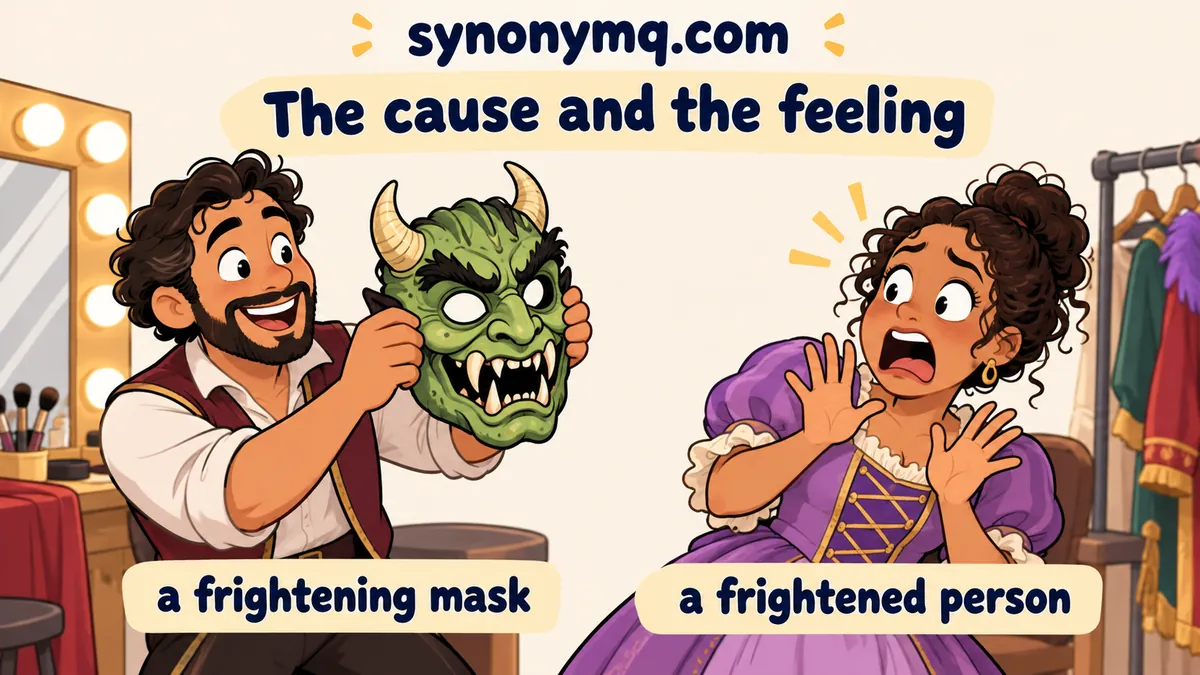
- Frighten: “The mask might frighten visitors.” The verb names what the mask could do.
- Frightening: “It is a frightening mask.” The adjective describes something that causes fear.
- Frightened: “A frightened visitor stepped back.” The adjective describes the person experiencing fear.
In “The mask is frightening the visitors”, frightening is part of the verb phrase. Check the whole sentence before labelling a word by its ending alone.
For more pairs where grammar changes the choice, see SynonymQ’s guide to commonly confused words.
How This Page Was Checked
Definitions and sentence patterns were checked against Oxford Learner’s Dictionaries and Merriam-Webster on 17 October 2026. The ticket-office, rehearsal and mask examples were written for this comparison.
Further entries used: scared, scare, frighten, fear and nervous.
Frequently Asked Questions
Are terrified and afraid the same?
They overlap, but terrified explicitly means intense fear. Afraid has a broader range and can also introduce polite bad news, where terrified would change the meaning.
What is the difference between “afraid” and “scared”?
Both describe fear. Scared is more conversational and fits before a noun. Afraid normally follows a verb and also appears in polite refusals.
What are the 7 types of fear?
There is no single seven-part classification implied by the English word fear. Such lists depend on their author’s framework; these adjectives describe feelings, not seven fixed categories.
Which is correct: “I am afraid” or “I am scared”?
Both are correct for feeling fear. Choose “I am afraid” when politely introducing bad news; scared does not carry that courtesy meaning.

Naveed Akhtar writes every guide on SynonymQ. He is an SEO content writer with ten years of article-writing experience, working on the question a thesaurus never answers: which of these words belongs in this sentence, for this reader. Every page cites the dictionary entries it draws on and the date they were read.