
Big vs Large vs Huge: 4 Swaps That Change the Meaning
Big vs large vs huge depends on meaning: big and large often describe the same size, while huge means extremely large. Use big for importance, large for neutral size or quantity, and huge when you want stronger emphasis.
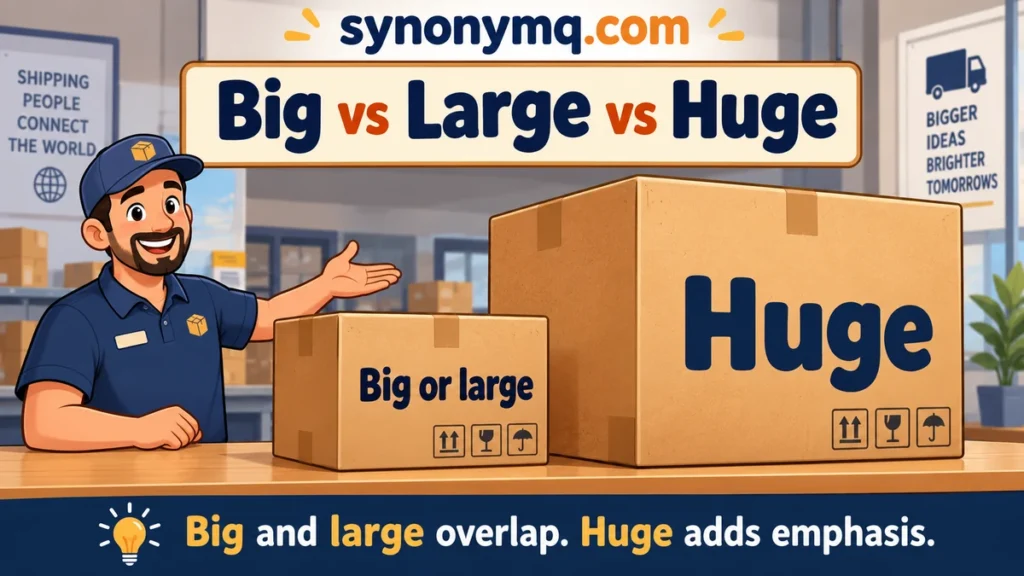
A café menu offers a large coffee. Your friend takes one look at the cup and says, “That’s huge!” Neither person has measured a different drink. One is naming a size; the other is reacting to it.
That distinction helps, but it does not explain every sentence. A big decision is important. A large decision sounds unusual. Before replacing one word with another, check what the adjective actually describes.
Four swaps that change what you mean
1. A big decision → a large decision
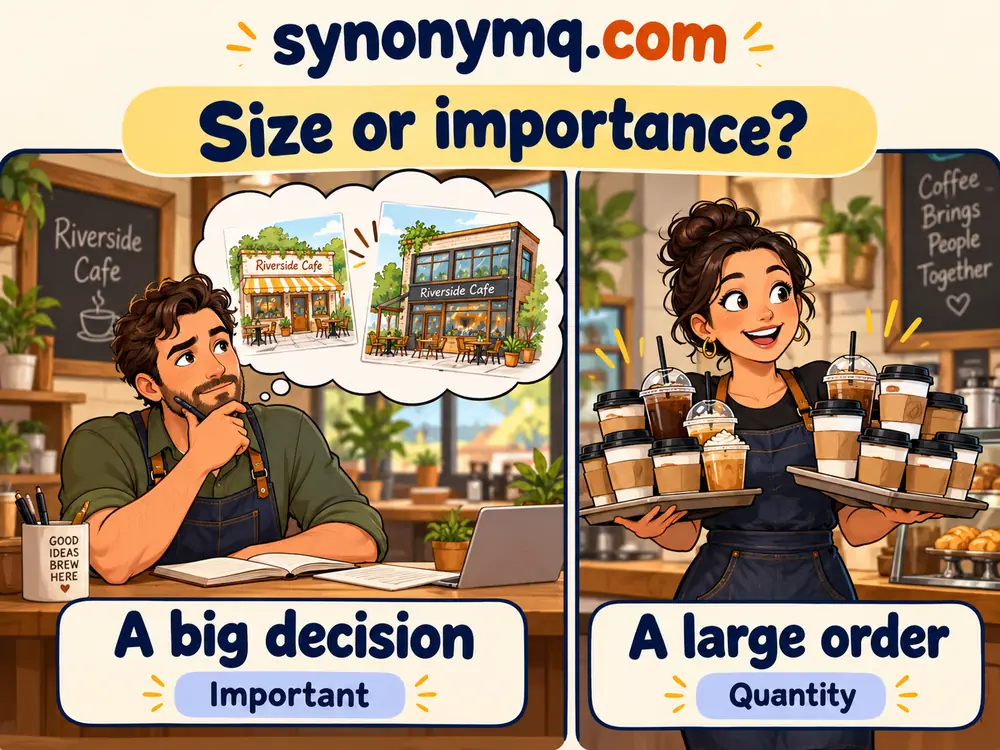
“Closing the café on Sundays was a big decision.” Here, big concerns importance and consequences. The owner might lose sales but gain time with family. Physical size is irrelevant.
Best replacement: “an important decision.” This is a direct swap in meaning, with a more explicit tone. “A huge decision” also works, but makes the consequences sound more significant.
“A large decision” is not the usual wording for this meaning. Large works well with quantity: “We received a large order for tomorrow’s meeting.”
2. My big sister → my large sister
“My big sister taught me to ride a bike.” In this family expression, big usually means older. It does not tell you which sister is taller.
Best replacement: “my older sister.” This is a direct swap for the intended age relationship. “My large sister” instead describes physical size and may sound tactless if that detail is unnecessary.
The same distinction applies to “big brother.” It is a useful reminder that related adjectives do not share every meaning.
3. A large coffee → a huge coffee
“I ordered a large coffee” can identify an option on the menu. “I ordered a huge coffee” tells the listener that the drink seemed exceptionally big. Huge adds a judgment instead of reliably identifying the menu option.
Best choice: keep large when ordering a size labeled Large. Use huge when describing your reaction. Big is natural in casual conversation, but may not specify which size you want.
This also applies to clothing. A large shirt can mean size L. A huge shirt may simply look much too big on the person wearing it. Product labels depend on the seller; adjectives alone do not establish measurements.
4. A large crowd → a huge crowd
“A large crowd waited outside the café.” Replacing large with huge keeps the sentence grammatical, but strengthens the description. The crowd now sounds strikingly large for that setting.
Substitution: direct swap, with stronger intensity. “A big crowd” also works and sounds conversational. Choose huge only when the emphasis fits what happened.
For a report, an estimate such as “about 300 people” may be more informative than any of these adjectives. Huge has no built-in numerical threshold.
Large is not automatically bigger than big
Big and large overlap in their ordinary size meaning. A big kitchen and a large kitchen may be exactly the same room. Large often sounds a little more formal, but formality does not increase the room’s dimensions.
| Word | Useful meaning | Original example | What to watch |
|---|---|---|---|
| Big | Large in size; also important or, in family expressions, older | We need a big table for the class. | Check whether size is really the intended meaning. |
| Large | Above ordinary size or quantity | The delivery contains a large number of notebooks. | Often useful for neutral descriptions and quantity phrases. |
| Huge | Extremely large in size, amount, or degree | The new timetable made a huge difference. | Adds emphasis, not a precise measurement. |
All three are adjectives in these examples. Their tone also depends on the noun: a huge improvement is welcome, while a huge delay is not. Huge itself does not mean good or bad.
Oxford’s definition of huge includes size, amount, and degree. That is why the word can describe both a building and a change in someone’s circumstances.
For size, small is a useful opposite of big or large. For “a big decision,” minor may be a better opposite. Choose the opposite of the intended meaning, rather than applying one antonym everywhere.
Use amount for water and number for bottles
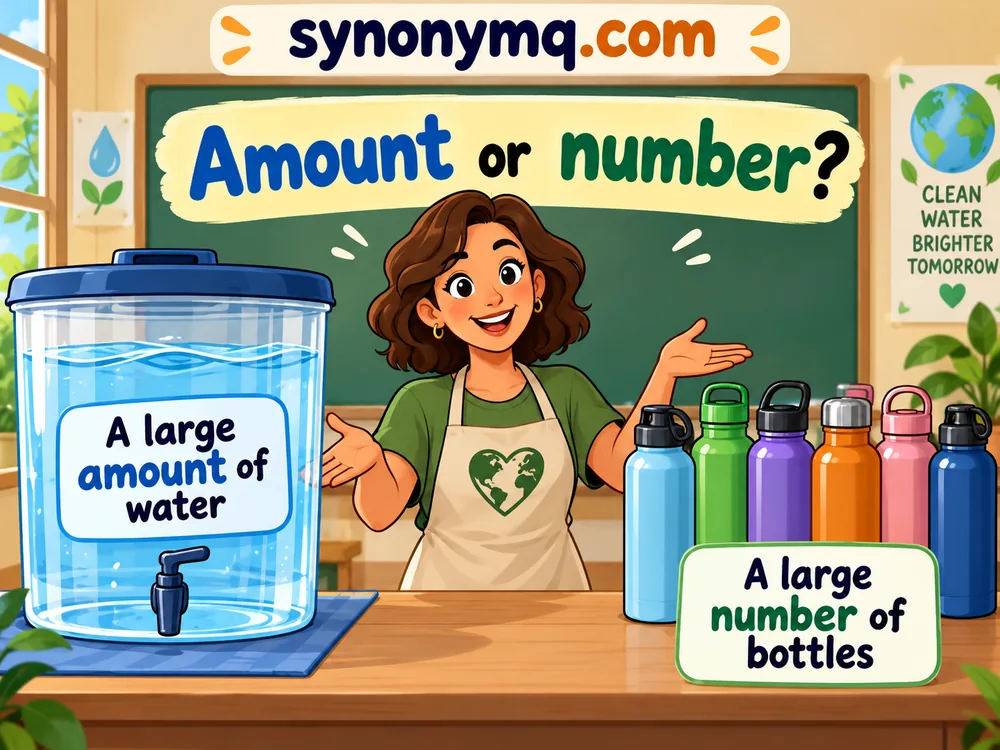
Use a large amount of with something you are treating as an uncountable quantity: water, time, or money. Use a large number of with plural countable things: bottles, hours, or coins.
- The clean-up required a large amount of water.
- The volunteers filled a large number of bottles.
- We spent a huge amount of time checking the labels.
Huge can replace large in these patterns when stronger emphasis is appropriate. “A big amount” is understandable, but large is the more natural choice for a neutral quantity description.
Do not turn this advice into a rule that big never occurs with an uncountable noun. “Big trouble” and “big business” are established expressions. What sounds natural depends on the whole phrase.
Bigger, larger, and largest
Use bigger or larger to compare size: “This tray is larger than that one.” Use biggest or largest when identifying the greatest size within a group.
Larger does not mean huge. A larger cup might be only slightly bigger than another cup. Likewise, the largest room in a very small apartment may still be small.
For measurements, write the difference directly: “The new shelf is 20 centimeters wider.” That tells readers something “much bigger” cannot.
Keep fixed expressions intact
“No big deal” means something is not particularly important. Changing it to “no large deal” loses the familiar expression. “By and large” means generally; “by and big” does not replace it.
These phrases illustrate the same issue discussed in our guide to commonly confused words: matching one dictionary meaning does not make every sentence interchangeable.
Enormous, massive, or ginormous?
If huge does not fit your tone, another adjective may help. These are near-synonyms for very large size or extent, not official levels on a scale. The examples below show where a direct swap works.
| Alternative | Substitution | Effect and limit |
|---|---|---|
| Enormous | Direct swap: a huge warehouse → an enormous warehouse | Strong size emphasis. It does not guarantee something larger than huge. |
| Massive | Direct swap: a huge stone bench → a massive stone bench | Can suggest bulk or solidity. It also has figurative uses, so literal weight is not always involved. |
| Ginormous | Direct swap: a huge sandwich → a ginormous sandwich | Informal and exaggerated. Usually a poor fit for a restrained factual report. |
Ginormous is a real dictionary word, spelled g-i-n-o-r-m-o-u-s. Merriam-Webster records ginormous, and Oxford labels it informal.
“Ginormous” and “enormous” can describe the same sandwich. The difference is chiefly how the description sounds, not an agreed difference in size. For careful measurement, give dimensions or a quantity.
Great is not a universal replacement either. “A great café” usually praises the café; “a large café” describes its size. A swap can remain grammatical while answering a different question.
Usage sources
The distinctions above were checked against Merriam-Webster on big, Oxford on large, and the linked entries for huge and ginormous. Examples are original.
Merriam-Webster on massive supports its physical and figurative meanings. BBC Learning English’s big/large lesson provides further phrase comparisons.
Frequently asked questions
What is the difference between large and huge?
Large describes considerable size or quantity. Huge means extremely large and adds stronger emphasis. Neither word supplies an exact measurement, so the difference depends on the context.
Is huge the same as big?
Huge overlaps with big when describing size, but is stronger. It cannot replace every meaning of big: a big sister usually means an older sister, not a huge sister.
Is “large” bigger than “big”?
No. Big and large often describe the same size. Large may sound more formal or identify a product size, but it does not automatically mean bigger than big.
What is bigger than huge?
There is no fixed next level. Enormous, gigantic, and ginormous can add emphasis, but they are not standardized measurements. Use dimensions or numbers when the exact size matters.

Naveed Akhtar writes every guide on SynonymQ. He is an SEO content writer with ten years of article-writing experience, working on the question a thesaurus never answers: which of these words belongs in this sentence, for this reader. Every page cites the dictionary entries it draws on and the date they were read.