
Collaborate vs Cooperate: 5 Examples That Clarify the Choice
Collaborate vs cooperate is a choice of emphasis: collaborate usually highlights creating or developing something together; cooperate can mean working together or helping when asked. Choose the word that describes the action, since their meanings overlap.
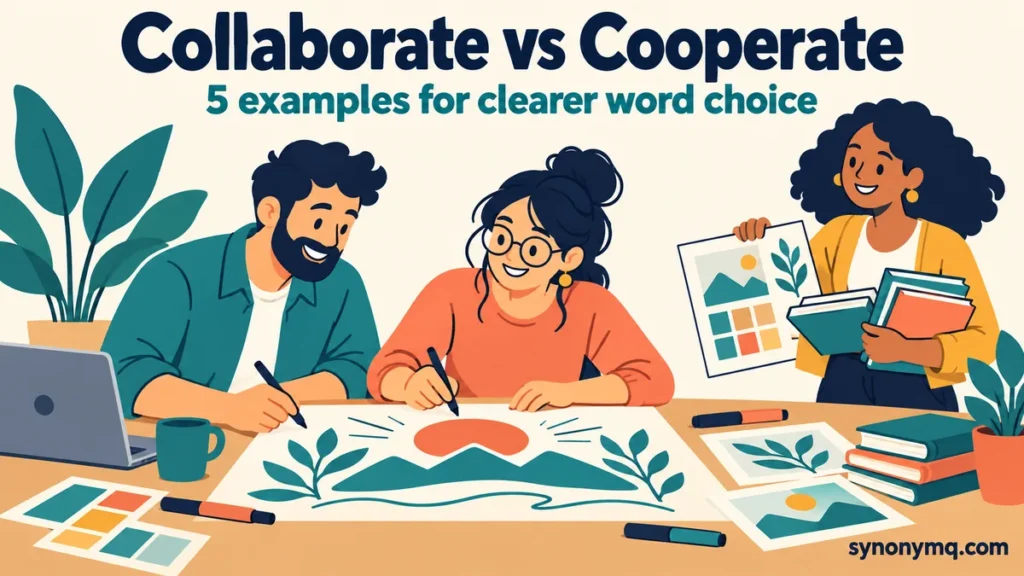
Collaborate vs cooperate meaning and overlap
Collins explains collaboration through people working together to produce something. A jointly written proposal, a research project or a new song makes that meaning easy to see.
Cambridge defines cooperate broadly enough to include working toward a purpose and helping when someone asks. Cooperation can involve a shared goal; it does not require separate goals or separate ownership.
The distinction is useful, but it is not a rigid classification of people or teams. A group can collaborate on a design and cooperate by sharing materials. Both descriptions can be accurate at the same time.
| What you mean | Useful choice | What it emphasizes |
|---|---|---|
| Developing something jointly | Collaborate | People contributing to shared work |
| Helping with a request | Cooperate | Willing assistance or compliance |
| Working together toward an aim | Either, depending on context | Joint work with collaborate; combined effort with cooperate |
Five examples from one festival project
Imagine a small arts festival. Its organizers need a poster, an entrance team and a performance schedule. The following examples are invented to show how the same event can involve different kinds of working together.
1. Two designers make one poster
“Maya and Leo collaborated on the festival poster.” This tells readers that both contributed to its creation. Perhaps Maya developed the illustrations while Leo revised the layout, with each responding to the other’s work.
“Maya and Leo cooperated on the festival poster” is also possible. It puts less emphasis on joint creation. Choose collaborated when the point is their creative partnership, rather than simply their willingness to help.

2. A printer sends the missing details
“The printer cooperated by sending the paper specifications.” The sentence describes helpful assistance. It does not say that the printer helped design the poster.
Replacing cooperated with collaborated would suggest a closer role in the joint work. If all the printer did was supply requested information, cooperated or simply helped makes the contribution clearer.
3. Visitors show their tickets
“Please cooperate with the entrance team by having your ticket ready.” Here, visitors are being asked to make a process run smoothly. They are not being invited to develop the admission system.
“Please collaborate with the entrance team” would sound like an invitation to work on a task together. For a visitor notice, “Please have your ticket ready” is even more direct. A familiar word is not always needed at all.

4. Two groups work toward the same aim
“The library and arts club cooperated to make the festival accessible.” Both groups share an aim. This is why the rule “cooperation means separate goals” fails.
Use collaborated if you want to highlight their joint development of an access plan. Use cooperated if you are describing their combined efforts more broadly. Neither verb alone tells readers how budgets or responsibilities were divided.
5. A colleague receives a request
“Would you collaborate with me on the festival programme?” This asks for a working partnership. The colleague may help shape the programme, rather than merely provide information for it.
“Would you cooperate with me?” can sound like a request for compliance, particularly after a disagreement. That is a context-dependent tone judgment, not a rule that cooperate is rude.
For one specific favour, name it: “Could you send me the performers’ biographies by Friday?” For shared decisions, invite collaboration. The difference is the work you are asking the other person to do.
Use with for people, on for projects and to for purpose
The UC Davis grammar guide distinguishes collaborate with a person from collaborate on a task. You can combine the patterns in one sentence.
- Person: “Maya collaborated with Leo.”
- Project: “They collaborated on the poster.”
- Purpose: “They collaborated to improve the layout.”
- Combined: “Maya collaborated with Leo on the poster.”
Cambridge also records collaborate with someone to do something. In that pattern, to introduces an action. “Collaborate to Leo” does not name a partner correctly; use “collaborate with Leo.”
With cooperate, “cooperate with the organizers,” “cooperate on the project” and “cooperate to solve the problem” are possible patterns. The preposition alone does not distinguish the two verbs.
Test the whole sentence before replacing a word
A replacement can preserve the grammar while changing the claim. The labels below describe the specific examples, not a promise that the same swap works everywhere.
| Original | Replacement and label | Meaning to check |
|---|---|---|
| They collaborated on the poster. | They cooperated on the poster. Direct Swap | Grammatically natural; joint creation becomes less explicit. |
| The printer cooperated with Maya. | The printer helped Maya. Swap With Adjustment | Remove with. Helped describes assistance without specifying how. |
| Please cooperate with the entrance team. | Please have your ticket ready. Requires Rewrite | Names the particular action requested in this situation. |
In a CV or project report, keep the action concrete. “Collaborated with two illustrators on a festival poster” gives readers more information than “Excellent collaboration skills.” Use the description only if it matches what you actually did.
Where coordination fits alongside both words
Cambridge describes coordinate as bringing activities or parts together so they work effectively. At the festival, coordinating could mean arranging sound checks around the performers’ arrival times.
The organizers might collaborate on the programme, cooperate with venue staff and coordinate the schedule. These verbs select different aspects of the work. They are not three compulsory stages or a ranking from basic to advanced teamwork.
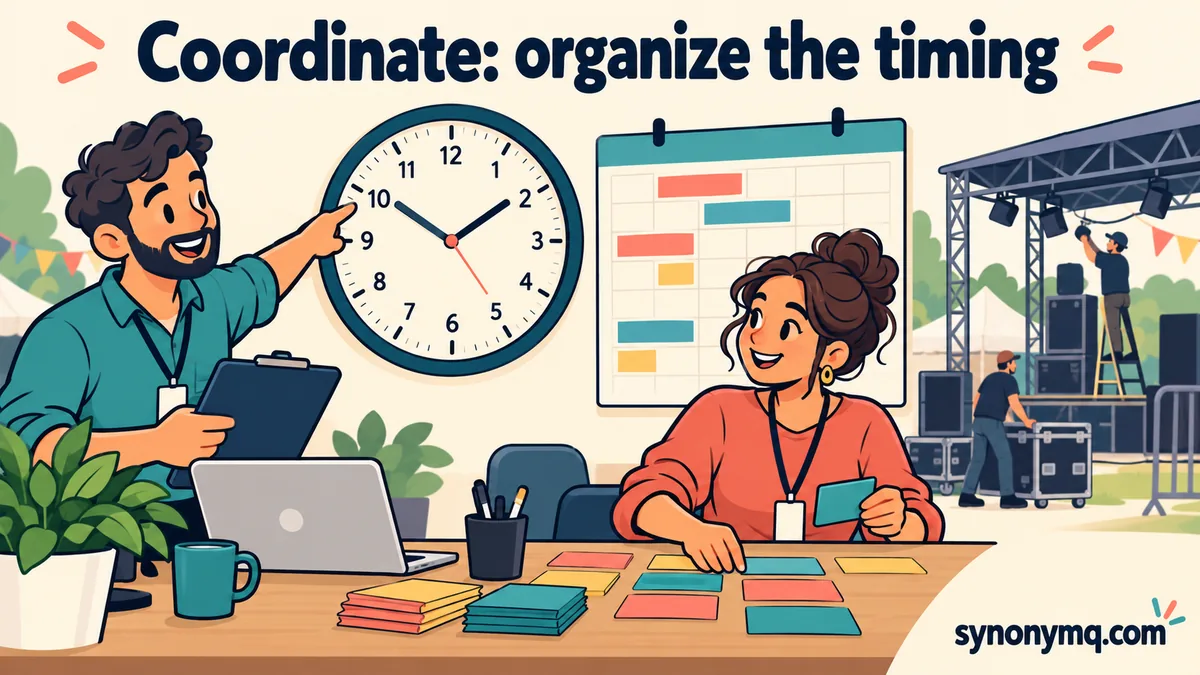
If your sentence is about arranging timings, coordinate is more precise. If it concerns jointly developing the programme, choose collaborate. If it concerns helping venue staff carry out a request, choose cooperate.
None of these verbs establishes who is in charge. For that separate question, see how leader and manager describe roles. Name the person’s responsibility rather than inferring rank from how people work together.
How This Page Was Checked
Collins and Cambridge support the meaning distinctions; UC Davis and Cambridge support the grammar patterns. The festival examples are original illustrations. Sentence recommendations are editorial judgments based on those meanings, not measured usage frequencies.
FAQs
What is the difference between collaborative and cooperative?
Collaborative highlights joint work. Cooperative can describe joint effort or willingness to help, as in a cooperative colleague. Context determines which meaning applies.
Does collaborate mean cooperate?
The meanings overlap when people work together. Collaborate more often highlights joint development; cooperate also covers helping with requests, where collaborate may suggest a different role.
Does collaboration require working at the same time?
No. People can contribute to shared work at different times, such as revising a joint document in turns. The word itself does not require simultaneous activity.
What is the difference between participation and collaboration?
Participation means taking part. Collaboration involves working with others on shared work. Participating in a festival does not necessarily mean helping to create or organize it.

Naveed Akhtar writes every guide on SynonymQ. He is an SEO content writer with ten years of article-writing experience, working on the question a thesaurus never answers: which of these words belongs in this sentence, for this reader. Every page cites the dictionary entries it draws on and the date they were read.