
Stationary vs Stationery: 5 Examples to Fix the Mix-Up
Stationary means not moving or not changing; stationery means writing materials, such as paper and envelopes. For stationary vs stationery, choose the a spelling to describe a condition and the e spelling to name the supplies you write with.
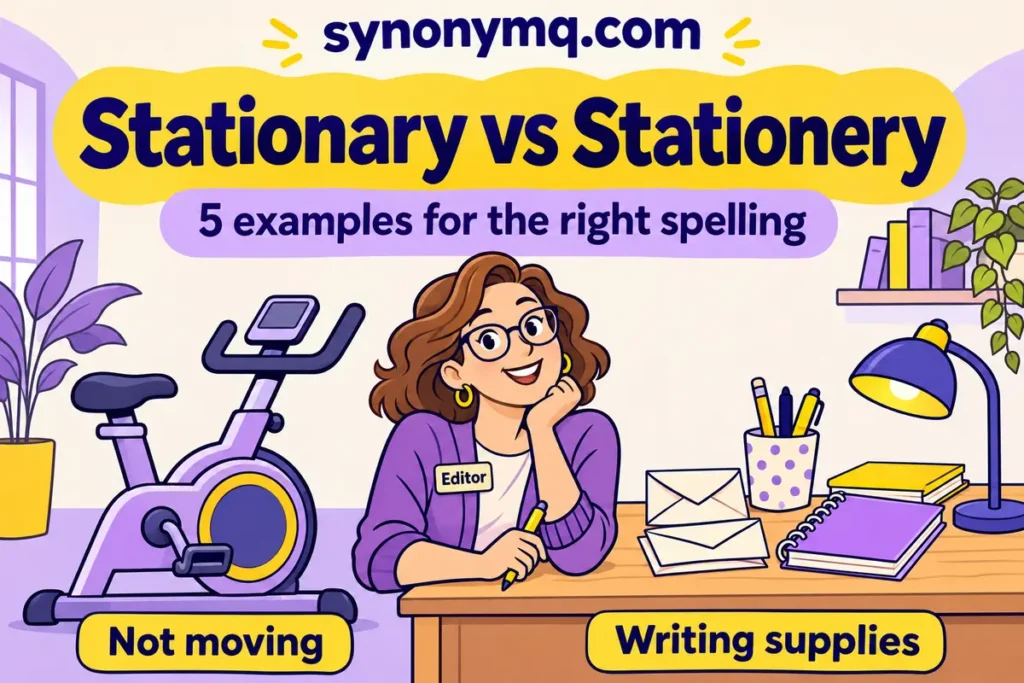
Stationary vs Stationery in Five Everyday Sentences
The spelling difference becomes easier to see when you look at what each word does. Stationary describes something. Stationery names a category of materials. These original examples put the distinction into familiar situations.
| Example | Sentence | Why it fits |
|---|---|---|
| 1 · Traffic | The delivery van remained stationary while the gate opened. | The van was not moving. |
| 2 · Exercise | Leena reads on a stationary bike during her warm-up. | The machine stays in one place. |
| 3 · Office order | Please order stationery for the new reception desk. | The request concerns writing materials. |
| 4 · Shop sign | The stationery shop sells notebooks and envelopes. | The word identifies what the shop sells. |
| 5 · Both words | The stationery remained stationary on the desk. | The writing supplies did not move. |
The fifth sentence is deliberately playful, but grammatically useful. The first word names the materials; the second describes their condition. A pile of paper can be stationary without changing its name from stationery.
When proofreading, try replacing the disputed word with “writing supplies” or “not moving.” The replacement that matches your intended meaning points to the spelling. You may need to adjust the sentence rather than swap the words mechanically.
A Stationary Bike Can Still Have Moving Parts
Texas A&M’s editorial style guide uses a stationary bicycle to illustrate the fixed-position meaning. The rider’s legs and the pedals move, but the machine does not travel across the floor.

The same distinction helps with vehicles and equipment. A bus can remain stationary at a stop while its engine runs. Calling it stationary says that it is not changing position; it does not say that the engine is off.
Stationary is an adjective. It works before a noun, as in “a stationary camera,” and after a linking verb, as in “The camera remained stationary.” Neither pattern refers to pens or paper.
Merriam-Webster also records an unchanging-condition sense. Stationary can therefore describe more than physical location. In a technical discussion, check what is said to remain unchanged before interpreting the word.
Do not replace stationary with stationery in a scientific expression simply because the spelling looks unfamiliar. The writing-materials noun is unrelated to that technical meaning. Specialist uses need their own definitions and context.
Stationery Names the Supplies, Even in a Shop Sign
Cambridge defines stationery as writing materials, including paper, pens, pencils and envelopes. It also records the narrower sense of letter-writing paper with matching envelopes.

That is why the normal sign is stationery shop or stationery store. “Stationary shop” would describe a shop that does not move. It might make sense when contrasting a fixed shop with a mobile business, but it does not identify the stock.
In stationery shop, the noun stationery modifies shop. A noun can do that job without turning into the adjective stationary. Other useful combinations include stationery cupboard, stationery supplies and stationery order.
Use stationery is, not stationery are
Cambridge marks stationery as uncountable. In ordinary writing, say “The stationery is in the cupboard” or “We need some stationery.” Do not add an s merely because the order contains several different items.
To count the contents, name the items: three notebooks, two pens or a pack of envelopes. You can also say “three items of stationery.” The plural items then takes are: “The three items of stationery are on the counter.”
Before: “These stationeries are for reception.”
After: “This stationery is for reception.”
More specific: “These notebooks and pens are for reception.”
For a purchase request, the specific version is often more useful. Stationery names a category; it does not tell a colleague the quantities, paper size or exact items you want.
Remember E for Envelope and A for Staying
Picture an envelope when you need stationery. For stationary, think of something staying in place. These are spelling aids, not explanations of the words’ origins.

Merriam-Webster suggests another cue: paper and letter share er with stationery. Choose whichever association you can recall quickly when writing an email or labelling a cupboard.
The sound will not settle the spelling
Stationary and stationery are homophones: they sound the same but have different meanings and spellings. A rough American pronunciation guide is STAY-shuh-nair-ee, with the main stress at the beginning.
Cambridge’s stationary pronunciation entry and stationery dictionary entry provide UK and US audio. Accent can affect the sound, but the a-versus-e distinction is not a British-versus-American spelling choice.
Why stationery is connected with a stationer
Merriam-Webster traces stationery to stationer, an older word used for a bookseller or publisher and now for a seller of writing materials. That connection explains the noun’s spelling more directly than the idea of paper sitting still.
Choose Alternatives by Meaning, Not by Similar Spelling
The two headwords are not synonyms. A replacement for stationary should preserve the relevant condition; a replacement for stationery should identify the materials. The following substitutions work only within their stated contexts.
| Original | Replacement | Substitution test |
|---|---|---|
| The van remained stationary. | The van remained motionless. | Direct Swap: a near-synonym in this stopped-vehicle context. |
| Keep the camera stationary. | Keep the camera in one position. | Swap With Adjustment: replace the adjective with a phrase. |
| We ordered stationery. | We ordered writing supplies. | Direct Swap: a contextual alternative for the broad materials sense. |
| She chose matching stationery. | She chose matching paper and envelopes. | Direct Swap: a more specific description if those are the items intended. |
Be careful with “motionless bike” as a substitute for stationary bike. It can describe an ordinary bicycle that happens to be stopped. The established exercise-machine name communicates more than a temporary lack of motion.
A spellchecker may accept either spelling because both are real words. Read the sentence for meaning before accepting a suggestion. Our commonly confused words guide covers other pairs that need the same kind of context check.
How This Page Was Checked
Meaning and word history were checked against Merriam-Webster, countability and pronunciation against Cambridge, and the bicycle distinction against Texas A&M. The five worked sentences and replacement examples are original teaching illustrations.
Frequently Asked Questions
Is it a stationary shop or a stationery shop?
Use stationery shop for a business selling writing materials. Stationary shop would describe a shop that stays in one place, rather than identify its products.
Are stationary and stationery pronounced the same?
Yes. They are homophones. Their meanings and spellings differ, so you need context rather than pronunciation to choose the correct word.
Can I say stationeries?
For ordinary writing materials, use uncountable stationery. To count them, say items of stationery or name the objects, such as notebooks and envelopes.
What is an easy way to remember stationery?
Remember the e in envelope for stationery. Alternatively, connect the er in paper with the er in stationery. Both cues point to writing materials.

Naveed Akhtar writes every guide on SynonymQ. He is an SEO content writer with ten years of article-writing experience, working on the question a thesaurus never answers: which of these words belongs in this sentence, for this reader. Every page cites the dictionary entries it draws on and the date they were read.