
Loose vs Lose: 6 Practice Sentences and Clear Fixes
Loose usually describes something that is not tight or secure. Lose means to stop having something, fail to find it, or fail to win. Use loose for a sleeve’s fit and lose for a missing key. Their final sounds differ, too.
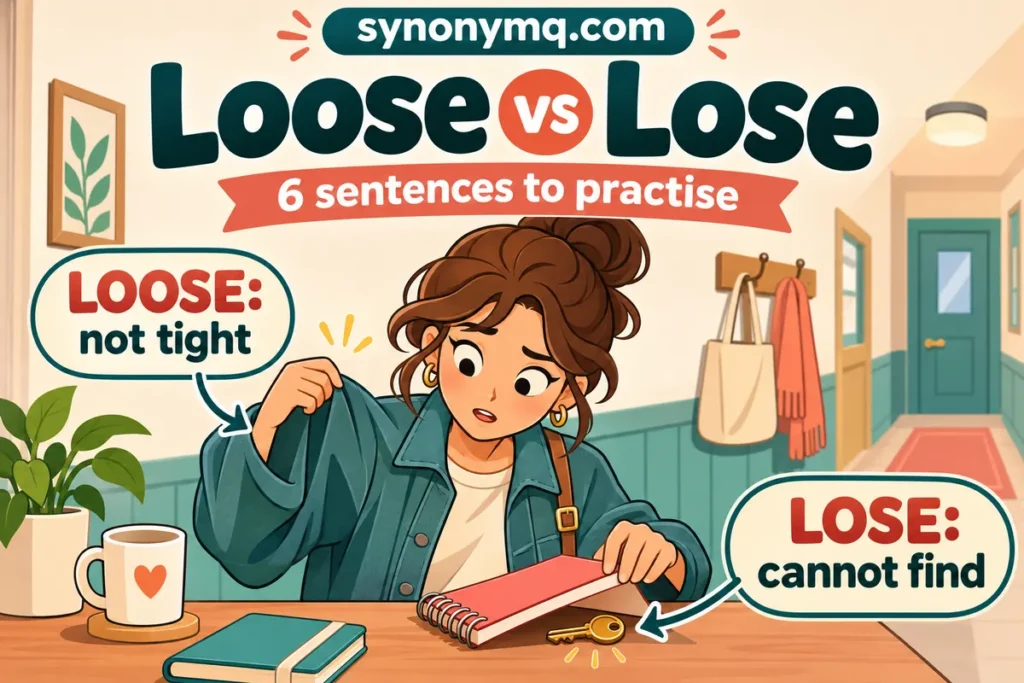
Loose vs Lose Depends on What You Mean
A loose sleeve is roomy. A loose handle is not firmly attached. Neither has necessarily disappeared. If you lose a jacket, however, the problem is that you no longer have it or cannot find it.

For an everyday spelling check, ask what the sentence is reporting. Is it describing how something fits or is fastened? Start with loose. Is it reporting a loss, a missing object or a defeat? Choose lose.
Cambridge’s entry for lose includes both no longer having something and failing in a competition. The object matters: losing a receipt and losing a match are different kinds of loss.
This is why a single replacement word cannot cover every use. “Misplace a receipt” works; “misplace a match” does not express being defeated in it.
A useful rule has one important exception
You may have learned that loose is an adjective and lose is a verb. That is a helpful starting point, but Merriam-Webster also records loose as a verb, meaning to free or release.
In “They loose the balloons,” the verb means release. For a straightforward instruction, “Release the balloons” makes the intended action clearer. Do not change loose to lose simply because it follows they or to.
Keep the meaning in view: “I will lose” predicts a loss; “I will loose the rope” describes releasing it. When the intended action is making a knot less tight, “I will loosen the knot” is an easy choice.
Listen for S in Loose and Z in Lose
The words look similar, but they are not homophones. VOA Learning English explains that loose ends with an s sound and lose ends with a z sound.

Try saying “a loose sleeve” and “lose a key.” Keep your attention on the ending. The double o does not make loose a longer version of lose; the final consonant distinguishes the words.
For spelling, picture the two o letters in loose as extra room inside a roomy sleeve. Lose has only one o, just like lost. These are memory aids, not explanations of the words’ history.
Losing and Loosing Belong to Different Verbs
The form you need depends on the original verb. Lose becomes loses, losing and lost. Loose, when used as a verb, becomes looses, loosing and loosed. “Loosing” is a real word, but it does not mean suffering a loss.
| Word | Job | Original example |
|---|---|---|
| Lose | Base verb | Do not lose the cloakroom ticket. |
| Loses | Present verb with he, she or it | He loses his place when the screen jumps. |
| Losing | -ing form of lose | Our team is losing by one point. |
| Lost | Past tense or past participle of lose | We have lost the delivery receipt. |
| Loosing | -ing form of loose, meaning releasing | The illustrator drew a child loosing a balloon. |
| Loss | Noun; plural losses | The club recorded its first loss. |

Merriam-Webster lists loosed and loosing under the verb loose. Those forms belong to release-related meanings; they do not replace lost or losing in a sentence about defeat.
Write “The team keeps losing,” not “The team keeps loosing,” when it keeps being beaten. Similarly, “She loses her notes” concerns missing notes, while “She looses the ribbon” describes releasing or untying it.
Loss names the event or result
Loss is a noun. Compare “We might lose” with “That would be a loss.” After might, you need the verb lose. After a, you can use the noun loss.
The past form is lost: “We lost yesterday.” Do not write “We loss yesterday.” Lost can also describe something missing, as in “a lost receipt”; its meaning still differs from a loose receipt lying unattached among other papers.
Loosen describes making something less tight
Loosen means to make or become looser, among its uses. “Loosen the strap” is a clear instruction; “The strap is loose” describes the result. Neither says that the strap has gone missing.
Fix the Meaning Before Changing the Spelling
Read the whole sentence before correcting a red underline or accepting a suggestion. Both loose and lose are valid spellings, so a spellchecker may accept the wrong word for your meaning.
| Draft | Clear correction | Why it works |
|---|---|---|
| The handle feels lose. | The handle feels loose. | Describes an insecure attachment. |
| I might loose the receipt. | I might lose the receipt. | Means failing to keep or find it. |
| I lose my notes. | I misplace my notes. | Direct Swap: a contextual alternative when their location is forgotten. |
| We could lose the match. | We could be beaten in the match. | Requires Rewrite: preserves the defeat meaning. |
| The strap is loose. | The strap is not tight. | Swap With Adjustment: replace an adjective with a negative phrase. |
These alternatives are context-specific. Misplace does not cover every kind of loss, and not tight does not explain every use of loose. Choose the description that fits the object and the event.
For “loose control” versus “lose control,” use lose when someone stops being in control. Loose can describe a relaxed degree of control in a different construction, but it does not express the act of losing it.
Other confusing pairs need their own checks. Our commonly confused words guide helps you find the relevant comparison instead of applying this spelling rule to unrelated words.
A Loose vs Lose Worksheet with 6 Sentences
Fill each gap with the correct form of loose or lose. Read the sentence for meaning before looking at the answers.
1. This drawer handle is _____ again.
2. Put the receipt in the folder so you do not _____ it.
3. Yesterday, our team _____ by one point.
4. I keep _____ my place in this long document.
5. The actor _____ the ribbon and opened the parcel.
6. These cuffs are too _____ for my wrists.
Answers and reasons
1. Loose: the handle is not secure. 2. Lose: the receipt might go missing. 3. Lost: yesterday requires the past form.
4. Losing: the writer keeps failing to keep their place. 5. Loosed: the actor released the ribbon. 6. Loose: the cuffs do not fit tightly.
In sentence 5, “untied” would be clearer if the ribbon was knotted. The exercise includes loosed deliberately: grammar shortcuts should not erase a valid word or its meaning.
Frequently Asked Questions
Do you lose or loose weight?
Use lose weight. Lose means to have less than before. Loose describes fit, so clothes may be loose; they do not “lose” in that sense.
Is it lose or loose money?
Use lose money when money goes missing or a financial loss occurs. Loose change means coins you are carrying; it does not mean lost money.
Do you loose or lose someone?
Use lose someone for separation, being unable to find them, or bereavement. Loose someone means release them from restraint, a different meaning.
Is it lose or loose in a game?
Use lose when you mean fail to win: “We might lose the game.” The past tense is lost; the ongoing form is losing.

Naveed Akhtar writes every guide on SynonymQ. He is an SEO content writer with ten years of article-writing experience, working on the question a thesaurus never answers: which of these words belongs in this sentence, for this reader. Every page cites the dictionary entries it draws on and the date they were read.