
59 Synonyms for Honor: Meaning, Register and How to Choose
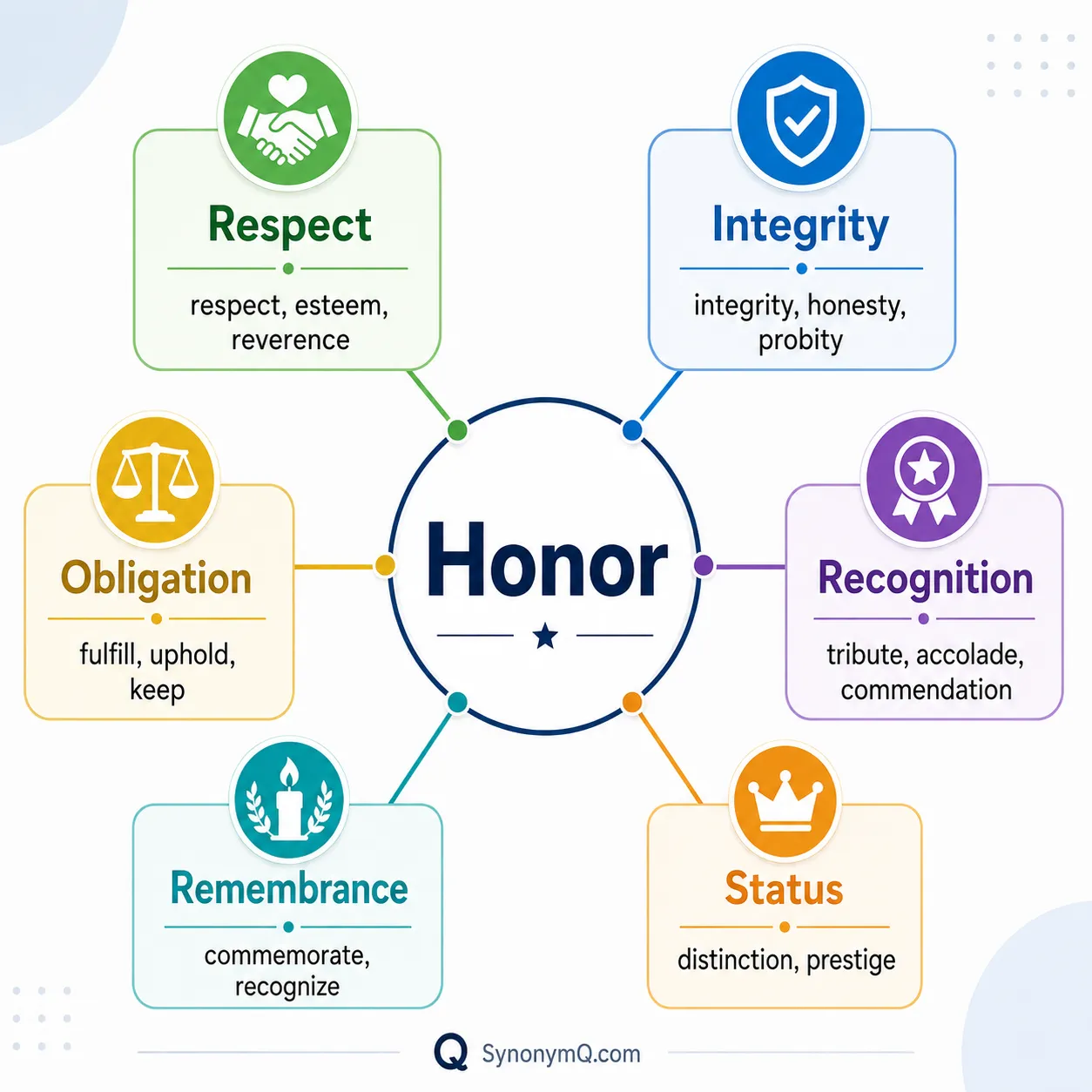
The best synonyms for honor are respect, esteem, reverence, distinction, integrity, dignity, accolade and glory. Honor means public respect earned by character or achievement, the integrity that earns it, or a formal mark of recognition. As a verb it means to show respect, commemorate, or keep a promise.

Quick-Reference Table: The 15 Strongest Synonyms for Honor
Start here if you need a word in the next thirty seconds. Every entry is expanded further down with register, meaning and an example.
| Synonym | Register | Intensity (1-5) | Best used for |
|---|---|---|---|
| Respect | Neutral | 3 | Everyday admiration for a person or rule |
| Esteem | Formal | 3 | Written praise of someone’s worth |
| Reverence | Formal | 5 | Deep, almost sacred respect |
| Tribute | Neutral | 4 | A gesture or speech offered in praise |
| Recognition | Neutral | 3 | Public acknowledgment of real work |
| Distinction | Formal | 4 | Earned excellence that sets someone apart |
| Prestige | Neutral | 3 | Status attached to a role or institution |
| Glory | Literary | 5 | Brilliant honor won by achievement |
| Dignity | Neutral | 3 | Composed self-worth that commands respect |
| Integrity | Formal | 4 | Moral consistency a manager can observe |
| Accolade | Formal | 4 | A formal award or emphatic public praise |
| Commendation | Formal | 4 | Official praise recorded for good service |
| Kudos | Casual | 2 | Quick credit in a team chat |
| Commemorate | Formal | 4 | Marking a death or a solemn anniversary |
| Uphold | Formal | 3 | Keeping a standard, rule or decision |
Intensity is SynonymQ’s editorial judgment: 1 = mild, 5 = strongest. A guide, not a measurement.
What Does Honor Mean?
Honor carries three separate meanings as a noun, and most word-choice mistakes come from mixing them up.
Sense one is respect received. Someone is held in honor because other people rate their conduct or achievement highly. Here honor lives outside you, in what others give.
Sense two is moral character held. A person of honor keeps their word when breaking it would be easier and cheaper. Here honor lives inside you, whether anyone is watching or not.
Sense three is a mark of recognition. An honor can be a medal, a degree, a title or an invitation to speak. Here honor is a countable thing you receive, which is why it takes a plural: she collected honors for thirty years.
The verb splits the same way. To honor a veteran is to show respect. To honor a contract is to keep a promise. To honor a founder at an anniversary dinner is to hold a ceremony. Merriam-Webster’s entry lists both the respect sense and the payment sense under the same verb, which tells you the overlap is real English rather than a coincidence of spelling.
Pick your synonym after you know which sense you mean, and the rest of the choice gets easy.
How to Pronounce Honor
Honor is pronounced ON-er, with two syllables and the stress on the first. The h is silent in both American and British English.
| Feature | Detail |
|---|---|
| Respelling | ON-er |
| Merriam-Webster | hon·or, \ˈä-nər\ |
| IPA (British) | /ˈɒnə/ |
| Syllables | 2 (hon·or) |
| Stress | First syllable |
| Part of speech | Noun, verb |
The silent h is the trap. It survives in spelling because early Old French restored a Latin letter that had already stopped being pronounced, and English inherited the spelling without the sound. That silent h is also why the article before it is an, not a: an honor, an honorable mention, an honest answer. Writing a honor is the single most common error with this word.
The Full List: 59 Synonyms for Honor, Grouped by Meaning
English gives us about sixty defensible alternatives here, spread across three noun senses and three verb senses, so the rest of this guide is about choosing between them well rather than collecting more of them. Every entry below gives register, part of speech, a short meaning and an original example.
Honor as Respect Given by Others
These nouns name the regard that flows toward a person from outside.
1. Respect (Neutral, noun) — regard earned by someone’s qualities or position — The crew treated the old engineer with a respect he never asked for.
2. Esteem (Formal, noun) — a considered high opinion of someone’s worth — She is held in esteem by colleagues who disagree with almost everything she argues.
3. Regard (Formal, noun) — attentive respect, usually paired with high or great — The department holds his fieldwork in high regard.
4. Reverence (Formal, noun) — deep respect touched with awe — He spoke about his grandmother’s kitchen with something close to reverence.
5. Veneration (Formal, noun) — respect for what is old, holy or historically weighty — The manuscripts are handled with a veneration that slows the whole reading room down.
6. Admiration (Neutral, noun) — warm approval of a person or an act — My admiration for the coach doubled the year the team lost every match and kept showing up.
7. Deference (Formal, noun) — respect expressed by yielding to another’s judgment — Out of deference to the family, the reporters stayed behind the fence.
8. Homage (Formal, noun) — a public act or gesture of respect toward someone senior or admired — The film pays homage to the nurses who ran the ward through the strike.
9. Tribute (Neutral, noun) — words, money or a gesture offered in praise of someone — Her students recorded a tribute and played it at the retirement lunch.
10. Praise (Neutral, noun) — spoken or written approval — Praise from that editor is rare enough that people frame the email.
11. Acclaim (Formal, noun) — enthusiastic public approval, often from critics or crowds — The second album met acclaim the first one never got.
12. Recognition (Neutral, noun) — public acknowledgment that someone’s work counts — After nine years of unpaid archiving, she finally got recognition from the city council.
Honor as Public Standing and Reputation
These nouns name the position a person occupies in other people’s estimation.
13. Prestige (Neutral, noun) — status attached to a person, role or institution — The prize carries more prestige than money.
14. Distinction (Formal, noun) — earned excellence that separates someone from peers — He retired with distinction after four decades in the same clinic.
15. Renown (Literary, noun) — widespread fame for something admirable — Her renown as a translator reached Tokyo long before she did.
16. Glory (Literary, noun) — brilliant honor won by achievement — The glory went to the striker; the defense went unmentioned again.
17. Dignity (Neutral, noun) — composed self-worth that commands respect — She answered the accusation with a dignity that ended the argument.
18. Standing (Neutral, noun) — a person’s rank in the opinion of a group — His standing in the union survived a very bad year.
19. Good name (Neutral, noun phrase) — an unspoiled personal reputation — He spent six months in court defending his good name over a single invoice.
20. Stature (Formal, noun) — importance and respect built up over time — A scholar of her stature does not usually reply to student emails within an hour.
21. Repute (Formal, noun) — the general opinion held of someone, now mostly fixed in set phrases — The firm is of good repute in a trade where that is not assumed.
Honor as Personal Integrity and Moral Character
These nouns name the inner quality that makes a person trustworthy.
22. Integrity (Formal, noun) — moral wholeness; acting the same when unobserved — The audit found no fraud and quietly confirmed her integrity.
23. Honesty (Neutral, noun) — truthfulness in speech and dealing — His honesty about the missed deadline saved the account.
24. Probity (Formal, noun) — strict moral correctness, especially with money or public office — The role demands probity above ordinary competence.
25. Rectitude (Formal, noun) — upright conduct guided by principle — Her rectitude made her unpopular in a department that liked shortcuts.
26. Uprightness (Formal, noun) — plain moral straightness — The village trusted his uprightness more than the paperwork.
27. Virtue (Formal, noun) — moral goodness as a settled habit — He wrote about courage as a virtue you practice, not a mood you catch.
28. Decency (Neutral, noun) — ordinary, reliable moral goodness — Basic decency would have been a phone call.
29. Righteousness (Formal, noun) — moral rightness, often with a religious sense — The sermon treated righteousness as daily practice rather than status.
30. Principle (Neutral, noun) — a moral rule someone refuses to break — She resigned on principle and never explained it publicly.
31. Nobility (Literary, noun) — greatness of mind and conduct — There was a quiet nobility in the way he took the blame for his team.
Honor as an Award, Title or Privilege
These nouns name honor as a countable thing you can receive.
32. Accolade (Formal, noun) — a formal award or emphatic public praise — The building collected accolades from three architecture bodies.
33. Award (Neutral, noun) — something officially given for achievement — The award came with a certificate and a very small check.
34. Commendation (Formal, noun) — official praise recorded for good service — He received a commendation for pulling two people from the flooded car.
35. Decoration (Formal, noun) — a medal or ribbon given for service or bravery — Her decorations sat in a drawer, not on a wall.
36. Laurels (Literary, noun) — honor won by victory, usually in the plural — He is still resting on laurels earned a decade ago.
37. Citation (Formal, noun) — a formal written mention of merit — The citation described her research as field-defining.
38. Kudos (Casual, noun) — informal credit and praise — Kudos to the night shift for catching the error before shipping.
39. Credit (Neutral, noun) — acknowledgment for having done something well — Give the intern credit; the fix was entirely hers.
40. Privilege (Neutral, noun) — a special opportunity you are fortunate to receive — It was a privilege to introduce her at the ceremony.
To Honor a Person: Verbs of Respect
These verbs describe showing honor to someone.
41. Revere (Formal, verb) — to respect deeply, with reverence — Students revere him for the same bluntness that annoys his colleagues.
42. Venerate (Formal, verb) — to treat as sacred or historically precious — The town venerates a bridge that has been rebuilt four times.
43. Exalt (Literary, verb) — to raise someone high in status or praise — The obituary exalted a man his own staff found difficult.
44. Laud (Formal, verb) — to praise publicly and warmly — Reviewers lauded the design and ignored the price.
45. Glorify (Literary, verb) — to present something as splendid, sometimes more than it deserves — The documentary glorifies the founder and skips the lawsuits.
46. Salute (Neutral, verb) — to acknowledge someone’s achievement openly — We salute the volunteers who kept the shelter open all winter.
47. Dignify (Formal, verb) — to give something worth or seriousness — A single line in the program dignified forty years of quiet work.
48. Look up to (Casual, phrasal verb) — to admire someone as a model — Younger nurses look up to her because she never rushes a handover.
To Honor an Occasion or a Memory: Verbs of Commemoration
These verbs describe honoring an anniversary, an event or someone who has died.
49. Commemorate (Formal, verb) — to mark a person or event with a ceremony or memorial — The plaque commemorates the miners who never came back up.
50. Celebrate (Neutral, verb) — to mark an occasion with joy — The department celebrates every thesis defense with terrible cake.
51. Memorialize (Formal, verb) — to preserve a memory in permanent form — The garden memorializes patients the ward lost that year.
52. Observe (Neutral, verb) — to keep a day or custom as it should be kept — Our office observes the holiday with a two-minute silence at eleven.
53. Mark (Neutral, verb) — to note an occasion in some visible way — They marked the anniversary by reopening the archive for one day.
To Honor a Promise or a Payment: Verbs of Fulfillment
These verbs describe honoring an obligation rather than a person.
54. Fulfill (Neutral, verb) — to carry out what was promised — The supplier fulfilled every term of the contract, late but complete.
55. Uphold (Formal, verb) — to maintain a standard, rule or decision — The board upheld the policy despite loud pressure to drop it.
56. Keep (Neutral, verb) — to do what you said you would do — He kept his promise about the deposit without being asked twice.
57. Abide by (Neutral, phrasal verb) — to accept and follow a rule or ruling — All bidders abide by the same disclosure rules.
58. Discharge (Formal, verb) — to complete a duty or debt fully — The trustee discharged her obligations before resigning.
59. Stand by (Casual, phrasal verb) — to remain loyal to an agreement or a person — We stand by the quote we gave you in March.
Save the ones you want to reuse with SynonymQ bookmarks, and check any word above in the free synonym finder before you commit it to a final draft.
Register and Formality: Where Each Word Belongs
Register is the fastest way to narrow fifty-nine words down to three. Sort by the room you are writing for, then choose on meaning.
| Register | Words for honor in this group |
|---|---|
| Formal | esteem, regard, reverence, veneration, deference, homage, acclaim, distinction, stature, repute, integrity, probity, rectitude, uprightness, virtue, righteousness, accolade, commendation, decoration, citation, revere, venerate, laud, dignify, commemorate, memorialize, uphold, discharge |
| Neutral | respect, admiration, tribute, praise, recognition, prestige, dignity, standing, good name, honesty, decency, principle, award, credit, privilege, salute, celebrate, observe, mark, fulfill, keep, abide by |
| Casual | kudos, look up to, stand by |
| Literary | renown, glory, nobility, laurels, exalt, glorify |
| Slang | none in common use |
| Archaic | none of the words above; honor in the sense of a woman’s chastity is the archaic use of the headword itself |
Two practical readings of that table. First, honor itself sits in the Neutral column, which is why it survives in a wedding toast and a court filing alike. Second, the Formal column is where most drafts go wrong: probity and rectitude are correct English that will make a cover letter sound like a nineteenth-century sermon.

Which Word Should You Use?
Answer one question first: are you naming respect received, character held, an award given, or an obligation kept? Then use the matching line.
- Someone earned admiration from others → respect, esteem, admiration, recognition
- You want deep, near-sacred respect → reverence, veneration
- A public gesture toward someone senior or admired → homage, tribute, salute
- Writing about a person’s moral core → integrity, character, principle, decency
- Writing about money, office or public trust → probity, integrity
- Naming a medal, prize or formal mention → accolade, award, commendation, decoration, citation
- Thanking someone for an opportunity → privilege, credit
- Marking a death or an anniversary → commemorate, memorialize, observe
- Marking a happy occasion → celebrate, mark
- Keeping a contract, promise or payment → fulfill, uphold, keep, abide by
- Maximum intensity in a speech or a poem → glory, reverence, exalt
- Casual credit in a team chat → kudos, credit, stand by
Three short rules cover most remaining cases. Use the concrete word over the abstract one when both fit, because the commendation lands harder than the honor. Use Neutral register unless the setting is explicitly ceremonial. And if two words feel equally right, choose the one your reader will not have to look up.

Words That Are Not True Synonyms for Honor
Thesauruses list all six of these near honor. Each one changes your meaning, and two of them can reverse it.
Pride. Pride is what you feel about yourself or your own side; honor is what others hold toward you, or the standard you hold yourself to. He took pride in the medal describes an emotion. He was honored with the medal describes an event. Swap them and a modest sentence turns boastful.
Fame. Fame measures how widely you are known, with no judgment attached. A person can be famous for fraud. Honor cannot be earned that way, so a famous surgeon and an honored surgeon say different things about the same career.
Reputation. Reputation is neutral and needs an adjective to mean anything: a bad reputation is still a reputation. Honor is positive by default. The company protected its reputation is a factual statement; the company protected its honor sounds like a duel is coming.
Obedience. Obedience is compliance with authority. Honoring your parents, in the sense the Fifth Commandment uses, includes care, provision and respect for their standing, which is broader than doing as you are told. The two are close enough to swap by accident and different enough to change the moral point of a sentence.
Flattery. Flattery is praise given for effect, usually inflated and usually self-interested. Honor implies the praise is deserved. Calling a speech a tribute when the audience heard flattery is the difference between a warm room and a cold one.
Redeem. This one catches careful writers. A shop honors a gift card; the customer redeems it. Both verbs sit on the same transaction, but they belong to opposite parties, so the store redeemed the voucher quietly puts the shop in the customer’s chair.

Head-to-Head: Honor vs Its Closest Rivals
Three pairs cause more confusion than the rest of the list combined.
Honor vs Respect
| Question | Honor | Respect |
|---|---|---|
| Register | Neutral, leans ceremonial | Neutral, everyday |
| Direction | Received from others, or held as a code | Given to others |
| Typical objects | veterans, a memory, a contract, a promise | a person, a rule, an opinion, a boundary |
| Best for | Ceremony, obligation, moral weight | Ordinary conversation and workplace writing |
Respect is the broader, plainer word, and it works in ordinary conversation where honor would sound staged. Honor adds ceremony, obligation or moral weight. You respect a colleague’s judgment; you honor a fallen colleague. You can also respect a rule you dislike, while honoring it implies you have accepted it as binding.
Honor vs Integrity
| Question | Honor | Integrity |
|---|---|---|
| Where it lives | Partly outside you, in others’ regard | Entirely inside you |
| What it measures | Standing plus adherence to a code | Consistency between values and actions |
| Can you lose it publicly | Yes, by scandal or disgrace | Only by your own conduct |
| Best for | Military, legal and ceremonial writing | Job applications and performance reviews |
Integrity is the better word for a résumé because it describes behavior a manager can observe. Honor points outward to reputation and to codes shared by a group. A person can keep their integrity while losing their honor, and that gap is the plot of a great deal of literature.
Commemorate vs Celebrate
| Question | Commemorate | Celebrate |
|---|---|---|
| Mood | Solemn, remembering | Joyful, marking success |
| Typical occasion | A death, a battle, a disaster anniversary | A birthday, a promotion, a founding |
| Register | Formal | Neutral |
| Best for | Memorials, plaques, remembrance days | Launches, milestones, parties |
Both mean marking an occasion, and the difference is emotional temperature rather than accuracy. Commemorate almost always implies loss or gravity, so using it for a product launch reads as unintentionally funereal. Celebrate at a memorial can sound careless unless the family has chosen that framing, which some do deliberately.
Honor vs Honour: Which Spelling Is Correct?
Both spellings are correct. Honor is standard in American English; honour is standard in British, Irish, Australian, New Zealand, South African and Indian English, and is generally preferred in Canada. Neither is a misspelling. The choice follows your audience, and consistency across a document matters more than which one you pick.
| Form | Where it is standard | Derived forms | Use it when |
|---|---|---|---|
| Honor | United States | honorable, honorary, honoree, honorific | Writing for US readers or US publications |
| Honour | UK, Ireland, Australia, New Zealand, South Africa, India, Canada | honourable, honoured, honours degree | Writing for Commonwealth readers |
The two spellings ran side by side for centuries; the split hardened later, with American preference for honor pushed along by Noah Webster’s dictionaries.
Watch the derived forms, because they do not all follow the same pattern. British English keeps the u in honourable and honoured but writes honorary and honorific without it. Fixed titles keep their own spelling wherever you are writing: an honours degree, the Honourable Member, and the American Medal of Honor stay as they are, because a proper name is not something a house style gets to change.

What Does Honor Mean in the Bible?
In English Bible translations, honor means treating a person as weighty and valuable through action, not merely feeling warmly toward them. The Fifth Commandment instruction to honor your father and your mother is the best-known example, and it covers respect, care and provision rather than obedience alone.
Two things are worth knowing about the words behind the translation. The Hebrew verb kabad, usually rendered as honor or glorify, has a root sense of being heavy — Strong’s glosses it “to be heavy, i.e. in a bad sense (burdensome, severe, dull) or in a good sense (numerous, rich, honorable).” To honor someone in Hebrew is to treat them as having weight.
The Greek noun timē, used across the New Testament, sits in the same family as the verb tinō, “to pay.” Strong’s defines it as “a value, i.e. money paid” and, by extension, “esteem (especially of the highest degree), or the dignity itself.” Honor there is closer to a price than to a mood.
That background explains why biblical honor reads as active rather than emotional. Honoring aging parents in that framework looks like practical support; honoring God looks like conduct. If you are writing for a religious audience, the near-synonyms that keep this sense best are esteem, reverence, revere and venerate, while praise and acclaim lean toward applause and sit less comfortably in the same sentence.
Common Collocations With Honor
These pairings sound natural to native speakers. Prefer them over grammatically correct combinations nobody actually says.
- in honor of — The scholarship was founded in honor of a teacher who taught there for forty years.
- a code of honor — The crew ran on an unwritten code of honor that no manual mentioned.
- guest of honor — She arrived late and discovered she was the guest of honor.
- honor roll — His name stayed on the honor roll every semester but one.
- do the honors — Since you built the thing, you should do the honors and cut the ribbon.
- honor a commitment — Small firms that honor a commitment during a bad quarter keep clients for a decade.
- honor a check — The bank refused to honor a check written on the closed account.
- defend someone’s honor — He defended his sister’s honor in a way that helped nobody.
- the honor of your presence — The invitation requested the honor of your presence, which meant a jacket.
- honorable mention — The photo took an honorable mention and a hundred dollars.
- maid of honor — Her sister was maid of honor and wrote the only good speech.
Etymology and Origin of Honor
Honor reached English around 1200 from Anglo-French honour and Old French onor, from Latin honorem (nominative honos), whose own origin is unknown. The h is a Latinate spelling correction made in early Old French for a sound that had already disappeared, which is why English writes a letter it does not say.
The senses arrived in a sequence. Around 1200 the word meant glory, renown and earned fame. By about 1300 it also covered the act of paying respect, the condition that inspires respect, and nobleness of character. A narrower use naming a woman’s chastity appeared in the late fourteenth century and now survives mainly in historical fiction and in the grim compound honor killing. The sense of a personal title to high respect dates from the 1540s.
The verb followed in the mid-thirteenth century from Old French onorer. Its commercial sense — accepting a bill as due — arrived around 1706, by way of the idea of performing a duty of respect toward an obligation. That is how one verb ended up covering both keeping your word and clearing a payment.
Choosing a Synonym for Honor by Writing Situation
The right alternative changes with the room. Four settings cover most of what people write.
Academic Writing and Essays
Academic prose rewards precision over grandeur. Prefer esteem, regard, recognition, distinction, integrity, probity and commemorate, and reserve glory and reverence for describing a source’s tone rather than your own argument.
Write the poem treats reputation as inheritable rather than the poem is about honor, since naming the specific sense stops a marker from guessing which one you meant. In literary essays, honor culture and code of honor are established terms, so use them directly instead of paraphrasing around them. If your word limit is tight, run the draft through the SynonymQ word counter before you start cutting, and check the section targets in our word count guidelines for essays, blogs and social posts.

Résumés, Cover Letters and Professional Email
Hiring managers read for evidence, so choose words that point at facts: recognition, commendation, award, citation, credit, integrity, uphold, fulfill. Received a commendation for reducing intake time by a third beats was honored for my work, because someone can verify it.
Two cautions. Avoid probity, rectitude and veneration entirely; they read as costume. And it was a privilege to is warm and safe in a thank-you email, while I was honored to can sound stiff unless the event genuinely was ceremonial.
Creative Writing and Fiction
Fiction is where the heavy words earn their place. Glory, renown, laurels, nobility, exalt, venerate and reverence all carry period flavor, which is useful in historical settings and risky in contemporary dialogue.
Let register do characterization. A character who says my honor demands it is telling you their era, their class or their self-image. A modern character in the same situation says I gave my word. Mixing the two on purpose is one of the cheapest ways to make a scene funny.
Everyday Conversation and Social Media
Speech prefers the short words: respect, credit, kudos, look up to, stand by. Kudos to the team works in a group chat where acclaim to the team would get you screenshotted.
Keep honor itself for the moments that deserve it, like a memorial post or a wedding toast, where its ceremonial weight is the point rather than an accident. Need alternatives fast while you write a caption? Run the word through the SynonymQ synonym finder and pick by register, not by whichever option looks most impressive.
Antonyms of Honor
The opposite of honor depends on the sense you started with: lost public respect, absent moral character, or a broken promise.
- Dishonor — the direct opposite in both noun and verb use, covering lost standing and broken obligations
- Disgrace — public loss of respect after a specific failure or scandal
- Shame — the internal feeling attached to that loss, and sometimes the loss itself
- Disrespect — everyday opposite of respect, common as a verb in speech
- Contempt — active scorn toward someone you consider worthless
- Scorn — open, expressed disdain
- Infamy — fame for something bad, the precise mirror of renown
- Ignominy — deep public humiliation, formal in register
- Disrepute — a damaged general reputation, as in bringing the profession into disrepute
- Degradation — the process of being reduced in dignity or status
- Humiliation — being made to feel small in front of others
- Corruption — the failure of probity, especially in office
- Betrayal — the opposite of honoring a trust or a promise
- Renege — the verb for failing to honor an agreement you made
These split the same way the synonyms do. Dishonor and disgrace answer the reputation sense, corruption and betrayal answer the integrity sense, and renege answers the obligation sense. Browse more opposites in the SynonymQ antonym finder, or read Antonyms 101: how opposite words sharpen your meaning for how to use contrast on purpose.
Honor in Spanish, French and Italian
All three languages inherit the noun from the same Latin source, so it looks familiar. The traps are in which verb form a sentence needs and in the near-synonym sitting next to it.
| Language | Word | Register | Notes |
|---|---|---|---|
| Spanish | honor | Formal | Masculine, el honor. RAE defines it as the moral quality of fulfilling one’s duties, and as the good reputation that follows merit. Honra is a related noun whose first RAE sense is esteem for one’s own dignity — inward where honor is outward. Verb: honrar, “respetar a alguien” |
| French | honneur | Formal | Masculine, l’honneur. En l’honneur de matches in honor of. Verb: honorer, which the Académie française also gives as settling an obligation — honorer une traite, honorer sa signature |
| Italian | onore | Formal | Masculine, l’onore. Treccani’s first sense is personal dignity as reflected in others’ regard. Verb: onorare, covering both surrounding someone with esteem and paying what is owed — onorare una cambiale |
One example sentence each:
- Spanish: El desfile honra a los bomberos de la ciudad. (Note the personal a before a specific human object — omitting it is an error.)
- French: La plaque honore les habitants du village.
- Italian: La cerimonia onora i medici dell’ospedale.
A caution the dictionaries do not settle. It is tempting to say respeto and rispetto are the everyday words while honor and onore are ceremonial, and in practice that is how the pairs usually behave. But no major dictionary attaches a register label to any of them, so treat that contrast as a writer’s rule of thumb rather than a fact, and have a native speaker check any line you plan to publish.
How to Avoid Repeating Honor in the Same Piece
Repetition of honor is especially visible because the word is ceremonial; three appearances in one paragraph make a tribute sound like a form letter. Five steps fix it.
- Name the sense first. Mark each use as respect, character, award or obligation. Half your repetitions will turn out to be different meanings that want different words.
- Convert some nouns to verbs. In honor of the founders becomes honoring the founders becomes the founders it commemorates. Changing the grammar removes the repetition without hunting for a synonym at all.
- Replace the weakest instance, not the strongest. Keep honor where it carries the most ceremony, usually the opening or the closing line, and swap the ones in the middle.
- Match register before meaning. In a formal citation, reach for commendation or distinction; in a caption, reach for credit or kudos. A correct word in the wrong register is more noticeable than a repetition.
- Read the result aloud. Ceremonial vocabulary hides badly in speech, and a sentence that trips your tongue will trip your reader.
For longer rewrites, the SynonymQ paraphrasing tool handles whole sentences rather than single words, and our guide to paraphrasing without plagiarizing covers how far a rewrite has to go to count as your own.

Frequently Asked Questions
What is another word for honor?
The best single alternative is respect for the everyday sense, integrity for the moral sense, and accolade for an award. Other strong options are esteem, reverence, distinction, prestige, dignity, glory, tribute and recognition. Pick by which sense you mean: respect received, character held, or a prize given.
What is the opposite of honor?
The direct opposite of honor is dishonor. Depending on the sense, disgrace and shame oppose lost public respect, corruption and betrayal oppose lost integrity, and renege opposes a broken promise. Infamy is the exact mirror of renown, since both mean widespread fame with opposite moral value.
What does honor mean in the Bible?
In English Bible translations, honor means treating someone as weighty and valuable through action, not only feeling. The Fifth Commandment to honor your father and your mother includes respect, care and provision. The section on biblical honor above explains the Hebrew kabad and Greek timē behind the English word.
What does it mean to honor someone?
To honor someone is to show publicly that you consider them valuable, through respect, praise, ceremony or care. It can mean giving an award, holding a memorial, following their wishes, or treating their position and needs as they deserve. The action matters more than the feeling behind it.
Is it honor or honour?
Both are correct. Honor is standard American spelling; honour is standard in British, Irish, Australian, New Zealand, South African and Indian English, and is generally preferred in Canada. Choose by audience and stay consistent. Proper names keep their own spelling, so the Medal of Honor keeps its American form everywhere.
What is another word for honored?
For the feeling, use privileged, humbled, grateful or touched, as in I am privileged to accept. For a person who has received recognition, use distinguished, decorated, celebrated, esteemed or acclaimed. For a kept promise, use fulfilled or upheld. The right choice depends on which sense of honored you mean.
What is the difference between honor and respect?
Respect is the broader, everyday word and flows toward another person; honor adds ceremony, obligation or moral weight and can also be something you hold yourself. You respect a colleague’s judgment and honor a fallen colleague. The comparison table above sets out register, direction and typical objects side by side.
What is the difference between honor and integrity?
Integrity is entirely internal — consistency between what you believe and what you do. Honor is partly external, living in other people’s regard and in codes shared by a group. That is why integrity is the safer word on a résumé and honor is the natural one in military, legal or ceremonial writing.
Is honor a verb or a noun?
Both. As a noun it names respect received, moral character, or an award. As a verb it means to show respect, to commemorate, or to keep an obligation, which is why a bank can honor a check and a city can honor a firefighter using the same word.
Why is the h in honor silent?
The h is a spelling restoration, not a pronunciation. Early Old French put the Latin letter back into a word whose h sound had already vanished, and English borrowed the spelling with the silence intact. That is also why you write an honor rather than a honor.
Choosing Your Word
Honor is one of the few English words that means something different depending on whether it is given, held, awarded or kept, so the synonym that fits your sentence depends entirely on which of those four you are writing about. Name the sense, match the register, then pick the most concrete word that fits. When two options feel equally right, the one your reader does not have to look up is almost always the better choice. Search any word from this guide in the SynonymQ synonym finder to compare alternatives side by side.
Written by Naveed Akhtar, an SEO content writer with 10 years of article-writing experience.
Published: August 16, 2026 · Last updated: August 16, 2026
Sources: Merriam-Webster (definitions, pronunciation, first known use) · Etymonline (origin and sense development) · Strong’s Hebrew 3513 and Strong’s Greek 5092 via Bible Hub (biblical terms) · Real Academia Española (Spanish) · CNRTL and the Académie française (French) · Treccani (Italian).
Further reading on the headword: Merriam-Webster, Cambridge Dictionary, Etymonline, Oxford Learner’s Dictionaries.

Naveed Akhtar writes every guide on SynonymQ. He is an SEO content writer with ten years of article-writing experience, working on the question a thesaurus never answers: which of these words belongs in this sentence, for this reader. Every page cites the dictionary entries it draws on and the date they were read.