
Definite vs Definitive: 3 Simple Checks for Better Writing
Definite vs definitive is a choice of emphasis: definite means clear, certain or fixed; definitive means conclusive, final or authoritative. Use definite for a confirmed date and definitive for an answer that settles a question. Their meanings can overlap.

Definite vs definitive: what changes in your sentence?
The useful distinction is the claim you want the reader to accept. Are you saying something is clear or settled in its details? Or are you presenting something as resolving a question or carrying special authority?
| Word | Main emphasis | Original example |
|---|---|---|
| Definite | Clarity, certainty or a fixed arrangement | We now have a definite date for the workshop. |
| Definitive | A conclusive answer or final resolution | The investigation produced a definitive explanation of the fault. |
| Definitive | An authoritative work or reference | Reviewers consider this the definitive history of the railway. |
This is a practical comparison, not a rule that divides every possible sentence. Both words can describe an answer, conclusion or decision. The surrounding context determines which feature matters.
A firm reply can also settle a dispute. In that situation, either adjective may fit, but the emphasis changes. Choose the feature your reader needs to understand rather than the word that sounds more impressive.
What does definite mean?
Merriam-Webster’s entry for definite covers freedom from uncertainty or ambiguity, as well as distinct limits. In ordinary writing, this supports uses involving clear answers, firm arrangements and identifiable features.
A definite date is established rather than tentative. A definite answer leaves the recipient with a clear response. A definite improvement is an improvement the writer treats as clear or noticeable.
- Arrangement: “We cannot book the room until we have a definite date.” The missing information is a settled date, not an authoritative assessment.
- Reply: “Please give me a definite yes or no before I order the tickets.” The speaker wants a firm commitment.
- Observation: “There was a definite improvement in the revised introduction.” The change is clear enough for the writer to recognize.
The adjective does not automatically explain why a claim is reliable. Someone can express a definite opinion without supplying convincing reasons. Clear commitment and good supporting evidence are different things.
That distinction matters in feedback. “I have a definite preference for the shorter version” states a firm preference. It does not claim that the shorter version is objectively the best choice for every audience.
What does definitive mean?
Oxford Learner’s Dictionaries records a final sense and a separate sense for something considered the best of its kind. This explains why the adjective works with both answers and reference books.
A definitive answer is presented as settling the question. A definitive version is treated as the final version. A definitive biography is being praised as an authoritative treatment of its subject.
- Resolution: “The archived correspondence supplied a definitive answer to the authorship question.” The material is presented as resolving the uncertainty.
- Final version: “Send the definitive text to the printer after approval.” The request concerns the version intended for publication.
- Authority: “The curator described the catalogue as the definitive guide to the collection.” The curator is making an evaluative claim about the guide.
Calling a book definitive does not establish that nobody will ever improve it. It reports an assessment of its authority or completeness. New evidence, a different purpose or a later edition may change that assessment.
Use the adjective carefully in promotional copy. If your guide covers only beginner questions, introductory, practical or a specific description of its scope may be more accurate than a claim to definitive coverage.
3 simple checks for choosing the right word
Apply these checks to the whole sentence. They identify your intended emphasis; they do not turn dictionary senses into mutually exclusive boxes.
1. Check for clarity or a settled detail
Try replacing the adjective with clear, certain or fixed. If one of those captures the point, definite is often the useful choice.
“We need a definite time for the interview” asks for a fixed time. Choosing definitive would distract from that straightforward scheduling request by suggesting finality or a special resolving function.
2. Check whether something settles the question
Ask whether the sentence presents an answer, finding or decision as resolving the issue. If that is the point, definitive highlights the conclusive or final character you mean.
“The additional records gave us a definitive answer” tells the reader what the records accomplished. If they only clarified one detail and left the main issue open, describe that narrower contribution instead.
3. Check whether you are claiming authority
If you mean a work is an authoritative treatment of its subject, choose definitive. This sense concerns the standing or quality attributed to a guide, edition, recording or other work.
“The definitive study of the architect’s early buildings” makes a stronger claim than “a detailed study.” Be ready to support that assessment with the work’s coverage, evidence or recognized standing.
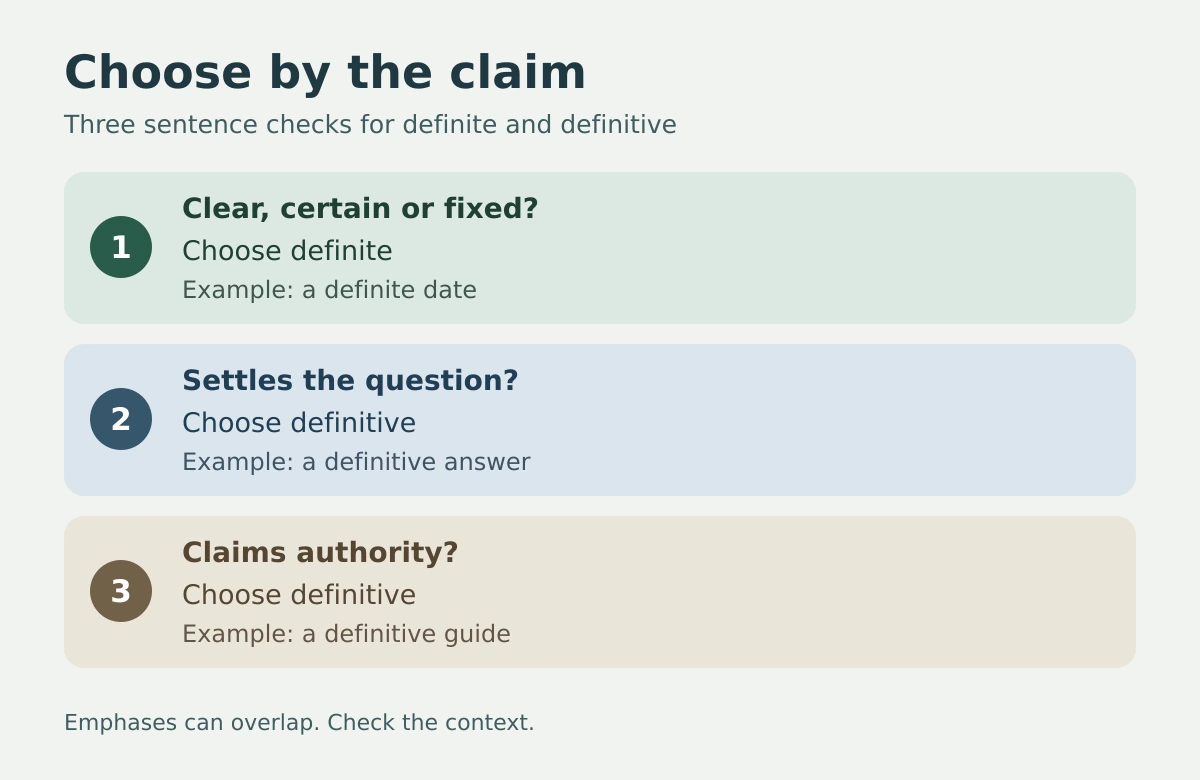
Definite answer or definitive answer?
Both expressions are valid. Use definite answer when the practical need is an unambiguous reply. Use definitive answer when you want to stress resolution, conclusiveness or finality.
A commitment someone can act on
Imagine an organizer asking whether you will attend a workshop. “I need a definite answer by Thursday” asks you to stop leaving the decision open. The organizer needs to know whether to reserve your place.
The response need not solve a complicated factual problem. A clear “Yes, I will attend” is enough for the organizer’s purpose. Firm answer or clear reply would also suit that context.
A question the evidence resolves
Now imagine an editor checking which author wrote an unsigned essay. “We need a definitive answer before publishing the attribution” asks for an answer that resolves the question, rather than a confident guess.
A signed draft might provide that resolution; an unsupported recollection might not. The adjective describes the claim being made about the answer. It cannot replace the evidence required to justify that claim.
Where the two expressions overlap
A supplier’s final refusal can be a definite answer because it is clear, and a definitive answer because it closes the matter. If both descriptions fit, choose the emphasis most relevant to the recipient.
For an email about headcount, clarity matters most. For a report explaining why further investigation is unnecessary, resolution matters most. This difference is more useful than memorizing a ban on one phrase.
If the result remains provisional, say so directly: “The documents suggest an answer, but they do not settle the attribution.” A carefully limited statement serves the reader better than either adjective used too strongly.
Check the noun beside the adjective
The noun often reveals what the adjective needs to do. Dates, limits and preferences point toward clarity or certainty. Versions, findings and reference works may call for finality or authority.
| Your intended meaning | Useful phrase | Why it fits |
|---|---|---|
| An established appointment | A definite date | The arrangement is no longer tentative. |
| A plainly recognizable change | A definite improvement | You are emphasizing the clarity of the change. |
| A firmly held view | A definite opinion | The person’s position is clear. |
| A limit that is specified | A definite limit | The boundary is identifiable. |
| A reply you can act on | A definite answer | The reply removes practical uncertainty. |
| A question resolved by findings | A definitive answer | The findings are presented as settling it. |
| The text intended as final | The definitive version | The version has final status. |
| A work judged authoritative | The definitive biography | The phrase evaluates the work’s standing. |
These are recommendations for the meanings shown, not a frequency ranking or a list of grammatical prohibitions. Another context may support a different phrase. Explain that context before treating a substitution as an error.
For a file name or workflow message, approved version can be clearer than definitive version. “Approved for printing” identifies the precise status without asking the reader to infer what “final” means in your process.
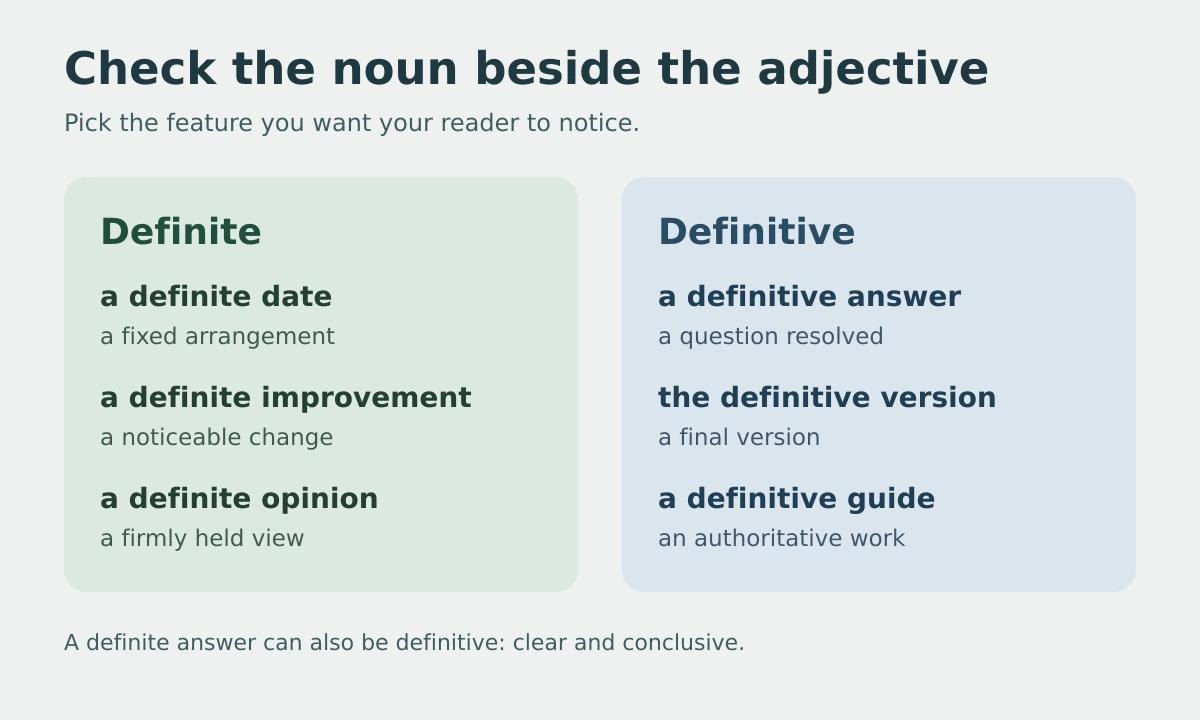
Keep certainty separate from supporting evidence
A writer’s confidence and the strength of an explanation are separate questions. “She gave a definite answer” can describe an unhesitating response. It does not tell you whether the response is well supported.
“She gave a definitive answer” presents the response as resolving the question. In analytical writing, explain what makes that assessment justified instead of expecting the adjective to establish it.
For example, “The logs identified the failed request and its timestamp” names the contribution of the evidence. “The logs proved everything definitively” leaves the reader guessing what was checked and what remained uncertain.
Match the claim to its scope. A record can establish the time a message was sent without establishing why the sender wrote it. A conclusive answer to the first question is not automatically an answer to the second.
A related distinction appears in credible vs creditable: identifying the specific claim prevents a similar-looking adjective from doing the wrong job. A believable explanation is not automatically a conclusive one.
Synonyms and alternatives: test the whole phrase
There is no single replacement that preserves every sense of either word. The alternatives below are near-synonyms in the stated context, or contextual alternatives that change the claim. They are not universal equivalents.
| Original phrase | Alternative | Relationship / swap | What changes |
|---|---|---|---|
| A definite answer | A clear answer | Near-Synonym / Direct Swap | Emphasizes lack of ambiguity; may say less about firm commitment. |
| A definite date | A fixed date | Near-Synonym / Direct Swap | Emphasizes the settled arrangement. |
| A definite improvement | A noticeable improvement | Near-Synonym / Direct Swap | Focuses on the change being perceptible. |
| A definite limit | A specified limit | Contextual Alternative / Direct Swap | Says the limit has been stated; does not by itself establish certainty. |
| A definitive answer | A conclusive answer | Near-Synonym / Direct Swap | Emphasizes resolution rather than the speaker’s firmness. |
| The definitive version | The final version | Near-Synonym / Direct Swap | Emphasizes final status; may omit a claim to authority. |
| A definitive guide | An authoritative guide | Near-Synonym / Swap With Adjustment | Change a to an; emphasizes authority rather than completeness. |
| A definitive guide | A comprehensive guide | Contextual Alternative / Direct Swap | Claims broad coverage, which need not make the guide authoritative. |
| A definite preference | I know which option I prefer. | Contextual Alternative / Requires Rewrite | States the person’s certainty as a complete sentence. |
For ordinary scheduling, fixed or confirmed may communicate the useful detail more directly. For a disputed factual issue, conclusive can make the evidence-related emphasis easier to recognize.
You can explore candidates with SynonymQ’s synonym search tool. Then test each candidate beside the original noun. A word that fits an answer may fail beside a date or change what a guide promises.
Four practical rewrites
A useful revision preserves the intended message. These examples improve a scheduling request, a claim about findings, a description of a person and a file-status instruction.
Scheduling: make the arrangement clear
Before: “Please send a definitive date for the interview.”
After: “Please confirm a definite date for the interview.”
The revision asks for an established date. If the real problem is that several dates have been proposed, “Please confirm which date is approved” identifies that problem even more precisely.
Findings: state the remaining limit
Before: “These notes give a definitive explanation of the error.”
After: “These notes identify when the error appeared, but its cause remains uncertain.”
This requires a rewrite because the original overstates the available information. Swapping in definite would not fix the unsupported claim about an explanation.
People: name the quality you mean
Before: “Maya is a definitive person.”
After: “Maya is decisive when the team needs a decision.”
The revision fits the intended meaning of making decisions readily. If you mean her view is firm, write “Maya is definite about which design she prefers.” Those descriptions are not interchangeable.
Documents: name the exact status
Before: “Use the definitive document.”
After: “Use the version approved for publication.”
The original can be valid, but the revision prevents uncertainty about which file to use. A precise status description may be more helpful than either adjective when multiple revisions are circulating.
Grammar, people and related word forms
In the ordinary uses discussed here, definite and definitive are adjectives. They can modify nouns, and they can follow a linking verb: “The arrangement is definite”; “The answer is definitive.”
Grammar alone does not select the right one. Both may fit the same position in a sentence while making different claims. Read the sentence for meaning after checking its structure.
Can definite describe a person?
Yes. Collins records a use involving a firm, confident manner. “She was definite about keeping the original title” naturally identifies a firm position.
For someone who makes choices readily, decisive is usually the clearer editorial recommendation. For someone who speaks firmly, assertive may fit, but it introduces a description of manner rather than certainty.
What does definitive person mean?
The phrase alone does not clearly describe an everyday personality trait. Merriam-Webster does record an exemplary sense of definitive, so a blanket claim that it can never concern people would be wrong.
Supply the type being exemplified: “The character is the definitive outsider” presents a representative example of an outsider. If you mean confident, certain or decisive, choose the word that names that quality.
Definitely and definitively follow the same practical contrast
Definitely expresses certainty or lack of ambiguity: “I will definitely attend.” Definitively emphasizes a final or decisive manner: “The records settled the question definitively.”
“I will definitively attend” is an awkward choice for an ordinary promise to be there. Choose definitely for that purpose. Keep definitively when the sentence genuinely concerns resolving or establishing something conclusively.
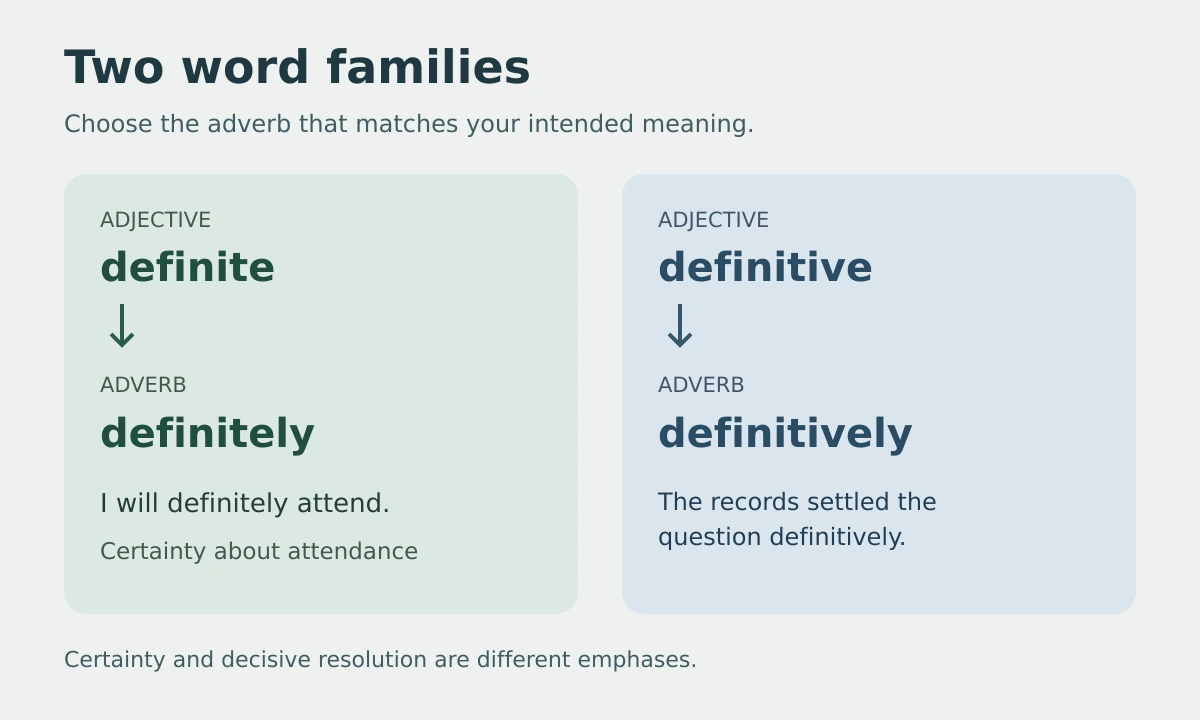
Check the spelling too: definite and definitely contain finite. The spellings definate and definately are incorrect. Do not confuse definitely with defiantly, which concerns defiance.
Definite vs indefinite is a different contrast
Indefinite can mean vague or lacking exact limits. “The launch date is indefinite” leaves the date unsettled; “The launch date is definite” says it is established.
An indefinite delay has no specified endpoint. It does not necessarily mean the delay lasts forever. If the duration is unknown, “We cannot yet give a reopening date” makes that limit explicit.
In grammar, the is the definite article, while a and an are indefinite articles. This is an established term: keep definite article, not definitive article, when discussing that grammar category.
Practice: choose the adjective that fits the intended meaning
Read the context before filling each gap. Some sentences could accept both adjectives with a change of emphasis, so the answer key explains the intended meaning rather than treating every alternative as ungrammatical.
- “The venue is reserved; we finally have a ___ date.” The arrangement is confirmed.
- “The signed manuscript gave the editor a ___ answer.” It resolved the authorship question.
- “Reviewers call it the ___ biography of the composer.” They regard the work as authoritative.
- “There is a ___ improvement in the second draft.” The improvement is plainly noticeable.
- “Please give me a ___ yes or no before I buy your ticket.” A firm reply is needed.
- “The approved file is the ___ version for publication.” Its status is final.
- “She is ___ about keeping the blue cover.” Her preference is firmly stated.
- “In this sentence, the is the ___ article.” The gap asks for the grammar term.
Answers with the reason for each choice
- Definite. The sentence concerns a fixed arrangement. It tells the reader when the event will happen, rather than evaluating a source or resolving a research question.
- Definitive. The manuscript resolves the stated uncertainty. Definite could emphasize clarity, but definitive better expresses the intended conclusive function.
- Definitive. This is the authoritative-work sense. The claim is attributed to reviewers; it is not presented as a guarantee that future biographies cannot improve on it.
- Definite. The writer means that the improvement is recognizable. Finality would add a different claim, such as treating the revision as the last word on the issue.
- Definite. The recipient needs a clear commitment. A final response might also be definitive, but clarity is the practical emphasis supplied in the question.
- Definitive. The context explicitly establishes final status. In a real workflow, identifying the file as “approved for publication” may be still clearer.
- Definite. The construction describes firmness about a particular choice. It does not praise the person as an authoritative reference or as a representative example of a type.
- Definite. The grammatical label is fixed. Substituting definitive would change the established term rather than offer another natural way to name the same category.
Your final word-choice check
Use definite when your reader needs clarity, certainty or a fixed detail. Use definitive when your point is resolution, final status or an authoritative treatment. If both fit, decide which emphasis the sentence needs.
Then test the noun and the strength of the claim. A firm opinion can still lack support; an authoritative guide need not be perfect forever. Keep a simpler phrase when it states the exact status or limitation more clearly.

Naveed Akhtar writes every guide on SynonymQ. He is an SEO content writer with ten years of article-writing experience, working on the question a thesaurus never answers: which of these words belongs in this sentence, for this reader. Every page cites the dictionary entries it draws on and the date they were read.