
Contemptible vs Contemptuous: 3 Simple Tests for Better Writing
Contemptible vs contemptuous comes down to who deserves contempt and who shows it. Use contemptible to condemn a person or act. Use contemptuous for a scornful person, look or tone. One judges the target; the other describes the attitude.
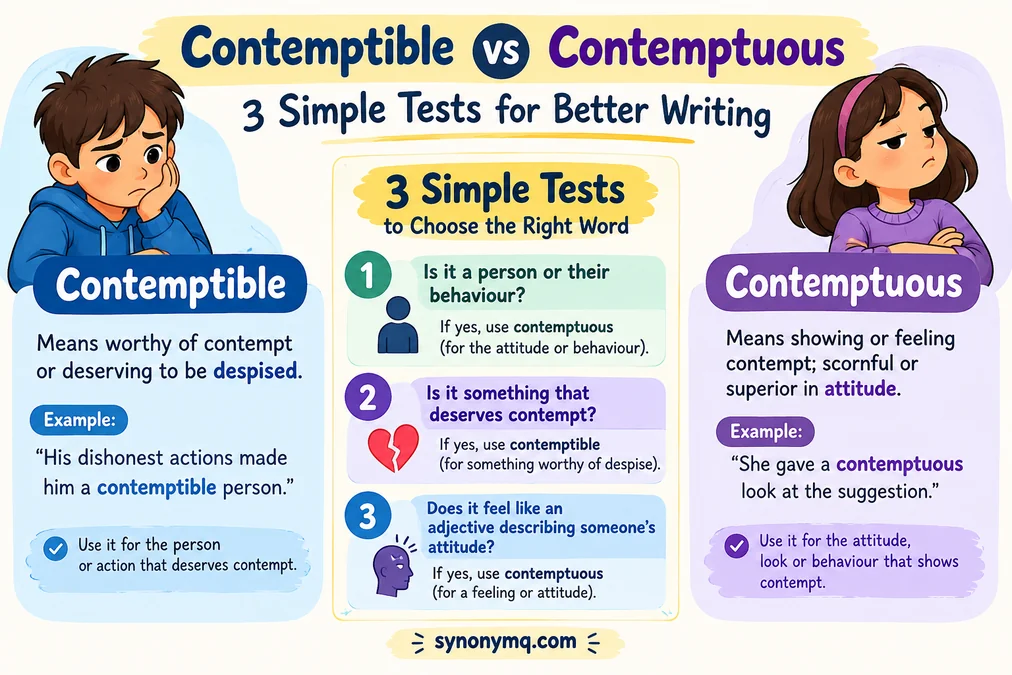

Contemptible vs contemptuous: the difference at a glance
These adjectives do different jobs. Calling conduct contemptible evaluates its worth. Calling conduct contemptuous identifies contempt within it. Changing the ending can therefore change the whole point of a sentence.
| Question | Contemptible | Contemptuous |
|---|---|---|
| What does it describe? | A target regarded as deserving contempt | A person or expression that feels or shows contempt |
| Plain explanation | Worthy of scorn | Scornful |
| Useful example | A contemptible betrayal | A contemptuous reply |
| Can it describe a person? | Yes: you judge that person | Yes: you describe that person’s attitude |
| Can it describe behavior? | Yes: the behavior merits condemnation | Yes: the behavior communicates contempt |
What does it mean if someone is contemptible?
You are saying that the person deserves contempt. It is a strong negative judgment, rather than a report that the person happens to dislike someone else. Give readers the conduct behind that judgment when the distinction matters.
Merriam-Webster’s contemptible entry defines the modern sense as deserving contempt. In “His exploitation of the volunteers was contemptible,” the writer condemns the exploitation.
That sentence tells us nothing about whether he felt contempt for the volunteers. Someone can act selfishly without sneering, speaking dismissively or looking down on the people affected.
What does contemptuous mean?
Contemptuous describes the feeling or expression of contempt. A person’s manner may suggest that another person, idea or concern is beneath consideration. The adjective points to that attitude.
Merriam-Webster’s contemptuous entry covers both feeling and showing contempt. “Her contemptuous smile ended the discussion” describes what the smile conveyed.
A smile does not need to be morally outrageous to look contemptuous. The writer may report a character’s attitude without agreeing with it. This separation is useful in fiction, analysis and descriptions of conversations.
3 simple tests for choosing the right adjective
Start with what you want to say, then check the adjective. These tests are editing aids based on the meanings above. They are especially useful when both words look grammatically possible.
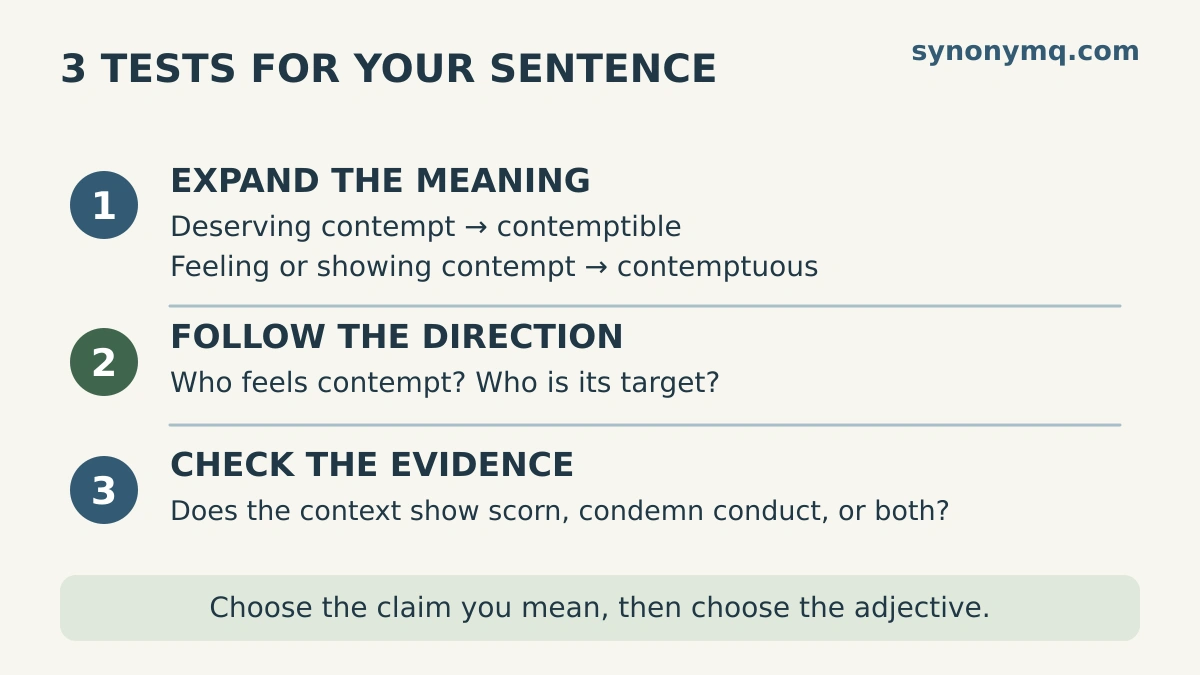
Test 1: expand the adjective into a phrase
Replace contemptible with “deserving contempt.” Replace contemptuous with “feeling or showing contempt.” The better paraphrase usually exposes the meaning you intended.
- “A contemptible deception” becomes “a deception deserving contempt.” The judgment survives.
- “A contemptuous laugh” becomes “a laugh showing contempt.” The attitude survives.
- “A contemptible laugh” judges the laugh itself as deserving scorn. That is possible, but it says something different.
Do not choose merely because one ending sounds more familiar. Ask whether your expanded phrase still makes the same claim. If it changes your point, switch the adjective or rewrite the sentence.
Test 2: identify who feels contempt and toward whom
In “Rina was contemptuous of the proposal,” Rina feels contempt and the proposal receives it. In “The proposal was contemptible,” the writer judges the proposal as deserving contempt.
The construction contemptuous of someone or something is particularly helpful. Oxford Learner’s Dictionaries records this pattern explicitly.
Write “The manager was contemptuous of the interns” when you mean that the manager looked down on them. “The manager was contemptible” instead condemns the manager, while leaving the target of any attitude unstated.
This is why “people take contemptuous; actions take contemptible” is an unreliable shortcut. Both adjectives can describe people and conduct. The direction of the judgment matters more than the noun category.
Test 3: check what the surrounding evidence supports
A sneer, a dismissive laugh or a remark about someone’s supposed inferiority may support contemptuous. A deliberately cruel betrayal may support the writer’s judgment contemptible. Identify which claim your evidence explains.
Suppose a speaker mocks a nervous colleague. “Her contemptuous reply” identifies the scorn in her response. “Her contemptible reply” condemns the response. The same reply can support both descriptions for different reasons.
If you need both claims, make them explicit: “Her reply showed contempt for the trainee, and the team considered it contemptible.” The sentence names the attitude and identifies whose judgment condemns it.
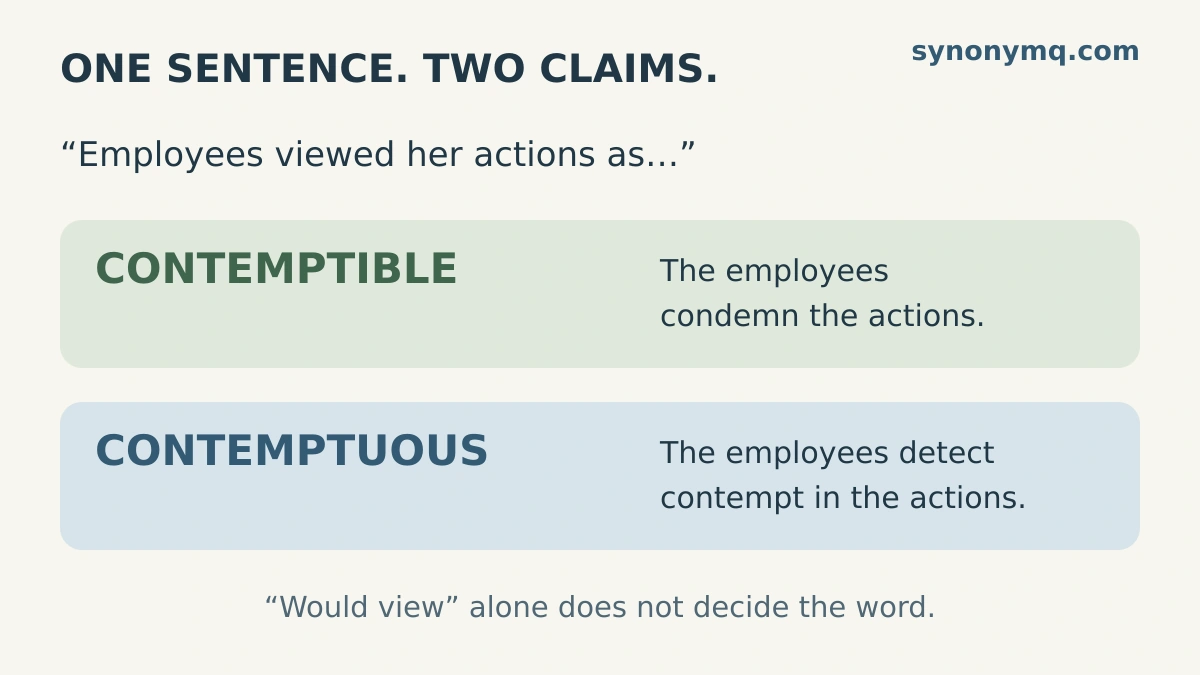
“Many employees would view her actions as contemptuous or contemptible”
Choose contemptible if the intended meaning is that the employees would condemn her actions. Choose contemptuous if the employees would interpret those actions as displaying contempt.
The words “would view” do not settle the choice. Employees can evaluate conduct or infer the attitude behind it. The rest of the sentence must tell readers which interpretation you mean.
| Intended point | Sentence | What it establishes |
|---|---|---|
| Employees condemn her conduct | Many employees would view her actions as contemptible. | They would regard those actions as deserving scorn. |
| Employees detect her contempt | Many employees would view her actions as contemptuous. | They would interpret her conduct as expressing contempt. |
| Specify the attitude’s target | Many employees would see her treatment of the interns as showing contempt for them. | The interns are the people she appears to look down on. |
For an exam question with a clear condemnation context, use contemptible. Without that context, treating the other adjective as automatically ungrammatical would be too strong. Explain the meaning shift instead.
For a workplace report, a concrete description can be more useful: “She dismissed every question without answering it.” That records observable conduct. Add an interpretation of her attitude only when the evidence supports it.
Phrase patterns and sentence examples
Look at the whole phrase when proofreading. Words such as tone and look often invite an attitude description. Words such as betrayal and deception often invite evaluation. These are useful cues, rather than absolute rules.
For a scornful tone, use contemptuous. Avoid contemptible if your only point is that the speaker expressed contempt, because it shifts the sentence toward condemning the tone itself.
| Example sentence | Reason for the adjective |
|---|---|
| Taking credit for her colleague’s work was contemptible. | The writer condemns the act of taking credit. |
| The committee rejected his contemptible attempt to exploit the dispute. | The attempt is judged deserving of contempt. |
| She considered his deliberate betrayal contemptible. | The sentence identifies whose negative judgment it is. |
| He gave the suggestion a contemptuous glance. | The glance expresses scorn toward the suggestion. |
| Her contemptuous tone made further discussion difficult. | The tone communicates a dismissive attitude. |
| They were contemptuous of anyone who asked for help. | The construction names the people they looked down on. |
| The novel’s contemptible official spoke in a contemptuous voice. | The first adjective judges the official; the second describes his manner. |
Keep attribution clear when describing disagreement. “The editor found the tactic contemptible” reports the editor’s evaluation. “The editor sounded contemptuous” describes an attitude detectable in the editor’s manner.
Neither adjective explains why a person acted as they did. If motive matters, supply it separately. Calling a remark contemptuous does not establish whether its speaker was insecure, angry or trying to impress someone.
Synonyms and alternatives that survive a sentence test
A thesaurus candidate can preserve the grammar while changing the implication. The alternatives below are classified for the stated context. A Direct Swap means that the replacement fits that sentence without restructuring.
| Replacement | Relationship | Test and label | Meaning to watch |
|---|---|---|---|
| Despicable for contemptible | Near-Synonym | “A contemptible betrayal” → “a despicable betrayal.” Direct Swap. | Preserves strong condemnation; the emphasis is not identical in every context. |
| Scornful for contemptuous | Near-Synonym | “A contemptuous reply” → “a scornful reply.” Direct Swap. | Keeps the expression of scorn in this example. |
| Disdainful for contemptuous | Near-Synonym | “A contemptuous glance” → “a disdainful glance.” Direct Swap. | Fits a look conveying that something is beneath consideration. |
| Unacceptable for contemptible | Contextual Alternative | “That conduct was contemptible” → “that conduct was unacceptable.” Direct Swap. | Reports rejection without necessarily claiming that the conduct deserves contempt. |
| Looked down on for was contemptuous of | Contextual Alternative | “She was contemptuous of the trainees” → “she looked down on the trainees.” Requires Rewrite. | The verb phrase replaces the adjective construction as a whole. |
For a vivid description of a sneer, scornful is a useful alternative. For serious condemnation, contemptible may already be the clearest word. Replacing it just to avoid repetition can soften or redirect your point.
Do not substitute contemptuous for contemptible as a style variation. The pair shares a root, but the modern distinction does not make them a primary synonym pair.
For broader choices about strong negative feeling, see hate, dislike and loathe. That comparison addresses the feeling you name; this one addresses whether your adjective judges a target or describes an attitude.
Contemptuous, disrespectful, condescending and contentious
What is the difference between contemptuous and disrespectful?
Disrespectful is broader: speech or conduct fails to show proper respect. Contemptuous identifies contempt within the attitude. Merriam-Webster’s definition of disrespectful includes discourtesy as well as contempt.
In a particular scene, interrupting someone might be careless and disrespectful. Sneering that their opinion is beneath consideration gives a clearer reason to call the conduct contemptuous. Explain that reason rather than simply intensifying the adjective.
Contemptuous vs condescending
Condescending emphasizes a patronizing sense of superiority. Contemptuous emphasizes scorn. Merriam-Webster’s condescending entry grounds the first distinction in a superior attitude toward others.
A speaker who explains an obvious point as though a capable colleague were a small child may sound condescending. A speaker who dismisses that colleague as unworthy of being heard may sound contemptuous. One exchange can show both.
Contemptuous vs contentious
Contentious concerns disagreement: an issue may provoke argument, or a person may be quarrelsome. It does not itself mean scornful. Merriam-Webster records both these contentious senses.
“The meeting was contentious” tells readers there was dispute. “The chair was contemptuous” tells readers about the chair’s attitude. A vigorous argument can remain respectful, so do not infer contempt merely from disagreement.
These nearby words illustrate different boundaries: insufficient respect, patronizing superiority, scorn and argument. Match the specific behavior you observed before choosing the strongest-sounding adjective.
Which is stronger, disdain or contempt?
There is no fixed strength ranking that works in every sentence. Merriam-Webster defines disdain through contempt for something regarded as unworthy or inferior.
Its contempt entry also explains their substantial overlap. Treating one as always stronger would turn overlapping meanings into an unsupported scale.
Compare “a faint look of contempt” with “utter disdain.” The modifiers change the expressed intensity. The event, tone and surrounding details matter more than choosing between these two nouns in isolation.
For this article’s adjective choice, you do not need that ranking. Contemptible concerns whether a target merits contempt; contemptuous concerns feeling or expressing it, whatever its intensity in context.
Word forms and opposites: keep the two families separate
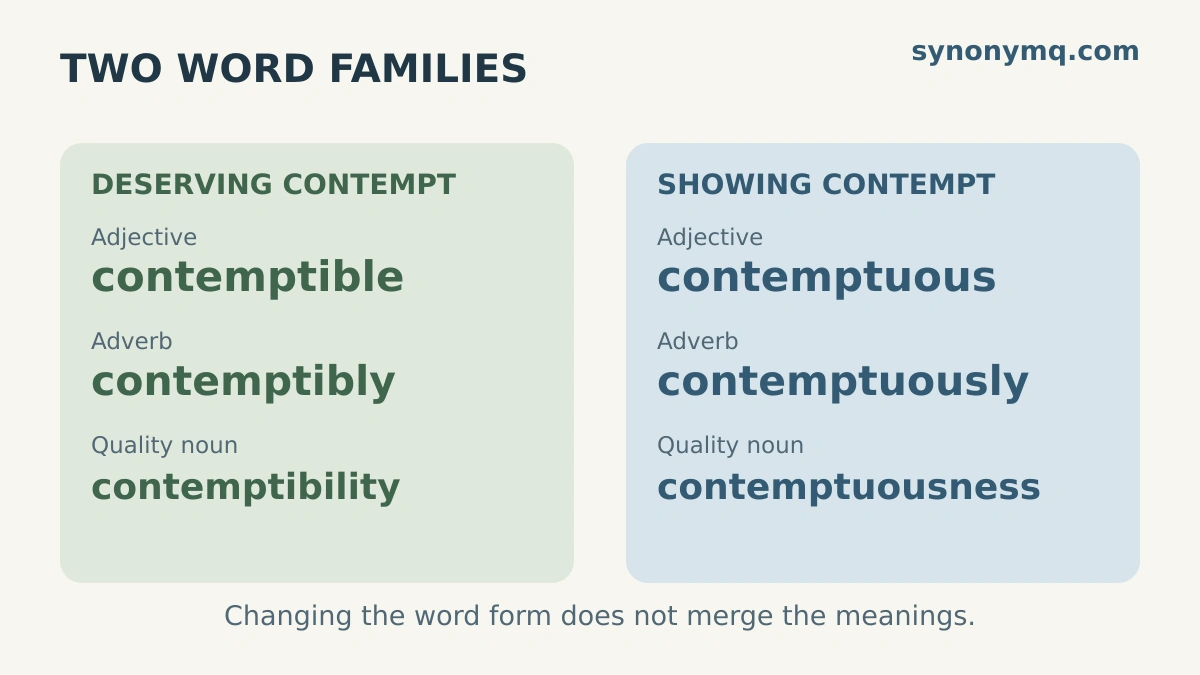
Both headwords are adjectives. Their adverbs preserve the distinction: contemptibly evaluates the manner as deserving contempt; contemptuously describes a manner that expresses contempt.
Compare “He behaved contemptibly toward the volunteers” with “He spoke contemptuously about the volunteers.” The first condemns his behavior. The second reports contempt in the way he spoke.
| Job | Deserving contempt | Feeling or showing contempt |
|---|---|---|
| Adjective | contemptible | contemptuous |
| Adverb | contemptibly | contemptuously |
| Quality noun | contemptibility; contemptibleness | contemptuousness |
Collins lists the contemptible forms; its contemptuous entry lists the other family. In ordinary explanation, a phrase such as “his scornful attitude” may be easier to read than a long abstract noun.
What is the opposite of contemptible?
Admirable is a useful opposite when you mean deserving a positive judgment. For contemptuous, respectful reverses the attitude. Collins lists these antonyms under the respective entries.
“Her admirable conduct” praises what she did. “Her respectful manner” describes how she treated others. An admirable person can still respond contemptuously in one exchange, which is why the two opposites belong to different comparisons.
Are the two headwords ever interchangeable?
Merriam-Webster records a contemptuous sense of contemptible as obsolete. That can explain an unexpected use in an older text. For a current article, email or essay, use the modern distinction unless you deliberately quote historical wording.
Oxford labels contemptible formal. In a routine workplace message, describe the conduct directly when a strong personal judgment would distract from the problem you need resolved.
Contemptible meaning in Urdu: compare it with contemptuous
Rekhta Dictionary’s contemptible entry includes لائق حقارت. Its contemptuous entry includes حقارت آمیز. These two glosses help preserve the English distinction.
- Contemptible — لائق حقارت: use this when judging someone or something as deserving contempt.
- Contemptuous — حقارت آمیز: use this when describing an attitude or manner that expresses contempt.
For example, “a contemptible betrayal” condemns the betrayal, while “a contemptuous reply” describes scorn in the response. Keep that difference when translating the whole sentence; a shared association with contempt does not make the adjectives interchangeable.
Practice: choose the claim your sentence needs
Choose an adjective for each context before reading the explanations. Focus on what the sentence asserts, rather than what you think of the person involved.
- The reviewer gave the amateur writer a ______ smile, as though the work did not deserve attention.
- The neighbors called the deliberate mistreatment of the animals ______.
- Several colleagues were ______ of the plan and dismissed it as beneath serious discussion.
- The journalist described the official’s deception as ______, without suggesting that he sneered at anyone.
Answers: 1 contemptuous; 2 contemptible; 3 contemptuous; 4 contemptible.
The smile in the first example expresses contempt. The neighbors in the second evaluate conduct. The third uses the attitude pattern “contemptuous of.” The fourth condemns deception without claiming that it displays scorn.
During your final edit, read the sentence with the full paraphrase restored. If you mean “deserving contempt,” keep contemptible. If you mean “feeling or showing contempt,” keep contemptuous and name its target when that helps.
For more comparisons that require choosing by meaning, visit SynonymQ’s commonly confused words guide.

Naveed Akhtar writes every guide on SynonymQ. He is an SEO content writer with ten years of article-writing experience, working on the question a thesaurus never answers: which of these words belongs in this sentence, for this reader. Every page cites the dictionary entries it draws on and the date they were read.