
Imply vs Infer: 4 Simple Sentence Fixes to Avoid Mix-Ups
Imply vs infer is a difference in direction: imply means suggest or indicate; infer means draw a conclusion from evidence. Use imply for what a message or clue suggests, and infer for what someone concludes from it.
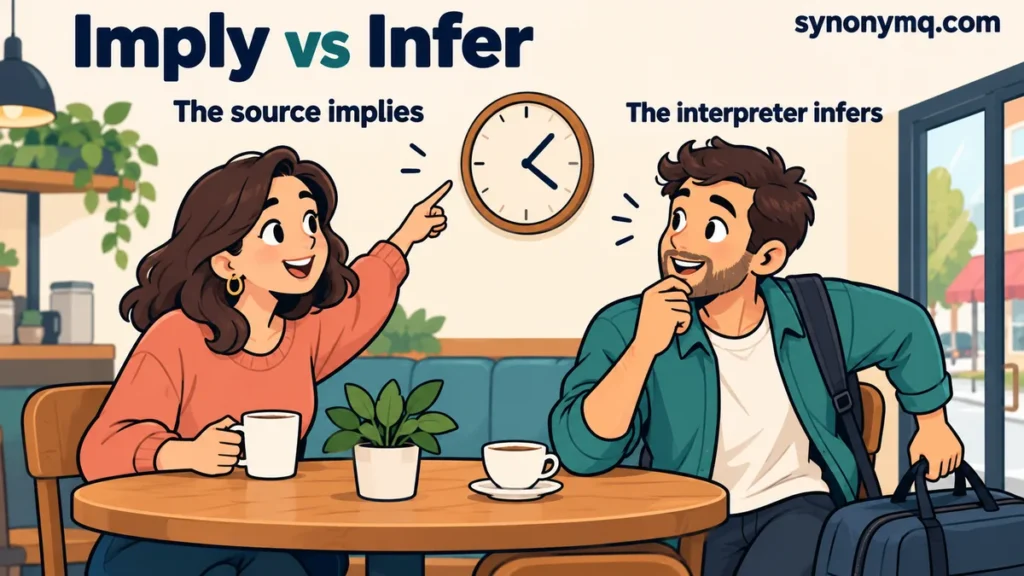
One Conversation, Two Different Jobs
Imagine Maya saying, “The last bus leaves in ten minutes,” while everyone is still chatting. She may be suggesting that the group should leave. Noah hears her and decides that they need to hurry.
| Focus | Example | What the verb describes |
|---|---|---|
| The suggestion | Maya implied that they should leave. | What her words conveyed without a direct request. |
| The interpretation | Noah inferred that they should leave. | The conclusion he reached from her words. |
The people are connected by one conversation, but the verbs describe different jobs. Switching the verb can change whether your sentence reports a suggestion or an interpretation.
A useful memory aid is the source implies; the interpreter infers. “The speaker implies; the listener infers” works for this example, but the broader version also covers books, gestures and physical clues.
These are not ordinary opposites such as hot and cold. An implication and an inference can concern the same idea. The difference is where the sentence puts its attention.
Imply vs Infer with Messages, Clues and Evidence
A person does not have to speak for a clue to suggest something. An unsigned invitation may imply that the host expects you to recognise the sender. A reader can infer who sent it from the handwriting.
Documents can also be subjects of imply: “The notice implies that booking is required.” For the usual reasoning sense of infer, name the interpreter: “Visitors may infer from the notice that booking is required.”
Merriam-Webster’s entry for imply includes indication through a consequence or association, as well as indirect expression. A human intention is therefore not required in every use.
Now consider a wet umbrella beside the door. You might infer that someone has just come in from the rain. The umbrella has no intention, and nobody needs to have hinted anything to you.
An inference is a conclusion drawn from information, not a guarantee that the conclusion is true. The umbrella might have been washed. Naming the clue helps readers judge how much your conclusion deserves their confidence.
Similarly, a brief reply may seem to imply annoyance, although the sender was simply busy. Keep the message, your interpretation and the sender’s actual intention separate when the distinction matters.
For ways to express a view with a different emphasis, compare SynonymQ’s guide to believe, think and feel. Those verbs should not automatically replace a statement about reasoning from evidence.

Grammar Patterns That Keep the Roles Clear
Both verbs can introduce a that-clause. The words after the verb may look identical, so identify the subject and the job it is doing before choosing the verb.
| Pattern | Original example | What to notice |
|---|---|---|
| imply that + clause | Her reply implied that the date was flexible. | The reply suggests an unstated meaning. |
| imply + noun | The added chairs implied a larger audience. | The object names what the clue suggests. |
| infer that + clause | I inferred that the date was flexible. | The subject reaches the conclusion. |
| infer something from something | We inferred the route from the footprints. | From introduces the evidence. |
| infer from something that + clause | We inferred from the footprints that someone had crossed the garden. | The evidence comes before the conclusion. |
| passive forms | A delay was implied by the message. A delay was inferred from the message. | The first describes the suggestion; the second describes a reading of it. |
Oxford Learner’s Dictionaries records the infer something from something and infer that patterns. Its imply entry records both noun objects and clauses.
Passive wording can leave the interpreter unnamed. “It was inferred that the door was unlocked” may be grammatical, but “The caretaker inferred that the door was unlocked” is clearer when readers need to know who made that judgment.
When Usage Guides Disagree
You may encounter infer used to mean imply, as in a question accusing someone of making a suggestion. Dictionaries do not all treat that overlap in the same way.
Oxford Learner’s Dictionaries records that meaning but labels it non-standard. Merriam-Webster’s usage guide recognises the overlap and treats maintaining the distinction as a preference.
For clear edited writing, use imply for the suggestion and infer for the conclusion. This recommendation avoids ambiguity without claiming that every recorded use of the other meaning is impossible.
Follow a teacher’s or publication’s stated convention when one applies. A dictionary recording a use and an editor recommending another are answering different questions.
4 Simple Sentence Fixes
These rewrites follow the usual distinction. Each fixes a different problem: the interpreter’s verb, the clue’s verb, an unsupported claim about intention, or a replacement verb’s grammar.
Fix 1: Use infer when the reader reaches the conclusion
Before: “I implied from Nina’s note that the meeting was cancelled.”
After: “I inferred from Nina’s note that the meeting was cancelled.”
You are reading the note and reaching a conclusion. Inferred makes that role clear; implied would ordinarily suggest that you were conveying the idea to somebody else.
Fix 2: Use imply when the clue suggests the meaning
Before: “The added chairs inferred that more guests were expected.”
After: “The added chairs implied that more guests were expected.”
The chairs are the clue, not the thinker. You could also rewrite the sentence as “We inferred from the added chairs that more guests were expected.” That version puts the reasoning in the foreground.
Fix 3: Attribute an interpretation instead of claiming intention
Before: “Nina’s silence meant she agreed.”
After: “I inferred from Nina’s silence that she might agree.”
The revision identifies your interpretation and allows uncertainty. It does not establish what Nina intended. If you need her agreement, ask her instead of treating silence as proof.
Fix 4: Adjust the grammar when changing to hint
Before: “His reply implied a delay.”
After: “His reply hinted at a delay.”
This is a Swap With Adjustment: the useful hint at + noun pattern needs at. Hint also presents the suggestion as a less direct clue; the rewrite may soften the impression created by implied.
Oxford’s hint entry records hint at something and hint that. Choose the pattern your sentence actually uses rather than carrying over the original grammar.
Insinuate Adds a Judgment About the Suggestion
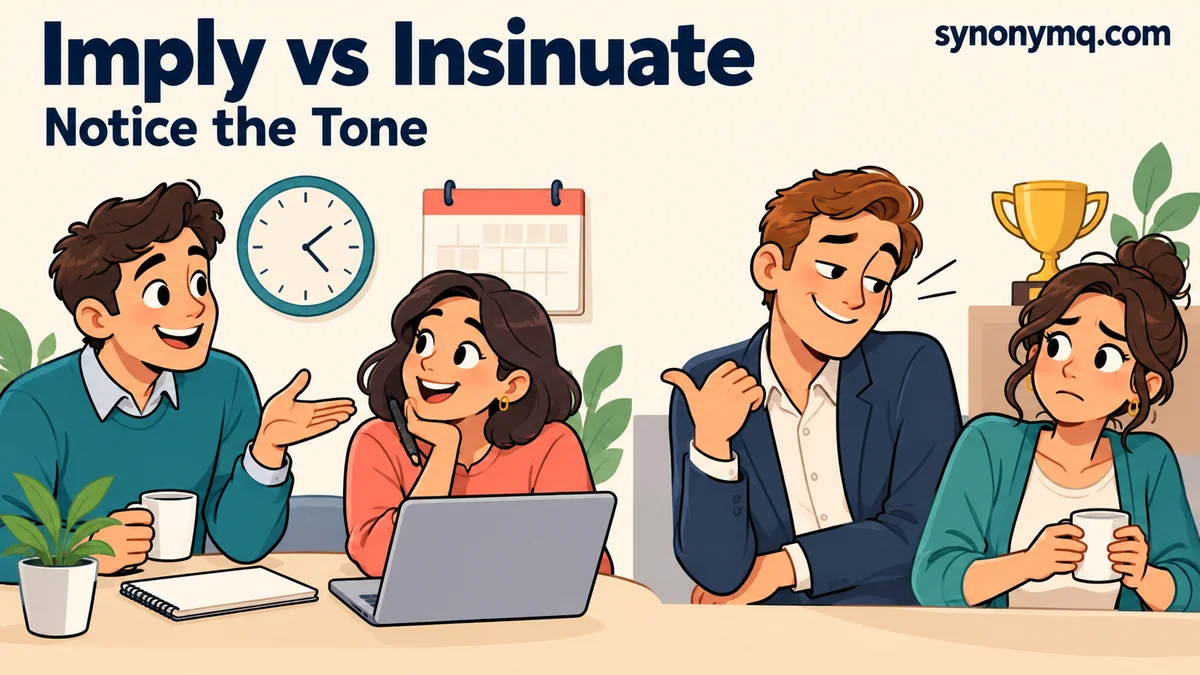
Imply can describe a neutral suggestion. Insinuate often portrays the suggestion as sly, underhanded or unpleasant. It can therefore change the narrator’s attitude, even when the suggested idea stays the same.
Neutral setting: “An eight o’clock meeting is quite early,” Rosa said. Her remark implied that a later start might suit her better.
Critical setting: “Interesting how your cousin keeps winning,” Ben said. He insinuated that the contest was unfair.
Merriam-Webster’s entry for insinuate describes artful or indirect suggestion; its synonym discussion connects the word with an unpleasant idea conveyed in an underhanded manner.
Use insinuate when that manner or negative tone belongs in your account. Keep imply when you want to report the suggestion without adding the same criticism of how it was made.
An insinuation is not proof that an accusation is true. The verb describes the communication, not the truth of what was suggested.
Deduce and Conclude Belong with Reasoning
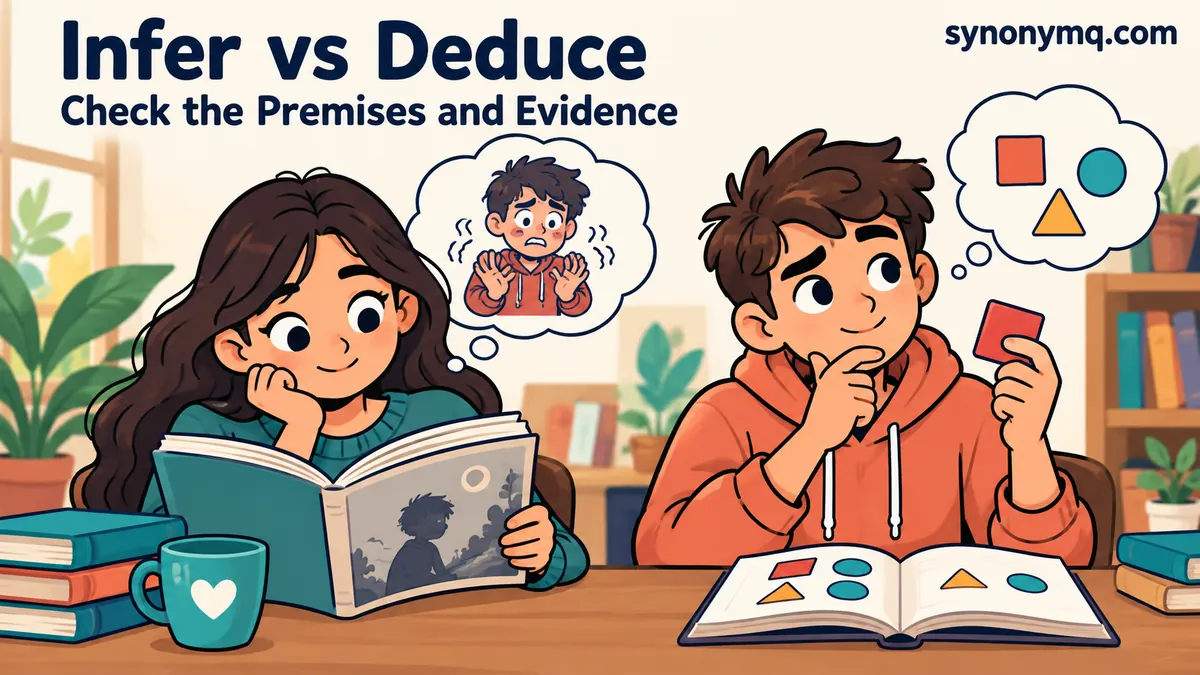
Infer, deduce and conclude can all describe reaching a judgment. They belong on the reasoning side of the usual comparison, rather than automatically replacing imply.
Merriam-Webster defines deduce through reasoning and notes its use for drawing a particular conclusion from a general principle. In ordinary writing, it can overlap with infer.
The puzzle says every red tile is numbered. This tile is red, so Ava deduced that it is numbered.
In that invented puzzle, Ava applies a stated rule. In the wet-umbrella example, she interprets a clue with more than one possible explanation. Both are instances of reasoning; the supporting information differs.
Deduce does not automatically make a conclusion certain, and infer does not automatically make it uncertain. Check the premises and evidence instead of using the verb as a confidence rating.
Conclude often foregrounds the judgment reached after reasoning. “I concluded from the timetable that the last train had left” can replace “I inferred from the timetable that the last train had left.”
That swap works for this reasoning sense. It fails in “The chair concluded the meeting,” where concluded means brought to an end. Test the whole sentence, not just the word’s thesaurus neighbours.
Synonyms and Alternatives: Test the Whole Sentence
No option below is a blanket replacement across every meaning. Direct Swap means the grammar works in the example given; it does not mean that the emphasis, tone or other uses are identical.
| Replace | Alternative and relationship | Substitution | Example and limit |
|---|---|---|---|
| imply | suggest Near-Synonym | Direct Swap | “Her reply implied/suggested that Friday would be better.” Suggest is broader: a direct proposal can also be a suggestion. |
| imply | indicate Near-Synonym | Direct Swap | “The extra chairs implied/indicated that a larger audience was expected.” Indicate can also describe a more explicit sign or signal. |
| imply | hint Near-Synonym | Swap With Adjustment | “Her reply implied a delay” becomes “Her reply hinted at a delay.” Add at for this noun pattern; the suggestion may sound subtler. |
| imply | insinuate Near-Synonym | Direct Swap | “Ben implied/insinuated that the contest was unfair.” Insinuate adds an account of a sly or unpleasant suggestion. |
| infer | deduce Near-Synonym | Direct Swap | “Ava inferred/deduced from the puzzle rule that the tile was numbered.” Deduce can highlight reasoning from a stated principle. |
| infer | conclude Near-Synonym | Direct Swap | “I inferred/concluded from the timetable that the train had left.” Use this swap for a reasoning result, not for ending a meeting. |
| infer | draw a conclusion Contextual Alternative | Requires Rewrite | “I inferred that the date was flexible” becomes “I drew the conclusion that the date was flexible.” This paraphrase is longer; keep infer when it already reads clearly. |
The entries for suggest and indicate support their broader uses. The recommendations here apply those definitions to the specific original sentences.
In the usual distinction, imply and infer are related words rather than drop-in synonyms for each other. Changing from imply to infer usually requires changing the subject or rewriting the sentence.
Implicate Connects Someone or Something to a Matter
In a common use, implicate connects a person with a problem or wrongdoing. Imply can suggest an idea about that involvement, but it does not automatically take the same object pattern.
“The comment implied that Pat was involved.”
“The evidence implicated Pat in the missing-file case.”
The first sentence reports a suggested proposition. The second names Pat as the person connected with the matter. A direct word swap would disrupt the structure; choose the verb for the claim you actually want to make.
Merriam-Webster also records involvement in a process and a consequence sense overlapping with imply. Implicate is therefore not restricted to accusations, and saying the words never overlap would overstate the distinction.
For an everyday indirect suggestion, keep imply. For someone’s involvement in a matter, consider implicate someone in something. Using implicate does not establish that a person is guilty.
Implying, Inferring, Implied and Inferred
The spelling changes are worth learning alongside the meanings. Mixing up the forms can distract readers even when you have chosen the right verb.
- Imply: implies, implied, implying. Keep the y in implying; use implied for the past form.
- Infer: infers, inferred, inferring. Inferred and inferring have a double r.
- Implication: something implied, or the act of implying, in the communication sense used here.
- Inference: the conclusion or reasoning involved in inferring.
“The implication of her message was that Friday suited her.”
“My inference from her message was that Friday suited her.”
The first centres the message’s suggested meaning; the second centres the reader’s interpretation. Implication and inference also have other uses, so these examples do not exhaust their meanings.
Imply or Infer? A Short Worksheet
Use the usual distinction taught on this page. Choose imply or infer, then supply the form that fits the sentence. Decide who or what provides the clue and who draws the conclusion before looking at the answers.
- The hushed conversation ______ that the news was private.
- Yesterday, from the locked gate, we ______ that the garden was closed.
- Are you trying to ______ that I forgot the appointment?
- Readers can ______ the narrator’s fear from her trembling hands.
- His brief reply seemed to ______ that he wanted to end the discussion.
- Last night, I ______ from his brief reply that he might be busy.
Answer key
- Implied. The conversation provides the suggestion. Implies also works if you are describing the scene in the present.
- Inferred. We drew a conclusion from the gate; yesterday places the event in the past.
- Imply. The question concerns a suggestion the other person may be making.
- Infer. The readers interpret the description of the narrator’s hands.
- Imply. The reply supplies an indirect suggestion; to takes the base form here.
- Inferred. I reached the interpretation, and last night calls for a past form.
When checking your own sentence, replace the verb mentally with suggest or draw a conclusion. If the resulting idea changes, check the subject and evidence again rather than treating the two verbs as interchangeable.
For other pairs where a small word change affects the meaning, see SynonymQ’s commonly confused words guide.
How This Page Was Checked
Meanings, usage notes and verb forms were checked against Merriam-Webster and Oxford Learner’s Dictionaries. The examples and worksheet are original; they are not quotations from a corpus.
The advice separates recorded usage from a recommendation for clear writing. Where dictionaries differ, the disagreement is stated rather than turned into an absolute rule.
Frequently Asked Questions
Why do people confuse infer and imply?
Both verbs can describe the same exchange, but from different viewpoints. Imply concerns what the message suggests; infer concerns what someone concludes. Their recorded meanings also overlap, which helps explain why usage advice varies.
What is the difference between inferring and referring?
Inferring means reaching a conclusion from information. Referring usually means mentioning something or directing attention to it. “I inferred she was upset” reports an interpretation; “I was referring to her email” identifies what you meant.
What is the difference between imply and insinuate?
Both can describe indirect communication. Insinuate usually adds a sly or unpleasant suggestion, often an accusation. Imply can be neutral. Use insinuate when the suggestion’s manner or negative tone matters.
What is an example of imply?
“When Leo said, ‘The last bus leaves in ten minutes,’ he implied that we should leave soon.” Leo suggests the next action without directly requesting it. The listener may infer that waiting would be a bad idea.

Naveed Akhtar writes every guide on SynonymQ. He is an SEO content writer with ten years of article-writing experience, working on the question a thesaurus never answers: which of these words belongs in this sentence, for this reader. Every page cites the dictionary entries it draws on and the date they were read.