
Anger vs Rage vs Fury: 3 Simple Checks for Better Word Choice
Anger vs rage vs fury: anger means displeasure; rage and fury mean intense anger. Neither is always stronger than the other. Choose by intensity, sentence pattern and context: words with similar meanings do not fit every phrase equally well.
Anger vs Rage vs Fury: Meaning and Overlap
Anger names the feeling without fixing its exact strength. You can write about a flicker of anger or overwhelming anger. The extra words tell the reader how much the person feels.
Merriam-Webster’s usage note treats anger as the general term and groups rage and fury together as words suggesting emotion strong enough to overwhelm self-control.
| Word | Main meaning | What to check |
|---|---|---|
| Anger | Displeasure, often directed at someone or something. | Does the sentence need to name the feeling without specifying its intensity? |
| Rage | Intense anger, especially anger that is difficult to control. | Does the situation support that much emotional force? |
| Fury | Extreme anger; also fierce force or activity in other contexts. | Is the sentence describing a feeling, a storm or energetic action? |
Oxford defines rage through violent anger that is hard to control. Its entry for fury also includes extreme anger and violent behaviour.
These definitions overlap. They do not support a rule that fury is always controlled while rage is always uncontrolled. Nor do they establish a permanent order in which fury must come before or after rage.
For example, “Leena felt rage when she discovered the forged signature” and “Leena felt fury when she discovered the forged signature” both convey intense anger. The surrounding story must supply any finer distinction.

Three Checks Before You Choose the Word
1. Match the intensity you actually mean
Imagine a neighbour repeatedly blocking your driveway. “I felt anger” leaves the strength open. “I felt rage” or “I felt fury” makes a much stronger claim about your reaction.
For a complaint that needs a measured tone, use anger or describe the specific problem. Avoid rage when it would exaggerate a minor inconvenience or distract from the action you want taken.
This is writing advice, not a ban on strong language. If a character feels overwhelming anger, a quieter word can understate the scene. Choose the intensity first; then make the details earn it.
2. Check the grammatical job
All three words can name an emotion as nouns. Anger and rage also have verb uses, but their ordinary patterns differ. “The accusation angered her” names a cause; “She raged about the accusation” describes her response.
Use enraged when a cause fills someone with rage: “The false accusation enraged her.” Do not mechanically replace angered her with raged her.
Merriam-Webster lists rage as an intransitive verb, while its entry for enrage gives the pattern that takes a direct object.
3. Read the whole phrase
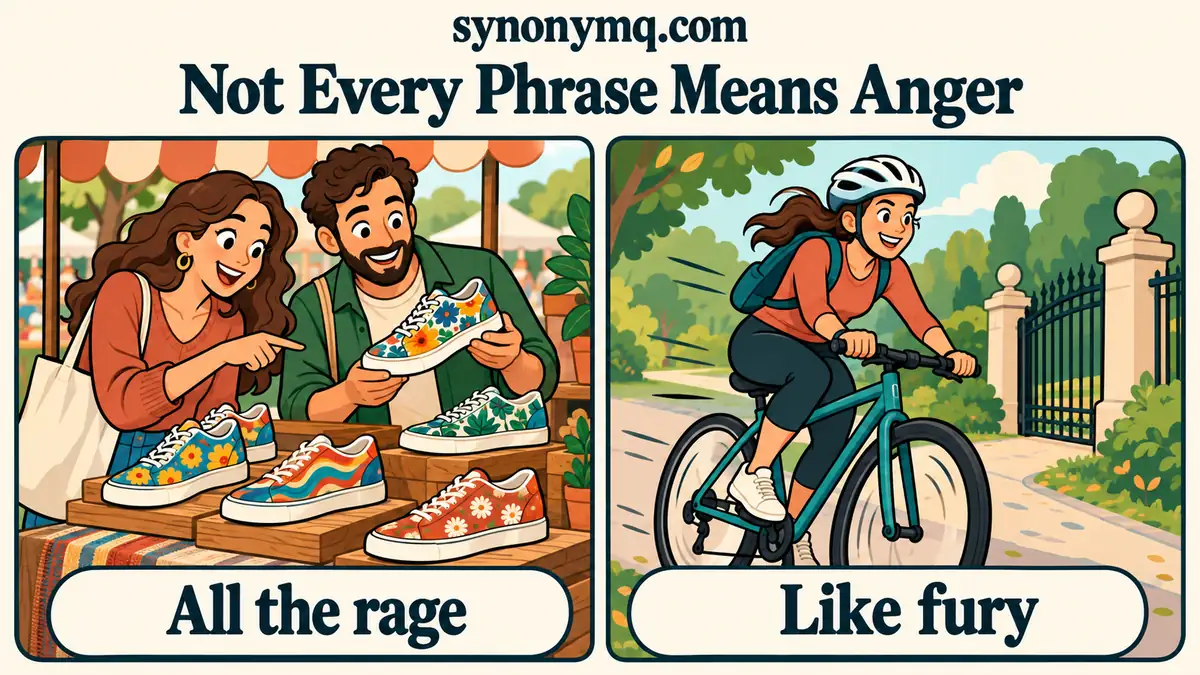
“The queue made him angry” concerns a feeling. “Those trainers are all the rage” concerns popularity. Replacing rage with fury in the second sentence would destroy the familiar expression.
Ask what the complete phrase is doing before reaching for a synonym. A good replacement preserves the intended meaning and fits the surrounding grammar; sharing a dictionary synonym list is only a starting point.
Sentence Patterns: In Anger, In a Rage, With Fury
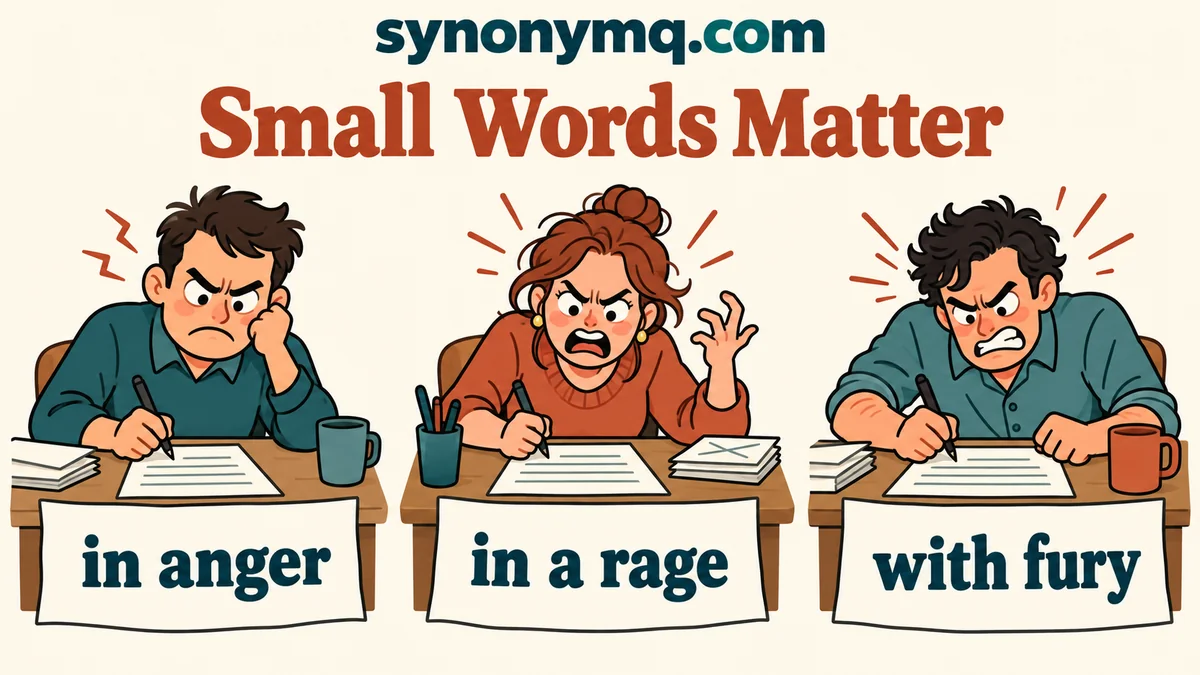
The small words around these nouns matter. Oxford records in anger, in a rage and both in fury and in a fury. They are useful patterns, not an exhaustive grammar rule.
| Original | Replacement | Result |
|---|---|---|
| She answered in anger. | She answered in a rage. | Swap With Adjustment: add a; the feeling becomes more intense. |
| He was shaking with rage. | He was shaking with fury. | Direct Swap: both fit this frame and convey intense anger. |
| She flew into a rage. | She flew into a fury. | Direct Swap: both describe entering a state of intense anger. |
| The accusation angered her. | She raged about the accusation. | Requires Rewrite: the focus shifts from the cause to her response. |
These are near-synonym substitutions in the stated contexts, not promises that every use will transfer. “He spoke with anger” remains natural even when “He spoke with fury” would overstate what happened.
Do not generalise the article pattern too far. “A sudden anger” is possible, and Oxford also records singular uses of fury. For ordinary sentence editing, start with the complete pattern you need.
Wrath and Other Alternatives Add Different Details
Wrath can add a suggestion of punishment or revenge. Merriam-Webster’s definition supports that distinction. It should not automatically become the final rung on an anger scale.
“The councillor feared the residents’ wrath” suggests a formidable angry response. “The councillor acknowledged the residents’ anger” simply identifies the feeling. The first sentence does more than turn up the volume.
| Alternative | Relationship | Substitution test | Recommendation |
|---|---|---|---|
| Rage | Near-Synonym | “They expressed anger” → “They expressed rage.” Direct Swap. | Use for an intense reaction. Avoid it if the strength is unsupported. |
| Fury | Near-Synonym | “They expressed anger” → “They expressed fury.” Direct Swap. | Use when extreme anger is intended; context must establish any contrast with rage. |
| Wrath | Near-Synonym | “He feared her anger” → “He feared her wrath.” Direct Swap. | Fits a threatening or punitive response; can sound dramatic in a routine complaint. |
| Indignation | Near-Synonym | “She expressed anger at the unfair rule” → “She expressed indignation at the unfair rule.” Direct Swap. | Emphasises perceived injustice, rather than intensity alone. |
| Resentment | Near-Synonym | “His anger lingered after the slight” → “His resentment lingered after the slight.” Direct Swap. | Fits a grievance that endures; avoid it for a passing reaction with no such implication. |
| Annoyance | Near-Synonym | “She showed anger at the interruption” → “She showed annoyance at the interruption.” Direct Swap. | A softer choice for irritation; it may understate serious anger. |
Merriam-Webster connects indignation with perceived unfairness, resentment with a continuing grievance, and annoyance with irritation.
The recommendations above are editorial judgments about these examples. A direct swap preserves the sentence structure; it can still change the meaning, strength or tone.
Hatred is another distinction worth keeping separate. Being angry with someone does not by itself say you hate them. If you mean dislike or aversion, see hate, dislike and loathe.
Furious and Enraged Describe the Person
Furious and enraged can both describe someone who is very angry. “The buyer was furious about the hidden charge” and “The buyer was enraged by the hidden charge” both fit.
Here, furious and enraged are near-synonyms. “The buyer looked furious” → “The buyer looked enraged” is a Direct Swap. “The charge enraged the buyer” → “The charge made the buyer furious” Requires Rewrite.
Oxford’s furious entry also includes great energy or speed. That wider meaning explains “a furious pace”; replacing it with “an enraged pace” would make an unnatural claim about the pace itself.
In everyday drafting, “I’m angry about the change” may already be precise enough. Use a stronger adjective when you intend the stronger claim, not because a thesaurus makes it look more impressive.
All the Rage, Like Fury and the Fury of a Storm
Some phrases leave the emotion sense behind. Read them as complete expressions before deciding whether an anger synonym belongs there.
- All the rage: very popular or fashionable. “Hand-painted trainers were all the rage at the market.” Keep the expression or rewrite it as “very popular.”
- Like fury: with great effort, force or speed. “We pedalled like fury to reach the gate before it closed.” The riders need not be angry.
- The fury of a storm: the storm’s fierce force. “The harbour wall took the full fury of the storm.” This describes the weather’s power.
Oxford records the first two idioms in its rage and fury entries. Merriam-Webster also gives fury a force or violence sense. Keep that wider meaning in view when reading descriptive prose.
“Fury of rage” is not a useful default replacement for either word in plain prose. If you mean extreme anger, rage or fury usually does the job alone; explain any special poetic meaning through context.
Before-and-After Edits That Preserve the Meaning
Overstated: “The missing attachment filled me with fury.”
Measured: “I was annoyed that the attachment was missing.”
Use the second version when the problem is an inconvenience. Keep fury if the writer really intends extreme anger; the edit is a change in meaning, not an automatic improvement.
Broken substitution: “The false accusation raged the volunteer.”
Repaired: “The false accusation enraged the volunteer.”
The repair gives the sentence a verb that takes the volunteer as its object. “The volunteer raged about the accusation” also works, but now you are describing the volunteer’s response.
Lost idiom: “Those hand-painted trainers are all the fury.”
Repaired: “Those hand-painted trainers are all the rage.”
The intended claim is popularity. “Those hand-painted trainers are very popular” is an equally clear rewrite when the idiom would distract your reader.
How This Page Was Checked
Definitions and sentence patterns were checked against the linked Merriam-Webster and Oxford entries. The examples are original illustrations; substitution labels apply to those sentences, not to every possible use.
The American Psychological Association describes anger across a range of intensity. This page uses that distinction for vocabulary guidance and does not turn emotion words into diagnostic stages.
Frequently Asked Questions
What is the difference between anger, rage, and fury?
Anger is the broad term; rage and fury name intense anger. Neither is always stronger than the other. The sentence and situation determine which fits.
What is Gen Z slang for anger?
Salty is an informal option for feeling resentful or bitter. It describes a person’s mood, not the noun anger. The dictionary does not restrict this use to Gen Z.
What are the 5 levels of rage?
The sources used here do not define five fixed levels of rage. Five-step charts depend on their authors’ models; they are not a rule for ranking anger, rage and fury.
What are the 7 different types of anger?
A seven-type list depends on the framework being used. Anger, rage and fury are overlapping vocabulary terms, not a seven-part classification. Check a list’s named source before treating its categories as universal.

Naveed Akhtar writes every guide on SynonymQ. He is an SEO content writer with ten years of article-writing experience, working on the question a thesaurus never answers: which of these words belongs in this sentence, for this reader. Every page cites the dictionary entries it draws on and the date they were read.