
Accept vs Except: Fix 5 Common Writing Mistakes
Use accept when you mean to take willingly, agree to, or recognize something as true. Use except when you mean to leave something out. The accept vs except distinction is about meaning: “We accept books” takes them in; “all books except textbooks” leaves textbooks out.
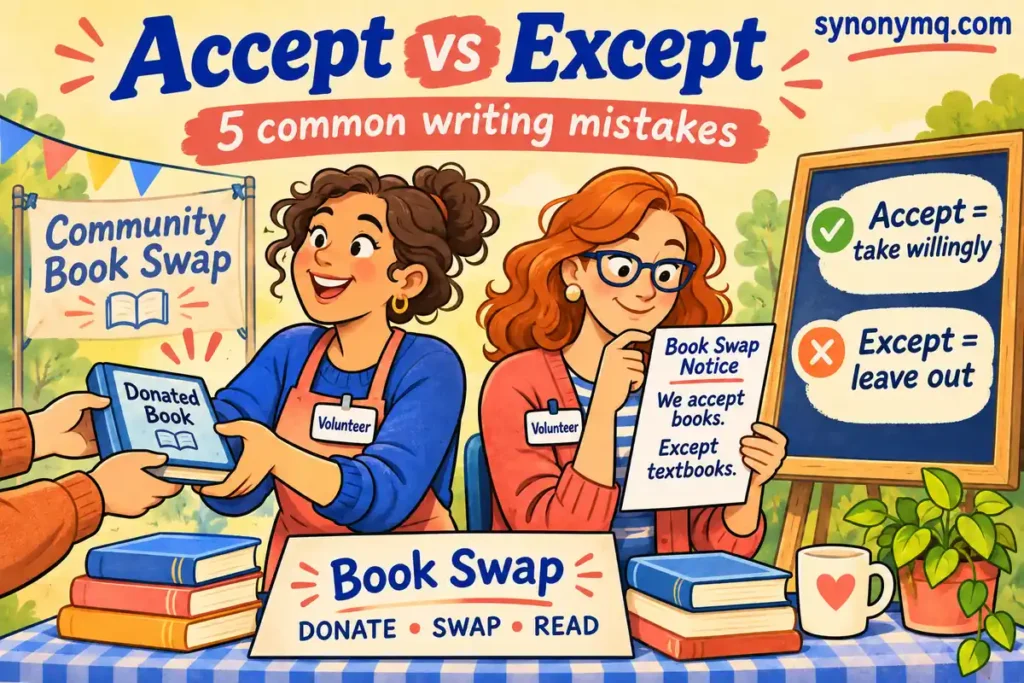
One Book-Swap Notice Can Use Both Words
Imagine a neighbourhood book swap with this notice: “We accept donated books. All genres are welcome except horror.” The first sentence describes what the organisers will take. The second names an exclusion.
You could combine them: “We accept books from every genre except horror.” Accept and except belong in the same sentence because they do different jobs. Choosing one does not make the other unnecessary.

For an offer, invitation or donation, choose accept when someone agrees to receive it. Choose except to identify the person or thing outside a statement’s scope.
The notice is a fictional example, not a suggested rule for book donations. Its purpose is to show how a spelling choice can change what a reader understands.
Cambridge’s accept entry also covers acknowledging something as true or satisfactory. Accepting a difficult fact does not mean liking it, so “accept is positive, except is negative” is an unreliable shortcut.
Accept vs Except: 5 Corrections That Preserve Your Meaning
These corrections assume the intention stated in the last column. A word is not wrong simply because the other spelling is more familiar; it is wrong when it fails to express what you mean.
| Draft | Correction | Intended meaning |
|---|---|---|
| Please except our invitation. | Please accept our invitation. | Say yes to the invitation. |
| Everyone accept Noor brought a book. | Everyone except Noor brought a book. | Noor is the person left out. |
| The club accepts for textbooks. | The club accepts books except for textbooks. | It takes books but excludes textbooks. The original was missing the thing accepted. |
| The donated novels were excepted into the collection. | The donated novels were accepted into the collection. | They were admitted to the collection. |
| All entries were accepted from the review. | All entries were excepted from the review. | They were excluded from the review. “Excluded” is often clearer here. |
The third example needs more than changing one letter. Accept normally needs an object when you name what is taken: “accept books,” “accept an invitation,” or “accept responsibility.”
It can also stand without an expressed object when the context supplies it: “They offered me a place, and I accepted.” Do not turn a helpful pattern into a rule that every use must have a noun immediately after it.
For the fourth and fifth examples, check the preposition too. Being accepted into a collection and excepted from a review describe different relationships.
Accepted and Excepted Are Both Real Verb Forms
Accepted is the past tense and past participle of accept. Excepted belongs to except used as a verb meaning to exclude. It is not automatically a misspelling.
Merriam-Webster explains this verb use as well as except’s more familiar preposition use. That is why “accept is a verb, except is not” fails as a complete rule.
Compare “The organiser accepted the late entries” with “The organiser excepted the late entries from judging.” One admits the entries; the other removes them from a specified process.

In a general email, “excluded from judging” may be easier to understand than “excepted from judging.” Keep excepted when it is an intentional term in the document, but do not choose it merely to sound formal.
The same distinction applies to accepts and excepts: “The club accepts donations” versus “The policy excepts textbooks from the donation scheme.” The second sentence could more plainly say “excludes textbooks.”
| Original | Alternative | Relationship and fit |
|---|---|---|
| I accept the terms. | I agree to the terms. | Near-Synonym in this consent sense; Swap With Adjustment: add “to.” “Accept” remains the natural original choice. |
| Everyone except Noor attended. | Everyone but Noor attended. | Contextual Alternative; Direct Swap in this exclusion pattern. |
| The entries were excepted from judging. | The entries were excluded from judging. | Near-Synonym in this exclusion sense; Direct Swap. |
These alternatives are tests for particular sentences, not a claim that accept and except are synonyms. Nor should accept always become receive: receiving an invitation does not tell us whether someone agreed to attend.
Except For, Except That and Except Me
Use except for before a noun phrase when it fits the exclusion you mean: “The shelves are empty except for one dictionary.” It identifies the thing that makes the broader statement less than completely true.
For a clause, use except that: “The room is ready, except that the labels are missing.” Do not insert for before that clause. Cambridge’s grammar guide distinguishes these patterns.
Both “all books except textbooks” and “all books except for textbooks” work. There is no need to add for automatically every time you write except.
“Everyone except me received a reminder” means I was left out. “They accept me as a member” means they welcome or admit me. The words following accept or except help reveal which meaning fits.
Pay attention to a following verb as well: “I accept that the date has changed” acknowledges a fact. “I will attend, except that I may arrive late” adds a qualification to the statement.
Spelling by Sound Can Send You to the Wrong Word
Accept and except can be homophones, but pronunciations vary. Cambridge lists more than one pronunciation of accept; its except pronunciation entry helps explain the possible overlap.
For proofreading, use meaning rather than trying to hear a fixed difference. Link the spelling except with exclude. For accept, ask whether someone is taking, agreeing to or acknowledging something.
A third spelling, expect, means something different again. In “We expect the books tomorrow,” the speaker anticipates their arrival. No decision to take them, and no exclusion, is stated by that verb.

A useful final check is to paraphrase the sentence. “Say yes,” “leave out” and “think will happen” point to three different messages. Choose the spelling after deciding which message you intend.
For more pairs that need their own meaning checks, browse the commonly confused words guide. The rule for this pair should not be carried over to unrelated words such as advice and advise.
How This Page Was Checked
Meanings and grammar were checked against Cambridge, Merriam-Webster and Collins. The book-swap examples are original illustrations. Pronunciation variation is acknowledged, and the exclusion sense of excepted is checked rather than treated as a typo.
Frequently Asked Questions
How do you use accept and except?
Use accept for taking, agreeing or acknowledging: “I accept the offer.” Use except for exclusion: “Everyone except Sam agreed.” Choose by the intended meaning.
What is the difference between but and except?
But can mean except after words such as everyone: “Everyone but Sam.” It also links contrasting ideas, so the two words are not always interchangeable.
What’s the difference between acceptable and exceptable?
Acceptable means satisfactory or able to be approved. Collins lists exceptable as a derivative of except; it is not the spelling to use for satisfactory.
What’s the difference between accept, except and expect?
Accept means take willingly, agree or acknowledge. Except indicates exclusion. Expect means anticipate or think something will happen: “We expect a reply tomorrow.”

Naveed Akhtar writes every guide on SynonymQ. He is an SEO content writer with ten years of article-writing experience, working on the question a thesaurus never answers: which of these words belongs in this sentence, for this reader. Every page cites the dictionary entries it draws on and the date they were read.