
Allusion vs Illusion: 5 Examples That Make It Clear
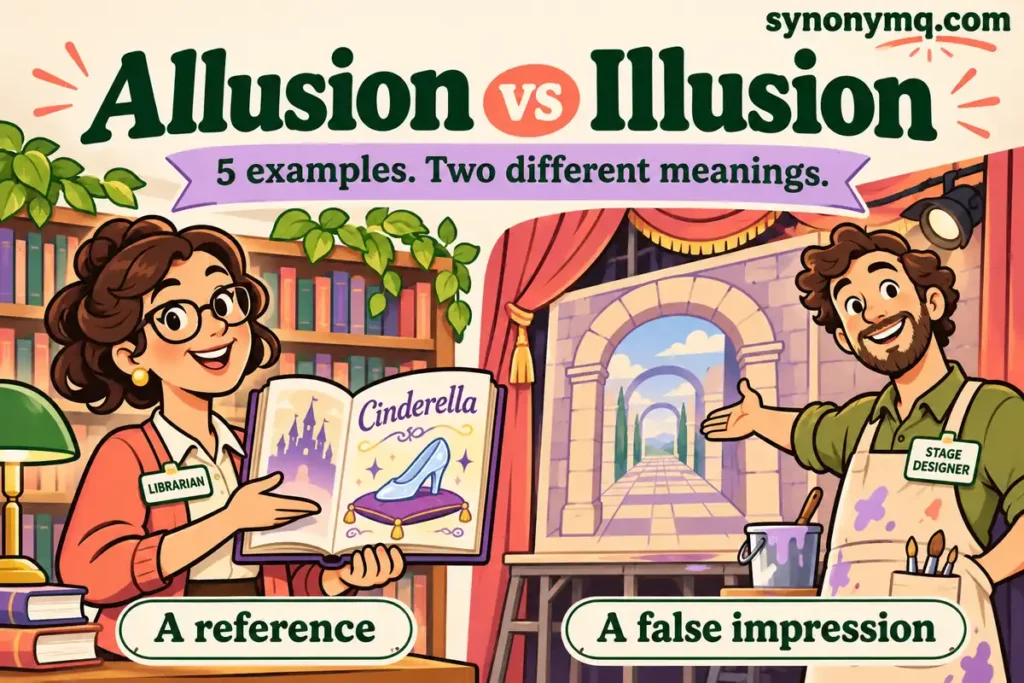
An allusion is an indirect reference; an illusion is a false impression or belief. For allusion vs illusion, ask what the sentence describes: a connection to something else, or something that seems true but is not. Both words are nouns.
Allusion vs Illusion: Start With the Meaning
The Language Portal of Canada separates an indirect reference from something that appears real or true but is not as it seems. The distinction concerns meaning, not formality or strength.
| If you mean… | Choose… | Ask yourself… |
|---|---|---|
| A hint at another story, person or event | Allusion | What does the reference point to? |
| An appearance that misleads | Illusion | What seems different from reality? |
| A mistaken belief about a situation | Illusion | What did someone wrongly believe? |
An allusion need not point to a real event. It can evoke a fictional character or story. The Poetry Foundation’s definition includes literary and mythic references as well as historical ones.
An illusion need not be a magic trick. In ordinary English, it can also be a mistaken idea. Cambridge’s illusion entry records both the belief sense and the misleading-appearance sense.
Five Situations Where the Choice Changes the Meaning
These invented examples follow a bookshop event and its small theatre performance. Each gives you enough context to choose the word, rather than asking you to guess from the spelling.
1. An invitation hints at a familiar story
“The glass slipper on the invitation was an allusion to Cinderella.” The illustration points readers towards a story without retelling it. That connection makes allusion the right word.
The glass slipper is part of the tale preserved in Cinderella; or, The Little Glass Slipper. The invitation in this example is invented. Its success as an allusion depends on readers recognising that connection.

2. Painted scenery appears to have depth
“The painted doorway created an illusion of depth.” The scenery is flat, but it appears to extend backwards. Choose illusion because the apparent depth does not match the surface being viewed.
Calling it an allusion would make a different claim: that the doorway refers to something else. A painting could do that too, but a convincing appearance of depth alone does not establish a reference.

3. A guest misunderstands the ticket price
“I was under the illusion that admission was free.” Here the guest wrongly believed something. No visual trick is necessary. Illusion describes the mistaken understanding.
For a simple practical correction, “I thought admission was free” is often enough. Use the fuller expression when you want to make the contrast between the earlier belief and the truth explicit.
4. A remark brings an earlier mishap to mind
“Her comment about spare keys was an allusion to last week’s lockout.” The speaker hints at an event that the listeners remember. Allusion works outside literary analysis too.
If she says, “Last week we locked ourselves out,” she has stated the event directly. Calling that a reference is straightforward; allusion is more useful when the connection is hinted at or left for the audience to recognise.
5. One performance contains both
“The performance included an allusion to Cinderella and an illusion of a disappearing shoe.” The first noun identifies the story connection. The second names an effect that makes the shoe seem to vanish.
The same scene can contain both things. A magical subject does not automatically make every reference an illusion, and a literary setting does not make every visual trick an allusion.
The Grammar Can Look Right While the Word Is Wrong
Both nouns can follow an: an allusion, an illusion. Both have ordinary plurals: allusions, illusions. Grammar alone therefore cannot catch “The painted scenery creates an allusion of depth” when you mean a deceptive appearance.
| Pattern | Example | Meaning |
|---|---|---|
| An allusion to | An allusion to an earlier argument | A reference pointing towards that argument |
| The illusion of | The illusion of an empty stage | An apparent state that is misleading |
| Under the illusion that | Under the illusion that entry was free | A mistaken belief expressed in a clause |
These are useful patterns, not a rule that one preposition always identifies the word. Meaning comes first. “An allusion in a speech” and “an illusion in a painting” both use in naturally.

Pronunciation gives a small clue
Cambridge lists allusion as /əˈluː.ʒən/ and illusion as /ɪˈluː.ʒən/ in its UK and US entries. Both stress the second syllable; the listed first vowels differ.
Roughly, the beginnings are “uh” and “ih”; the shared ending sounds like “LOO-zhun,” with the middle consonant heard in vision. Use the linked recordings for the sounds and the sentence’s meaning for the spelling.
Use a Plainer Replacement When It Helps
Allusion and illusion are not synonyms. Other expressions can replace each in a particular sentence, but the whole construction still needs checking. The labels below apply only to the examples shown.
| Original | Alternative | Fit and limit |
|---|---|---|
| It was an allusion to the lockout. | It was an indirect reference to the lockout. | Near-Synonym; Direct Swap. The indirect connection stays explicit. |
| The backdrop gave an illusion of distance. | The backdrop gave a false impression of distance. | Near-Synonym; Swap With Adjustment. Change an to a as well. |
| I was under the illusion that entry was free. | I mistakenly believed entry was free. | Contextual Alternative; Requires Rewrite. Replace the noun phrase with a verb phrase. |
Keep allusion when the reference itself matters to your analysis. Choose indirect reference for a reader who may not know the term. Keep illusion when the misleading appearance or belief is the point, rather than merely saying something is imaginary.
For other pairs whose similar forms hide different meanings, see the commonly confused words guide. A natural-sounding substitution can still change what you claim.
A Five-Sentence Word-Choice Quiz
Fill each gap with allusion or illusion. Decide whether the sentence points to something else or describes a misleading appearance or belief before looking at the answers.
1. The invitation’s glass slipper was an ___ to Cinderella.
2. Painted shadows created the ___ of a deep doorway.
3. I was under the ___ that the event was free.
4. Her hint about spare keys was an ___ to our lockout.
5. The disappearing shoe was an ___ produced on stage.
Answers and reasons
1. Allusion: the image points to a familiar tale. 2. Illusion: the apparent depth is misleading. 3. Illusion: the guest held a mistaken belief.
4. Allusion: the remark indirectly recalls an event. 5. Illusion: the shoe appears to vanish. The story reference and the stage effect are separate facts.
Sources and Example Notes
Definitions were checked against the linked dictionaries and language references. The five event scenarios, replacement sentences and quiz are original illustrations. The Cinderella connection is grounded in the linked text; word-choice recommendations are editorial.
Frequently Asked Questions
What is an example of an allusion?
A glass slipper on an invitation can be an allusion to Cinderella. It evokes the familiar story without retelling it.
What is the difference between an allusion, an illusion, and a delusion?
An allusion is a reference. An illusion is a misleading appearance or belief. In ordinary usage, a delusion is a false belief; clinical usage needs separate context.
Can you give me an example of an allusion or illusion?
A remark hinting at last week’s lockout is an allusion. A flat stage painting that appears to contain a deep doorway creates an illusion.
What’s the difference between allusion and allegory?
An allusion briefly refers to something else. An allegory develops figurative meaning through characters and events across a narrative. The same work can contain both.

Naveed Akhtar writes every guide on SynonymQ. He is an SEO content writer with ten years of article-writing experience, working on the question a thesaurus never answers: which of these words belongs in this sentence, for this reader. Every page cites the dictionary entries it draws on and the date they were read.