
Beautiful vs Pretty vs Gorgeous: 3 Checks Before You Choose
Beautiful vs pretty vs gorgeous depends on tone and use. Pretty conveys charm, beautiful expresses broad admiration, and gorgeous adds strong praise. Check what you mean, what you describe, and the grammar before you choose.
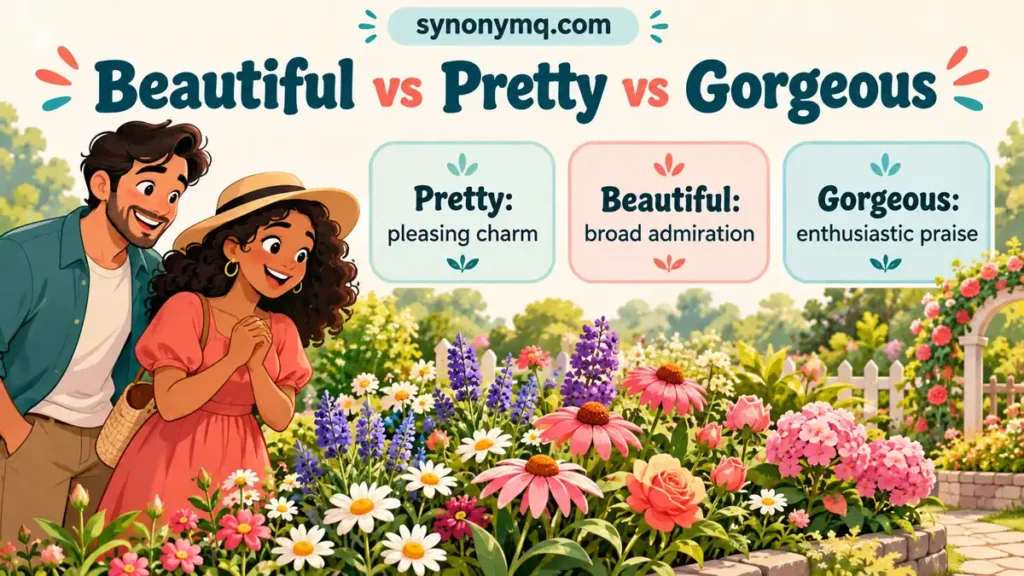
Imagine three friends looking at the same flower garden. One calls it pretty, another beautiful, and the third gorgeous. They may agree completely about the garden while expressing different levels of enthusiasm.
1. Beautiful vs Pretty vs Gorgeous: Check the Tone
All three words work as adjectives when they describe attractiveness. They are Near-Synonyms: a replacement can keep the sentence grammatical while changing its tone.
| Word | Main distinction | Tone or context | Original example |
|---|---|---|---|
| Pretty | Pleasant attractiveness, often delicate or charming | Usually a lighter compliment | “The blue cups look pretty beside the daisies.” |
| Beautiful | Beauty that appeals to the senses or mind | Broad admiration; useful beyond appearance | “The choir brought a beautiful warmth to the song.” |
| Gorgeous | Striking beauty or strong visual appeal | Enthusiastic, often informal praise | “Those orange flowers look gorgeous in the evening light.” |
Merriam-Webster’s entry for pretty emphasizes grace and pleasing appearance. Oxford’s American English entry labels the main sense of gorgeous informal.
As a rough guide, pretty is often milder than beautiful, while gorgeous sounds especially enthusiastic. This describes the force of the words, not an objective ranking of people or things. Tone and personal habits still matter.
2. Check What You Are Describing
A room, outfit, garden, or photograph
Each word can fit the same noun. Try them in “You arranged a ___ bouquet.” Pretty highlights its pleasing charm; beautiful gives fuller admiration; gorgeous makes the praise more emphatic.
These are Direct Swap options in that sentence, but they do not sound identical. For a warm thank-you note, beautiful is a useful choice. For an excited message about a vivid arrangement, gorgeous may better match your reaction.
With photographs, name what you admire when precision helps: “The reflection in the window is beautiful” says more than “Nice photo.” Calling the picture gorgeous can emphasize its striking visual effect.
Music, a gesture, or an idea
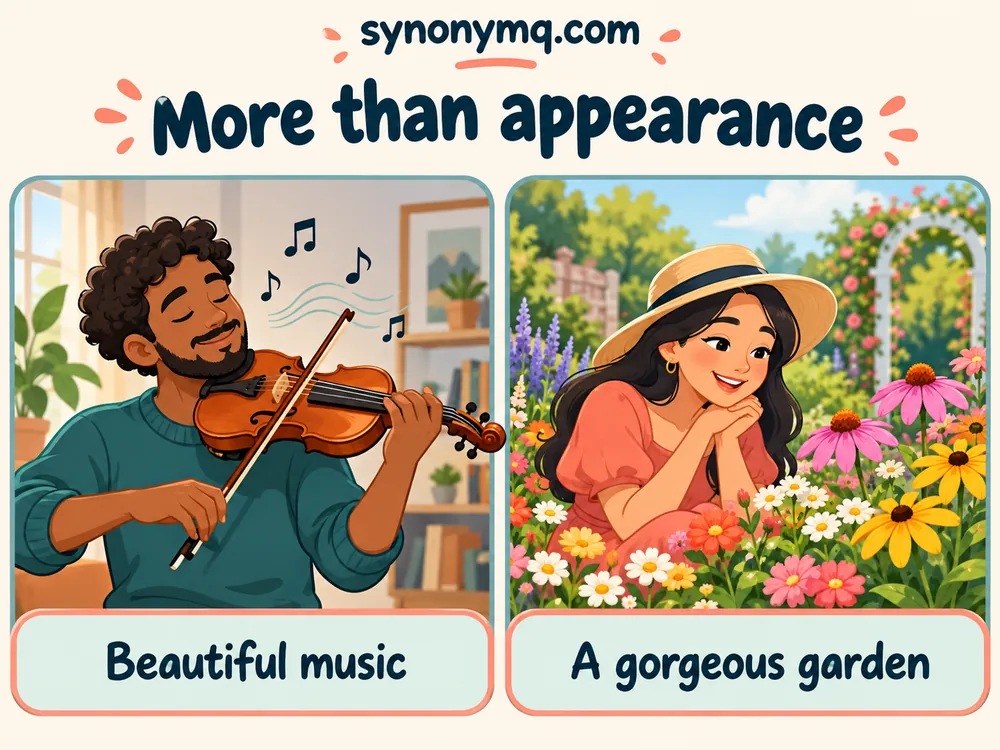
Beautiful is not limited to looks. Oxford’s American English definition includes pleasure for the mind as well as the senses.
- “That is a beautiful melody.” The sound is being praised.
- “Leaving flowers for every neighbor was a beautiful gesture.” The action is being admired.
- “The designer found a beautiful solution to the storage problem.” The praise concerns the solution’s elegance or quality.
A pretty melody is also natural, but it suggests a pleasing, possibly delicate tune. Gorgeous music is possible as enthusiastic praise. Beautiful is the more flexible choice when you want admiration without a strongly conversational voice.
A formal description
In a museum label or an academic discussion, explain the quality you mean. Instead of only calling a vase gorgeous, you might describe its rich colors or balanced shape. The detail helps the reader understand your judgment.
This is an editing choice, not a rule banning gorgeous from formal writing. Keep the word when a quotation, review, or personal response calls for that voice.
What Does the Choice Mean in a Compliment?
“You look pretty,” “You look beautiful,” and “You look gorgeous” all express admiration for appearance. Gorgeous often sounds more excited; beautiful can sound more heartfelt. None has a fixed hidden meaning.
If someone calls you pretty rather than beautiful, that alone does not reveal how much they care about you. The situation, relationship, delivery, and their usual way of speaking matter more than a rigid three-word scale.
Likewise, beautiful does not automatically mean “beautiful inside,” and gorgeous does not automatically mean romantic interest. A friend can call your jacket gorgeous without making a comment about attraction.
For a personal compliment, choose wording you mean. For feedback on someone’s work, make the work the subject: “Your color choices are beautiful” gives a clearer message than a comment on the person’s appearance.
3. Check Whether Pretty Describes Beauty or Degree
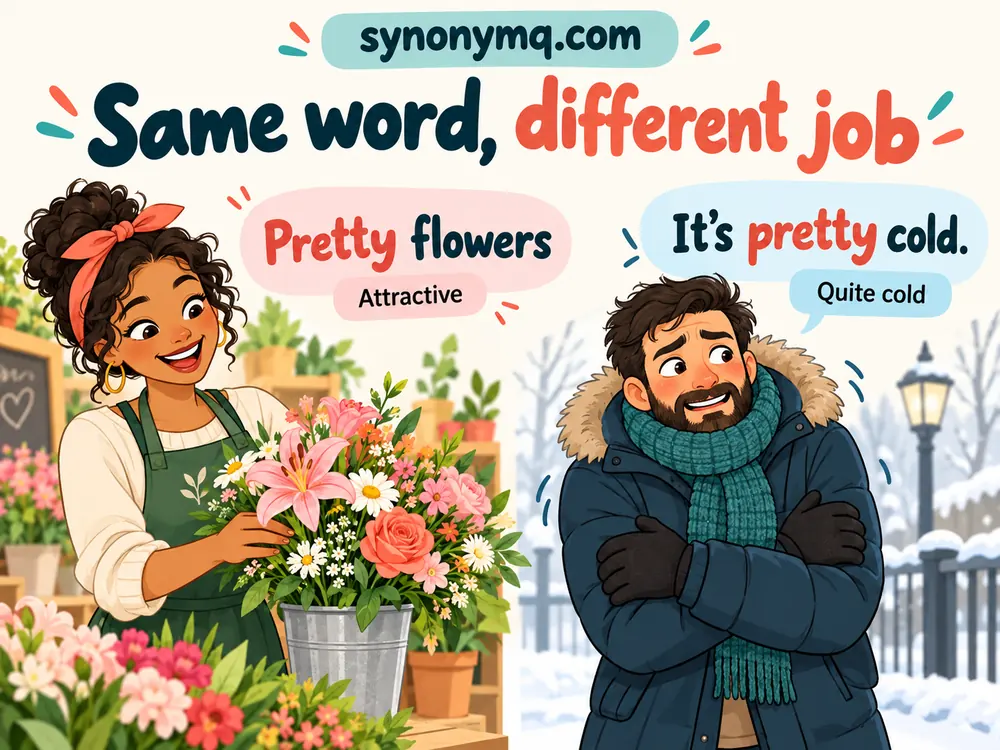
In “pretty flowers,” pretty describes a noun. In “pretty cold,” it changes the strength of another adjective. Here it is an adverb meaning something like fairly, quite, or sometimes very, depending on context.
Oxford lists both moderate and stronger uses of pretty as an adverb. Do not assume it always means exactly “a little.”
| Sentence | Meaning | Replacement |
|---|---|---|
| “The paper lanterns are pretty.” | They look attractive. | Beautiful or gorgeous can work, with stronger praise. |
| “The paper lanterns are pretty expensive.” | The price is fairly or quite high. | Quite expensive works. Gorgeous expensive does not. |
| “The lanterns glowed beautifully.” | The manner or effect of their glowing is being praised. | Beautifully is an adverb; beautiful is the adjective. |
Swap With Adjustment: “She chose a beautiful arrangement” becomes “She chose an attractive arrangement.” The article changes from a to an; attractive gives less emphatic praise.
Requires Rewrite: replace “The vase is gorgeous” with “The vase’s rich colors catch the light” when specific visual detail better serves the reader.
For comparisons, use prettier and prettiest, or more beautiful and most beautiful. Avoid “more prettier.” Beautiful also has the adverb beautifully; “she sings beautifully” describes how she sings.
Where Cute, Stunning, and Other Alternatives Fit
Nearby words add their own meanings. Cute is not simply a lower score on a beauty scale, and stunning is not an exact replacement for every use of beautiful.
| Alternative | Relationship and distinction | Example and change |
|---|---|---|
| Cute Direct Swap for pretty in the planter example | Near-Synonym for attractive; often suggests endearing appeal | “A cute little planter” highlights charm. “A gorgeous planter” gives stronger visual praise. |
| Stunning Direct Swap for gorgeous in the mural example | Near-Synonym for extremely attractive or impressive | “The mural is stunning” emphasizes its strong effect on the viewer. |
| Good-looking Direct Swap for beautiful in the appearance example | Near-Synonym for a person’s physical attractiveness | “He is good-looking” describes appearance. It does not replace beautiful in “a beautiful act of kindness.” |
| Hot Direct Swap for gorgeous in the actor example, with a meaning shift | Contextual Alternative for sexual attractiveness; informal | “She thinks the actor is hot” emphasizes attraction. It changes the message of a general compliment. |
Oxford records an informal attraction sense of cute, so the word does not always mean childlike or innocent. Its meaning depends on the person or thing being described.
Stunning also means shocking or surprising in other contexts. A stunning defeat is not a beautiful defeat. Choose by the sentence, not just the thesaurus list.
The same principle applies to other commonly confused words: a substitute should preserve the meaning you intend, not merely belong to a related group.
A Simple Way to Choose
Use pretty for pleasing charm, beautiful for broad admiration, and gorgeous when enthusiastic praise fits. If the sentence contains pretty plus another adjective, check whether you mean degree instead of beauty.
You do not need the strongest word every time. “The flowers look pretty on your desk” is a complete compliment. Keep it if that is the reaction you want to express.
Frequently Asked Questions
Is there a difference between pretty, beautiful, and gorgeous?
Yes. Pretty suggests pleasing charm, beautiful offers broader admiration, and gorgeous adds enthusiastic praise. Their meanings overlap, but context and grammar can make a replacement change the message.
Is it better to say beautiful or gorgeous?
Use beautiful for broad admiration, including music, ideas, or thoughtful gestures. Choose gorgeous for enthusiastic praise when an informal tone fits. Neither is always the better compliment.
Can I use gorgeous for a girl?
Yes. Gorgeous can describe a girl or woman and means very attractive in this context. Use it as a respectful compliment appropriate to the relationship and situation.
Which one is more powerful, beautiful or gorgeous?
Gorgeous usually sounds more emphatic in a compliment about appearance. Beautiful can carry deeper personal feeling in context. The words express a speaker’s reaction, not an objective beauty score.

Naveed Akhtar writes every guide on SynonymQ. He is an SEO content writer with ten years of article-writing experience, working on the question a thesaurus never answers: which of these words belongs in this sentence, for this reader. Every page cites the dictionary entries it draws on and the date they were read.