
Emigrate vs Immigrate: 3 Viewpoints on One Move
Emigrate means leave a country to live elsewhere; immigrate means enter another country to live there. In emigrate vs immigrate, the difference is viewpoint. Use emigrate to emphasize departure, immigrate to emphasize arrival, and migrate for the broader movement.
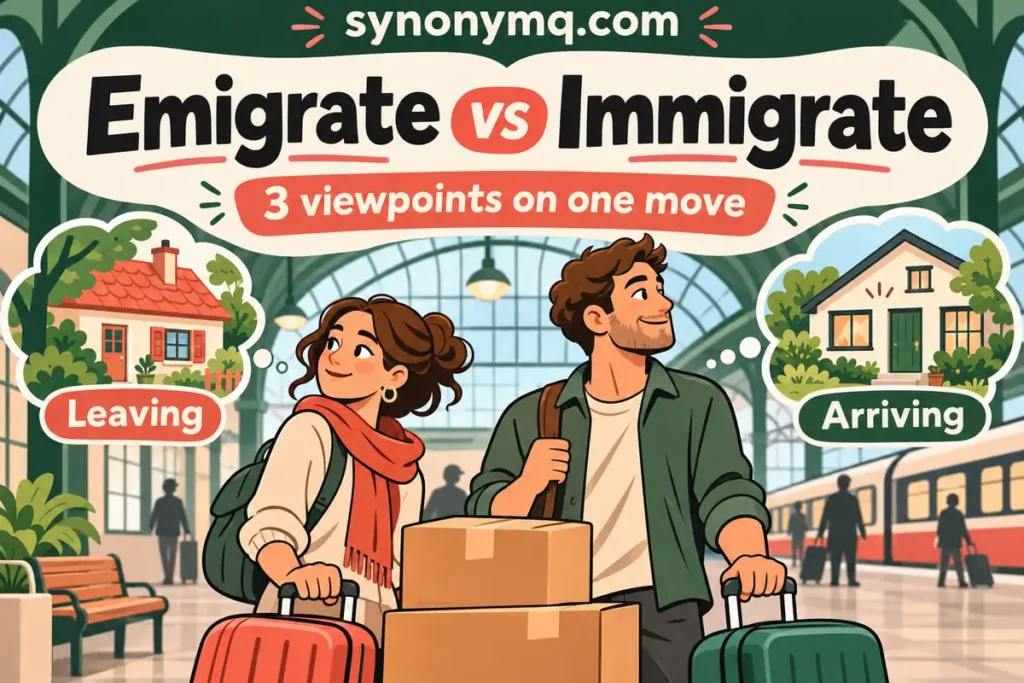
Emigrate vs Immigrate Through One Person’s Move
Imagine that Sofia leaves Portugal and makes a new home in Canada. Her move can be described in three ways without changing what happened. The choice depends on which part of the story you want your reader to notice.
1. Departure from the old country
Sofia emigrated from Portugal. This sentence puts her departure at the centre. It would fit a family history discussing why she left, or an account of people leaving Portugal to live elsewhere.
Merriam-Webster defines emigrate around leaving a place of residence or country to live somewhere else. The idea is a change of home, not simply walking out of a building or taking a short holiday.

2. Arrival in the new country
Sofia immigrated to Canada. Now the sentence presents her move from the receiving country’s perspective. It would suit a story about her arrival, her new neighbourhood or the life she built after moving.
Merriam-Webster’s entry for immigrate focuses on entering and becoming established, especially in another country. Yes, immigrate is a standard English word; it is not an incorrect version of emigrate.

3. The movement as a whole
Sofia migrated from Portugal to Canada. This describes the movement more generally. Migrate is broader: the Language Portal of Canada applies it to people and animals moving between places.
The three sentences do not describe three separate journeys. Sofia is the person leaving, the person arriving and the person moving. Emigrate and immigrate select a direction of attention; migrate leaves that emphasis more open.
From and To Help, but Neither Chooses the Verb for You
“Emigrate from” and “immigrate to” are useful starting patterns. They connect departure to the old place and arrival to the new one. The mistake is turning those helpful patterns into a rule that forbids every other combination.
Cambridge records emigrate with both from and to. “Sofia emigrated to Canada” is therefore possible: it emphasizes her departure while also naming the destination. You do not have to mention Portugal in every sentence.
You can also name the origin after immigrate: “Sofia immigrated to Canada from Portugal.” The receiving country remains the focus, even though the sentence tells us where she came from.
The Chicago Manual of Style’s usage Q&A explains that either verb can work in a sentence about moving to Canada. Choose emigrate to stress leaving and immigrate to stress the new destination.
Cambridge also records immigrate into. For a straightforward personal history, immigrated to is a clear choice. That recommendation does not make immigrated into ungrammatical.
Before editing, ask what the surrounding paragraph is about. A departure story may need emigrated; an account of settlement may need immigrated. If the sentence only needs to tell us where someone now lives, moved may be enough.
The Person and the Process Have Matching Names
Use emigrant or immigrant for the person, and emigration or immigration for the process. The same viewpoint distinction carries through these word families. A person does not become a different person when the description changes.
| Form | Departure emphasis | Arrival emphasis |
|---|---|---|
| Base verb | Emigrate | Immigrate |
| Past tense | Emigrated | Immigrated |
| Present participle | Emigrating | Immigrating |
| Person | Emigrant | Immigrant |
| Process | Emigration | Immigration |
In our example, Sofia is an emigrant from Portugal and an immigrant to Canada. Her emigration from Portugal is also her immigration to Canada. Which noun you choose tells the reader which country’s perspective matters.
Keep the tense consistent when comparing sentences. “She emigrated” and “she immigrated” both describe the past. “She is emigrating” and “she is immigrating” describe an ongoing move. Do not compare emigrated with immigrate as if tense were the main difference.
Merriam-Webster notes that emigrant and immigrant do not, by themselves, imply illegality. These words describe a person’s movement in relation to a place; they are not substitutes for a specific statement about legal status.
Listen for EM at the Start of Emigrate
These words are similar in spelling, but they do not have identical pronunciations. Cambridge gives the following UK forms, with the main stress at the start. The readable guides are approximate; the linked entries also provide audio.
Emigrate: /ˈem.ɪ.ɡreɪt/, roughly EM-ih-grayt. The first vowel sounds like the vowel in head. See Cambridge’s emigrate pronunciation.
Immigrate: /ˈɪm.ɪ.ɡreɪt/, roughly IM-ih-grayt. The first vowel sounds like the vowel in ship. See Cambridge’s immigrate pronunciation.
For spelling, remember e for exit and im for in. This is a memory aid for the viewpoint, not a rule about which preposition must follow the verb.
Migrate Covers More Than International Settlement
People can migrate between regions within one country. A family moving from a rural district to a city is an example of internal migration. In a casual conversation about that family, “They moved to the city” will often communicate the point more directly.

For ordinary international-settlement examples, emigrate and immigrate give useful directional emphasis. Avoid claiming they can only ever refer to countries: authoritative usage guidance also recognizes movement between regions.
In biology, the reference point is a population
Biology uses immigration and emigration for movement into and out of populations. OpenStax’s population genetics chapter discusses animals leaving one group and joining another. A political border is not required.
For a study of a particular animal population, arrivals count as immigration and departures as emigration. Identify the population being discussed first. The same movement can be an exit from one group and an entry into another.
Use Move or Relocate When the Directional Emphasis Is Unneeded
Emigrate and immigrate are related words, not freely interchangeable synonyms. Broader alternatives can make a sentence simpler, but may remove the distinction between departure and arrival.
| Original sentence | Alternative | Substitution and limit |
|---|---|---|
| Sofia emigrated from Portugal. | Sofia moved from Portugal. | Direct Swap: contextual alternative; does not alone establish international settlement. |
| Sofia immigrated to Canada. | Sofia relocated to Canada. | Direct Swap: contextual alternative; describes a new location with less emphasis on entering a country. |
| Sofia is an immigrant to Canada. | Sofia moved to Canada to make a new home. | Requires Rewrite: explains the move instead of naming the person. |
Use the specific verb when its viewpoint matters. Use moved when a change of home is all the reader needs to know. For more examples of distinctions that survive similar spellings, explore our commonly confused words guide.
How This Page Was Checked
Definitions and forms were checked against the linked dictionaries; preposition guidance against Cambridge and Chicago; the biology note against OpenStax. Sofia’s move and the replacement sentences are original teaching examples.
Frequently Asked Questions
What is the difference between immigration and emigration?
Immigration views a move as entry into a country to live there. Emigration views it as departure to live elsewhere. One move can be both.
What is the hardest country to immigrate to?
There is no useful universal answer without defining the applicant, immigration route and criteria. A country ranking would require separate, current research beyond this vocabulary guide.
Am I immigrating or emigrating?
You may be both: emigrating from the country you leave and immigrating to the country where you settle. Choose the word matching your sentence’s viewpoint.
Do humans migrate or emigrate?
Humans do both. Migrate broadly describes movement between places; emigrate emphasizes leaving a place to live elsewhere. Migration can also occur within one country.

Naveed Akhtar writes every guide on SynonymQ. He is an SEO content writer with ten years of article-writing experience, working on the question a thesaurus never answers: which of these words belongs in this sentence, for this reader. Every page cites the dictionary entries it draws on and the date they were read.