
Mentor vs Coach: 4 Sentence Choices That Change the Role
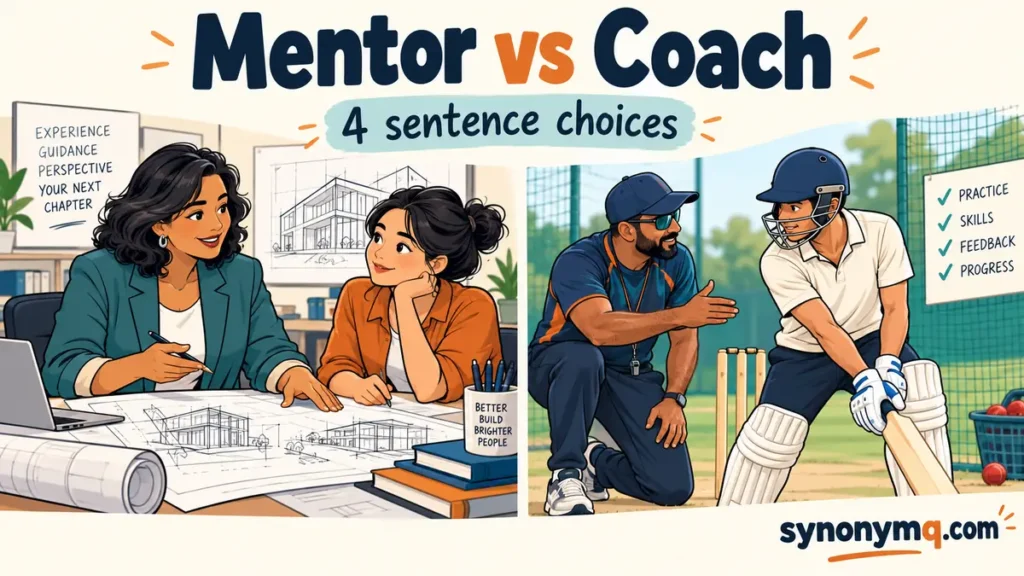
Mentor vs coach depends on the support you mean. A mentor offers guidance drawn from experience; a coach helps develop skills or performance. Workplace coaching often uses questions rather than instruction, and one person can fulfil both roles.
What the role tells your reader
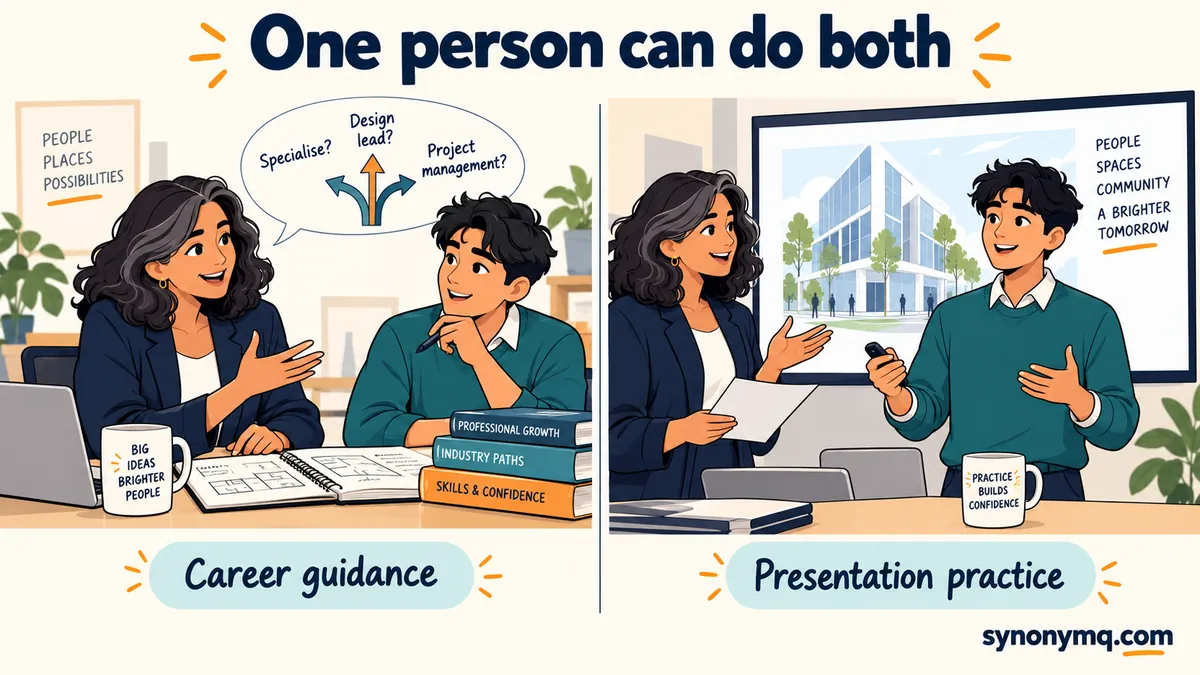
A junior architect might discuss career options with an experienced colleague, then practise a presentation with a coach. Both conversations help, but the labels tell us something different about the support.
Cambridge defines a mentor through sustained help and advice for someone younger or less experienced. Experience and guidance are central to the relationship.
In its teaching sense, Cambridge defines a coach as someone helping people improve at a sport, skill or subject. A coach can also train and organize a sports team.
These are overlapping roles, not exact synonyms. Calling someone your mentor foregrounds their guidance; calling them your coach foregrounds the coaching they provide. Neither label tells the whole story on its own.
Mentor vs coach in four sentence choices
The following situations are invented teaching examples. Each shows what changes when you replace the role word, even where both versions are grammatically possible.
1. Career guidance from someone who has done the work
“Leena is my mentor; she helps me think through the kind of architecture practice I want to join.”
Use mentor if Leena draws on relevant experience to guide the speaker’s development. The sentence describes a continuing source of perspective, rather than identifying a particular training session.
“Leena is my coach” could also be true, but it makes a different claim about their arrangement. Do not change mentor to coach simply because you want to avoid repeating a word.

2. A coach working on a specific skill
“Our cricket coach helps us practise our batting technique.”
Choose coach when you mean the person training the players. “Our cricket mentor” may describe an experienced source of guidance, but it does not identify the same training responsibility as clearly.
A coach might demonstrate a movement, organize practice or correct technique. The claim that coaches only ask questions would be misleading in this sports setting.

3. Professional coaching through questions
“My coach helped me explore how to handle difficult project meetings.”
Here, coach can describe a professional who supports reflection and helps the client develop their own approach. It need not mean someone teaching the technical details of the client’s profession.
The CIPD workplace factsheet describes coaching as essentially non-directive development focused on performance. That is a workplace framework, not a definition of every kind of coach.
Choose mentor instead if your point is that an experienced colleague shared lessons from handling similar meetings. Choose coach if you are describing the coaching relationship and process.
4. One person doing both jobs
“Leena mentors me as I build my career, and she coached me through yesterday’s presentation rehearsal.”
This sentence gives the same person two functions. Mentor describes the broader guidance; coached describes the focused preparation. There is no need to force Leena into only one category.
A published discussion of mentoring and coaching recognizes that the roles can merge. It also stresses agreeing on the relationship’s scope and style.
When both roles matter, say what the person actually does. “She guides my career choices and helps me rehearse presentations” is more informative than an unexplained “mentor/coach” label.
Why workplace comparisons do not define every coach
Workplace guides often contrast an experienced mentor’s advice with a coach’s questioning. That distinction can help you understand a programme, but it becomes inaccurate when applied to every use of coach.
A cricket coach may need detailed knowledge of batting technique. A professional coach helping someone reflect on leadership may work without being an expert in that person’s technical field.
Duration is also a clue rather than a definition. CIPD says mentoring relationships tend to last longer, while coaching may have a defined period or form part of an ongoing management style.
So a short relationship is not automatically coaching, and a long relationship is not automatically mentoring. Read the programme’s description and choose the word that matches the actual support.
| Original wording | Possible replacement | Substitution judgement |
|---|---|---|
| She is my mentor. | She is my coach. | Direct Swap grammatically; the role changes. Use only if coaching describes the relationship. |
| He coached the cricket team. | He mentored the cricket team. | Direct Swap grammatically; guidance replaces the explicit training emphasis. |
| She mentored me. | She was my mentor. | Swap With Adjustment: a verb becomes a noun phrase. |
| She is my mentor and coach. | She guides my career and helps me rehearse. | Requires Rewrite: specify the two functions when the labels are vague. |
In this table, mentor and coach are contextual alternatives. A direct grammatical swap does not guarantee an unchanged meaning. Keep a formal role title when that title is the information your reader needs.
Both roles can involve comments on someone’s work. If you need to describe those comments precisely, see feedback vs criticism.
Mentor, mentee and the verb patterns
A mentor gives guidance; a mentee receives it. Cambridge’s mentee entry identifies the mentee as the person helped by a mentor.
“Leena is Amir’s mentor” and “Amir is Leena’s mentee” describe the same relationship from opposite sides. Swapping the names without changing the role word reverses who is helping whom.
Mentor also works as a verb: “Leena mentors Amir.” Its past form is mentored: “Leena mentored Amir during his first year.” The noun mentor names the person; the verb describes the activity.
Coach works as a noun and a verb too: “Our coach arrived early” and “She coached us before the match.” For a skill or subject, the pattern coach someone in something is also available.
Write “She coached me in public speaking” when that is the skill being developed. Write “She mentored me as I started my career” when you mean guidance across that stage of development.
For other word pairs whose meanings overlap without matching completely, browse commonly confused words.
How This Page Was Checked
The meanings and grammar were checked against Cambridge Dictionary. Workplace distinctions draw on CIPD; the seven-role FAQ names the model presented by Stanford Medicine. The sentence examples are original illustrations.
Workplace conventions are kept separate from general English meanings. No rule is inferred from payment, relationship length or a person’s job title alone.
FAQs
What is the difference between a mentor and a life coach?
A mentor offers guidance based on experience. A life coach helps clients clarify personal goals and work towards them. The emphasis differs, although their activities can overlap.
Who qualifies to be a mentor?
A mentor needs relevant experience to guide someone less experienced. Formal programmes may set additional eligibility or training requirements; check the programme rather than assuming the title proves qualifications.
What are the seven roles of a mentor?
Stanford Medicine presents Tobin’s model: teacher, sponsor, advisor, agent, role model, coach and confidante. These are roles in a specific framework, not a universal definition.

Naveed Akhtar writes every guide on SynonymQ. He is an SEO content writer with ten years of article-writing experience, working on the question a thesaurus never answers: which of these words belongs in this sentence, for this reader. Every page cites the dictionary entries it draws on and the date they were read.