
Notable vs Noteworthy: Only 1 of Them Is Safe for Bad News
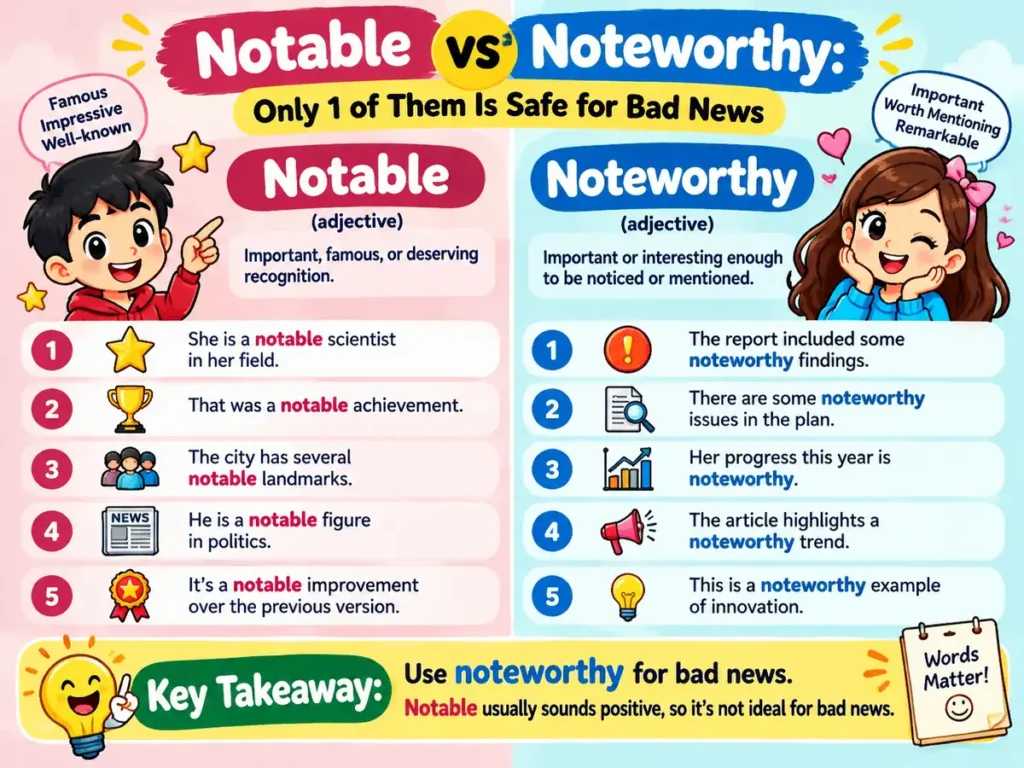
Notable and noteworthy are close, and one difference is usable. Merriam-Webster defines noteworthy as worthy of attention “especially because of some special excellence”. Notable carries no such lean. So a notable failure reads fine and a noteworthy failure does not.
By Naveed Akhtar, an SEO content writer with 10 years of article-writing experience · Updated 22 September 2026 · About 7 minutes
Notable vs Noteworthy: The Difference Is One Clause
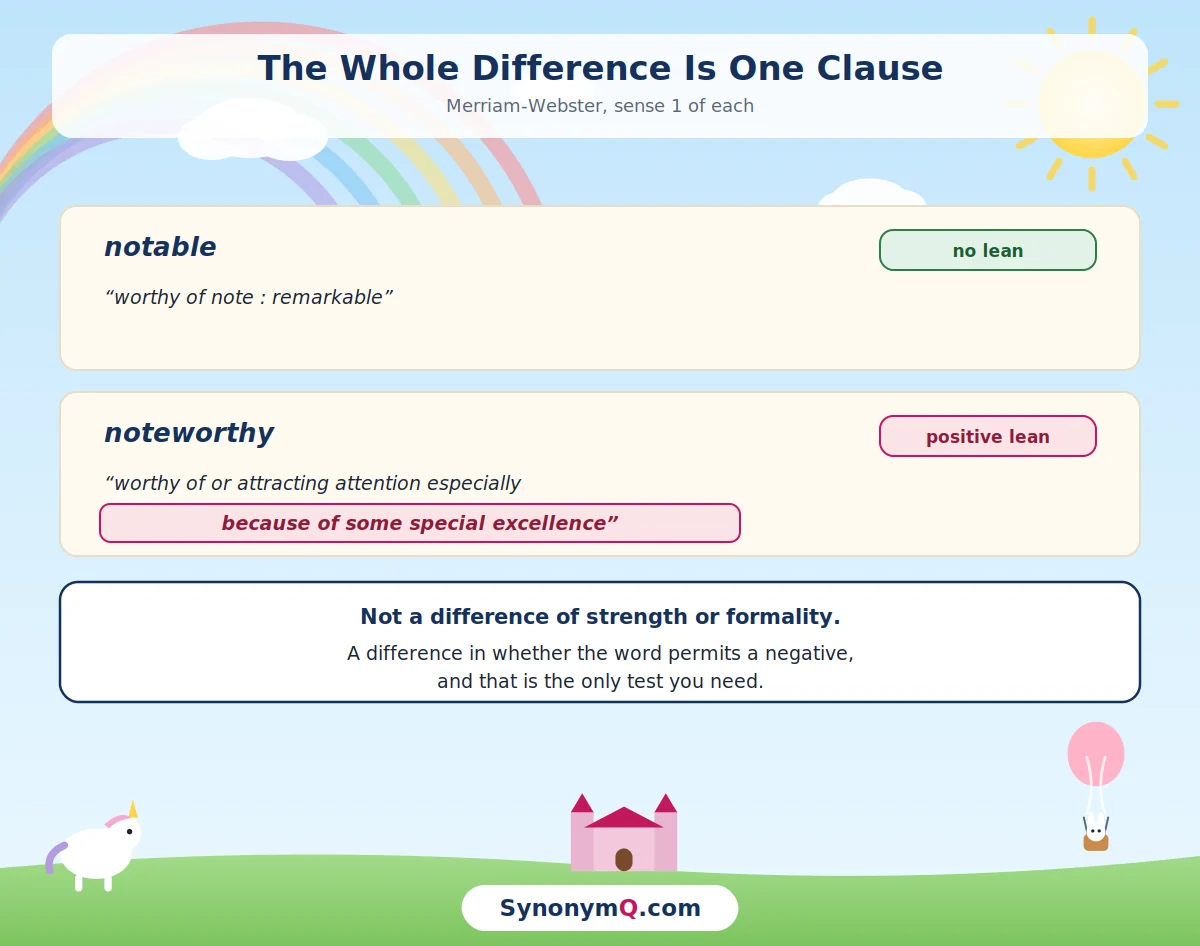
Put the two entries next to each other and the whole distinction is in a clause most readers skim past.
| Word | The gloss |
|---|---|
| notable | “worthy of note : remarkable” |
| noteworthy | “worthy of or attracting attention especially because of some special excellence“ |
One of them has a value judgement built into the definition. Notable says a thing is worth noting. Noteworthy says it is worth noting because it is unusually good.
That is not a difference of strength or formality. The two words are equally strong and equally usable in formal writing. They differ in whether the word permits a negative, and that turns out to be the only test you need.Most pages on this pair say the two are interchangeable, or list synonyms for both and leave you where you started. The clause above is in the dictionary and it does the work.
The Test: Can You Use It About Something Bad?
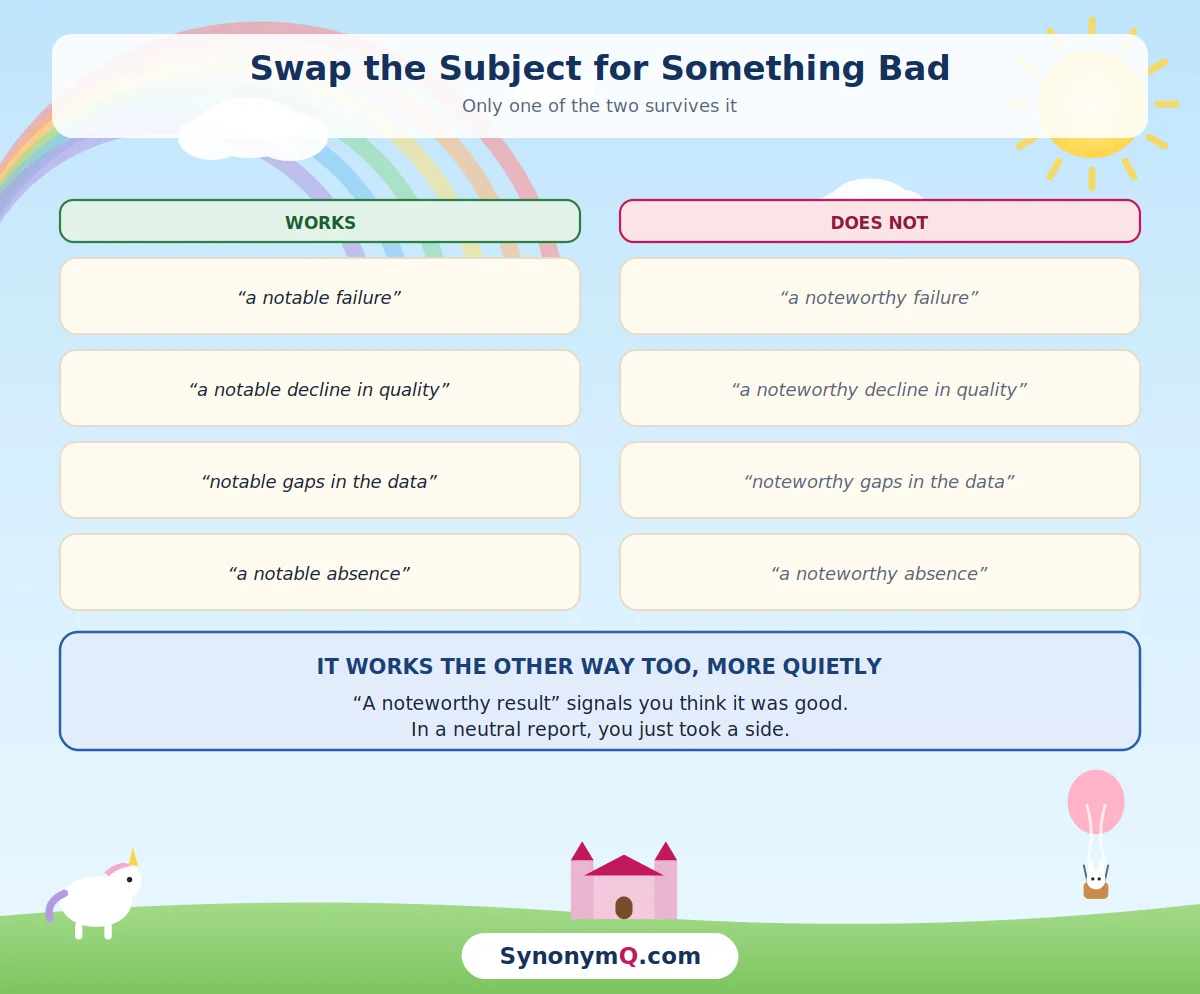
Take four sentences where the thing being described is unwelcome.
| With notable | With the other word | Verdict |
|---|---|---|
| “a notable failure” | “a noteworthy failure” | Only the first works. The second reaches for praise it cannot deliver |
| “a notable decline in quality” | “a noteworthy decline in quality” | The second sounds like the decline was impressive |
| “notable gaps in the data” | “noteworthy gaps in the data” | The second congratulates the gaps |
| “a notable absence” | “a noteworthy absence” | A fixed phrase. Nobody says the second |
The test in one line. If the thing you are describing is a problem, a loss or an error, use notable. The other word will fight you.
It works in the other direction too, and more quietly. Writing “a noteworthy result” signals that you think the result was good. If you were trying to stay neutral in a report, you have just taken a side without noticing.Sentences where a word smuggles in a feeling you did not intend are the same hazard covered at synonyms for alone, where every alternative adds an emotion the plain word does not carry.
Notable Has a Second Sense. The Other Does Not.
The lean is one difference. Here is the other, and it explains why notable turns up in places its partner never does.
Merriam-Webster gives notable a sense 1b: “distinguished, prominent.” That is a claim about standing, not about being worth a mention.
Claims eminence — a real statusa notable physicist Claims only that she is worth remarking ona noteworthy physicistThe first is a compliment about her position in the field. The second is fainter and slightly odd, because it treats an established scientist as a curiosity.
There is no second sense on the other side. Merriam-Webster gives the newer word one sense and stops.
One of Them Is Also a Noun
A short point, and a hard line. Notable is a noun as well as an adjective: “a person of note”, and in the plural, notables.
No such form existsSeveral noteworthies attended the opening. The noun formSeveral notables attended the opening.If your sentence needs a person rather than a description, only one of the two words is available.
The Third Word People Reach For
Search this pair and Google will hand you a page about notable versus noticeable instead. That substitution is a clue: readers conflate all three, and the dictionary shows why.
| Word | Shared base | What it adds on top |
|---|---|---|
| notable | “worthy of note” | Eminence. Sense 1b, “distinguished, prominent” |
| noteworthy | worthy of attention | Excellence. The “special excellence” clause |
| noticeable | “worthy of notice” | Perceptibility. Sense 2, “likely to be noticed” |
All three start from the same idea and each bolts on something different. That is why they feel interchangeable and are not.
The one that separates noticeable cleanly. It is the only one of the three that describes whether something can be perceived at all. A noticeable smell is one you can smell. A notable smell would be one worth remarking on, which is a different claim about the same smell.So noticeable is the word for small physical differences: a noticeable gap, a noticeable improvement, a noticeable limp. Neither of the other two fits those, and none of the three is a general-purpose substitute for the others.
The Same Idea, Built Three Times
These are not words that drifted apart. They were assembled separately, three times over, and the dates say so.
| Word | First known use | How it was built |
|---|---|---|
| notable | 14th century | Arrives from Latin, through French |
| noteworthy | 1552 | Assembled in English: note + worthy |
| noticeable | 1753 | Built later again, from notice + -able |
Four centuries end to end, and the same idea every time. English already had a word meaning “worth noting” in the 1300s and built two more anyway.
That explains the heavy overlap. It also explains why the residue that separates them is small: each newer word was made to do a job an older one already did, so the only room left was in what it added.
Good, Bad or Neither: Picking Between Them
| Ask | Use | Label |
|---|---|---|
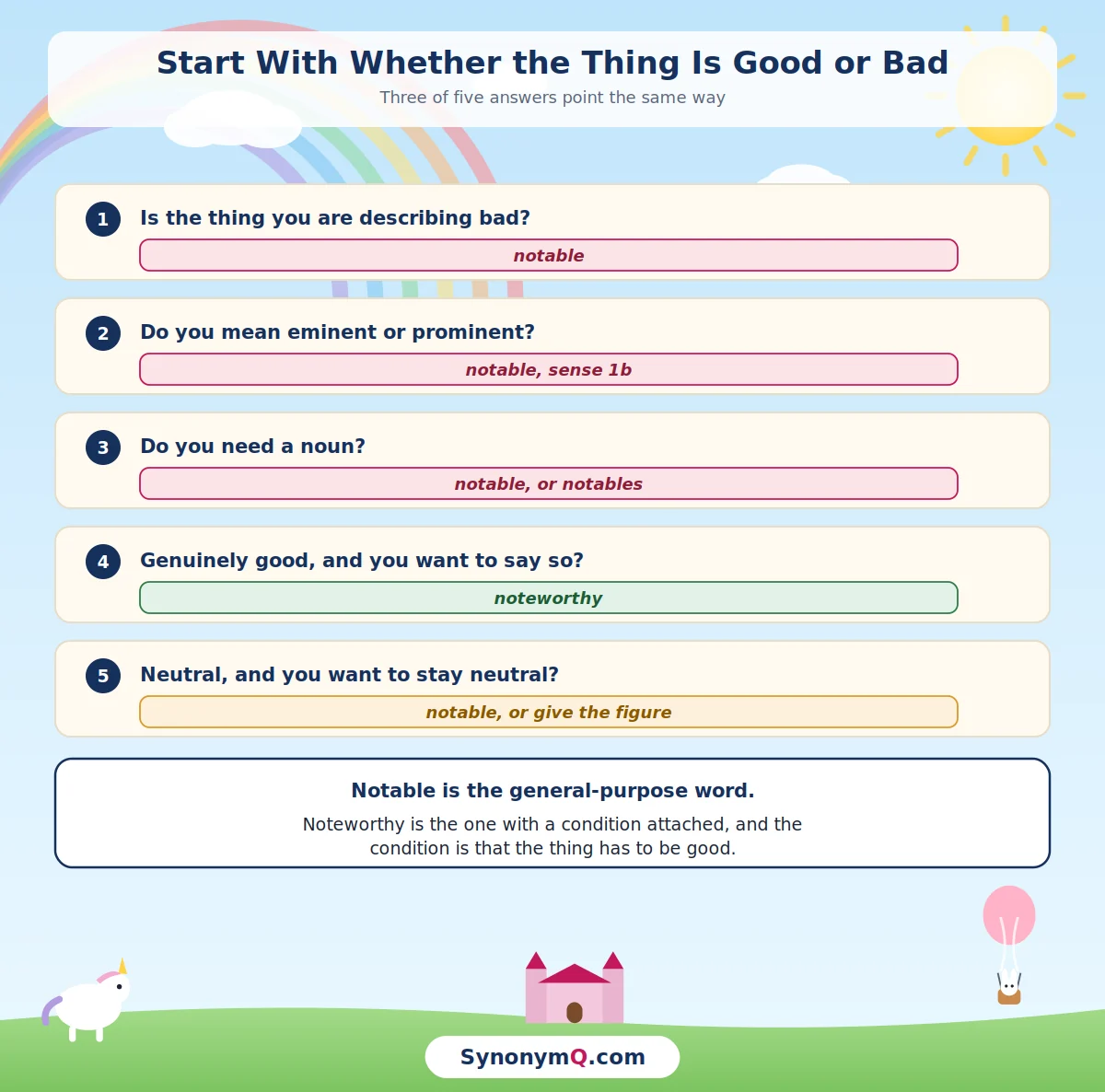
| Is the thing you are describing bad? | Notable. The other word will read as praise | Requires Rewrite |
| Do you mean eminent or prominent? | Notable, sense 1b. There is no equivalent | Requires Rewrite |
| Do you need a noun? | Notable, or notables. Only one option exists | Requires Rewrite |
| Is the thing genuinely good, and do you want to say so? | Noteworthy. The lean is working for you | Direct Swap |
| Neutral, and you want to stay neutral? | Notable, or drop the adjective and give the figure | Swap With Adjustment |
Three of the five rows point the same way, which is the honest summary of this pair: notable is the general-purpose word and noteworthy is the one with a condition attached.
The last row is worth taking seriously. “Sales rose a notable 12%” is doing less work than “sales rose 12%”, and choosing between two adjectives is often a sign neither is needed.
Frequently Asked Questions
What is the difference between notable and noteworthy?
Merriam-Webster defines noteworthy as worthy of attention “especially because of some special excellence”. Notable has no such clause. So notable works for good, bad and neutral things; the other leans positive.
Can I say “a noteworthy failure”?
You can, and most readers will find it odd. The word is defined around special excellence, so applying it to a failure reads as either sarcasm or a slip. Notable failure is the ordinary phrasing.
Is “notable” a noun?
Yes. Merriam-Webster lists it as a noun meaning “a person of note”, commonly used in the plural: local notables. There is no matching noun form of the other word.
Which one is more formal?
Neither. Both sit comfortably in formal writing and neither carries a register label. Choosing between them on formality is choosing on the one axis that does not separate them.
Are they ever interchangeable?
Often — when the thing described is positive or neutral and you do not need the eminence sense or the noun. In those sentences the choice is genuinely free.
How This Page Was Checked
Read from the sources attributed, on 22 September 2026:
- Sense 1a, sense 1b “distinguished, prominent”, the noun entry, and the 14th-century date — Merriam-Webster, notable.
- The single sense including the “especially because of some special excellence” clause, the absence of a noun form, and the 1552 date — Merriam-Webster, noteworthy.
- Both senses, “worthy of notice” and “likely to be noticed”, and the 1753 date — Merriam-Webster, noticeable.
What is reasoning rather than a retrieved fact. No dictionary states that one word cannot describe something bad.
That conclusion is drawn from the “special excellence” clause and from how the test sentences read. It is offered as a usable rule, not as a dictionary ruling.
What could not be checked. No corpus or frequency data was retrieved, so the claim that “a noteworthy failure” is rare rests on the definition and on the test sentences, not on counts.
Where the two are genuinely interchangeable, this page says so rather than manufacturing a distinction. That is most sentences.
Written by Naveed Akhtar, an SEO content writer with 10 years of article-writing experience.
Related: hate, dislike and loathe are separated by degree rather than by lean, and the commonly confused words index groups the pairs worked through here.

Naveed Akhtar writes every guide on SynonymQ. He is an SEO content writer with ten years of article-writing experience, working on the question a thesaurus never answers: which of these words belongs in this sentence, for this reader. Every page cites the dictionary entries it draws on and the date they were read.