
Quiet vs Silent vs Still: 3 Key Differences That Matter
Quiet vs silent vs still: quiet usually means little noise or activity; silent emphasizes no speech or sound; still often means no movement. Their meanings overlap, so choose by what your sentence describes: volume, speaking, motion or continuing time.
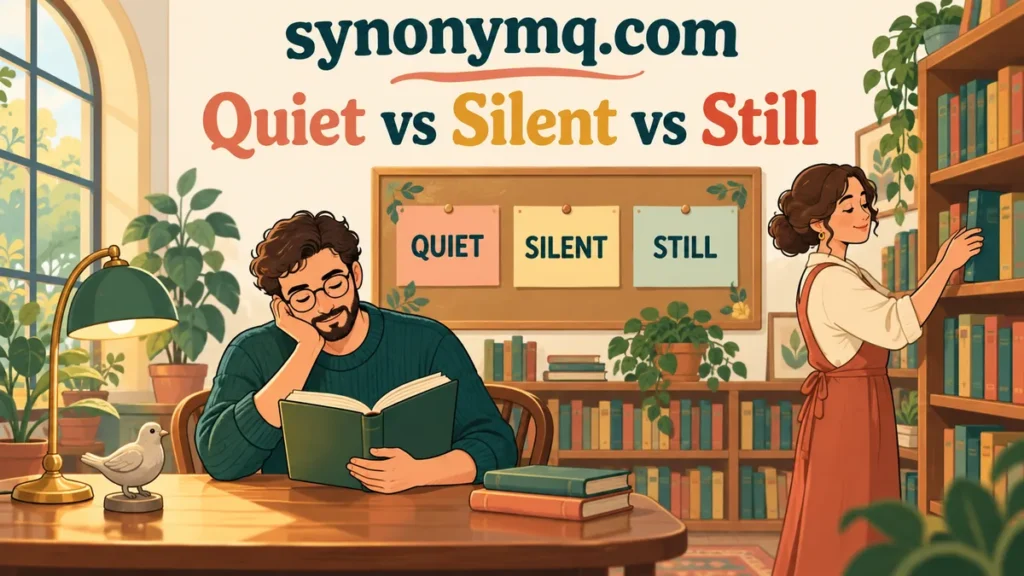
- Low noise or little activity: a quiet room, a quiet afternoon.
- No speech or sound: a silent reader, a silent room.
- No movement: a still figure, still air.
- Something continues: “The room is still quiet.” Here, still means the quietness continues.
Quiet vs Silent vs Still: A Quick Comparison
A library can be quiet while pages turn. A reader can be silent while walking to a shelf. Someone can remain still while a dog barks nearby. Each description picks out a different feature of the scene.
| Word | Useful starting meaning | Original example | What it does not establish |
|---|---|---|---|
| Quiet | Little noise, activity or disturbance | We found a quiet table beside the window. | That every sound has stopped |
| Silent | Not speaking or making sound | The reader stayed silent during the discussion. | That the person is motionless |
| Still | Not moving, in the physical sense | The model held a still pose for the photograph. | That the surroundings are quiet |
These are starting points, not sealed categories. Merriam-Webster also records still in senses involving quiet and calm. A still house can suggest an absence of activity as well as sound.
1. Quiet Can Allow Some Sound
Quiet works when a sound is low or a place is not noisy. “They had a quiet conversation” means they spoke in low voices. It does not mean they exchanged no words.
A quiet café might have a few customers, low voices and cups touching saucers. A quiet afternoon might simply have little happening. Oxford includes low activity as well as low noise.
“Be quiet” can mean stop talking
Do not turn the distinction into a rule that quiet always permits conversation. Cambridge gives “be quiet” as a way to tell someone to stop talking. The situation supplies the intended limit.
For a clear instruction, say what you need: “Please lower your voice,” “Please stop talking,” or “Please hold still.” These requests concern different actions, even though the same person might need to do all three.
Direct Swap: “The room became quiet.” → “The room became silent.”
Quiet and silent are Near-Synonyms here. The second version puts more emphasis on the absence of sound. Keep quiet if small background noises are part of the scene you want to describe.

2. Silent Focuses on Sound or Speech
Silent is useful when the absence of speech matters: “Mina stayed silent while the others answered.” That sentence tells us she did not speak during that moment. It does not tell us whether she moved, listened closely or agreed.
For places and objects, silent often makes a stronger claim about the lack of sound than quiet. Everyday descriptions can still be relative: Oxford’s sound sense allows little or no sound.
A quiet person and a silent person
A quiet person may tend to speak little. A person who was silent during lunch did not speak then. But silent can also describe a habitual manner, as in “the silent type”; it is not restricted to temporary behavior.
Choose the wording your evidence supports. “He said little during the meeting” reports an observation. Calling him shy, unfriendly or unhappy adds an explanation that the observation alone does not establish.
Merriam-Webster records both not speaking and tending to speak little. That overlap is why quiet versus silent cannot be reduced to personality versus behavior in every sentence.
A quiet person is not necessarily alone, either. If your sentence concerns company rather than speech, see the alternatives to alone and choose that separate meaning carefully.
3. Still Often Focuses on Movement
When a photographer says “Hold still,” the request concerns movement. A person can hold still while speaking, and a silent person can walk across the room. Lack of motion and lack of speech are separate observations.
Use still for air that is not moving, a steady pose or water without visible movement. Oxford’s adjective entry supports this physical sense as well as calm, quiet surroundings.
“The corridor was still” may suggest that nothing was moving or happening. “The corridor was silent” directs attention to sound. If both details matter, “The corridor was still and silent” gives each a job.

Choose Synonyms by the Meaning You Need
A replacement needs to fit both the meaning and the grammar. The labels below apply only to the stated example. None is an exact replacement across every sense of quiet, silent or still.
| Alternative | Relationship | Sentence replacement | Operation and meaning change |
|---|---|---|---|
| Soft for quiet | Near-Synonym | a quiet voice → a soft voice | Direct Swap. Keeps the low-volume sense; it does not mean no voice is heard. |
| Hushed for quiet | Near-Synonym | a quiet conversation → a hushed conversation | Direct Swap. Emphasizes very quiet speech; context may suggest the speakers are keeping their voices down. |
| Noiseless for silent | Near-Synonym | a silent door mechanism → a noiseless door mechanism | Direct Swap. Describes sound, not whether the mechanism moves. |
| Peaceful for quiet | Contextual Alternative | a quiet afternoon → a peaceful afternoon | Direct Swap. Emphasizes freedom from disturbance; it need not exclude gentle sounds. |
| Calm for quiet | Contextual Alternative | a quiet response → a calm response | Direct Swap. Describes composure rather than just volume; use it only when that extra meaning fits. |
| Unmoving for still | Near-Synonym | a still figure → an unmoving figure | Swap With Adjustment. Change a to an; the physical lack of movement is the point. |
Calm is not a reliable substitute for quiet when you only know how loudly someone spoke. A low voice can belong to an upset person. Describe the voice as quiet; describe the response as calm only if composure is what you mean.
Quiet, Quite, Still Quiet and Silence
Quiet and quite are different words
Cambridge distinguishes quiet from quite. Quiet describes low noise or activity in “a quiet room.” Quite is an adverb of degree, as in “quite calm” or “quite different.”
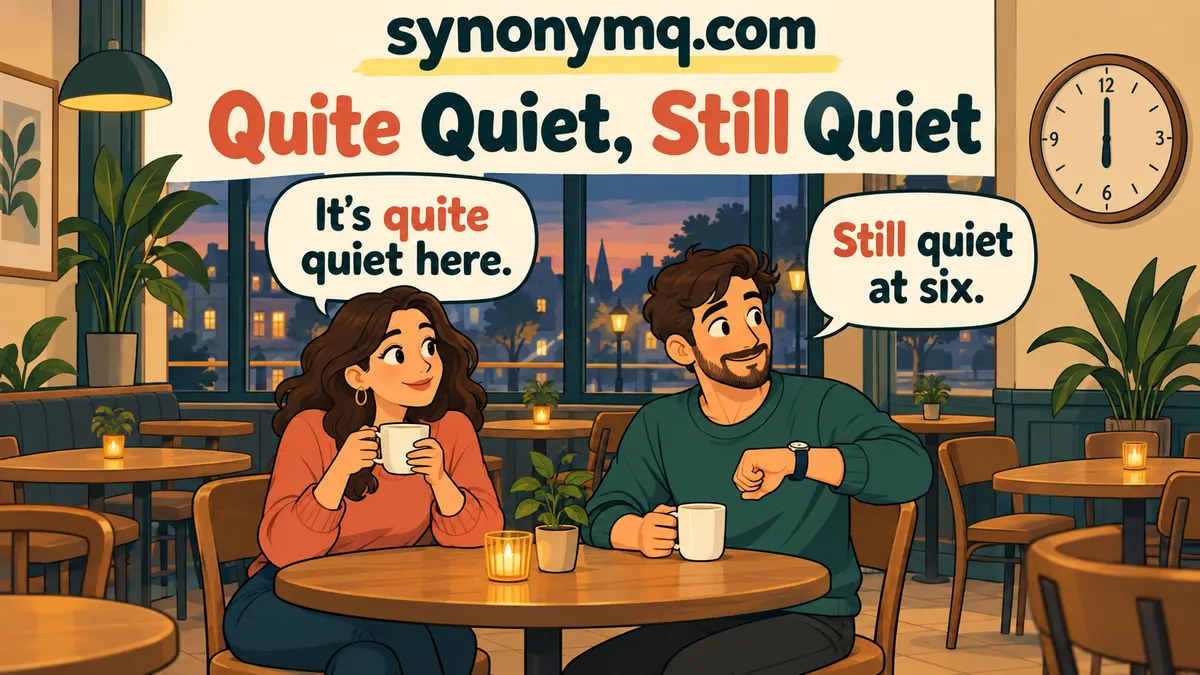
“It is quite quiet here” is grammatical: quite modifies quiet. The degree expressed by quite depends on context. It is not a spelling variant of quiet, so “Please be quite” does not mean “Please stop talking.”
Still quiet means the quietness continues
In “The café is still quiet at six,” still is an adverb showing that the condition continues. It does not mean the café is motionless. This is the continuing-time sense in Oxford’s still adverb entry.
Compare “The child is still,” which can describe no movement, with “The child is still talking,” which describes speech continuing. Look at the whole construction before choosing a synonym.
Silent is an adjective; silence can be a noun
In “The room was silent,” silent describes the room. Silence names the absence of speech or sound, so it needs a different grammatical position.
Requires Rewrite: “The room was silent.” → “There was silence in the room.”
Requires Rewrite: “He remained silent during the discussion.” → “He did not speak during the discussion.”
Silence is a Related Word here, not an adjective replacement. Write “Please be silent,” not “Please be silence.” Quiet can also be a noun: “I need some quiet” is grammatical.
Quiet, Calm and Silent in Familiar Phrases
Two similar words can work together when they contribute different details. “Calm and quiet” can describe both composure and low noise. “Still and silent” can describe both motion and sound.
“So silent and quiet” may simply repeat an idea. Keep both words if the repetition creates a rhythm you want; otherwise, one precise adjective usually gives the sentence enough direction.
| Phrase | Meaning in this use | Word-choice advice |
|---|---|---|
| A silent letter | A written letter that is not pronounced, such as the b in lamb | Keep silent; quiet letter is not the usual term for this feature. |
| Keep quiet about a plan | Do not reveal the plan | The request concerns information, not merely speaking softly. |
| Still water on a drinks menu | Water without carbonation | Neither quiet water nor silent water communicates this menu choice. |
| Peace and quiet | Freedom from unwanted activity or disturbance | Quiet is a noun here; the familiar expression is already clear. |
The drink sense of still is separate from water lying motionless in a pond. Collins records both meanings, so the setting matters even when the noun stays the same.
How This Page Was Checked
Definitions and grammatical forms were checked against Oxford, Merriam-Webster, Cambridge and Collins. The examples are original teaching sentences.
Recommendations describe the specific wording shown, not every possible use of each word.
The alternatives table uses the entries for soft, hushed, noiseless, peaceful, calm and unmoving. Merriam-Webster’s quiet entry also supports its noun use.
Frequently Asked Questions
Is quiet the same as silent?
They overlap. Quiet can allow low sounds or little activity. Silent usually emphasizes no speech or sound, although “be quiet” can also mean stop talking.
Can something be still without being silent?
Yes. A person can remain still while speaking. In that sentence, still describes movement and silent would describe speech. Still also has broader quiet or calm senses.
Does a quiet person always stay silent?
No. A quiet person may speak less or speak softly. Silent can describe not speaking at a particular moment or a habit of saying little.
Is “quite quiet” correct English?
Yes. Quite is an adverb of degree, and quiet describes low noise or activity. In “quite quiet,” the first word modifies the second; they are not alternative spellings.

Naveed Akhtar writes every guide on SynonymQ. He is an SEO content writer with ten years of article-writing experience, working on the question a thesaurus never answers: which of these words belongs in this sentence, for this reader. Every page cites the dictionary entries it draws on and the date they were read.