
Tired vs Exhausted vs Weary: 3 Differences That Matter
Tired vs exhausted vs weary depends on strength and context. Tired means needing rest; exhausted means very tired; weary often suggests tiredness after sustained effort. Weary of something means losing interest or patience. Choose by context.
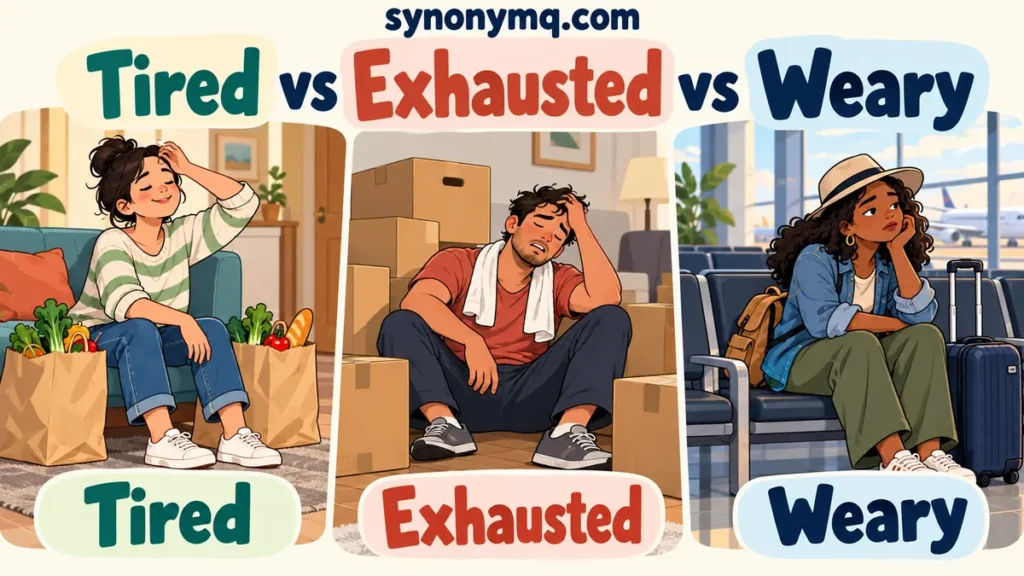
Tired vs Exhausted vs Weary: The Quick Comparison
After an afternoon of moving boxes, “I’m tired” and “I’m exhausted” can describe the same person with different emphasis. “I’m weary of moving boxes” adds another possibility: the speaker has had enough of the activity.
| Word | What it emphasizes | Original example | Watch for |
|---|---|---|---|
| Tired | A need for rest or sleep | My legs feel tired after the walk. | It is broad, not restricted to mild tiredness. |
| Exhausted | A strong lack of energy | By the last box, I felt exhausted. | It is stronger than an unqualified tired. |
| Weary | Tiredness, often after sustained effort | The weary passengers finally reached the station. | Weary of can mean losing interest or patience. |
Oxford Learner’s Dictionaries connects weary with hard work or long activity. It does not restrict the word to emotional tiredness. A long walk can leave you weary too.
1. Exhausted Makes the Tiredness More Emphatic
Tired is a useful everyday description when you want to say you need a rest. Exhausted makes that description stronger. It can fit physical effort, demanding concentration or an emotionally difficult experience.
Oxford defines exhausted as very tired and records both physical and emotional examples. “Exhausted is physical, weary is emotional” is therefore an unreliable rule.
Direct Swap: “I felt tired after clearing the storage room.” → “I felt exhausted after clearing the storage room.”
These are Near-Synonyms, but the replacement increases the emphasis. Choose exhausted if that stronger description is accurate. You do not improve the sentence merely by making it more dramatic.
Tired does not always mean slightly tired
“I’m extremely tired” is ordinary English. Oxford’s tired entry includes strong modifiers, so tired is not confined to the lowest point on an energy scale.
There is no fixed vocabulary step above exhausted. If you need more detail, explain the experience: “I was exhausted after carrying furniture upstairs.” A concrete cause often tells the reader more than another intensifier.
For a short caption, “Tired after the walk, happy about the view” makes a clear contrast. This is an original example, not a quotation attributed to a famous person.
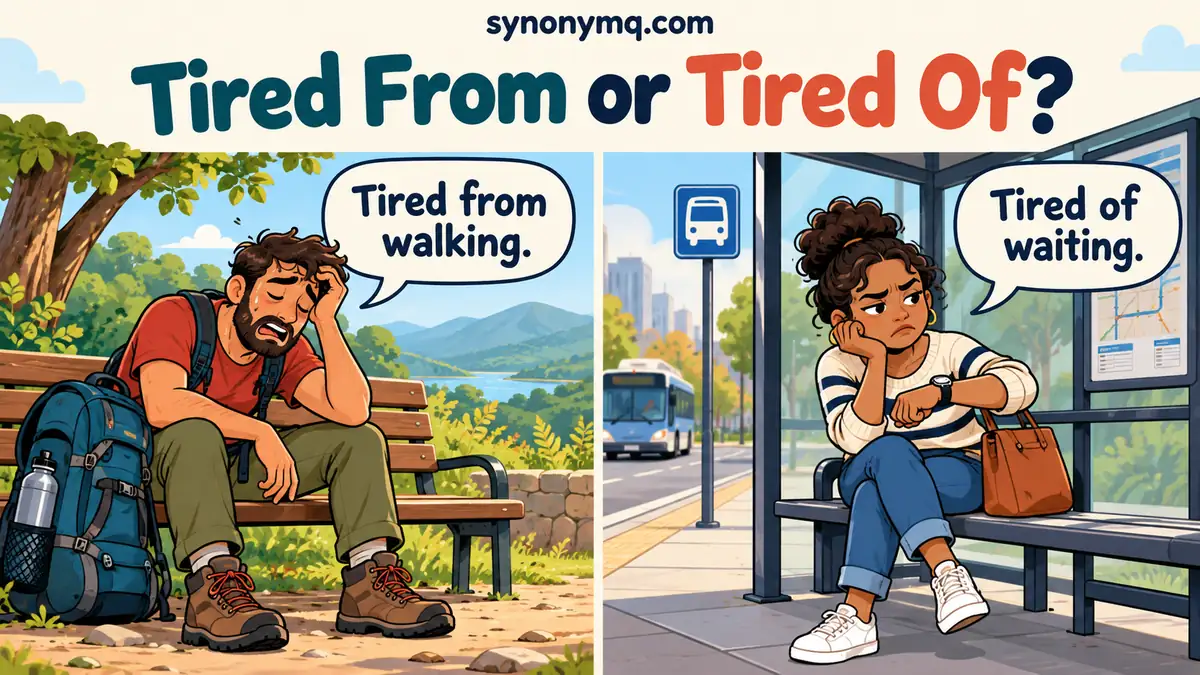
2. Tired From and Tired Of Say Different Things
“I’m tired from walking” identifies what caused the tiredness. “I’m tired of walking” says you have had enough of walking. You might mean both, but changing from to of changes what the sentence tells the reader.
| Sentence | Likely meaning | What not to assume |
|---|---|---|
| I’m tired from answering calls. | The calls have used my energy. | It does not necessarily say I dislike the work. |
| I’m tired of answering calls. | I have had enough of the activity. | It does not necessarily say I need sleep. |
| I’m weary of the same excuses. | My patience or interest has run out. | The complaint is not about physical exertion. |
| I’m exhausted from answering calls. | The activity has left me very tired. | It is not a direct equivalent of being bored with it. |
Merriam-Webster records weary of as exhausted patience, tolerance or pleasure. That explains why someone can be weary of delays even while feeling physically energetic.
Weary of is more formal than fed up with
Oxford marks the weary of sense as formal. “Residents are weary of repeated delays” can suit a report. “We’re fed up with the delays” sounds more conversational and directly expresses frustration.
Do not write “exhausted of the excuses” as a routine replacement. Use weary of or tired of for lost patience, or rewrite the sentence if you mean the excuses and arguments have drained your energy.
3. A Person Feels Tired; a Task Can Be Tiring
In “I feel tired,” tired describes the speaker’s state. In “Moving boxes is tiring,” tiring describes the activity’s effect. Oxford defines tiring as making someone need rest or sleep.
Requires Rewrite: “I was tired after moving the boxes.” → “Moving the boxes was tiring.”
The rewrite shifts attention from the person to the cause. It is useful when you want to describe the work itself. “I am tiring” does not normally give the same simple description as “I am tired.”

Tired and exhausted work before a noun or after a linking verb: “a tired worker,” “an exhausted worker,” and “the worker seems exhausted.” Weary also fits both positions: “a weary passenger” and “the passenger looked weary.”
In a sentence such as “The long climb tired us,” tired is a past-tense verb instead. Oxford’s verb entry for tire separates this use from the adjective.
For more examples of word-choice problems caused by meaning or grammar, see commonly confused words grouped by their differences. The sentence structure matters as much as the synonym list.
Test a Replacement in the Whole Sentence
Use a stronger word only when you want a stronger meaning. These six alternatives are classified for the examples shown. A direct swap preserves the grammar; it does not promise identical emphasis.
| Alternative | Relationship | Original → replacement | Operation and effect |
|---|---|---|---|
| Exhausted | Near-Synonym of tired | We felt tired after the move. → We felt exhausted after the move. | Direct Swap. Stronger; avoid if you mean only a little tired. |
| Weary | Near-Synonym of tired | The tired passengers sat down. → The weary passengers sat down. | Direct Swap. Suits the context of a long or demanding journey. |
| Drained | Near-Synonym of exhausted | I felt exhausted after the discussion. → I felt drained after the discussion. | Direct Swap. Emphasizes having little energy left. |
| Worn out | Near-Synonym of exhausted | We were exhausted after gardening. → We were worn out after gardening. | Direct Swap. Fits a person feeling very tired after work. |
| Sleepy | Contextual Alternative | I feel tired and want to go to bed. → I feel sleepy and want to go to bed. | Direct Swap. Specifically points to wanting sleep, not just rest. |
| Fed up | Contextual Alternative | I’m weary of the delays. → I’m fed up with the delays. | Swap With Adjustment. Change of to with; the complaint becomes more conversational. |
Oxford describes drained as very tired and without energy. Exhausted and drained overlap; do not turn them into fixed categories in which one is always physical and the other always emotional.
Oxford labels fed up informal and records fed up with. Keep weary of if its more formal tone suits the sentence. Neither phrase is a substitute for tired from exercise.
Weary and Wary: One Letter, a Different Meaning
Weary means tired or lacking enthusiasm; wary means cautious about a possible problem. Oxford’s wary entry emphasizes caution. The words are spelling confusables, not synonyms.
A hiker can be weary after a long walk and wary of a slippery path. The first word describes tiredness; the second describes caution. Replacing one with the other changes the message rather than its strength.

Check the meaning before correcting the spelling. “We’re wary of another delay” can mean concern about its possibility. “We’re weary of the delays” says the repeated experience has worn down our patience.
Where Sleepy, Fatigued and Fatigue Fit
Sleepy specifically means needing or being ready for sleep. Tired is broader. After carrying boxes, “I need to sit down” can explain tiredness without saying you are ready for bed.
Oxford labels fatigued formal and allows physical or mental tiredness. It is a Near-Synonym of exhausted in suitable contexts, but it need not improve an ordinary message to a friend.
Fatigue is a noun in “The workers experienced fatigue.” It is a Related Word, not an adjective replacement after are. Write “They are fatigued” or “They feel tired,” rather than “They are fatigue.”
Requires Rewrite: “The workers were tired.” → “The workers experienced fatigue.”
The rewrite makes the wording more formal and shifts attention to the condition. This comparison concerns English usage; the choice of adjective alone does not establish a medical cause or tell you how long a feeling will last.
How This Page Was Checked
Definitions, adjective patterns and register labels were checked against Oxford Learner’s Dictionaries and Merriam-Webster. The sentence comparisons are original applications of those entries, not personal accounts.
Oxford’s entry for worn out supports its use for a very tired person. The examples distinguish energy, patience, caution and grammar without assigning a medical meaning to every everyday word.
Frequently Asked Questions
What is the difference between “weary” and “exhausted”?
Exhausted emphasizes very strong tiredness. Weary often suggests sustained effort or lost enthusiasm. Both can describe physical tiredness; weary of also expresses having had enough.
What is the difference between “weary” and “tired”?
Tired is the broader everyday word. Weary often suggests tiredness after prolonged effort. Weary of something can also mean losing interest or patience.
Does weary mean tired?
Yes. Weary can describe a tired person, body part or expression. In weary of something, it can instead emphasize boredom or a loss of patience.
What are the four types of tired?
There is no fixed four-part classification in ordinary English. Words such as tired, sleepy, exhausted and weary describe overlapping meanings, not four universal medical categories.

Naveed Akhtar writes every guide on SynonymQ. He is an SEO content writer with ten years of article-writing experience, working on the question a thesaurus never answers: which of these words belongs in this sentence, for this reader. Every page cites the dictionary entries it draws on and the date they were read.