
Risk vs Issue: 4 Simple Checks to Avoid Vague Updates
Risk vs issue is mainly a distinction between uncertainty and an existing concern. In project updates, a risk may affect the plan; an issue needs attention now. Write “delivery may be late” for a risk and “delivery is late” for an issue.
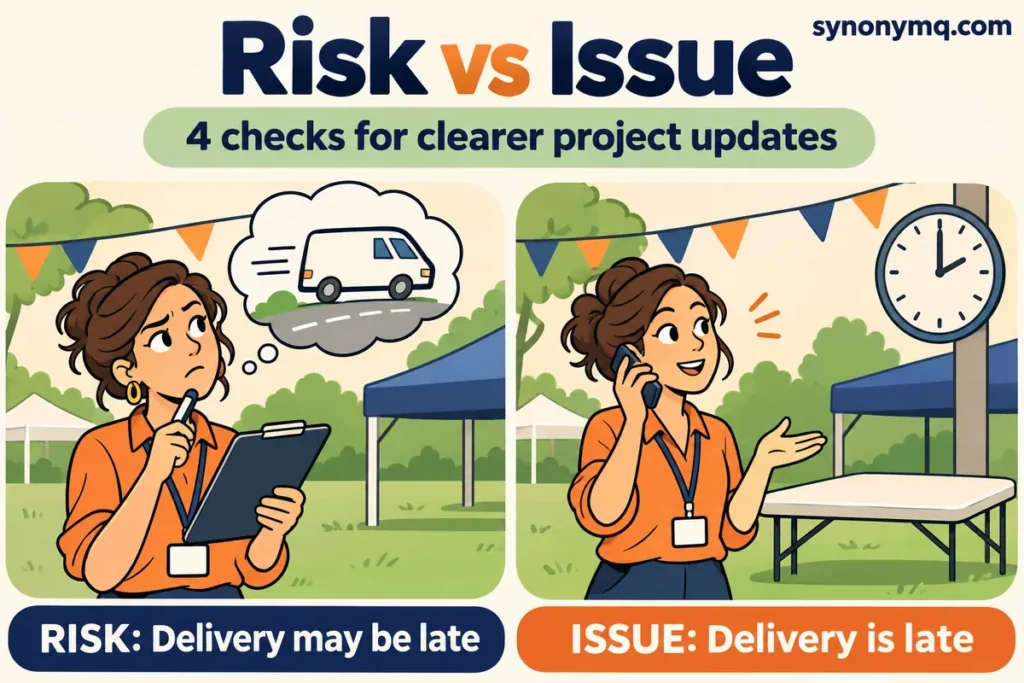
Risk vs Issue: Four Checks Before You Choose
“We have a supplier issue” leaves the reader guessing. Has the supplier missed a deadline, or are you worried that it might? The right noun helps, but the sentence also needs to say what is known.
Cambridge Dictionary describes the everyday meaning of risk around the possibility of harm. Its entry for issue includes both a problem and a subject people discuss.
1. Identify what is still uncertain
Use risk when an uncertain event or circumstance could affect the work. “The supplier may miss the delivery date” identifies a possibility. “The missed delivery is delaying setup” reports an existing problem.
Do not classify the item by how worrying it sounds. A serious risk can remain uncertain, while a minor issue can already exist. Severity and certainty answer different questions.
In everyday writing, risk usually suggests a possible bad result. Project terminology can be broader: a PMI-published discussion of risks and issues includes positive as well as negative effects.
A possible early delivery might create an opportunity to finish setup sooner. That belongs to the wider project-management sense of risk, even though most readers would not call early delivery “a risk” in casual conversation.
2. Separate a possibility from a confirmed problem
Once the supplier misses the agreed delivery time, the missed delivery is a fact. Calling it only a risk makes the update less precise. State the problem, its known effect and the next action.
The calendar is not the only test. A supplier may confirm today that it cannot fulfil next week’s booking. The event lies ahead, but the inability to fulfil the booking is already a problem to address.
University of Exeter’s guidance explicitly includes events that will definitely occur in its issue category. This is why “risk means future, issue means past” is a useful shortcut with limits.
3. Keep the current issue separate from its possible effects
An issue can create another risk. “The delivery is late” describes the current situation. “The delay may prevent us from opening on time” describes a further effect that remains uncertain.
Write both statements when both matter. Otherwise, “the opening is at risk” can hide the immediate problem, while “the event will open late” may claim more certainty than the evidence supports.
Choose the level you are describing: the missed delivery, the delayed setup or the possible late opening. They are connected, but they do not necessarily have the same status.
4. Check whether you are using project terminology
In a formal project report, use the definitions agreed for that project. In an ordinary conversation, issue can simply mean a matter for discussion. “The issue of accessibility” does not, by itself, report a failure.
The APM glossary uses a narrower project definition of issue, tied to delegated tolerances and sponsor support. That definition should not be presented as the only meaning of the everyday word.
When a label could confuse your audience, name the situation first. “The venue has cancelled our booking” is more informative than “a venue issue has arisen,” whichever reporting framework you use.
One Delivery, Three Different Updates
Imagine a community event waiting for hired equipment. The following fictional updates show how the wording changes as evidence becomes available. The examples illustrate the distinction; they are not reports of a real event.
| What is known | Useful wording | Why it fits |
|---|---|---|
| The delivery is due tomorrow. The supplier warns of possible disruption. | There is a risk that the equipment will arrive late. | The delay has not been confirmed. |
| The agreed arrival time has passed. The equipment has not arrived. | The equipment delivery is late; setup is paused. | The missed delivery is now an issue. |
| Setup is paused, but the team might still finish before opening. | The late delivery creates a risk of a delayed opening. | A confirmed issue has an uncertain further effect. |

Notice that the issue does not erase the remaining uncertainty. The delivery can be late without making a late opening inevitable. See imminent vs inevitable for another distinction between timing and certainty.
A useful update could read: “The delivery missed its arrival slot. Lina is arranging collection from the depot. We will confirm the opening time after the equipment arrives.”
This wording names the fact, the owner and the next decision. It avoids both a vague warning and an unsupported promise that everything will be fine.
Risk Register or Issue Log?
A risk register records identified risks and planned responses. An issue log records issues and tracks their handling. The APM glossary distinguishes these records, although organisations may combine them within one system.
For risk and issue management, the record should help someone decide what to do. A label without a clear description, owner or follow-up is unlikely to support a useful conversation.
| Record | Information to include | Event example |
|---|---|---|
| Risk register | Uncertainty, possible effect, assessment, owner, response and review date | Possible late delivery; confirm transport arrangements before the event. |
| Issue log | Known problem, current effect, owner, action, target date and status | Delivery missed; organise collection and record when setup can resume. |
These are suggested fields, not a mandatory template or examination rule. In a RAID log, use the risks and issues sections according to your organisation’s definitions; the chosen format does not replace a clear description.
If a tracked risk occurs, update its status and connect it to the issue record where your process requires one. Retain the history so readers can see what was anticipated and what actually happened.
Do not create two unrelated entries that look like separate problems when they describe the same event. Equally, do not close every associated risk merely because one event has occurred; further uncertain effects may remain.

Better Wording for Emails and Reports
Risk and issue are related words, not interchangeable synonyms. Replacing one with the other can change a possibility into an apparent fact, or make a confirmed problem sound hypothetical.
For a risk statement, describe the uncertainty and the effect it could have. For an issue statement, describe what is known and what needs attention. Use the wording as a guide, not a form that must fit every sentence.
| Vague wording | Clearer wording | What the edit changes |
|---|---|---|
| There is a staffing issue. | Two confirmed absences leave the welcome desk uncovered. | Names an existing problem. |
| Staffing will be a problem. | If the remaining volunteer cancels, the desk may be uncovered. | Shows the condition and possible effect. |
| We have a risk with the booking. | The venue has cancelled the booking; we need another location. | Reports a fact instead of understating it as uncertainty. |
Keep ordinary grammatical patterns in mind: a risk of delay, a risk that delivery will be late, an issue with the booking, and an issue to resolve. The surrounding words help identify the intended meaning.
“We may have an issue” is grammatical everyday English. It anticipates a possible problem. In a project risk statement, explain what may happen rather than assuming the word issue proves that the problem already exists.
Likewise, “at risk” describes exposure to a possible adverse result: “The opening time is at risk.” It does not establish that the opening time has already changed. Add the confirmed facts when you have them.
When Issue Means a Topic
“We discussed the issue of accessibility” can mean that accessibility was the subject under discussion. “We found an accessibility issue” normally points to a problem. The surrounding sentence makes the difference.
Do not turn every issue into a danger. Nor should issue automatically replace problem as a softer-sounding word: a precise description often helps the reader more than either label.
| Original sentence | Alternative | Substitution guidance |
|---|---|---|
| There is an issue with the booking. | There is a problem with the booking. | Direct Swap: problem is a near-synonym in this sentence. |
| Accessibility was the main issue discussed. | Accessibility was the main topic discussed. | Direct Swap: topic is a contextual alternative for the discussion sense, without implying a fault. |
| There is a risk of a late delivery. | The delivery might be late. | Requires Rewrite: a contextual alternative that states the uncertain event directly. |

Other meanings are separate again. An issue of a magazine is an edition, and to issue a notice is to release it. Risk cannot replace issue in either expression.
How This Page Was Checked
Everyday meanings were checked against Cambridge Dictionary. Project usage was compared with PMI-published material, APM’s glossary and University of Exeter guidance. The examples are original illustrations; framework-specific limits are stated where relevant.
Frequently Asked Questions
Can an issue exist before its effects are visible?
Yes. A confirmed cancellation is already a problem, even if its disruption comes later. Distinguish the known situation from effects that remain uncertain.
Does every issue begin as an identified risk?
No. A team can discover an issue it never recorded as a risk. Recording risks improves preparation; it does not guarantee every problem will be predicted.
Is an issue always more serious than a risk?
No. An issue may be minor, while an uncertain risk could have severe consequences. Judge urgency and impact separately from whether something has happened.
Are a dependency and a risk the same thing?
No. A dependency is a relationship between activities or requirements. Uncertainty about whether a dependency will be met can create a risk.

Naveed Akhtar writes every guide on SynonymQ. He is an SEO content writer with ten years of article-writing experience, working on the question a thesaurus never answers: which of these words belongs in this sentence, for this reader. Every page cites the dictionary entries it draws on and the date they were read.