
Imminent vs Inevitable: 4 Combinations, Not 2 Degrees
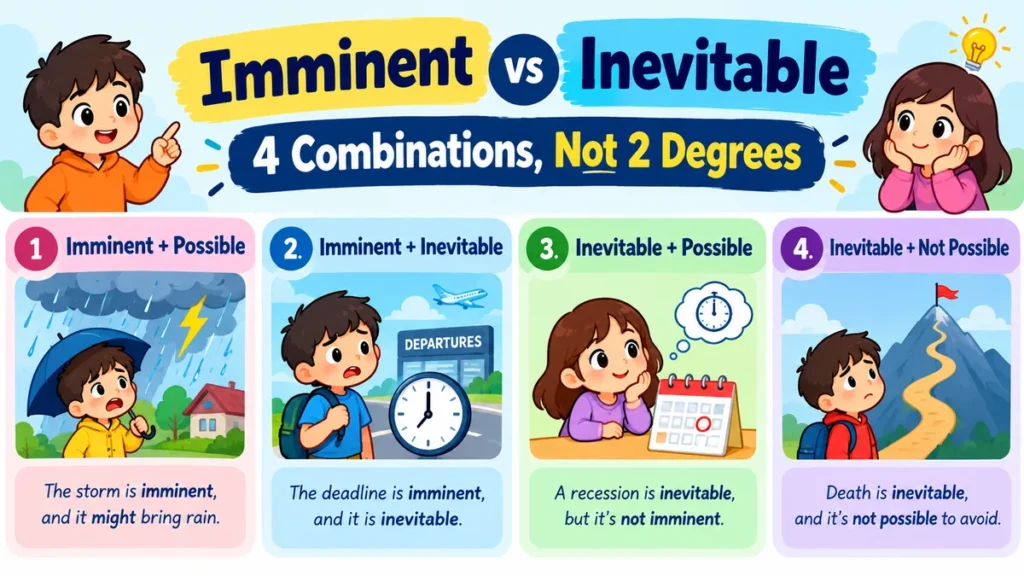
Imminent vs inevitable is not a question of degree. Oxford defines imminent as likely to happen very soon, and inevitable as something you cannot avoid or prevent. One is about time; the other is about certainty, and its definition contains no time at all.
Written by Naveed Akhtar, an SEO content writer with 10 years of article-writing experience. About 8 minutes to read.
The Proof Is in What Oxford Leaves Out
Put the two definitions side by side and read them for what is missing rather than for what is there.
| Word | Definition | What it is measuring |
|---|---|---|
| imminent | “(especially of something unpleasant) likely to happen very soon” | Time |
| inevitable | “that you cannot avoid or prevent” | Certainty |
There is no time in the definition of inevitable. Not “soon,” not “eventually,” nothing. And there is no certainty in the definition of imminent: something can be about to happen and still be stopped.
That is why these two words are not two settings on one dial. They answer different questions, and a sentence can need either answer, both, or neither.
There is one thing the definitions share, and it is worth noticing because it explains the confusion. Oxford hedges imminent with “especially of something unpleasant,” and its collocation list is arrival, catastrophe, danger.
Inevitable leans the same way in practice: Oxford’s own examples are job losses and a rise in interest rates. So both words turn up around bad news, which is why imminent vs inevitable feels like one question when it is two.
Imminent vs Inevitable: The Four Combinations
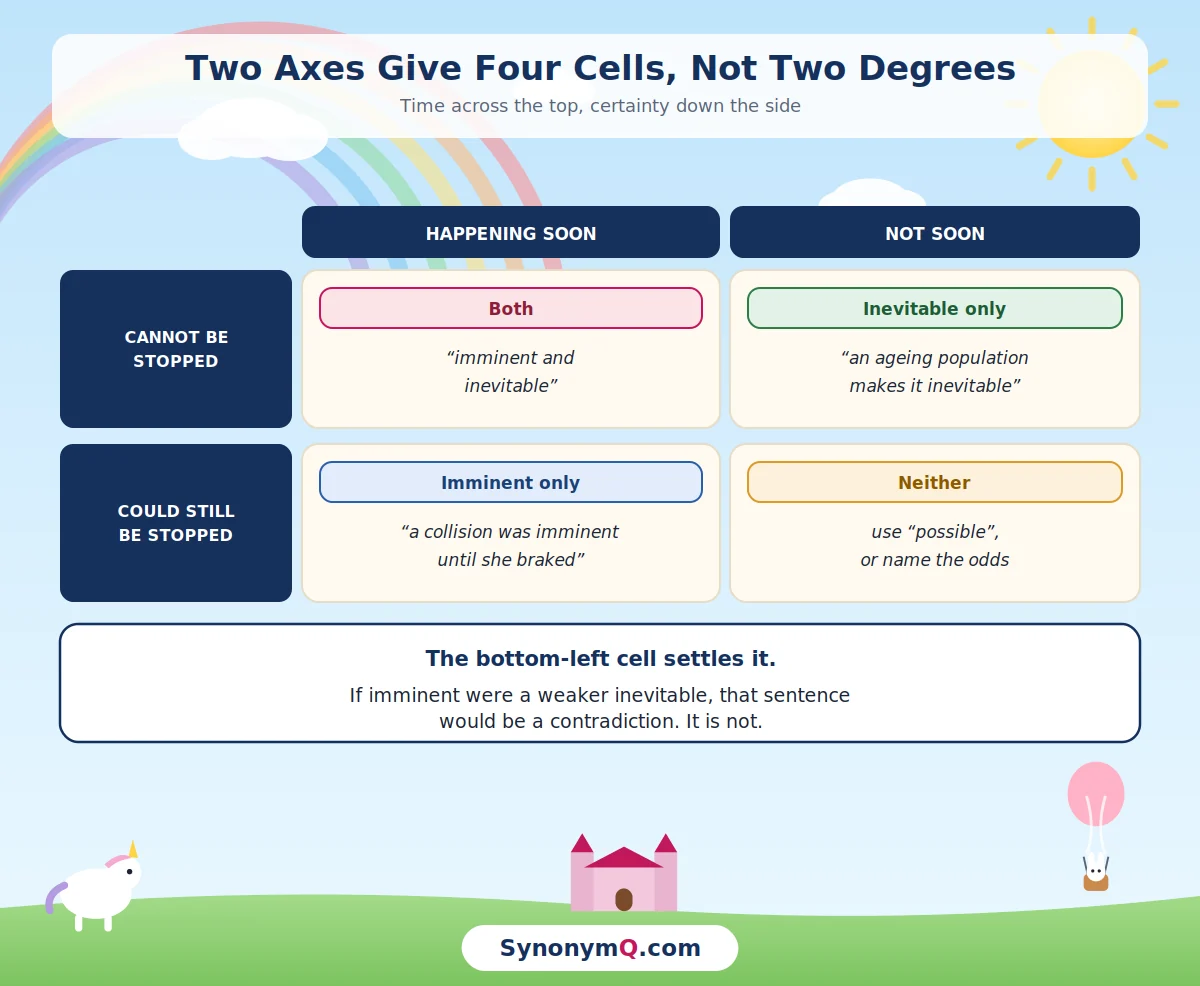
Two independent axes give four cells, and every one of them describes real situations you will need to write about.
| Happening soon | Not soon | |
|---|---|---|
| Cannot be stopped | Both. The collapse was imminent and inevitable | Inevitable only. An ageing population makes the change inevitable |
| Could still be stopped | Imminent only. A collision was imminent until she braked | Neither. Use possible, or name the odds |
The bottom-left cell is the one that settles the argument. A collision can be imminent and then not happen. If imminent were a weaker form of inevitable, that sentence would be a contradiction, and it is not.
Two-axis problems look like scales until you find the cell that breaks the line, which is the same thing that happens with the opposite of risk averse, where the missing middle term does the work.
One Sentence, Four Versions
The grid is easier to trust when you watch a single sentence move through it. Take a company announcing bad numbers.
| Sentence | What you have committed to |
|---|---|
| Redundancies are imminent. | They are days away. You have not said they are certain |
| Redundancies are inevitable. | They are coming. You have not said when, and it may be next year |
| Redundancies are imminent and inevitable. | Days away, and nothing will stop them |
| Redundancies are possible this quarter. | Neither close enough nor certain enough for either word |
Read as a staff email, those are four genuinely different messages, and the difference is not tone. The first leaves room for a reprieve. The second leaves room for a year of planning.
Getting this wrong in a document that people act on is the practical cost of treating imminent vs inevitable as a matter of emphasis. One reader clears their desk; another updates a forecast.
Each Word Already Has a Partner, and It Is Not the Other
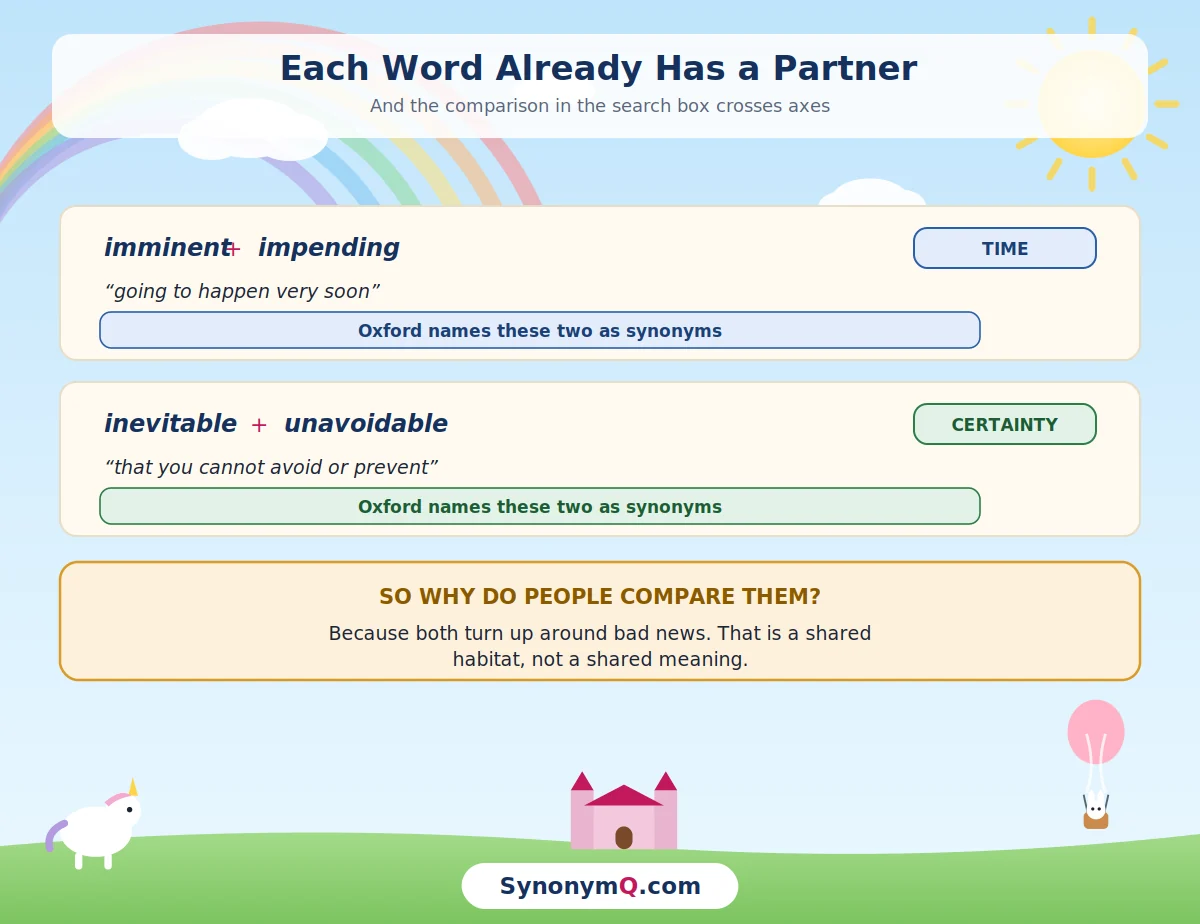
Here is the part that reframes the question. Neither of these words was short of a near-synonym before you compared them, and their real partners sit on their own axis.
| Word | Its real partner | Axis |
|---|---|---|
| imminent | impending, which Oxford names as a direct synonym | Time |
| inevitable | unavoidable, which Oxford gives as its synonym | Certainty |
Oxford defines impending as “(usually of an unpleasant event) that is going to happen very soon” and lists the same collocations as imminent: arrival, catastrophe.
So the comparison in the search box crosses axes. It is a reasonable thing to wonder, because both words show up around bad news, but it pairs each one with a word that is not measuring what it measures.
Two Things Inevitable Does That Imminent Cannot
Beyond the axes, the two words are not even the same kind of word, and a short check settles it.
First, inevitable is also a noun. Oxford gives the inevitable its own entry, glossed “something that is certain to happen,” with you have to accept the inevitable and the phrase bow to the inevitable.
There is no matching form of the other word. The imminent is not English, and that is a hard line you can check in five seconds.
Second, inevitable has a second sense that is often humorous: “happening so often that you always expect it,” illustrated by the English and their inevitable cups of tea.
Nothing is being called unstoppable there. It is affection dressed as fatalism, and imminent cannot be used that way at all. The English and their imminent cups of tea is simply an announcement that tea is coming.
Choosing in a Real Sentence
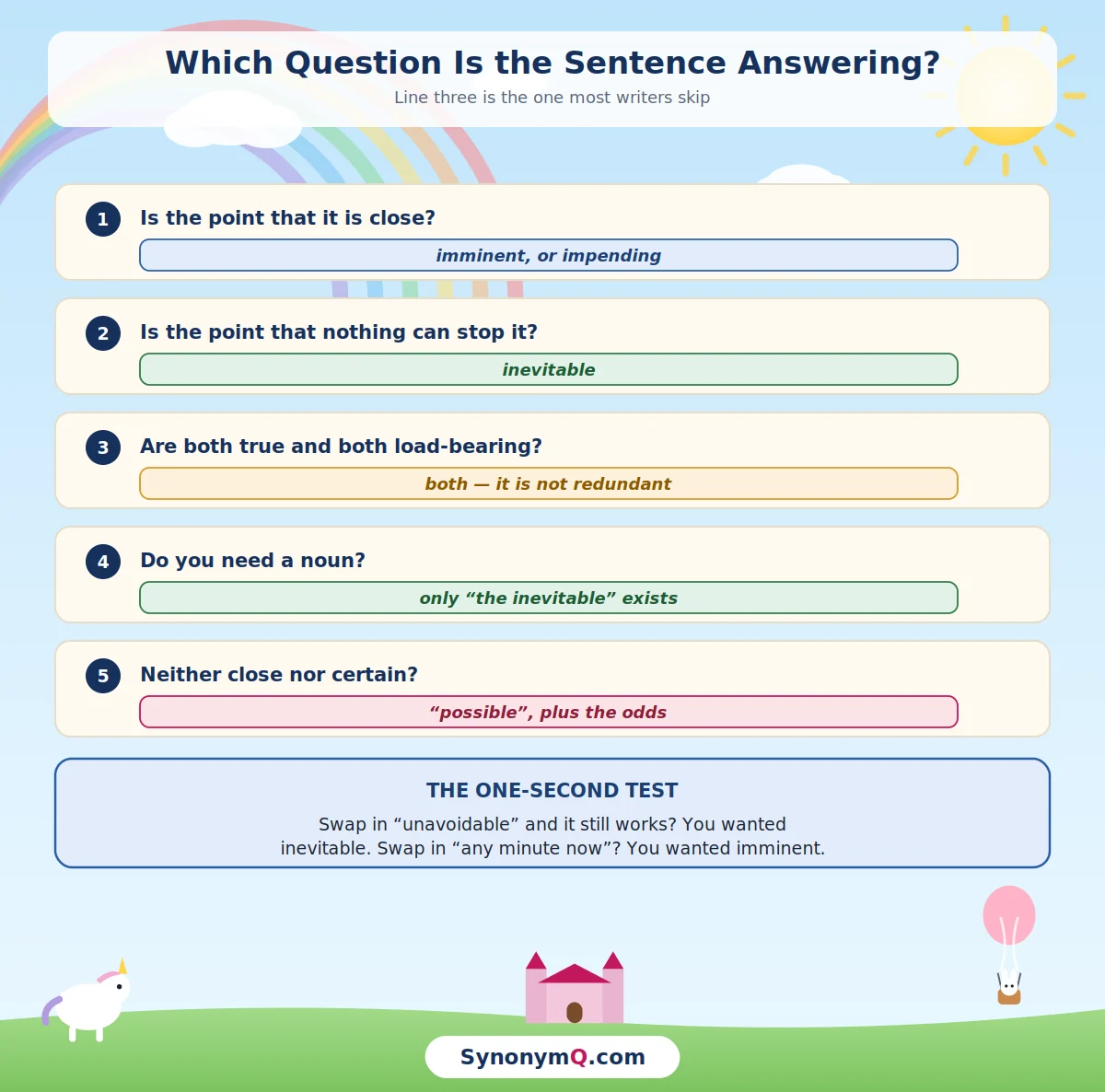
Work down this list and stop at the first line that matches.
- Is the point that it is close? Use imminent, or impending if you want the slightly more formal one.
- Is the point that nothing can stop it? Use inevitable, and note that you have said nothing about when.
- Are both true and both load-bearing? Use both. Imminent and inevitable is not redundant, because each word is carrying a different claim.
- Do you need a noun? Only inevitable has one: the inevitable.
- Is it neither close nor certain? Neither word fits. Say possible, or give the actual odds and the actual timeframe.
| Where | Verdict | Why |
|---|---|---|
| imminent and impending, describing timing | Direct Swap | Oxford names them as synonyms and gives them the same collocations |
| inevitable to unavoidable | Swap With Adjustment | Same claim, but you lose the noun form and the humorous sense |
| imminent to inevitable, or back | Requires Rewrite | You have changed which question the sentence answers, from when to whether |
Words that sit near each other because they turn up in the same kind of sentence, rather than because they mean the same thing, are the recurring trap at comprised vs compromised and notable vs noteworthy.
Frequently Asked Questions
What is the difference between imminent and inevitable?
Imminent means it will happen very soon. Inevitable means it cannot be avoided. Oxford’s definition of inevitable mentions no timeframe at all, so something can be inevitable and still years away.
Can something be imminent but not inevitable?
Yes, and this is the clearest proof the words are not degrees of each other. A collision can be imminent right up to the moment somebody brakes. It was about to happen; it did not happen.
Can something be inevitable but not imminent?
Yes, and it is common in writing about demographics, climate and long-term costs. An ageing population makes the change inevitable says nothing about the change arriving this year.
Is “imminent and inevitable” redundant?
No. Each word carries a separate claim, so the pair says the event is both close and unstoppable. It is only redundant if one of the two is not actually true.
Which word is stronger?
Neither, because they are not on the same scale. Inevitable feels stronger because it removes hope, but imminent is the more urgent of the two, and urgency and certainty are different pressures.
How This Page Was Checked
Read from the sources attributed, on 27 September 2026:
- Oxford Learner’s Dictionaries, imminent: “(especially of something unpleasant) likely to happen very soon,” and the collocations arrival, catastrophe, danger.
- Oxford Learner’s Dictionaries, inevitable: sense 1 “that you cannot avoid or prevent” with the synonym unavoidable; the humorous second sense and its cups-of-tea example; and the noun entry the inevitable with bow to the inevitable.
- Oxford Learner’s Dictionaries, impending: “(usually of an unpleasant event) that is going to happen very soon,” its identification of imminent as a synonym, and the shared collocations.

Naveed Akhtar writes every guide on SynonymQ. He is an SEO content writer with ten years of article-writing experience, working on the question a thesaurus never answers: which of these words belongs in this sentence, for this reader. Every page cites the dictionary entries it draws on and the date they were read.