
Appreciation vs Gratitude — 3 Times They Are Not Interchangeable
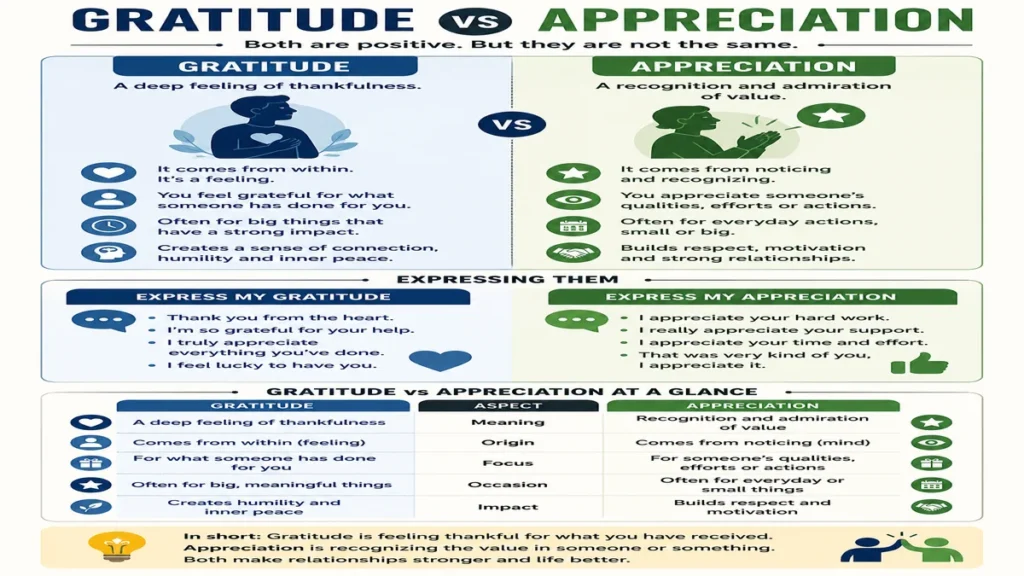
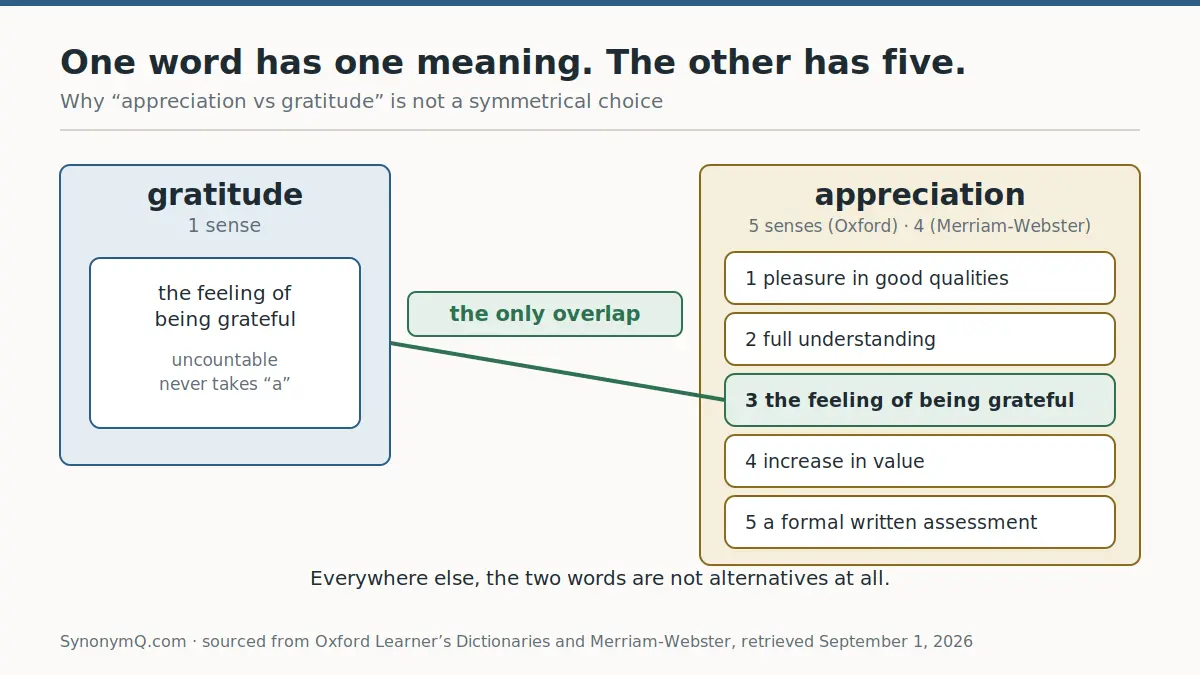
Appreciation vs gratitude comes down to range. Gratitude has one meaning: the feeling of being grateful. Appreciation has that meaning plus several others. When you are thanking someone, both words work and the choice is about warmth and formality. Everywhere else, the substitution runs one way only, and three of appreciation’s other senses have no gratitude equivalent at all.
Appreciation vs Gratitude: The Short Version
Every thesaurus lists these two as synonyms. Merriam-Webster puts appreciation first among gratitude’s synonyms. That listing is accurate and it is also the reason people get this wrong: a thesaurus records candidacy, not interchangeability.
| Word | Senses in Oxford Learner’s | Senses in Merriam-Webster | Grammar |
|---|---|---|---|
| gratitude | 1 | 1 | Uncountable. Never takes a or an |
| appreciation | 5 | 4 | Uncountable, singular, and countable in one formal sense |
The two words meet inside exactly one of appreciation’s senses. That overlap is real and you can use it. The other senses are where writers come unstuck.
What Gratitude Means
Oxford Learner’s Dictionaries defines gratitude as “the feeling of being grateful and wanting to express your thanks”, and marks it uncountable, CEFR level C1. There is no second sense. There is no technical sense, no financial sense, no aesthetic sense.
The grammar that actually breaks
The patterns are narrow and worth memorizing, because they are where the word fails when you push it somewhere it does not go:
- gratitude to someone for something: I would like to express my gratitude to everyone
- in gratitude for something: She was presented with the gift in gratitude for her long service
- with gratitude: He smiled at them with gratitude
- a debt of gratitude: I owe you a great debt of gratitude
Note the prepositions. Gratitude runs to a person and for a thing. It does not take of before the thing you are grateful for, which is precisely the slot appreciation fills.
The adjectives it takes
Oxford lists deep, profound and heartfelt among gratitude’s adjectives, and the entry’s own examples reach for a deep sense of gratitude and eternal gratitude. Every one of those intensifies rather than qualifies. That is a small signal worth reading: the word is built to be felt strongly, which is why using it for a minor favor sounds slightly off even when nothing is technically wrong.
What Appreciation Means, All Five Senses
Oxford lists five. Only the third one is about thanks.
| Sense | Example | Grammar | Can gratitude replace it? |
|---|---|---|---|
| Pleasure in recognizing good qualities | an appreciation of jazz | uncountable | No |
| Full understanding of a situation | a full appreciation of the risks | uncountable or singular | No |
| The feeling of being grateful | a token of your appreciation | uncountable or singular | Yes |
| Increase in value over time | appreciation of the property | uncountable or singular | No |
| A formal written or spoken assessment | a critical appreciation of Keats | countable, marked formal | No, but rare enough to ignore |
Merriam-Webster splits the same territory into four senses rather than five, grouping the assessment sense with judgment and evaluation. The dictionaries disagree about how to count. They agree completely about the asymmetry, and the asymmetry is the point.
That fifth sense is the one to set aside. A critical appreciation of Keats is a piece of literary criticism, the word is countable there, and Oxford marks it formal. Unless you write about literature for a living you will never reach for it, which is why the count in this article’s title is three rather than four.
The One-Way Substitution Rule
Test the swap in both directions and you get two different answers.

Gratitude to appreciation is usually a direct swap when you are thanking someone. I want to express my gratitude becomes I want to express my appreciation with no structural change and only a small shift in warmth.
Appreciation to gratitude is a swap with adjustment at best, and in three common cases it requires rewrite or fails outright. Those three cases are the ones in the title.

1. When appreciation means enjoyment
She has a deep appreciation of Baroque music.
Swap in gratitude and you get a deep gratitude of Baroque music, which is not a register problem or a stylistic wobble. It is ungrammatical. Gratitude does not take of before its object, and it does not mean enjoyment. If you want the gratitude word here, you have to rewrite the sentence entirely: she is grateful for Baroque music means something quite different and probably not what you meant.
2. When appreciation means understanding
The report shows a full appreciation of the risks involved.
This sense is common in business and academic writing and it has no gratitude equivalent at all. A full gratitude of the risks is nonsense. Watch for the article: a full appreciation is grammatical because appreciation can be singular here, while gratitude is uncountable and cannot take a in any sense.
This is also the sense that makes appreciation useful in writing that has nothing to do with thanks. A better appreciation of the trade-offs is a normal sentence in a strategy memo, and a reader who has filed appreciation under “polite noun for thank you” will misread it.
3. When appreciation means an increase in value
We are counting on appreciation of the property over ten years.
Its opposite is depreciation, which is the fastest way to confirm which sense you are reading. A learner who has been taught that appreciation simply means gratitude will misread a mortgage document, an annual report or a news story about house prices. This is the sense worth teaching explicitly for that reason.
The Prepositions Are Not Interchangeable Either
Even inside the overlap, where both words mean thanks, the grammar around them differs. This is the detail that separates writing that reads as fluent from writing that reads as almost right.

Write in appreciation of all you’ve done and in gratitude for her long service. Both appear in the dictionary record. What does not appear is the crossover: in appreciation for and in gratitude of are the two shapes to watch for in your own drafts.
Which One Should You Use?
Inside the thanking sense, where both words genuinely work, the choice is register and warmth rather than meaning.

| Situation | Better choice | Why |
|---|---|---|
| Work email to a colleague | appreciation | Warm without being intense. Gratitude can read as heavier than the favor deserved |
| Thank-you card after a personal kindness | gratitude | Carries more feeling. This is the situation it was built for |
| Reply to a positive performance review | appreciation | Professional register. Pairs naturally with feedback and support |
| Formal letter, eulogy, speech of thanks | gratitude | Weight is the point. Deep gratitude is idiomatic; the phrase carries in a way appreciation does not |
| Acknowledging long service or sacrifice | gratitude | A debt of gratitude has no appreciation equivalent in the dictionary record |
| Anything ambiguous or financial nearby | gratitude | Removes any chance of the value sense being read |
For a work email thanking someone for help on a project, use appreciation. Avoid gratitude there because the intensity overshoots: it can make an ordinary favor sound like a rescue, and the recipient notices.
Phrases Where the Choice Is Already Made
Some patterns are fixed. These are the ones the dictionary record actually supports, which is a narrower list than intuition suggests.
- A debt of gratitude. Oxford prints I owe you a great debt of gratitude. No parallel debt of appreciation appears in its entry.
- A token of either. This one surprises people. Oxford prints a token of my gratitude under gratitude and a token of your appreciation under appreciation. Both are attested. Use whichever fits your register.
- In appreciation of versus in gratitude for. Both are standard, and the preposition changes with the noun.
- A lack of appreciation. Oxford prints this one; the natural gratitude equivalent is the separate word ingratitude, which is stronger and sounds like an accusation.
- Feel gratitude, have appreciation. Oxford lists feel among gratitude’s verbs and have among appreciation’s. Both entries list express and extend, so those are safe with either word.
One caution on those last points. A verb missing from a dictionary’s collocation list is not proof that the combination is wrong, only that the dictionary did not list it. Treat these as reliable defaults rather than prohibitions.
When Gratitude Is Already the Better Word
Most advice on this pair pushes writers toward appreciation because it sounds more professional. That is a mistake often enough to be worth naming.
Gratitude is the better word whenever the feeling is genuinely large, whenever the context is personal rather than transactional, and whenever the sentence needs weight. I am deeply grateful lands harder than I have great appreciation, and in a eulogy, a resignation letter or a note after a serious kindness, landing harder is the entire job. Reaching for appreciation there reads as an attempt to keep emotional distance, which the reader will feel even if they could not name why.
There is a second case. When money, property or investment appears anywhere nearby, gratitude removes an ambiguity that appreciation introduces. We want to express our appreciation to our investors is a sentence with a faint second reading that nobody intended.
If the two words seem interchangeable in your sentence, you are inside the overlap and either is defensible. Pick gratitude when you mean it and appreciation when you are being courteous.
Frequently Asked Questions
Is it “express my gratitude” or “express my appreciation”?
Both are correct and both are attested. Oxford prints express my gratitude and lists express among appreciation’s verbs. Use gratitude for weight and appreciation for professional warmth.
Can appreciation always replace gratitude?
Within the thanking sense, effectively yes. The reverse is not true, and that asymmetry is the whole practical difference.
Why does my bank statement mention appreciation?
That is a separate sense meaning increase in value, the opposite of depreciation. It has nothing to do with thanks.
Is “gratitude” too formal for a work email?
Not too formal, but often too heavy. The word carries intensity rather than ceremony, so it fits a serious favor in a work email and overshoots an ordinary one.
How This Page Was Checked
Senses, grammatical labels, prepositions and example phrases were taken from the live dictionary entries for gratitude and appreciation at Oxford Learner’s Dictionaries, and cross-checked against Merriam-Webster, retrieved September 1, 2026. Where the two dictionaries divide the senses differently, both counts are shown rather than one being presented as definitive. No frequency or corpus claim is made anywhere on this page, because none was measured.
Related reading on SynonymQ: whether “I’m humbled” is the right response to praise, and formal alternatives to honor.

Naveed Akhtar writes every guide on SynonymQ. He is an SEO content writer with ten years of article-writing experience, working on the question a thesaurus never answers: which of these words belongs in this sentence, for this reader. Every page cites the dictionary entries it draws on and the date they were read.