
Grief vs Sorrow vs Sadness: Which One Fits Your Sentence
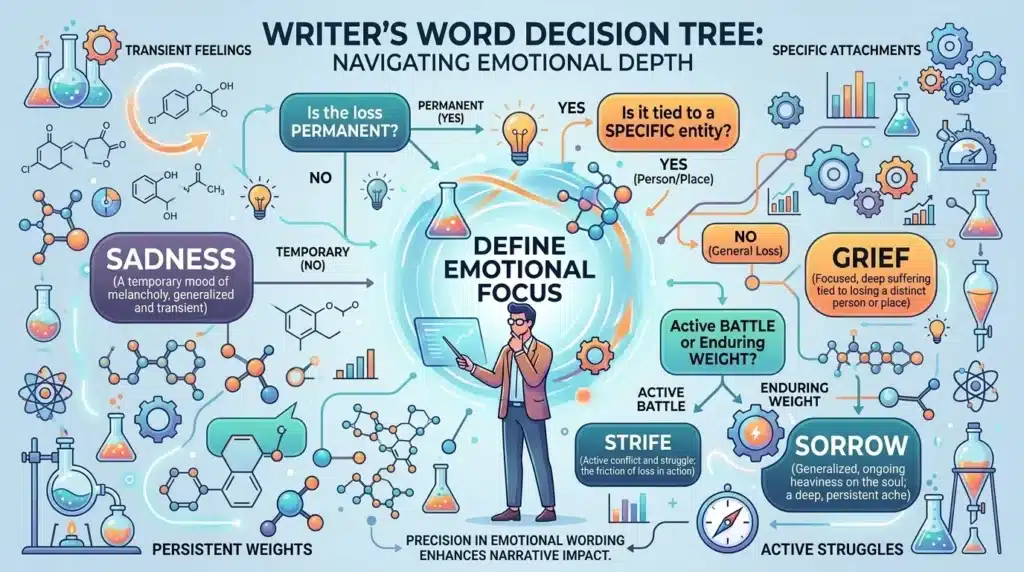
Grief vs Sorrow vs Sadness becomes clearer when you compare cause and register. Sadness is the general word: it needs no specific cause and carries no formality. Grief is sharper and tied to a particular loss, usually a death. Sorrow is the formal word and often adds a sense of regret or remorse. Choose by cause first, then by register.
The Three-Question Test
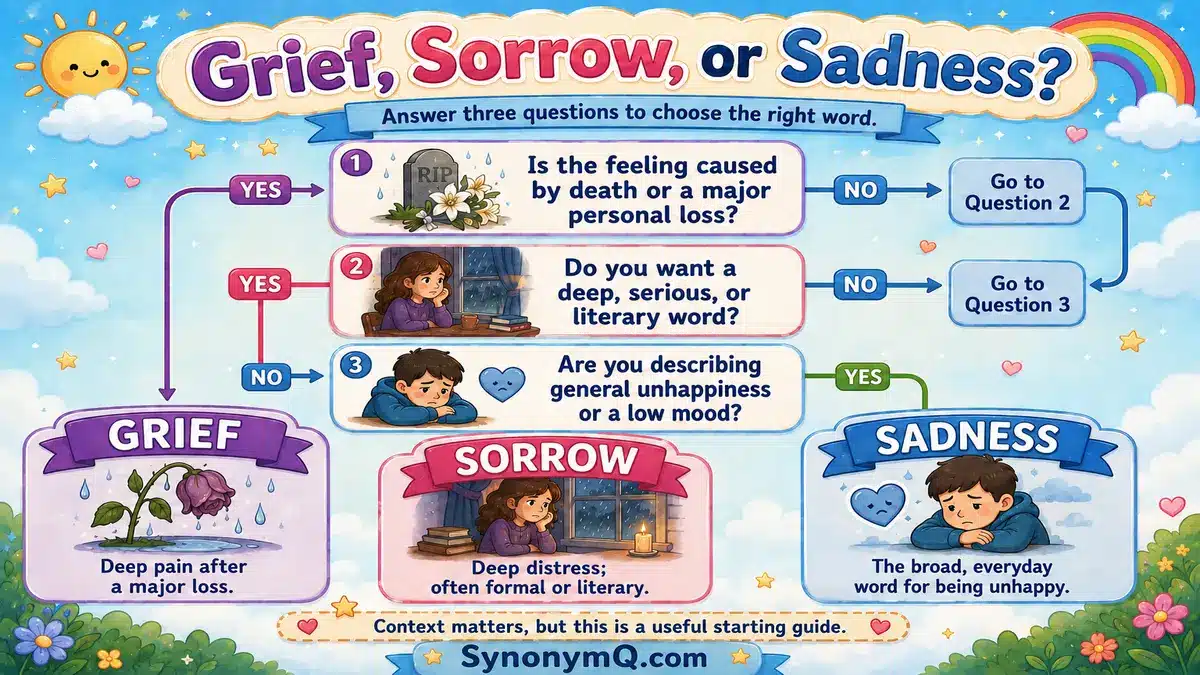
Most explanations of these words describe feelings. That doesn’t help you finish a sentence. These three questions do.
1. Is there a specific loss behind it? Yes, and recent: grief. No, or nothing you can name: sadness.
2. How formal is the writing? A eulogy, a legal statement, a hymn, a literary passage: sorrow. An email, an essay, a conversation: sadness.
3. Is there regret or remorse mixed in? Yes: sorrow. Merriam-Webster’s synonym discussion is explicit that sorrow “implies a sense of loss or a sense of guilt and remorse,” which is the note the other two don’t carry.
If two answers point different ways, question 1 wins. Cause outranks register, because using grief for a non-loss overstates the situation in a way readers notice immediately.
What Each Word Actually Means
These are the published definitions, not paraphrases.
| Word | Merriam-Webster’s definition | What it implies |
|---|---|---|
| Sadness | “the quality or state of being sad : sorrowfulness, unhappiness, gloominess” | Merriam-Webster calls sadness “a general term usually without implications about cause or intensity of unhappy feeling” |
| Grief | “deep and poignant distress caused by or as if by bereavement” | Merriam-Webster: grief “implies poignant sorrow for an immediate cause” |
| Sorrow | “deep distress, sadness, or regret especially for the loss of someone or something loved” | Merriam-Webster: sorrow “implies a sense of loss or a sense of guilt and remorse” |
Read the sadness row again, because it is the part every forum answer gets wrong. Sadness is not a weaker version of the other two. It is an unmarked one. It makes no claim about why you feel it or how hard it hits.
That’s why “a deep sadness” and “a passing sadness” are both natural. Neither phrase fights the word.
Sorrow Is Formal, and That Decides Most of Its Cases
Oxford Learner’s Dictionaries labels the noun sorrow “rather formal.” Neither grief nor sadness carries a register label in that dictionary, and sadness is marked B1, ordinary intermediate vocabulary.
That single label settles more word choices than any nuance of feeling.
Write sorrow in a eulogy, a condolence letter from an institution, a hymn, a court statement or a literary passage, and it reads as dignified. Write it in a message to a colleague and it reads as costume.
Overcorrected: I heard about your dog. I’m filled with sorrow. Natural: I heard about your dog. I’m so sorry. That’s really sad news.
This is the trap a thesaurus creates. Sorrow sits in the same synonym list as sadness, so it looks like an upgrade. It isn’t an upgrade; it’s a different register, and register mismatches are the most visible mistake in the whole family.
For more on how a formal-register word behaves once you move it into ordinary writing, see our guide to choosing between formal and casual alternatives for fancy.

Grief Has a Casual Sense the Other Two Don’t
Here is the reversal almost nobody mentions, and it is the most useful thing on this page.
Grief is usually described as the heaviest of the three. It is also the only one of the three with an everyday, low-stakes sense. Oxford Learner’s Dictionaries lists an informal meaning of grief: “problems and worry.”
That gives you:
- The new booking system gave us a lot of grief last quarter.
- Stop giving me grief about the deadline.
- Good grief, look at the time.
Now try the substitution:
- ✗ The new booking system gave us a lot of sorrow.
- ✗ Stop giving me sadness about the deadline.
- ✗ Good sorrow, look at the time.
All three fail, and they fail badly enough to be funny. So the direction of the error matters: swapping sorrow in for grief overstates; swapping grief in for sorrow can accidentally trivialise. Neither substitution is safe by default.
Oxford also lists come to grief (to end in failure or be harmed in an accident) and give somebody grief (to criticise and be annoyed with someone). Both are locked; see the locked phrases below.

Grief, Mourning and Bereavement Are Three Different Slots
Writers reach for these interchangeably and then produce sentences that don’t quite work. They aren’t synonyms; they’re three parts of one event.
| Word | What it names | Merriam-Webster |
|---|---|---|
| Bereavement | The fact of the loss: the circumstance you are in | “the state or fact of being bereaved or deprived of something or someone” |
| Grief | The feeling the loss produces, on the inside | “deep and poignant distress caused by or as if by bereavement” |
| Mourning | The outward expression of that feeling | “an outward sign (such as black clothes or an armband) of grief for a person’s death” |
Merriam-Webster doesn’t state the three-way distinction as a rule, but its own definitions build it: bereavement is a state, grief is caused by bereavement, and mourning is an outward sign of grief.
The practical consequences are immediate:
- Employers write bereavement leave, never “grief leave”. The policy responds to the fact of a death, not to a measurement of feeling.
- A person can be in mourning publicly while their grief is private, which is exactly why the two words exist.
- Bereaved describes the person; grieving describes what they’re doing; mourners describes who came to the funeral.
Get these right and a condolence note, an HR policy or a news paragraph stops sounding slightly off without the reader knowing why.
Can You Swap Them Directly?
Not often. Here is each pairing tested honestly.
| Original | Replacement | Works? | What changes |
|---|---|---|---|
| She was overcome with grief. | sorrow | Swap with adjustment | Becomes formal and adds remorse; fine in a eulogy, wrong in a text message |
| She was overcome with grief. | sadness | Requires rewrite | Understates severely; “overcome with sadness” reads as melodrama over a small cause |
| He expressed his sorrow at the news. | sadness | Direct swap | Slightly less formal, meaning intact |
| He expressed his sorrow at the news. | grief | Requires rewrite | Implies he personally suffered the loss, which the original doesn’t claim |
| A sadness she couldn’t explain. | melancholy | Direct swap | Oxford labels melancholy literary; fits fiction, not a report |
| A sadness she couldn’t explain. | grief | ✗ Fails | Grief needs a cause; “grief she couldn’t explain” contradicts the word |
| The system gave us grief. | sorrow / sadness | ✗ Fails | The informal sense has no equivalent in either word |
The pattern underneath: sadness substitutes into the other two more safely than they substitute into it. It is the unmarked term, so it rarely says anything wrong. It just says less.
If you want to test a swap in your own sentence rather than a sample one, run both versions through the SynonymQ synonym finder and read them aloud in order.
The same three-way marking is applied to a very different word in our substitution test for catalyst and its alternatives, if you want to see the method on a noun with no emotional weight at all.

Locked Phrases: Do Not Substitute
In these expressions the word is fixed. A synonym doesn’t weaken the phrase; it breaks it.
| Locked phrase | Meaning | Never write |
|---|---|---|
| good grief | exclamation of surprise or exasperation | good sorrow, good sadness |
| come to grief | to end in failure, or be hurt in an accident | come to sorrow, come to sadness |
| give someone grief | to hassle or criticise someone | give someone sorrow |
| grief-stricken | overwhelmed by grief | sorrow-stricken, sadness-stricken |
| drown your sorrows | to drink because you’re unhappy | drown your griefs, drown your sadness |
| more in sorrow than in anger | with regret rather than hostility | more in sadness than in anger |
The last one is worth pausing on. Oxford gives “They said that the decision was made more in sorrow than in anger” as a model sentence, and the phrase only carries its meaning with sorrow in it. Swap in sadness and you have a grammatical sentence that means nothing in particular.
Where the Words Came From (and Why Two Mean “Heavy”)
This is the part that makes the register difference feel less arbitrary.

Sad started somewhere unexpected. The Online Etymology Dictionary gives Old English sæd meaning “sated, full, having had one’s fill,” and traces the modern sense through the notion of “heavy, ponderous” and then “weary, tired of.” The meaning “unhappy, sorrowful, melancholy, mournful” is in place by around 1300.
Grief arrives at heaviness by an entirely separate road. Etymonline records it from early 13c. meaning “hardship, suffering, pain, bodily affliction,” from Old French grief, from Latin gravare “make heavy; cause grief,” from gravis “weighty.” Around 1300 it shifts to “mental pain, sorrow.” Merriam-Webster dates the English word to the 15th century in its current sense and gives the same Latin root.
Sorrow does not. Etymonline gives Middle English sorwe, from Old English sorg “grief, regret, trouble, care, pain, anxiety,” from Proto-Germanic *sorg-, perhaps from a root meaning “to worry, be sick.” Merriam-Webster dates it to before the 12th century, the oldest of the three in English.
So two of these words independently arrived at emotional pain through the idea of physical weight, and one arrived through the idea of worry and sickness. That is not a curiosity. It is why weighed down by grief and a heavy sadness are natural collocations, while a heavy sorrow is noticeably rarer. Sorrow’s imagery was never about weight.
Sorrow and Sorry Are Not Related
They look related. They aren’t. Etymonline states plainly that sorrow is “not considered to be connected etymologically with sore (adj.) or sorry.”
The resemblance is coincidence, and it’s worth knowing because the assumed link quietly pushes writers toward sorrow when they mean apologetic. They are two different ideas that happen to sound alike.

Choosing in Real Writing Situations
| You are writing | Use | Because |
|---|---|---|
| A condolence note to a friend | sorry / sad, or grief about their loss | Sorrow about your own feelings makes the note about you |
| An institutional condolence statement | sorrow | The formal register is the point |
| An HR or benefits policy | bereavement | It names the circumstance, not the emotion |
| A university essay on literature | sorrow or melancholy | Both fit the register; melancholy is literary |
| A psychology or health paper | sadness, or grief for loss specifically | The neutral clinical term is sadness |
| A news report on a death | grief for the family, mourning for public ritual | The two words cover different halves of the event |
| A novel, interior monologue | sadness or melancholy | Both work without a stated cause |
| A message to a colleague | sad | Anything heavier reads as performance |
The rule under the table: match the word to the register of the document, not to the size of the feeling. Writers overshoot because they’re trying to signal that they care, and the overshoot is what reads as insincere.
Stronger and Softer Than All Three
If none of the three is right, these are the nearest moves in each direction. The definitions in quotation marks are Merriam-Webster’s own synonym discussion.
Stronger than grief:
- Anguish: “suggests torturing grief or dread.” Use it for acute, active suffering, not for a settled state.
- Woe: “deep or inconsolable grief or misery.” Now largely literary or ironic; woe is me is a joke in most modern contexts.
- Despair: the loss of hope, not the presence of pain. A different axis entirely.
Softer or narrower than sadness:
- Melancholy: Oxford: “a feeling of being very sad that lasts for a long time and often cannot be explained,” labelled literary. Duration and inexplicability are built in.
- Regret: Merriam-Webster: “implies pain caused by deep disappointment, fruitless longing, or unavailing remorse.” Aimed backwards at a choice.
- Wistfulness: sadness with fondness in it. There is no equivalent among the main three.
Note that melancholy is the only one of these with a duration built into its definition. If the feeling needs to have lasted, that’s the word, and no amount of modifying sadness gets you there as economically.
Frequently Asked Questions
Is grief always stronger than sadness?
Usually, but strength is not the real difference. Grief is tied to a specific loss, and losses tend to hurt more than feelings with no cause attached. Merriam-Webster describes sadness as carrying no implication about intensity at all, so the distinction is cause, not size.
Can you grieve something that is not a death?
Yes. Merriam-Webster’s definition reads “caused by or as if by bereavement,” which covers a divorce, a diagnosis, a lost home or a closed business. What it does not cover is grief with no identifiable cause.
Which word belongs in an academic essay?
It depends on the field, not the feeling. Use sadness in psychology and health writing, where it is the neutral clinical term. Use sorrow or melancholy in literary criticism, where the register matches the subject. Do not mix the two conventions inside one paper.
Is sorrow an old-fashioned word?
No, it is formal rather than dated. Oxford Learner’s Dictionaries labels it “rather formal,” not archaic. It is current in eulogies, journalism and institutional statements. It simply is not conversational.
Mourning or grieving, which is which?
Grieving is the feeling; mourning is showing it. Merriam-Webster defines mourning as “an outward sign (such as black clothes or an armband) of grief for a person’s death.” You can grieve privately and never mourn publicly, or observe every form of mourning while feeling something far more complicated.
How This Page Was Checked
Every definition and label on this page was retrieved from a published dictionary on 26 August 2026 and is attributed in the sentence that uses it.
- Definitions, synonym discussions and first-use dates: Merriam-Webster
- Register labels, CEFR levels, IPA and example sentences: Oxford Learner’s Dictionaries
- Etymologies and sense-shift dates: Online Etymology Dictionary
Collocation observations (that a heavy sorrow is rarer than a heavy sadness, for instance) are SynonymQ editorial judgement based on general modern usage, not corpus measurements. They are marked as such rather than presented as data.
Target topic: SynonymQ lexical methodology, covering how synonym relationships, register labels and regional claims are classified and verified.
Target topic: SynonymQ synonyms for sadness, the full alternatives hub this comparison belongs to.
Related on SynonymQ: how register changes which alternative to honor you should pick · the emotional-state vocabulary around empowered

Naveed Akhtar writes every guide on SynonymQ. He is an SEO content writer with ten years of article-writing experience, working on the question a thesaurus never answers: which of these words belongs in this sentence, for this reader. Every page cites the dictionary entries it draws on and the date they were read.