
A synonym for fancy depends on the sense you need. For decoration, use ornate, elaborate or intricate. For expense and status, use upscale, posh, luxurious or swanky. For the disapproving edge, use ostentatious, flashy or pretentious. British English also uses fancy as a verb meaning like or want.
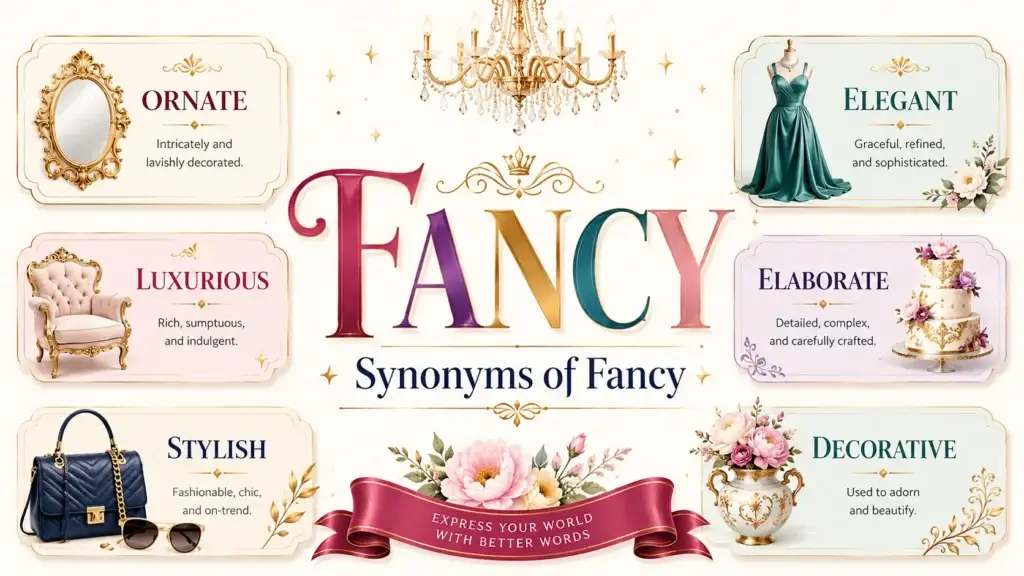
Quick-Reference Table: The 15 Strongest Synonyms for Fancy
| Synonym | Register | Intensity (1-5) | Best used for |
|---|---|---|---|
| ornate | Formal | 4 | Carved, painted or heavily decorated objects |
| elaborate | Neutral | 3 | Designs built from many worked-out parts |
| intricate | Neutral | 3 | Small, complex, carefully made detail |
| upscale | Neutral | 3 | Shops, neighborhoods, restaurants |
| luxurious | Neutral | 4 | Hotels, fabrics, holidays |
| lavish | Neutral | 4 | Spending, parties, hospitality |
| opulent | Formal | 5 | Wealth you can see the moment you walk in |
| deluxe | Neutral | 3 | Products and packages sold as an upgrade |
| elegant | Neutral | 3 | Clothing and design that stays restrained |
| posh | Casual | 3 | British speech about class and money |
| swanky | Casual | 4 | Showy new venues, cars and parties |
| plush | Casual | 3 | Interiors that feel soft and expensive |
| flashy | Casual | 4 | Cars, watches and clothes with no subtlety |
| ostentatious | Formal | 5 | Display that is meant to be noticed |
| bougie | Slang | 3 | Online talk about status spending |
Intensity is SynonymQ’s editorial judgment: 1 = mild, 5 = strongest. A guide, not a measurement.
What Does Fancy Actually Mean?
Fancy carries three separate jobs in English, and choosing a substitute without knowing which one you need is the single most common mistake with this word. It works as an adjective, a verb and a noun, and the three barely overlap.
That range is why a thesaurus dump is unhelpful here. Ornate and whim both appear on the same thesaurus page, yet neither can replace the other in any sentence you would actually write.

Fancy as an Adjective
The adjective means decorated rather than plain, expensive rather than ordinary, or complicated rather than simple. Merriam-Webster’s entry runs from “not plain: ornamental” through “swank, posh” to “extravagant” and “executed with technical skill and style.”
The tone shifts with the noun it modifies. A fancy hotel is a compliment; fancy language is usually a complaint.
Note the animal-breeding sense too, which surprises people: fancy rats, fancy pigeons and fancy goldfish are bred for ornamental qualities, not for looking wealthy.
Fancy as a Verb
As a verb, fancy splits along the Atlantic. In British and Irish English it means to want something (fancy a coffee?) or to be attracted to someone (I think she fancies you), and both uses are informal and extremely common.
The older, shared sense is “to imagine or suppose,” as in I fancy he already knew. That one now reads as literary or slightly dated in American English.
There is a third British use worth knowing: to rate something as likely to win. I fancy them for the title is ordinary sports talk in the UK and near-meaningless in the US.
Fancy as a Noun
The noun means a liking or inclination (she took a fancy to the blue one), a passing notion (a passing fancy), or the imaginative faculty itself (a flight of fancy).
This is the oldest sense of the word and the one furthest from “expensive.” It is also the sense that carries the fixed phrases most learners meet first.
The Full List: 84 Synonyms for Fancy, Grouped by Nuance
Below are 84 genuine alternatives, grouped by the sense they actually replace. Numbering runs straight through, so entry 40 belongs to the same list as entry 4.
Every entry carries a register label and an original example. Save the ones you want with SynonymQ Bookmarks, or search for more with the SynonymQ synonym finder.
Group 1: Decorated Rather Than Plain (Adjective)
This group covers surface decoration: carving, pattern, trim, and anything added to a plain object to make it look worked-on.
1. Ornate Formal adjective — covered in elaborate carved or painted decoration. — The hotel lobby had an ornate plaster ceiling that nobody looked up at.
2. Elaborate Neutral adjective — made of many carefully worked parts. — Her wedding cake was more elaborate than the wedding.
3. Decorative Neutral adjective — added for looks rather than function. — The buttons on the cuff are purely decorative.
4. Ornamental Formal adjective — existing to decorate rather than to work. — The gates are ornamental; the real security is the camera above them.
5. Intricate Neutral adjective — built from many small parts in a complex pattern. — The tilework is so intricate that photographs flatten it.
6. Embellished Formal adjective — made more attractive by added detail. — She wore a plain black dress embellished with a single line of beading.
7. Adorned Literary adjective — decorated, often with something precious. — The manuscript was adorned with gold leaf on every capital.
8. Frilly Casual adjective — decorated with ruffles or lace, often mildly dismissive. — He wanted a plain shirt, not something frilly.
9. Gilded Literary adjective — covered in gold or gold-colored decoration. — The gilded mirrors made the small room feel like a stage set.
10. Baroque Formal adjective — extravagantly ornate in style. — The proposal had a baroque fee structure that took an hour to explain.
11. Bedecked Literary adjective — covered all over with decoration. — The hall was bedecked with paper lanterns for the festival.
Group 2: Expensive, Upscale, and High-Status (Adjective)
This group covers cost and social standing rather than decoration: the sense of fancy you reach for when describing a restaurant, a car or a neighborhood.
12. Upscale Neutral adjective — aimed at people with money to spend. — They moved the store to an upscale mall and doubled the prices.
13. Luxurious Neutral adjective — expensive and very comfortable. — The seats were luxurious, which almost made up for the delay.
14. Lavish Neutral adjective — generous to the point of excess, usually about spending. — The company threw a lavish launch party three weeks before the layoffs.
15. Opulent Formal adjective — displaying obvious, heavy wealth. — The opulent dining room seated forty and was used twice a year.
16. Sumptuous Formal adjective — richly luxurious, especially of food, fabric or interiors. — A sumptuous velvet curtain hid a very ordinary stage.
17. Deluxe Neutral adjective — sold as a superior version of a standard item. — The deluxe edition adds twelve pages and thirty dollars.
18. High-end Neutral adjective — at the expensive top of a product range. — She built the kitchen around one high-end oven and cheap everything else.
19. Upmarket Neutral adjective — aimed at wealthier buyers; more common in British English. — The chain went upmarket and lost half its regulars.
20. Posh Casual adjective — expensive and socially superior; strongly British. — We went somewhere posh for their anniversary and nobody enjoyed it.
21. Swanky Casual adjective — stylishly expensive in a way that wants to be seen. — He booked a swanky rooftop bar to impress a client who ordered tap water.
22. Ritzy Casual adjective — glamorously expensive. — The hotel was ritzy in a slightly faded, 1970s way.
23. Plush Casual adjective — soft, comfortable and clearly costly. — Their new office is plush enough to make the old one feel like a garage.
24. Swish Casual adjective — smart and expensive; chiefly British. — She turned up in a swish rented car and parked it two streets away.
25. Bougie Slang adjective — upscale in a self-conscious, status-aware way. — Ten dollars for oat milk is a bougie problem and I have it.
26. Swell Archaic adjective — stylish and first-rate; now dated American slang. — He called it a swell party, which told you exactly how old he was.
Group 3: Elegant and Genuinely Refined (Adjective)
These words describe restraint and good judgment rather than quantity of decoration. They are the flattering end of fancy, and they are not interchangeable with the showy end.
27. Elegant Neutral adjective — attractive through simplicity and good proportion. — The invitation was elegant: one line of type, thick paper, nothing else.
28. Refined Formal adjective — showing cultivated taste and polish. — His refined accent came from four years of practice, not from birth.
29. Stylish Neutral adjective — fashionable and well put together. — She has a stylish way of wearing clothes that cost almost nothing.
30. Chic Neutral adjective — fashionably elegant, usually with a French edge. — The bakery is small, chic and impossible to get into before ten.
31. Sophisticated Neutral adjective — worldly and complex in a refined way. — The wine list is sophisticated; the food is fried chicken.
32. Tasteful Neutral adjective — chosen with restraint and good judgment. — The renovation was tasteful, which is another way of saying beige.
33. Genteel Formal adjective — polite and refined, often with a hint of strained respectability. — The tearoom kept up a genteel atmosphere on a shrinking budget.
34. Dressy Casual adjective — smart enough for a formal occasion, said of clothing. — The invitation said dressy, so nobody knew what to wear.
35. Classy Casual adjective — showing style and good behavior. — Sending a handwritten note afterward was a classy move.
Group 4: Overdone, Showy, or Pretentious (Adjective)
Here fancy turns critical. These words say the decoration or the spending has gone past the point of good judgment, and most of them cannot be used as compliments.
36. Extravagant Neutral adjective — spending or displaying far beyond what is needed. — An extravagant bouquet arrived for a colleague nobody could identify.
37. Ostentatious Formal adjective — designed to attract notice and impress. — The ostentatious watch did more talking than he did.
38. Pretentious Neutral adjective — claiming more importance or sophistication than is deserved. — The menu was pretentious enough to describe water as an ingredient.
39. Gaudy Neutral adjective — brightly showy in poor taste. — Gaudy gold lettering ruined an otherwise decent sign.
40. Flashy Casual adjective — attention-grabbing and short on subtlety. — He drives something flashy and parks it across two spaces.
41. Showy Neutral adjective — striking and obviously meant to be seen. — The showy opening number was the best thing in the show.
42. Flamboyant Neutral adjective — confidently colorful and theatrical. — Her flamboyant scarves became the department’s unofficial calendar.
43. Over-the-top Casual adjective — excessive to the point of comedy. — The proposal video was over-the-top and she said yes anyway.
44. Florid Formal adjective — excessively elaborate, especially of language or ornament. — His florid cover letter buried three good sentences under thirty bad ones.
45. Grandiose Formal adjective — impressive in an inflated, unrealistic way. — The grandiose five-year plan did not survive its first quarter.
46. Highfalutin Casual adjective — pompous, especially about language or manners. — Skip the highfalutin vocabulary and tell me what the product does.
47. Fussy Casual adjective — overloaded with small unnecessary details. — The design is fussy; three elements are doing the work of one.
48. Glitzy Casual adjective — flashily glamorous, often superficially so. — A glitzy awards ceremony for an industry with eleven employees.
49. Fancy-schmancy Slang adjective — mockingly overdone; reduplicative and always joking. — He came back from the conference with a fancy-schmancy new job title.
50. Bedizened Archaic adjective — dressed or decorated in a gaudy way. — The old novel describes her as bedizened with borrowed jewels.
Group 5: Premium Grade and Skillful Execution (Adjective)
Two narrower senses live here: fancy as a trade grade for goods, and fancy as praise for technically skilled movement, as in fancy footwork.
That second sense sits on top of another word entirely. If the movement itself is what you are describing, our 85 synonyms for play covers the sport, music and performance verbs underneath it.
51. Premium Neutral adjective — of higher quality and price than standard. — The premium tier adds a phone number you can actually call.
52. Select Formal adjective — chosen as being of the best quality. — Only select grades of the fruit go into the export boxes.
53. Choice Formal adjective — of particularly fine quality. — The butcher keeps a few choice cuts behind the counter for regulars.
54. Prime Neutral adjective — of the highest grade available. — Prime beef and a broken grill made for a long evening.
55. Virtuosic Formal adjective — displaying exceptional technical skill. — Her virtuosic dribbling drew a foul and a standing ovation.
Group 6: Fancy as a Verb (To Like, Want, or Imagine)
The verb splits into two families: wanting or liking something, which is chiefly British and informal, and imagining or supposing, which is shared but now sounds literary.
56. Like Neutral verb — to find pleasant or attractive. — I like the second design better, though I could not tell you why.
57. Want Neutral verb — to wish to have. — If you want dessert, order it before they close the kitchen.
58. Feel like Casual verb phrase — to be in the mood for. — I feel like a swim, and then I feel like doing nothing at all.
59. Be into Casual verb phrase — to be interested in or attracted to. — He is into old cameras and has the shelf space to prove it.
60. Be keen on Casual verb phrase — to be enthusiastic about; common in British English. — She is keen on the idea but not keen on the timeline.
61. Take a shine to Casual verb phrase — to develop a quick liking for. — The cat took a shine to the one guest who dislikes cats.
62. Go for Casual verb phrase — to be attracted to a type. — He goes for people who argue with him, which explains a lot.
63. Have a thing for Slang verb phrase — to have a strong, slightly helpless liking. — She has a thing for hotel stationery and steals it every time.
64. Crave Neutral verb — to want intensely. — By day three of the diet he craved bread more than company.
65. Imagine Neutral verb — to form a picture of in the mind. — Imagine the same room with the wall taken out.
66. Suppose Neutral verb — to believe something to be true without proof. — I suppose she has already heard, but I would check.
67. Picture Neutral verb — to visualize clearly. — Picture the stage empty, then add one chair.
68. Envision Formal verb — to conceive of as a future possibility. — The founders envision a version of this that runs offline.
69. Reckon Casual verb — to think or suppose; common in British and Australian English. — I reckon they will move the deadline again.
Group 7: Fancy as a Noun (A Whim, a Liking, the Imagination)
The noun covers three related ideas: a personal liking, a passing notion, and the imaginative faculty. These are the oldest senses of the word.
70. Liking Neutral noun — a feeling of enjoying or preferring something. — He has a liking for early mornings that nobody in the house shares.
71. Fondness Neutral noun — warm, affectionate liking. — Her fondness for the old building outlasted the building.
72. Penchant Formal noun — a strong habitual liking. — The director has a penchant for scenes that begin in the rain.
73. Predilection Formal noun — an established preference. — The committee’s predilection for round numbers shaped the whole budget.
74. Inclination Neutral noun — a leaning toward something. — I had no inclination to argue at eleven at night.
75. Soft spot Casual noun — a particular affection, often slightly indulgent. — She has a soft spot for the intern who keeps breaking the printer.
76. Whim Neutral noun — a sudden wish with no particular reason behind it. — We drove to the coast on a whim and regretted it by noon.
77. Caprice Formal noun — an unpredictable change of mind. — The schedule now depends on the caprice of one shareholder.
78. Notion Neutral noun — a loose idea or impulse. — He got a notion to repaint the hallway and stopped halfway.
79. Daydream Neutral noun — a pleasant imagined scene. — The whole plan was a daydream with a spreadsheet attached.
80. Reverie Literary noun — a state of pleasant absorbed thinking. — The train noise pulled her out of a long reverie.
81. Vagary Formal noun — an unpredictable turn or notion. — Harvest dates follow the vagaries of the weather, not the calendar.
82. Conceit Literary noun — a fanciful notion or an elaborate figure of speech. — The novel rests on one conceit: the narrator is already dead.
83. Imagination Neutral noun — the power of forming mental images and ideas. — Her imagination outran the budget in the first meeting.
84. Fantasy Neutral noun — an imagined scene, usually pleasant and unlikely. — Retiring at forty was a fantasy he priced out twice a year.
English gives us roughly this many defensible alternatives and no more, which is why the rest of this guide is about choosing well rather than adding words. A list of two hundred would mostly be other people’s near-misses.
Register and Formality Table
Every major synonym above sorted into six buckets. Use this when the problem is tone rather than meaning.
| Register | Words |
|---|---|
| Formal | ornate, ornamental, embellished, baroque, opulent, sumptuous, refined, genteel, ostentatious, florid, grandiose, select, choice, virtuosic, envision, penchant, predilection, caprice, vagary |
| Neutral | elaborate, decorative, intricate, upscale, luxurious, lavish, deluxe, high-end, upmarket, elegant, stylish, chic, sophisticated, tasteful, extravagant, pretentious, gaudy, showy, flamboyant, premium, prime, like, want, crave, imagine, suppose, picture, liking, fondness, inclination, whim, notion, daydream, imagination, fantasy |
| Casual | frilly, posh, swanky, ritzy, plush, swish, dressy, classy, flashy, over-the-top, highfalutin, fussy, glitzy, feel like, be into, be keen on, take a shine to, go for, reckon, soft spot |
| Slang | bougie, fancy-schmancy, have a thing for |
| Literary | adorned, gilded, bedecked, reverie, conceit |
| Archaic | swell, bedizened |
Two practical notes. Posh, swish, be keen on and reckon read as British to American ears, and bougie is current online slang that will date faster than the rest of this table.

Which Word Should You Use?

Match the situation, not the dictionary definition. Here is the short version.
- Describing a decorated object (a ceiling, a cake, a dress) → ornate, elaborate, intricate
- Describing an expensive place (a hotel, a restaurant, a neighborhood) → upscale, luxurious, high-end
- Describing expensive clothing → elegant, dressy, stylish
- Praising restraint and taste → elegant, tasteful, refined
- Criticizing display → ostentatious, flashy, gaudy
- Criticizing complicated writing → florid, highfalutin, pretentious
- Writing a formal report → ornate, opulent, ornamental, extravagant
- Writing casual social copy → posh, swanky, bougie, plush
- Praising skilled movement → virtuosic, showy, elaborate
- Naming a food or product grade → premium, select, choice, deluxe
- Saying you want something (British English) → feel like, be keen on, go for
- Saying you are attracted to someone → be into, have a thing for, take a shine to
- Naming a sudden idea → whim, notion, caprice
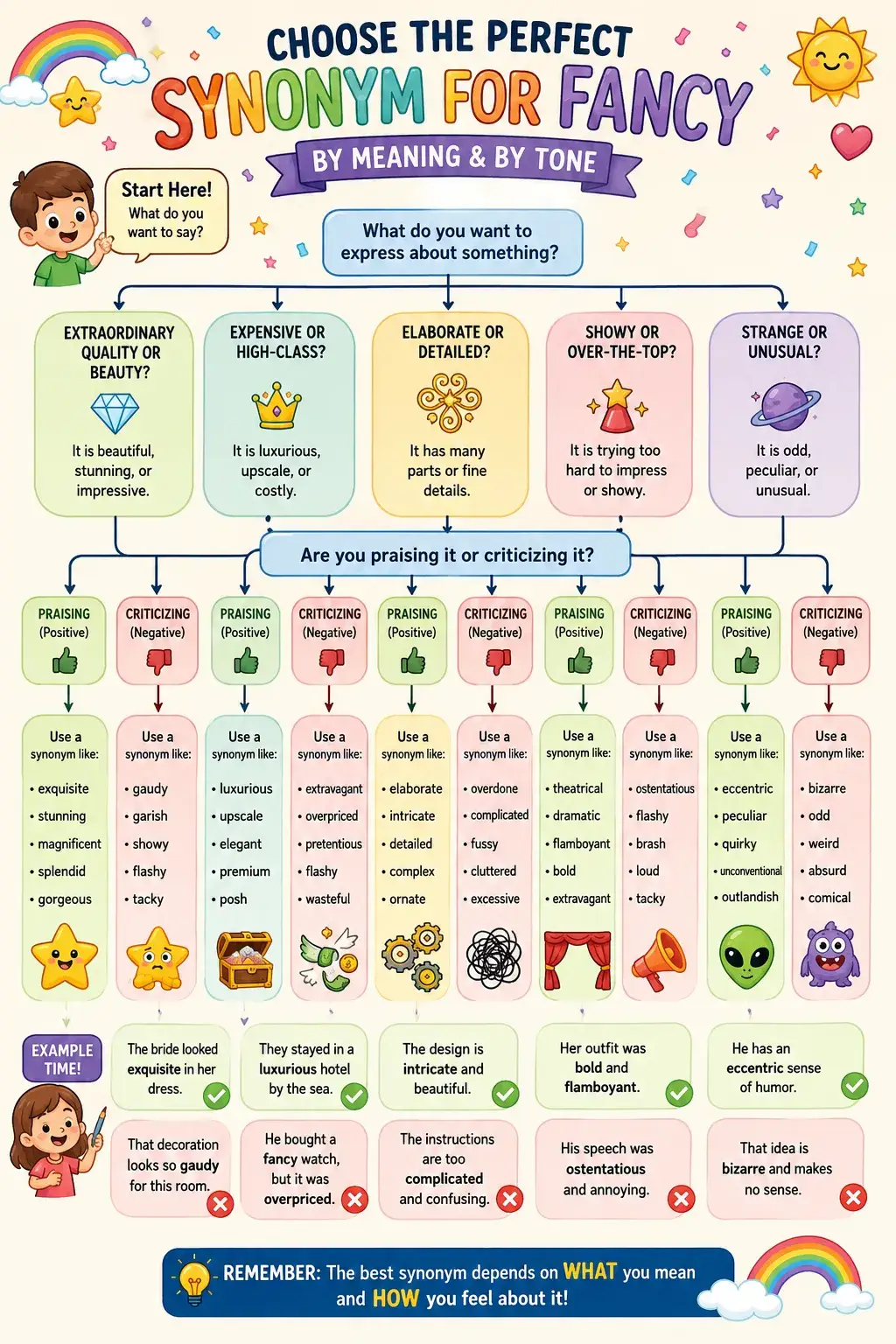
Three decision rules cover most cases. First, decide whether you are praising or criticizing, because fancy itself is ambiguous and its synonyms are not.
Second, decide whether you mean decoration or money, since ornate and upscale are not neighbors. Third, check the register against the rest of your sentence.
Words That Are Not True Synonyms for Fancy
These five turn up on thesaurus pages or in learner writing, and each one changes your meaning in a way you probably did not intend.
Fanciful — this looks like the obvious adjective form, and it means the opposite of what most people expect. Fanciful means imaginary or unrealistic, not decorated. Writing “a fanciful hotel” says the hotel may not exist, which is a very different review.
Fantastic — it shares an ancestor with fancy and has drifted a long way. In modern use it means excellent or wildly imaginative. “A fantastic restaurant” praises the food; “a fancy restaurant” describes the prices, and the two claims are independent.
Formal — clothing guides swap these constantly, and they are separate axes. Formal is about the rules of an occasion; fancy is about visible expense and decoration. A plain black tuxedo is formal and not especially fancy; a sequined jumpsuit is fancy and not formal.
Expensive — this is the closest of the five and still not a substitute. Expensive states a price; fancy claims that the thing looks and feels elevated. A dull replacement part can be expensive, and nobody would call it fancy.
Beautiful — beauty is about aesthetic effect, decoration is about added detail, and plenty of beautiful things are severely plain. If you mean visual appeal rather than ornament, our guide to synonyms for beautiful covers that word properly.

Head-to-Head Comparisons
Four pairs cause most of the confusion around this word.
Fancy vs Posh
| Question | Fancy | Posh |
|---|---|---|
| Core meaning | Decorated, expensive or complicated | Upper-class and expensive |
| Regional feel | Global English | Strongly British |
| What it judges | The thing itself | The social class attached to it |
| Example | A fancy coffee machine | A posh accent |
Posh carries class in a way fancy does not. A working-class family can own a fancy television; calling the television posh sounds wrong because posh attaches to people and the things that mark them.
American readers also hear posh as borrowed and slightly performed. If your audience is US-based, upscale or swanky will land more naturally.
Fancy vs Elegant
| Question | Fancy | Elegant |
|---|---|---|
| Core meaning | More decoration or expense than plain | Beauty through simplicity and proportion |
| Direction of praise | Can be a compliment or a complaint | Almost always a compliment |
| Amount of detail | More | Less, better chosen |
| Example | A fancy gold-trimmed menu | An elegant one-line menu |
These two often pull in opposite directions. Adding detail makes something fancier and frequently makes it less elegant, which is why the words are not interchangeable in design writing.
Use elegant when restraint is the point. Use fancy when quantity, cost or visible effort is the point.
Fancy vs Fanciful
| Question | Fancy | Fanciful |
|---|---|---|
| Root sense | Ornament and expense | Imagination and unreality |
| Applies to | Objects, places, clothes | Ideas, stories, explanations |
| Tone | Neutral to admiring | Skeptical |
| Example | A fancy proposal document | A fanciful proposal |
The trap is that fanciful looks like the adjective fancy should have been. It descends from the noun sense instead, so it means “existing only in the imagination.”
Call a plan fanciful and you have said it will not work. Call it fancy and you have said it has too many fonts.
Fancy vs Like (the British Verb)
| Question | Fancy (verb) | Like |
|---|---|---|
| Register | Informal, chiefly British | Neutral, global |
| Romantic reading | Strongly implied for people | Only if stated |
| Works for objects | Yes, meaning “want right now” | Yes, meaning “enjoy generally” |
| Example | Do you fancy a coffee? | Do you like coffee? |
The difference is time and intent. Do you like coffee asks about a lasting preference; do you fancy a coffee asks whether you want one in the next ten minutes.
The romantic sense is the one ESL learners most need to know. Telling a British colleague you fancy them is not a comment on their work.
Common Collocations With Fancy
These pairings are fixed. Swapping in a synonym breaks them, even when the synonym means the same thing on its own.
- fancy restaurant — We saved up for a fancy restaurant and spent the meal talking about the bill.
- fancy dress — In British English this means a costume party, not formal clothing, and the misunderstanding ruins parties every year.
- fancy footwork — It took some fancy footwork to keep both clients happy through the merger.
- nothing fancy — Bring a salad, nothing fancy, we are eating in the garden.
- fancy goods — The shop sold fancy goods, which in trade language means small decorative items.
- fancy prices — They rebranded the same beans and charged fancy prices for them.
- take a fancy to — He took a fancy to a chair he could not afford and thought about it for a year.
- a passing fancy — The band was a passing fancy that lasted one summer and two haircuts.
- flight of fancy — Her flight of fancy about moving to the coast turned into a signed lease.
- tickle your fancy — If a walking tour tickles your fancy, the guide starts at nine.
- fancy that — Fancy that, the one week I skip the meeting is the week they decide something.
- fancy oneself — He fancies himself a negotiator, which is why nobody lets him near a contract.
Note how few of these accept a substitute. You cannot say ornate dress, luxurious footwork or a passing whim and keep the meaning intact, which is exactly why collocations matter more than synonym counts.

Etymology and Origin of Fancy
Fancy began as a contraction of fantasy. Etymonline dates the noun to the mid-15th century with the sense “inclination, liking,” from fantasy by way of Old French fantaisie, Latin phantasia and Greek phantasia, “power of imagination; appearance, image.”
The imaginative senses came next. Etymonline records “productive imagination” in the 1580s and “fanciful image or conception” in the 1660s, with the verb “take a liking to” appearing in the 1540s and “imagine” by the 1550s.
The adjective is the newcomer. Etymonline dates “fine, elegant, ornamental” as opposed to plain to 1751, while Merriam-Webster gives 1646 for the adjective’s first known use in its earliest sense.
Two related forms round out the family. Fancier, “one with a special taste or aptitude,” dates to 1765 and survives in pigeon fancier, and the collective noun the fancy, meaning devotees of a sport, is dated to 1735 and was long associated with boxing.
Fancy by Writing Situation
The right substitute changes with the document. Here is what actually works in four common ones.
Academic Writing and Essays
Academic prose wants precision over color, so the decorative senses of fancy need replacing with words that state a criterion.
Use ornate, ornamental, elaborate, intricate, opulent and extravagant when you are describing objects or architecture. Use florid and grandiose when you are critiquing style, since both are established critical terms.
Avoid posh, swanky, bougie and fancy-schmancy entirely in graded work. They will read as unedited speech even in an otherwise strong paragraph.
If your essay is running long because you are describing rather than arguing, the SynonymQ word counter will show you where the description is concentrated.
Résumés, Cover Letters and Professional Email
Job documents punish decoration. Recruiters read for evidence, and fancy language is the fastest way to look like you are covering a thin claim.
Use premium, high-end, select and upscale when describing products, clients or markets you worked with. “Managed a portfolio of upscale retail clients” is concrete; “worked on fancy accounts” is not.
Avoid ostentatious, florid, highfalutin and grandiose about your own work, and avoid lavish about budgets you controlled unless you want to sound careless with money.
One test before you send: read the sentence aloud. If it sounds like a brochure, cut a word rather than swapping one.
Creative Writing and Fiction
Fiction is the one place the literary and archaic entries earn their keep. Adorned, gilded, bedecked, bedizened, reverie and conceit all carry period texture that neutral words cannot.
Match the word to the observer, not the object. A character who resents wealth sees an ostentatious dining room; a character who covets it sees a sumptuous one, and the room never changes.
The noun senses are useful in close third person. Whim, caprice, notion and vagary let you name a character’s impulse without explaining it.
Everyday Conversation and Social Media
Casual writing wants the words people actually say. Posh, swanky, plush, ritzy, classy, bougie and fancy-schmancy all work here and mostly fail everywhere else.
Bougie has the shortest shelf life on the list. It reads as current now and will date this post faster than anything else in it, so use it where a timestamp does not hurt you.
British and American readers split on posh and swish. If your audience is mixed, upscale and flashy travel further.
That divide runs past vocabulary into spelling. Our guide to synonyms for honor handles a word where the two Englishes disagree about the letters as well as the register.
Need a different angle on a specific sentence? Run the word through the SynonymQ synonym finder and compare the options side by side before you commit.
Antonyms of Fancy
Opposites depend on the sense, so pick from the right column rather than grabbing the first one.
Against the decorated sense:
- plain — the default opposite; no decoration at all
- unadorned — formal, and slightly more emphatic than plain
- undecorated — neutral and literal, good for descriptions of objects
- austere — plain by choice, with a moral or aesthetic edge
- minimalist — plain as a deliberate design position
- spartan — plain to the point of discomfort
Against the expensive sense:
- cheap — low cost, often with a quality judgment attached
- budget — low cost, neutral, common in travel and product writing
- no-frills — stripped of extras on purpose
- downmarket — aimed at less wealthy buyers; more British than American
- modest — inexpensive without being poor
- basic — the standard version, no upgrades
Against the overdone sense:
- understated — deliberately quiet; usually a compliment
- restrained — showing controlled judgment
- simple — uncomplicated, the broadest option here
Note that simple and plain are not fully interchangeable. Plain describes appearance; simple describes structure, so a plain box can still be complicated inside.
For the verb sense, the opposites are dislike, detest and be put off by. For the noun sense meaning imagination, the contrast is fact or reality rather than a true antonym.
Build a full opposite list for any word with the SynonymQ antonym finder, and see our guide on how opposite words sharpen your meaning for why antonym pairs are worth learning together.
Fancy in Spanish, French and Italian
No single word covers all the senses of fancy in any of these languages, so translate the sense rather than the word. VERIFY-NATIVE
| Language | Word | Register | Notes |
|---|---|---|---|
| Spanish | elegante | Neutral | Adjective, same form for both genders; covers the elegant and smart senses, not the ornate one |
| Spanish | lujoso / lujosa | Neutral | Agrees with the noun; the standard choice for expensive hotels and cars |
| Spanish | recargado / recargada | Neutral | Literally overloaded; the critical sense, close to fussy or over-decorated |
| French | chic | Neutral | Invariable in modern use; stylish rather than heavily decorated |
| French | luxueux / luxueuse | Neutral | Agrees with the noun; the expensive sense |
| French | orné / ornée | Formal | Agrees with the noun; the decorated sense, common in art and architecture writing |
| Italian | elegante | Neutral | Same form for both genders; the refined sense |
| Italian | lussuoso / lussuosa | Neutral | Agrees with the noun; the expensive sense |
| Italian | ornato / ornata | Formal | Agrees with the noun; the decorated sense, and literary when applied to style |
Example sentences, one per language:
- Spanish: Cenamos en un restaurante muy elegante. (We had dinner at a very fancy restaurant.)
- French: Ils ont loué une salle luxueuse pour le mariage. (They rented a fancy hall for the wedding.)
- Italian: La facciata è troppo ornata per i miei gusti. (The facade is too fancy for my taste.)
Register and regional preference vary more than a table can show, and the British verb sense of fancy has no direct equivalent in any of the three. Have a native speaker confirm before publishing anything that depends on these.
How to Avoid Repeating Fancy
Repetition is usually a symptom of describing the same quality three times rather than a vocabulary shortage. Work through it in this order.
- Name the sense first. Decide whether each use means decorated, expensive, complicated or skilled. Two of the four will usually turn out to be doing nothing.
- Delete before you substitute. If a sentence still works with the adjective removed, remove it. A “fancy restaurant in the old quarter” is often just “a restaurant in the old quarter.”
- Swap the part of speech. Turn the adjective into a detail: not “a fancy car” but “a car with a hood ornament.” Concrete detail beats a stronger adjective almost every time.
- Vary the register on purpose. If two uses must stay, make one formal and one casual so the repetition reads as range rather than habit.
- Check the collocations. Fancy dress, fancy footwork and nothing fancy are fixed. Leave them alone and change the free uses around them.
- Read the paragraph aloud. Repetition you cannot hear is usually not a problem, and repetition you can hear will not be fixed by a thesaurus alone.
For longer passages, the SynonymQ paraphrasing tool rewrites whole sentences rather than single words, which handles step three better than manual swapping. Our guide to paraphrasing without plagiarizing covers where that line sits.
Frequently Asked Questions
What are synonyms for fancy clothes?
For clothing, the strongest alternatives are dressy, elegant, stylish, smart, chic and formal-looking. Dressy is the closest everyday match, since it means smart enough for an occasion. Use ornate or embellished only when the garment itself carries added decoration such as beading, lace or embroidery.
Two warnings. Fancy dress in British English means a costume, not smart clothing, and formal refers to the rules of an occasion rather than the look of the outfit.
Is bougie another word for fancy?
Yes, in casual and online English. Bougie means upscale in a self-conscious, status-aware way, and it usually carries a light mockery that fancy does not. It works for tastes and spending habits rather than objects, so “a bougie coffee order” sounds natural and “a bougie ceiling” does not.
It is slang and it is recent, so keep it out of academic and professional writing.
What is a synonym for fancy things?
For objects, use ornate, decorative, ornamental, embellished or intricate when you mean decorated, and luxury goods, high-end items or fancy goods when you mean expensive. In trade language, fancy goods is a fixed term for small decorative items rather than a loose description.
Pick by what the object actually has: added detail, or a high price.
What is a synonym for fancy starting with B?
Four good ones: baroque (extravagantly ornate), bougie (upscale in a status-aware, slang way), bedecked (covered in decoration, literary) and bedizened (gaudily decorated, archaic). Baroque is the safest in general writing, and bougie is the only one that sounds current in conversation.
Bedecked and bedizened both belong in fiction or historical writing rather than modern prose.
What is a slang synonym for fancy?
The main ones are bougie, swanky, ritzy, swish, glitzy, plush and fancy-schmancy. Bougie is the most current, fancy-schmancy is always joking, and swish is chiefly British. All of them place you firmly in casual register, which is useful in social copy and fatal in a cover letter.
Swell is the dated version and now reads as a period marker.
What is a synonym for a fancy restaurant?
Upscale is the most neutral and widely understood choice, followed by high-end, fine-dining, swanky and posh. Use upscale restaurant in professional or American writing, posh restaurant in British conversation, and fine-dining restaurant when the category itself is what you mean.
Avoid ornate restaurant, which describes the plasterwork rather than the prices.
What is another word for a fancy person?
For people, the useful words are posh, refined, genteel, sophisticated, elegant and classy. Posh points at social class, refined and genteel at manners, and sophisticated at worldliness. For the critical version, use pretentious, ostentatious or highfalutin.
There is also fancier, a separate noun meaning an enthusiast or breeder, as in pigeon fancier.
Is fancy an adjective, a verb, or a noun?
All three. As an adjective it means decorated, expensive or complicated, as in a fancy hotel. As a verb it means to want or like something, chiefly in British English, as in do you fancy a coffee, and more formally to imagine or suppose. As a noun it means a liking, a whim or the imagination.
The adjective is the newest of the three and the noun the oldest.
What is a synonym for beautiful?
Close alternatives include lovely, gorgeous, stunning, striking, exquisite and radiant. None of them is a synonym for fancy, because beauty is about aesthetic effect while fancy is about added decoration and cost, and plenty of beautiful things are deliberately plain.
Our full guide covers the distinctions in detail: synonyms for beautiful.
What is a synonym for expensive?
Use costly, pricey, high-priced, steep or exorbitant depending on how strong you need it. Pricey is casual, costly is neutral, and exorbitant means the price is unreasonable rather than merely high.
Expensive and fancy overlap but are not the same claim. A spare part can be expensive and completely plain, and a decorated item can be cheap.
What is the opposite of fancy?
The plainest opposites are plain, simple, basic and unadorned for the decorated sense, and cheap, budget and no-frills for the expensive sense. Choose by which meaning you are reversing, since plain and cheap say very different things about the same object.
Understated is the opposite of the overdone sense and is usually a compliment.
What does it mean when someone says they fancy you?
In British, Irish and Australian English it means they are romantically or physically attracted to you. It is informal, mild and much softer than saying they are in love with you. American English does not use fancy this way, which causes regular confusion in mixed company.
The same verb applied to an object simply means wanting it, as in I fancy a sandwich.
Is fancy a formal or informal word?
Fancy is neutral as an adjective and informal as a verb. “A fancy hotel” is acceptable in most writing, though academic prose usually prefers ornate, opulent or extravagant for precision. The verb sense meaning want or like is informal and regionally British, so it does not belong in formal documents.
The noun senses, such as a passing fancy, read as neutral to slightly literary.
Picking the Right Word for Fancy
The word is doing four jobs at once, and your sentence only needs one of them. Decide first whether you mean decoration, cost, complication or skill, then decide whether you are praising or criticizing.
Once those two choices are made, the list above narrows to three or four real candidates, and the register table settles the rest. That is a faster route to the right word than scrolling two hundred loose associates.
Try the SynonymQ synonym finder on the exact sentence you are writing, and check the register table before you commit to anything from the slang row.
About the Author

Naveed Akhtar writes every guide on SynonymQ. He is an SEO content writer with ten years of article-writing experience, working on the question a thesaurus never answers: which of these words belongs in this sentence, for this reader. Every page cites the dictionary entries it draws on and the date they were read.