
What to Say Instead of Per My Last Email (It Does Two Jobs)
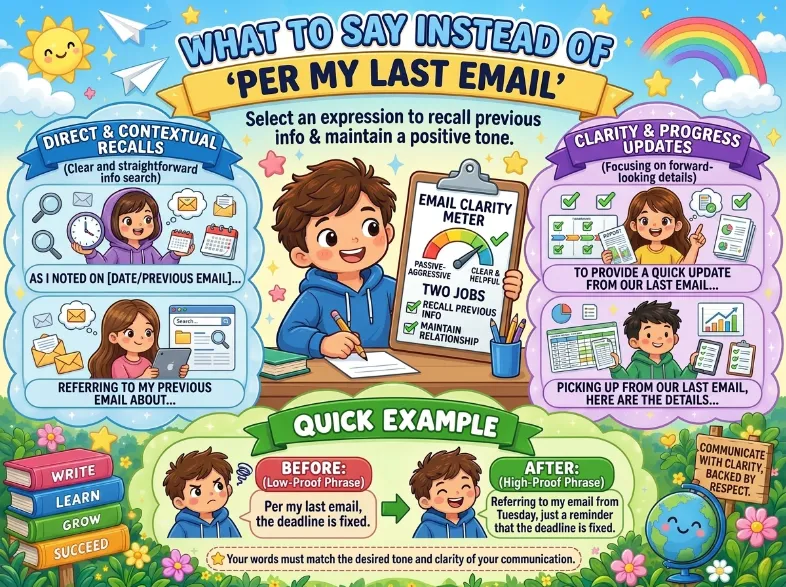
What to say instead of per my last email depends on which job you need done. The phrase points back to information and signals the reader missed it. Use please see below to point, following up on to ask for a reply, and a date to put it on the record.
By Naveed Akhtar, an SEO content writer with 10 years of article-writing experience · Updated 12 September 2026 · About 8 minutes
The Problem Is Not the Word “Per”
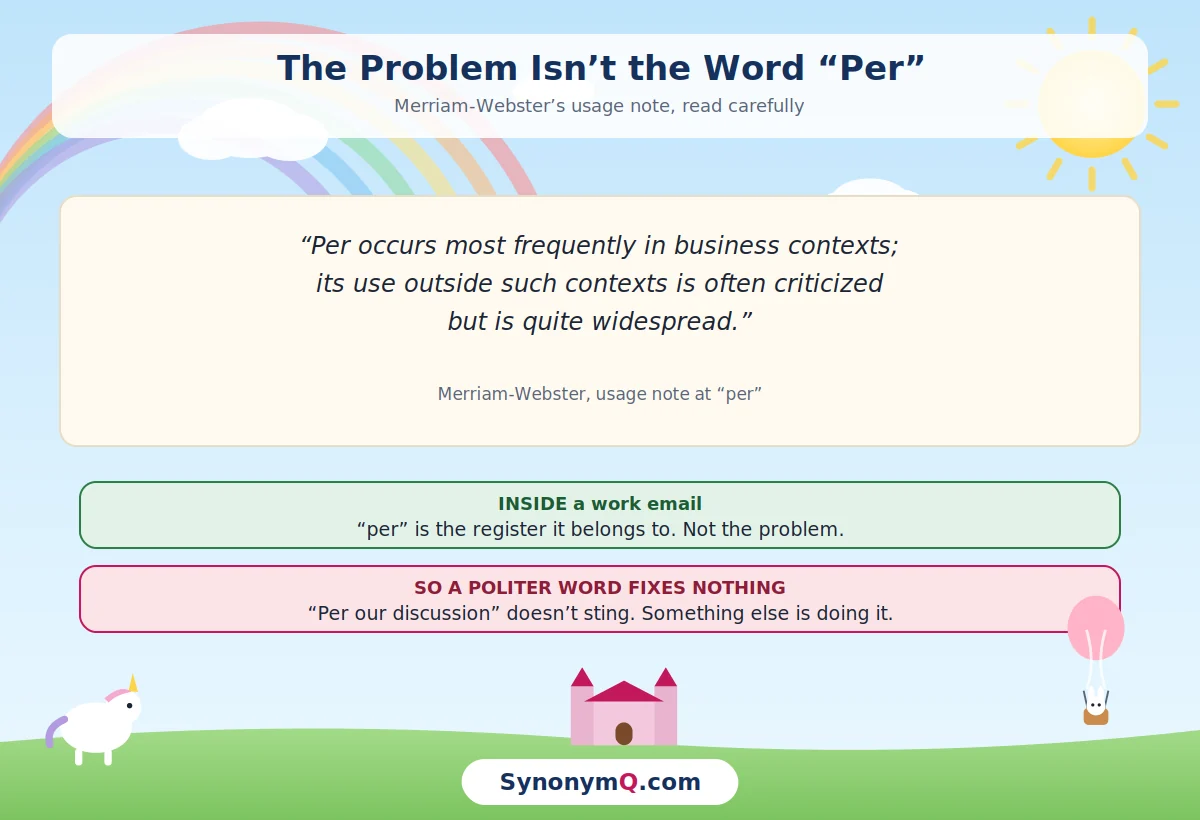
The usual advice treats this phrase as too stiff or too corporate. The dictionary does not support that reading.
“Per occurs most frequently in business contexts; its use outside such contexts is often criticized but is quite widespread.”
Merriam-Webster, usage note at perRead it carefully. The criticism attaches to per used outside business. Inside a work email, per is the register it belongs to, and swapping it for something warmer fixes nothing.
Merriam-Webster also gives the relevant sense as “according to”, noting it is often used with as. So as per is not an error either, whatever you may have been told.
Which means the fix is not a politer word. If register were the problem, per our discussion would sting too. It does not. Something else is doing the damage.What the Phrase Actually Does
Per my last email performs two separate actions in five words, and that is why replacing it is harder than it looks.
The first action is pointing: it directs the reader to information that already exists. That part is useful and often necessary.
The second is marking a failure: it records that the information was already sent and not acted on. That part is the sting.
Every alternative on every list drops one of the two. None of them is a synonym, because the original does two things and each replacement does one.
The Damage Is in “Last”, Not “Per”
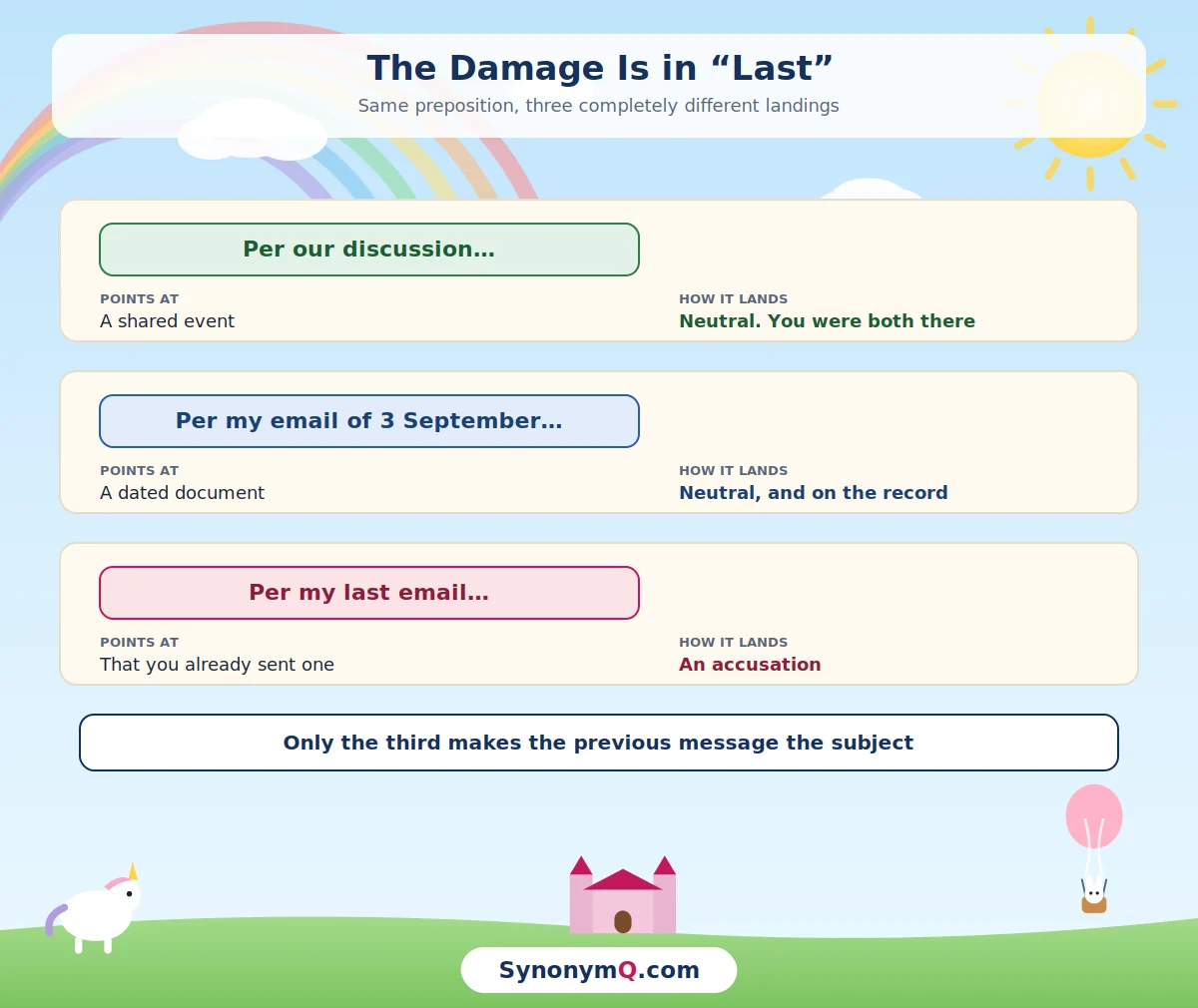
Compare three openers that share the same preposition and land completely differently.
| Opener | What it points at | How it lands |
|---|---|---|
| Per our discussion… | A shared event | Neutral. You were both there |
| Per my email of 3 September… | A dated document | Neutral, and on the record |
| Per my last email… | The fact that you already sent one | An accusation |
The preposition is identical in all three. What changes is the object, and only the third one makes the previous message itself the subject of the sentence.
Last is doing the work. It means “the one before this”, which only matters if the reader failed to act on it, so naming it announces the failure.
This one is reasoning, not a dictionary label. Merriam-Webster says nothing about last in this construction. The comparison above is an argument from what each phrase refers to, and you can test it on your own inbox.What to Say Instead of Per My Last Email: Decide the Job First
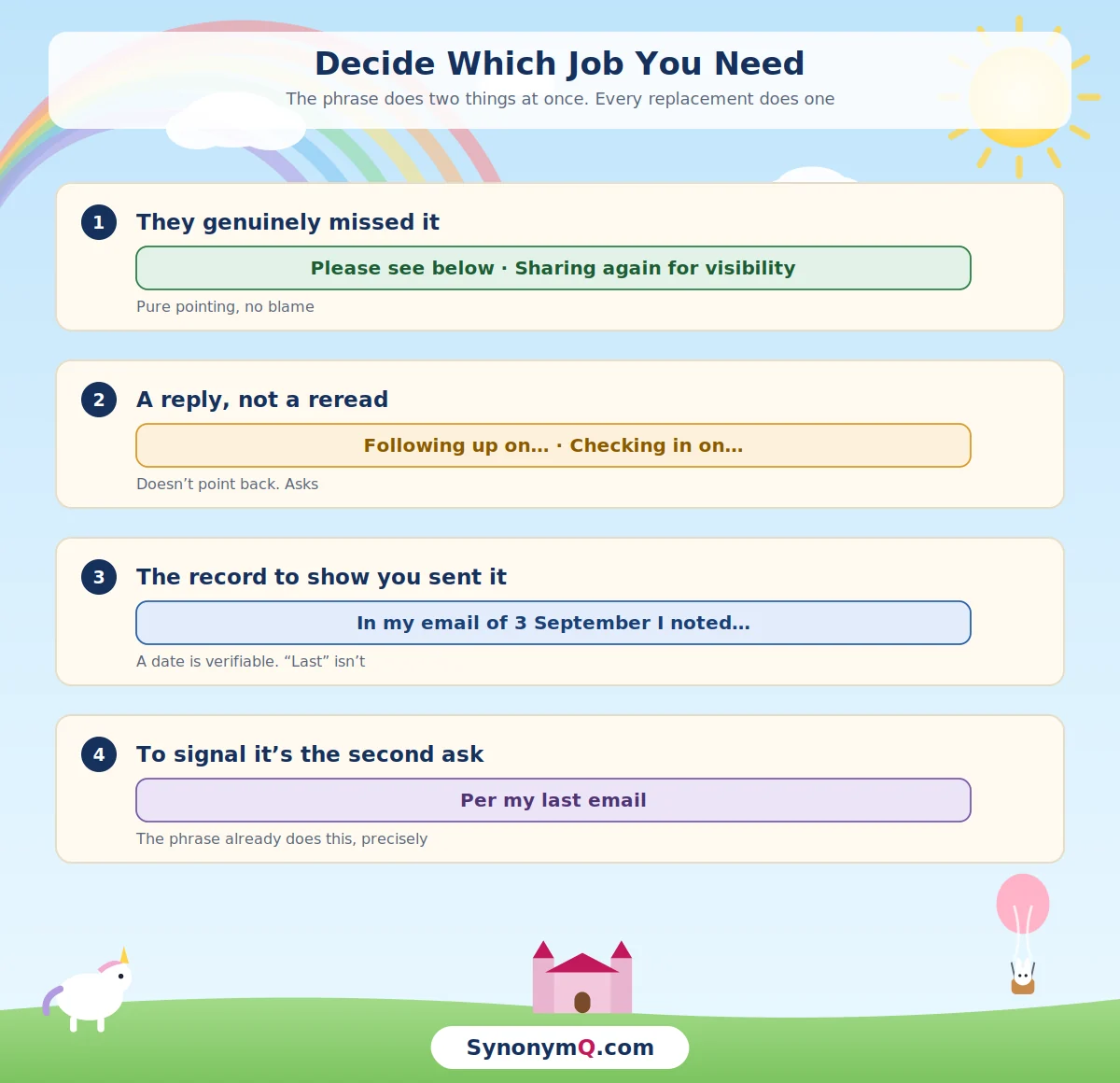
Before choosing a replacement, settle what you actually want to happen next. The four situations take different openers and are not interchangeable.
| What you need | Use | Why it fits | Label |
|---|---|---|---|
| They genuinely missed it | Please see below · Sharing again for visibility | Pure pointing, no blame attached | Direct Swap |
| A reply, not a reread | Following up on… · Checking in on… | Does not point back at all. Asks a fresh question | Swap With Adjustment |
| The record to show you sent it | In my email of 3 September I noted… | A date is verifiable. Last is not | Requires Rewrite |
| To signal it has been asked twice | Per my last email | The phrase already does this, precisely | Keep |
If They Genuinely Missed It
Most of the time this is the true situation, and the reader’s failure was accidental rather than rude. Point without commentary.
BeforePer my last email, the deadline is the 14th. AfterSharing again for visibility: the deadline is the 14th.Please see below works when you are forwarding the original thread and the text is genuinely below. Used when it is not, it sends the reader hunting.
If You Need a Reply, Not a Reread
This is the most common mismatch. The writer points backwards when what they actually want is an answer, and pointing backwards does not ask for one.
Points backwards, asks nothingPer my last email, we need your sign-off. AsksFollowing up on the sign-off — can you confirm by Thursday?The rewrite is longer and gets answered more often, because it contains a question and a date. The original contains neither.
If You Need the Record to Show You Sent It
Sometimes the point is not the reader at all. It is the thread, read later, by someone else.
In that case last is the weakest possible reference, because it depends on who is counting. A date does not.
Unverifiable laterPer my last email, I flagged the licensing risk. Verifiable laterIn my email of 3 September I flagged the licensing risk.This version also reads as calmer, which is a side effect rather than the aim. Precision usually sounds less annoyed than vagueness does.
If You Do Want to Signal Frustration
The honest case. Sometimes you have asked twice, it matters, and you want that on the page.
Per my last email communicates exactly that, which is why it has the reputation it has. The word is not failing; it is working.
The decision is whether to send it, not which synonym to use. If you want the reader to feel the second ask, no politer opener will do it, and a politer opener that still carries the sting is worse than the plain phrase.Business writing carries several phrases that quietly assign responsibility this way, which is the same problem as choosing between alternatives to an aggressive timeline.
What the Alternative Lists Recommend
The pages ranking for this question offer between five and eleven openers each. Sorted by which of the two jobs each one performs:
| Opener | Points back? | Asks for a reply? | Watch out for |
|---|---|---|---|
| As discussed | Yes | No | Only honest if you actually discussed it. It is not a synonym for “I emailed you” |
| As previously mentioned | Yes | No | Carries the same sting. Previously does what last does |
| Please see below | Yes | No | Requires the text to be below |
| Apologies if you missed it | Yes | No | Takes blame you do not owe, and reads as sarcasm to some readers |
| Following up on · Checking in on | No | Yes, if you add one | Fresh ask. Add the question and a date or it drifts too |
| Circling back | No | Vague | Says nothing about what you want. Jargon standing in for a request |
As previously mentioned deserves the warning. It is recommended widely as the polite version, and it performs the identical second job: it names that you already said it.
Frequently Asked Questions
Is “per my last email” rude?
It is not impolite in wording, and it has a reputation for reading as passive-aggressive. LanguageTool describes it as carrying “negative tone” baggage regardless of intent. Whether that is rude depends on whether you meant it.
Is “as per my last email” grammatically wrong?
No. Merriam-Webster gives “according to” as a sense of per and notes it is often used with as. The doubling is redundant in style terms, not an error.
What is the most professional alternative?
A date. In my email of 3 September… is more professional than any softened opener, because it is checkable and it drops the implied failure entirely.
Should I just avoid the phrase completely?
No. Keep it for the case where you want a second ask on the record and you are willing to own that. Register is not the issue here, much as it is not the issue when choosing a transition word in an email.
How This Page Was Checked
Read from the sources attributed, on 12 September 2026:
- The usage note on per, the “according to” sense and the note that it is often used with as — Merriam-Webster.
- The description of the phrase’s negative-tone baggage and the list of alternatives discussed above — LanguageTool.
One argument on this page is reasoning rather than a retrieved fact, and it is labelled where it appears: that the sting comes from last rather than from per.
No claim is made about how any specific recipient will react, or about what any employer prefers. Those vary.
Written by Naveed Akhtar, an SEO content writer with 10 years of article-writing experience.
Target topic: asking for something twice in writing without souring the thread

Naveed Akhtar writes every guide on SynonymQ. He is an SEO content writer with ten years of article-writing experience, working on the question a thesaurus never answers: which of these words belongs in this sentence, for this reader. Every page cites the dictionary entries it draws on and the date they were read.