
Synonyms for Aggressive Timeline: What Each One Signals
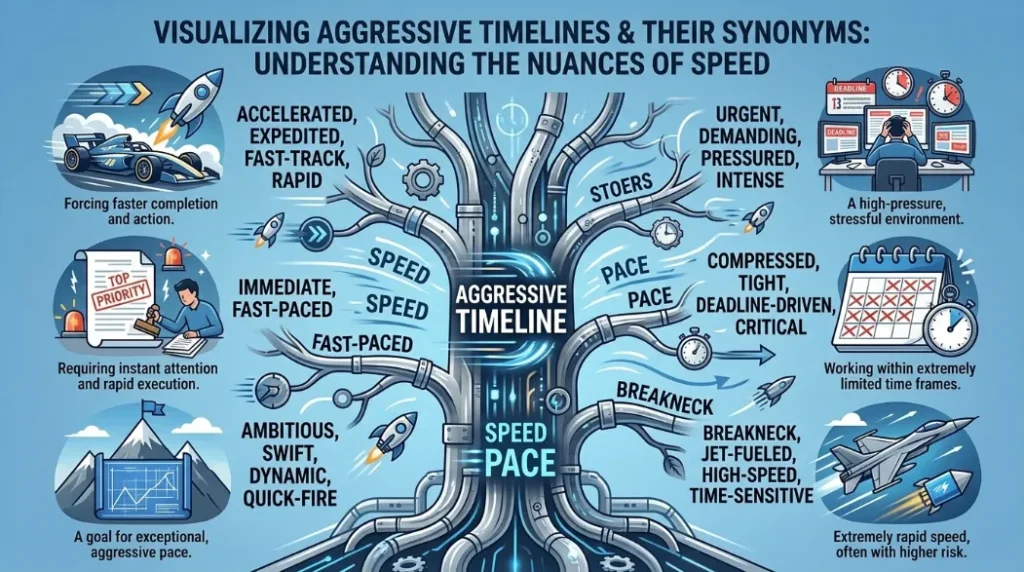
Synonyms for aggressive timeline are not interchangeable: each one makes a different claim about whose fault the schedule is. Ambitious says the plan asks a lot. Tight says there is not enough time. Demanding says the work is hard. Accelerated says you sped something up. Optimistic says you expect to miss it.
What “Aggressive” Already Says About Your Schedule
Before choosing a replacement, it helps to know what the original word is doing. Oxford Learner’s Dictionaries gives aggressive four senses. The one you are using in a project plan is the second: “determined and acting with force in order to succeed”, and Oxford marks that sense sometimes disapproving.
That label is the reason this question comes up at all. It is the only word in this article that carries a disapproval marker in the dictionary. When you write “we are working to an aggressive timeline”, a portion of your readers hear determination and another portion hear something closer to reckless, and the dictionary itself says both readings are available.
Twenty-Two Synonyms for Aggressive Timeline, Twelve Actual Words
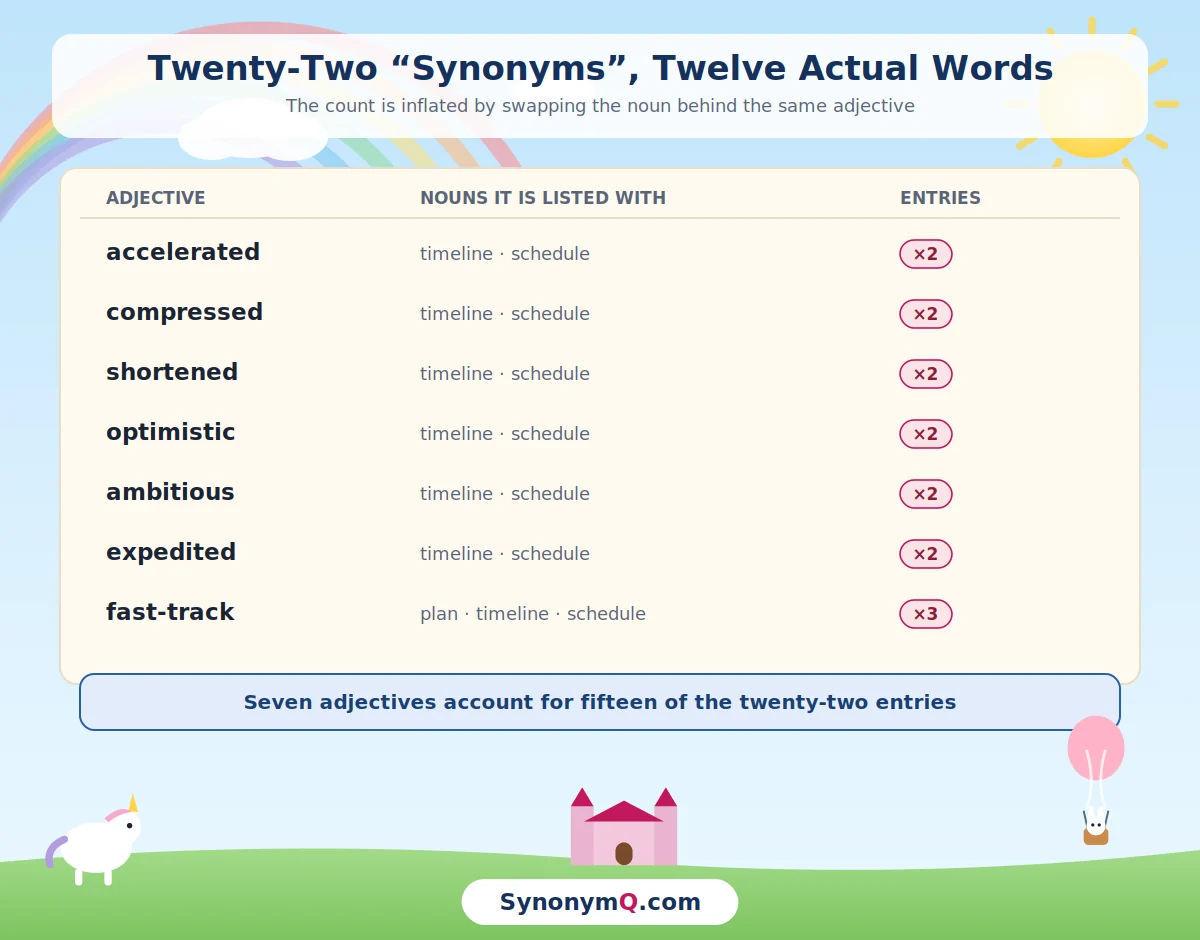
The page currently ranking second for this question lists twenty-two alternatives for aggressive timeline. Reading the list carefully, most of them are the same word twice.
Accelerated timeline and accelerated schedule are both there. So are compressed timeline and compressed schedule, shortened timeline and shortened schedule, optimistic timeline and optimistic schedule, ambitious timeline and ambitious schedule, expedited timeline and expedited schedule, and fast-track attached to plan, timeline and schedule.
Strip the noun swaps and twenty-two phrases collapse into roughly twelve adjectives: accelerated, rapid, fast-track, tight, ambitious, optimistic, expedited, compressed, intense, demanding, challenging, shortened. The count is inflated by shuffling timeline, schedule, timetable and timeframe behind the same words.
That would be a harmless quirk if the twelve were interchangeable. They are not, and the differences are not stylistic.
Five Claims Hiding in One Word List
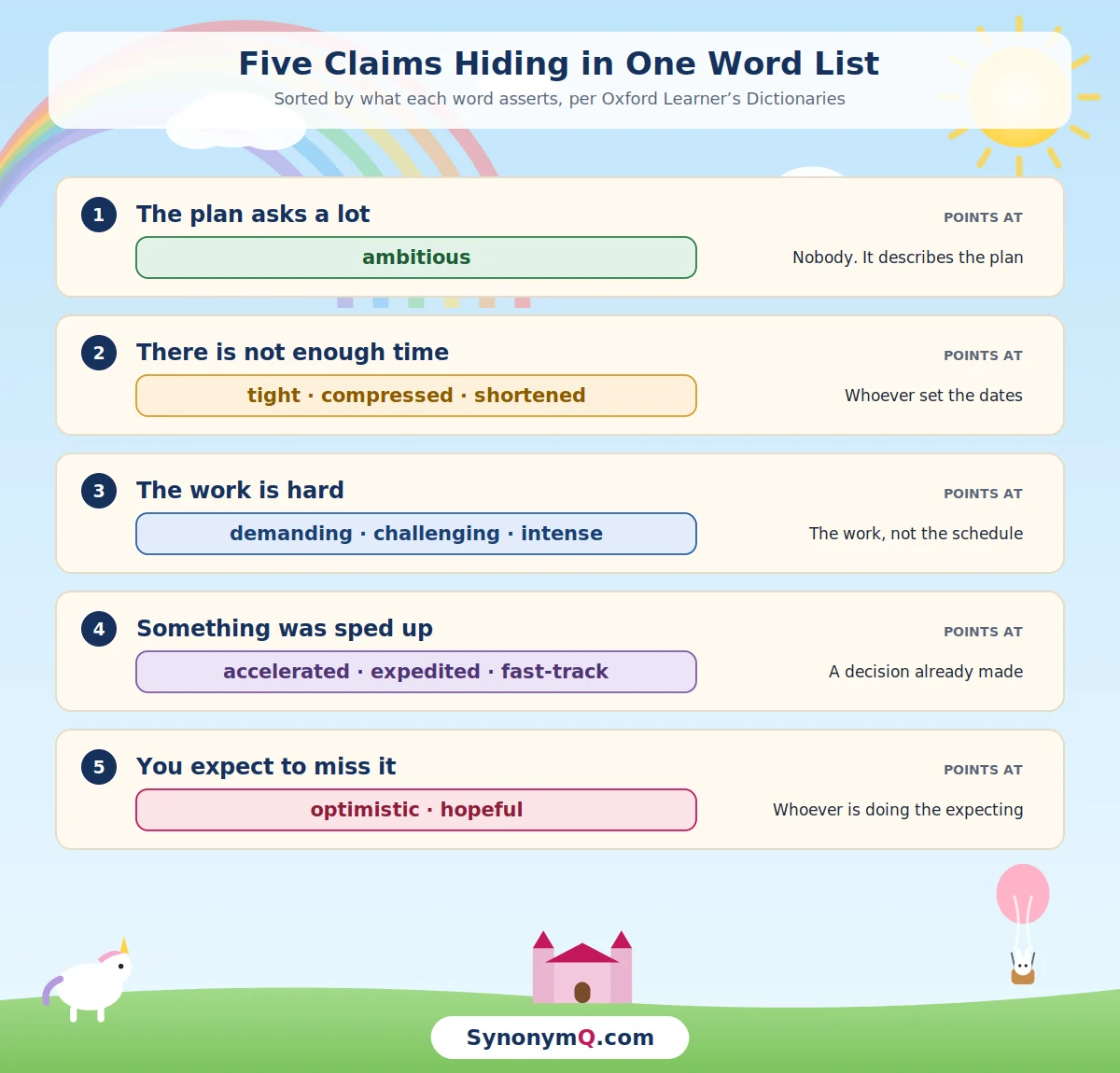
Sorted by what each word actually asserts, using the definitions the dictionary publishes rather than the groupings a thesaurus generates:
| The claim | Words | What the dictionary says | Who it points at |
|---|---|---|---|
| The plan asks a lot | ambitious | “needing a lot of effort, money or time to succeed” | Nobody. It describes the plan |
| There is not enough time | tight, compressed, shortened | tight: “difficult to manage with because there is not enough” | Whoever set the dates |
| The work is hard | demanding, challenging, intense | demanding: “(of a piece of work) needing a lot of skill, effort, etc.” | The work, not the schedule |
| Something was sped up | accelerated, expedited, fast-track | expedite: “to make a process happen more quickly” (formal) | A decision that was already made |
| You expect to miss it | optimistic, hopeful | optimistic: “expecting good things to happen or something to be successful” | Whoever is doing the expecting |
Read down the last column and the problem with a flat synonym list becomes obvious. These five groups do not differ in tone. They differ in who is responsible for the situation, and choosing between them in a status update is a political act whether you intend it or not.
Ambitious: The Closest True Replacement
Oxford’s second sense of ambitious is “needing a lot of effort, money or time to succeed”, with the example “the government’s ambitious plans for social reform”. That is almost exactly what aggressive means in the second sense, minus the disapproval label.
Ambitious describes the plan as a thing that will be hard to achieve. It does not say the dates are wrong, it does not say anyone made a mistake, and it does not predict failure. For most sentences where you were reaching for aggressive, it is the substitution that changes least.
One caution. Oxford’s first sense of ambitious is about a person: “determined to be successful, rich, powerful, etc.” That sense sits behind the word, so ambitious can faintly attribute the ambition to whoever wrote the plan. It is much quieter than the disapproval on aggressive, but it is there.
Ambitious also describes what a plan intends rather than what it delivered, which is the same distinction that makes ability a weak word on a resume: both name a capability that has not been demonstrated yet.
Tight, Compressed, Shortened: You Are Describing a Shortage
Oxford’s third sense of tight is “difficult to manage with because there is not enough”, filed under money and time, with the examples “the president has a tight schedule today” and “the deadline for finishing the project is too tight”.
Note what changed. Ambitious describes a plan that requires a lot. Tight describes a quantity that is insufficient. The first is about the size of the goal; the second is about a shortage, and a shortage exists because someone allocated too little.
Compressed and shortened are stronger versions of the same claim, and both imply a previous, longer version that someone cut. If no earlier schedule existed, neither word is accurate.
Demanding, Challenging, Intense: You Are Describing the Work
Oxford defines demanding as “(of a piece of work) needing a lot of skill, effort, etc.” Note the parenthesis. The dictionary attaches the word to a piece of work, not to a period of time.
This makes “demanding timeline” slightly off-target. What is demanding is the work; what is tight is the schedule. The phrase is common enough to pass unremarked, but it blurs the two, and if you are choosing carefully you can say the thing you mean:
Challenging behaves the same way and is softer. Intense describes the experience of the period rather than the schedule itself, which is why it fits a sprint and not a delivery date.
Accelerated, Expedited, Fast-Track: You Are Describing a Change of Plan
These three are not descriptions of a schedule at all. They are descriptions of something that happened to a schedule. Oxford defines expedite as “to make a process happen more quickly” and labels it formal.
All three presuppose an earlier, slower plan. Used where no such plan existed, they invent a history, and in a document that will be read later, an invented history is a small liability. If you did compress an existing schedule, they are the most accurate words available, because they say what actually occurred.
Register matters here too. Expedited is marked formal and suits a contract or a change order. Fast-track is the most informal of the twelve and reads oddly in a legal document. If you want general alternatives for speed rather than schedule-specific ones, the alternatives to quickly cover the adverbs.
Optimistic: The One That Reads as Doubt
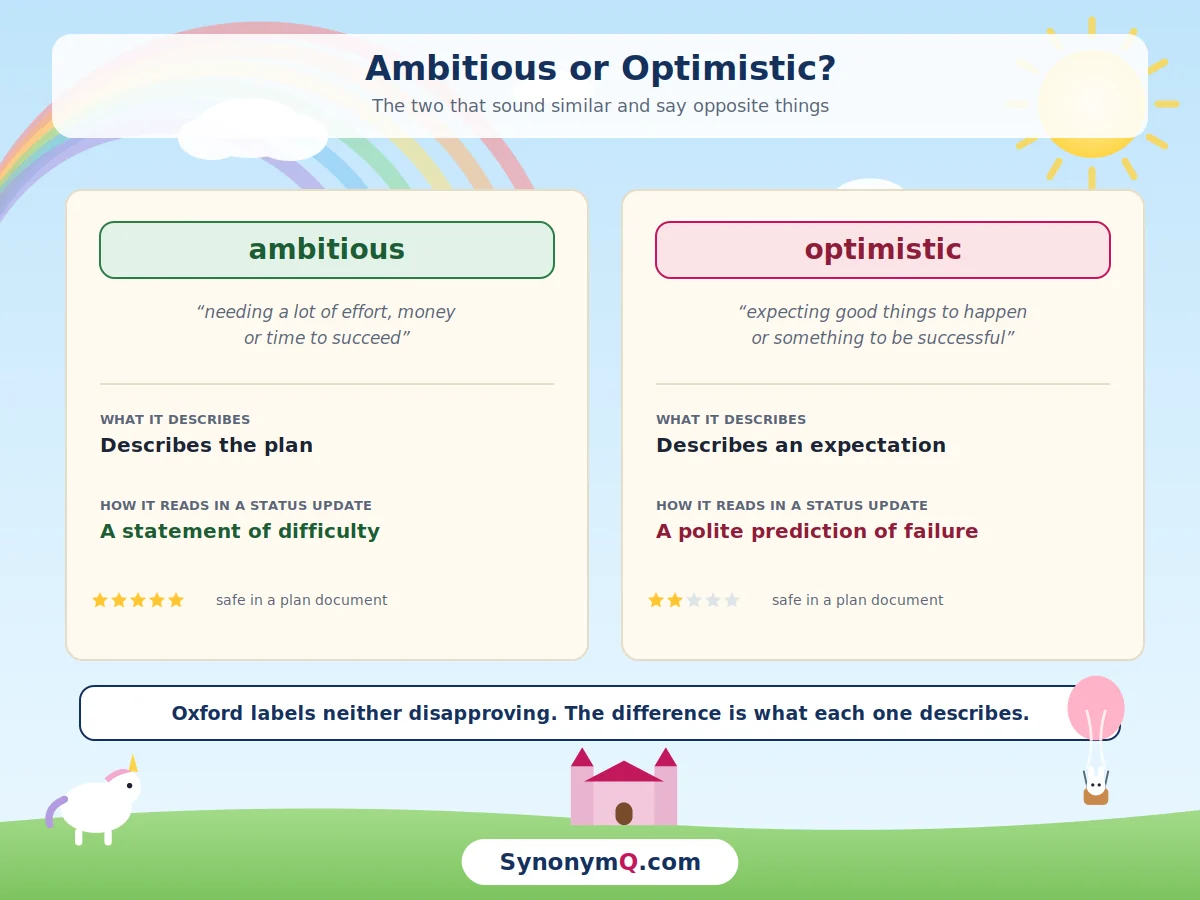
Oxford gives optimistic a single sense: “expecting good things to happen or something to be successful; showing this feeling”. The dictionary carries no disapproving label and lists positive as a synonym.
So on the page, optimistic is a positive word. In a project document it usually is not, and the reason is visible in the definition itself: optimism describes an expectation, not a property of the plan. Every other word in this article describes the schedule. Optimistic describes somebody’s state of mind about the schedule. Once a timeline is located in a person’s hopes rather than in the plan’s arithmetic, you have implied that the hopes might be wrong.
Practically: “the timeline is optimistic” is one of the strongest polite ways to say a plan will fail. If that is your meaning, it is an excellent phrase. If it is not, choose from one of the other four groups.
Two Phrases That Aren’t English
The same ranking page offers positive timeline and hopeful timeline alongside the real collocations. Neither is natural English. Positive and hopeful describe people and outlooks; they do not attach to schedules, and a reader meeting either phrase will pause on it.
Both are artefacts of automatic list generation, presented with no signal that they differ from the working phrases beside them. This is the ordinary hazard of a thesaurus that assembles collocations by pattern rather than by observing use.
The Same Choice in Growth, Marketing and Approach
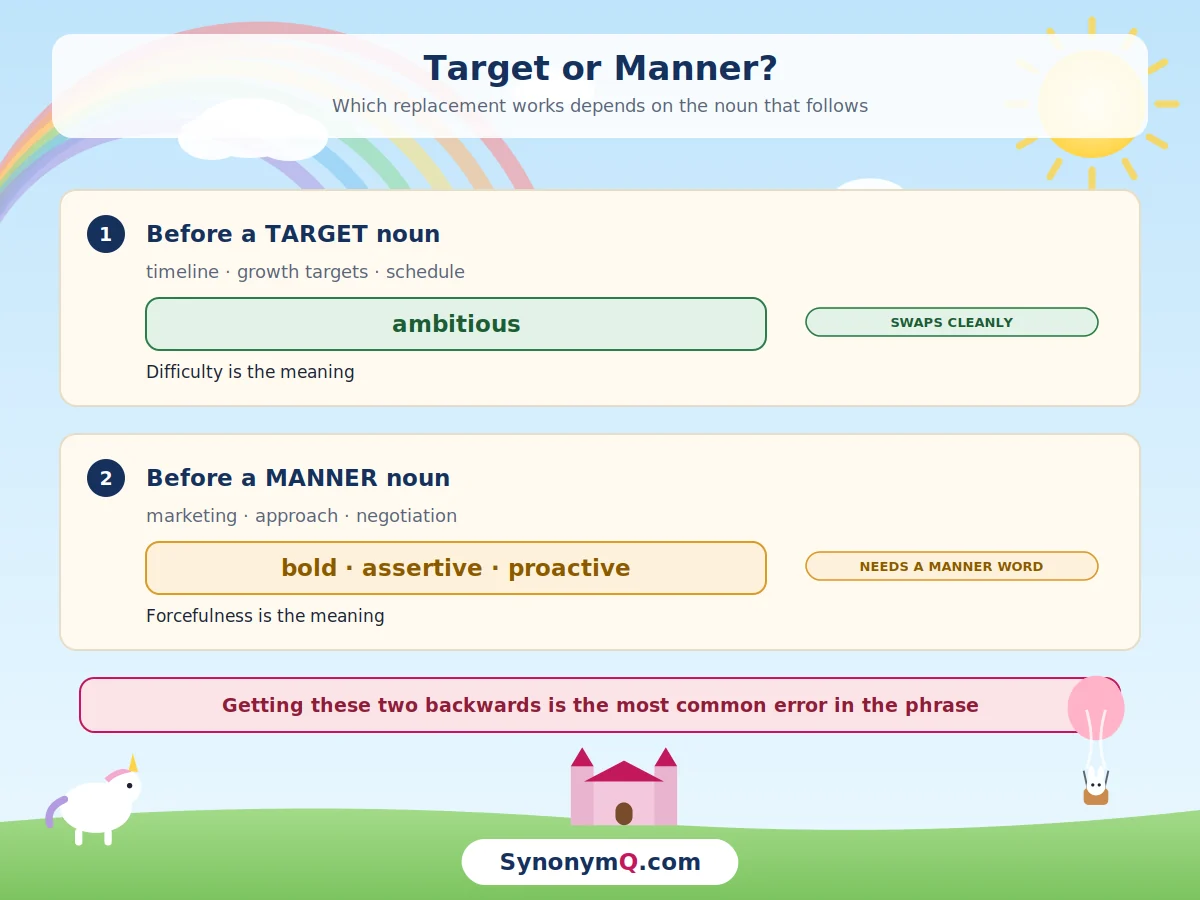
Aggressive attaches to several business nouns, and the disapproval label travels with it every time.
| Phrase | Safest replacement | What changes |
|---|---|---|
| aggressive timeline | ambitious timeline | Removes the disapproval, keeps the difficulty Direct Swap |
| aggressive growth targets | ambitious growth targets | Same Direct Swap |
| aggressive marketing | bold marketing · high-intensity marketing | Ambitious marketing is weaker here, because the ambition belongs to the campaign’s goals rather than its manner Swap With Adjustment |
| aggressive approach | assertive approach · proactive approach | These describe manner, which is what approach needs Swap With Adjustment |
The pattern: aggressive before a target means difficulty, so ambitious replaces it cleanly. Before a manner noun such as marketing, approach or negotiation, it means forcefulness, and needs a manner word instead. Getting these two backwards is the most common error in the phrase.
When “Aggressive” Is Still the Right Word
Three cases where replacing it would cost you accuracy.
When forcefulness is the point. “An aggressive negotiating position” is not a euphemism for an ambitious one. If you mean forceful, say forceful, and aggressive is the ordinary word for it.
When the disapproval is intentional. Describing a competitor’s pricing as aggressive puts a judgement on the record on purpose. Softening it to ambitious compliments them.
When it is the established term. “Aggressive growth fund” is a fixed category name in investing. Rewriting a term of art makes a document harder to search, not easier to read. Other business words carry the same lock. See the difference between given and provided for a case where two near-identical words are not swappable in contracts.
Frequently Asked Questions
What is a professional way to say aggressive timeline?
Ambitious timeline in almost every case. It carries the same meaning as the business sense of aggressive, which Oxford defines as “needing a lot of effort, money or time to succeed”, without the disapproval label attached to aggressive. Use tight only when you want the shortage of time itself on the record.
Is “aggressive timeline” negative?
Partly, and that is why it is unstable. Oxford marks the relevant sense of aggressive “sometimes disapproving”, so the phrase can be read as determined or as unrealistic depending on the reader. That ambiguity is fine in speech and expensive in a document that will be forwarded.
What’s the difference between an ambitious and an optimistic timeline?
Ambitious describes the plan: it needs a lot to succeed. Optimistic describes an expectation about the plan, which implies the expectation could be wrong. Calling a schedule ambitious is a statement of difficulty. Calling it optimistic is, in most workplaces, a polite prediction of failure.
Can I just say the deadline is tight?
Yes, and it is accurate when the time genuinely is insufficient — Oxford’s sense is “difficult to manage with because there is not enough”. Be aware that a shortage implies an allocator. In a retrospective that is exactly right; in a kickoff email it reads as a complaint. For other business words that shift responsibility, see the alternatives to however in an email.
How This Page Was Checked
Every definition and label quoted here was read from the entry it is attributed to, on 9 September 2026:
- Senses and the sometimes disapproving label on aggressive; definitions for ambitious, optimistic, tight, demanding and expedite — Oxford Learner’s Dictionaries, entry by entry.
- The twenty-two-item list discussed in section two was read from the page ranking second for this query on the same date, and the count of distinct adjectives is mine.
Two claims on this page are editorial judgement rather than retrieved fact, and are labelled as such where they appear: that optimistic reads as doubt in project documents, and that tight implies an allocator. Both follow from what the dictionary says these words describe; neither is a dictionary label. Where a word carries no register label, none is claimed for it.
Written by Naveed Akhtar, an SEO content writer with 10 years of article-writing experience.
Target topic: aggressive vs assertive in performance reviews

Naveed Akhtar writes every guide on SynonymQ. He is an SEO content writer with ten years of article-writing experience, working on the question a thesaurus never answers: which of these words belongs in this sentence, for this reader. Every page cites the dictionary entries it draws on and the date they were read.