
45 Synonyms for Benefits: Which One Should You Use?
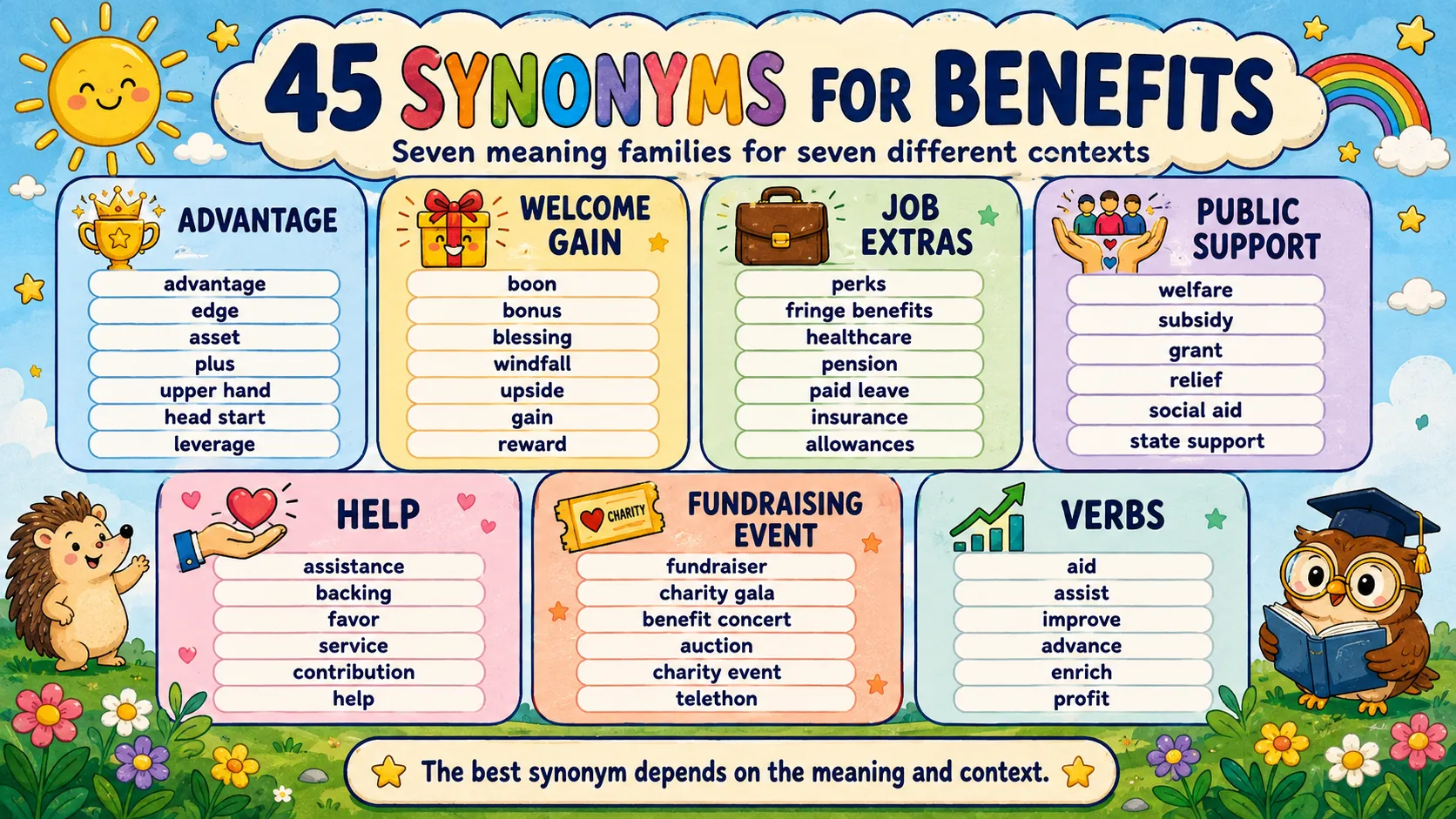
A benefit is an advantage, help or good result that something gives you. The strongest synonyms for benefits are advantage, upside, gain, perk, boon, blessing and allowance. Which one fits depends on whether you mean a good effect, a job extra, a government payment or a fundraising event.
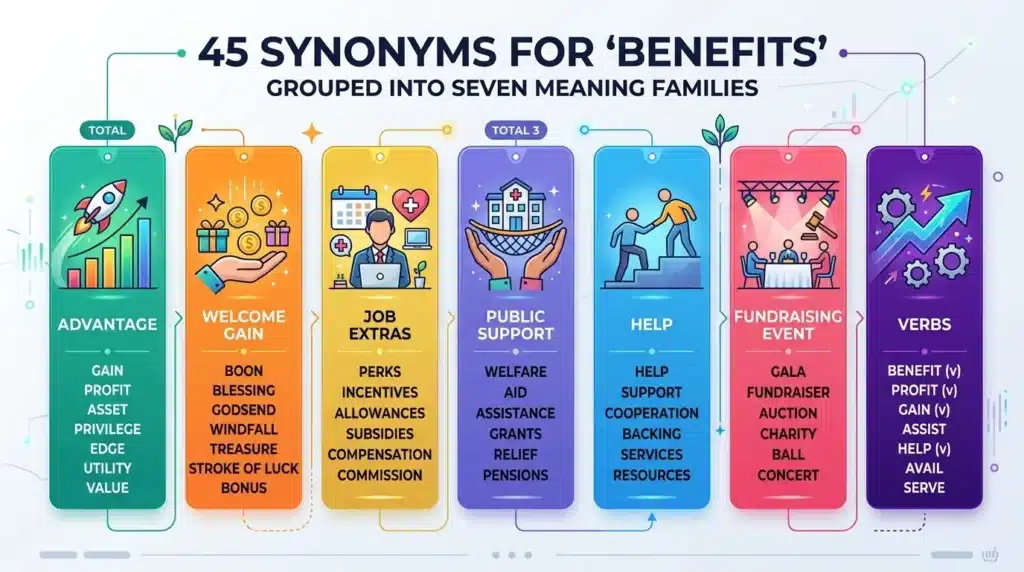
Quick-Reference Table: The 14 Most Useful Alternatives
| Synonym | Register | Intensity (1–5) | Best used for |
|---|---|---|---|
| advantage | Neutral | 3 | The safest one-for-one swap in almost any sentence |
| upside | Casual | 2 | Business talk and blog writing; pairs with a downside |
| gain | Neutral | 3 | Measurable improvement: money, health, efficiency |
| plus | Casual | 2 | Listing a small extra in conversation or a review |
| value | Neutral | 3 | Worth delivered to a customer, reader or client |
| boon | Literary | 4 | Something arriving as unusually welcome relief |
| blessing | Neutral | 4 | A good outcome you feel grateful for |
| windfall | Neutral | 4 | An unexpected financial gain |
| bonus | Neutral | 3 | An extra on top of what was expected |
| perk | Casual | 2 | Small job extras: free coffee, flexible hours |
| perquisite | Formal | 3 | Contracts, HR policy and legal writing |
| allowance | Neutral | 3 | A regular sum paid for a stated purpose |
| entitlement | Formal | 3 | A benefit someone has a legal right to |
| welfare | Neutral | 3 | Government support, in North American English |
Intensity is SynonymQ’s editorial judgment: 1 = mild, 5 = strongest. A guide, not a measurement.
The Full List: 45 Synonyms for Benefits, Grouped by Meaning
English gives us roughly forty-five genuine alternatives here, so the rest of this guide is about choosing between them well rather than collecting more of them.
Each entry shows its register and part of speech, then one original example sentence. Save the ones you want with SynonymQ bookmarks, and search any of them in the SynonymQ synonym finder for a wider list.
Advantage or good effect: the everyday sense
This group covers the plain meaning of a helpful result that something produces.
1. advantage (Neutral, noun) — a favorable factor or condition — The advantage of a smaller class is that the teacher learns every name in a week.
2. upside (Casual, noun) — the positive side of a situation that also has a negative side — The upside of the delay is that we caught two bugs before launch.
3. plus (Casual, noun) — a small extra advantage worth mentioning — Free parking is a plus, though it was not why I took the job.
4. gain (Neutral, noun) — an increase or measurable improvement — The new filter produced a gain of nine percent in water clarity.
5. value (Neutral, noun) — the worth something delivers to the person receiving it — Readers see the value of the course in week two, not week one.
6. good (Neutral, noun) — benefit considered in a broad, almost moral sense — She argued the closure served the good of the whole neighborhood.
7. use (Neutral, noun) — practical usefulness, most often in negative sentences — The manual was of no use to anyone who had not already assembled the frame.
8. avail (Formal, noun) — usefulness, now almost only in fixed negative phrases — He pleaded for an extension, to no avail.
Something welcome that you receive
These words carry warmth or relief. The benefit feels like a gift rather than a calculation.
9. boon (Literary, noun) — something that makes life noticeably easier — The night bus was a boon to hospital staff on the late shift.
10. blessing (Neutral, noun) — a good outcome you feel thankful for — Losing that contract turned out to be a blessing.
11. godsend (Casual, noun) — something arriving exactly when it was needed — The loaner laptop was a godsend the week mine died.
12. windfall (Neutral, noun) — an unexpected gain, usually money — The refund was a windfall that covered the whole repair.
13. bonus (Neutral, noun) — an extra on top of what was promised — The view from the balcony was a bonus we had not paid for.
14. dividend (Neutral, noun) — a benefit paid back later by earlier effort — Learning to touch-type paid dividends for the rest of her career.
15. payoff (Casual, noun) — the reward that arrives at the end of an effort — Six months of rehab, and the payoff was walking her daughter to school.
16. behoof (Archaic, noun) — advantage or profit, found now only in older texts — The land was granted to the abbey for the behoof of the poor.
Job extras and entitlements
Here the word means something an employer or an institution provides on top of pay.
17. perk (Casual, noun) — a small non-cash advantage of a job — The best perk was a desk by the window.
18. perquisite (Formal, noun) — the formal term for a job perk, common in contracts — Company housing is listed as a perquisite in clause nine.
19. allowance (Neutral, noun) — a fixed sum paid regularly for a stated purpose — Field staff receive a travel allowance every month.
20. entitlement (Formal, noun) — something a person has a legal right to receive — Statutory sick pay is an entitlement, not a favor.
21. compensation (Formal, noun) — the full package of pay and benefits, especially in US HR writing — Her compensation includes equity vesting over four years.
22. emolument (Formal, noun) — payment or profit from holding an office — The role carries no emolument beyond expenses.
23. provision (Formal, noun) — arrangements made in advance to cover a future need — Pension provision was the sticking point in negotiations.
24. package (Neutral, noun) — the whole set of employment benefits, treated as one thing — Two candidates turned us down over the package, not the salary.
Public and financial support
This group carries the strongest regional and tonal risks in the whole list. Read the labels closely.
25. welfare (Neutral, noun — chiefly North American) — government support for people in financial need — Cuts to welfare hit rural counties hardest.
26. dole (Casual, noun — chiefly British) — unemployment benefit, now slightly dated and often disapproving — He was on the dole for most of that winter.
27. handout (Casual, noun) — money given as charity, almost always critical in tone — They wanted a fair contract, not a handout.
28. subsidy (Formal, noun) — money paid to keep a price or an industry viable — The bus route survives on a county subsidy.
29. stipend (Formal, noun) — a regular fixed payment, often to a student or trainee — The fellowship pays a modest stipend and covers travel.
30. relief (Neutral, noun) — assistance given to people in hardship — Flood relief reached the village four days late.
Help given to a person or a cause
These are the closest synonyms for the verb-like sense of benefit as helping someone.
31. aid (Formal, noun) — help, especially organized or official help — Legal aid made the appeal possible.
32. help (Neutral, noun) — the plainest word in the group, and often the best — Her notes were a real help the night before the exam.
33. assistance (Formal, noun) — help, in official or written registers — Applicants may request assistance completing the form.
34. support (Neutral, noun) — ongoing help, practical or emotional — Peer support kept half the cohort from dropping out.
35. service (Neutral, noun) — a useful act done for someone else — You would be doing me a service by reading the draft.
36. benefaction (Formal, noun) — a charitable gift, usually a large one — The wing was built on a single benefaction in the founder’s will.
The fundraising-event sense
In this sense a benefit is not an advantage at all. It is an occasion.
37. fundraiser (Neutral, noun) — an event held to raise money — The fundraiser cleared enough for two new minibuses.
38. gala (Neutral, noun) — a formal celebratory fundraising event — Tickets to the gala fund the scholarship for a year.
39. charity event (Neutral, noun) — the plainest description of the same thing — She sang at a charity event for the children’s ward.
When you need the verb, not the noun
Use these when your sentence is this benefits us, not this is a benefit.
40. profit (Neutral, verb) — to gain something useful, often followed by from — Nobody profits from a rushed decision.
41. further (Formal, verb) — to help something advance — The grant furthered research that had stalled for years.
42. advance (Formal, verb) — to move something forward — The ruling advanced the tenants’ case considerably.
43. boost (Casual, verb) — to raise or improve something quickly — Free breakfast boosted attendance in the first month.
44. enrich (Formal, verb) — to make something deeper or more valuable — Two years abroad enriched her teaching more than any course.
45. assist (Neutral, verb) — to help, in a measured or official tone — A ramp at the side door assists anyone using a wheelchair.
If you want a longer raw list of candidates before narrowing down, run the word through the SynonymQ synonym tool and then come back to the register table below.
Register and Formality Table
Every alternative above sits in one of six registers. This is the vocabulary the rest of the article uses.
| Register | Words in this group | What choosing it signals |
|---|---|---|
| Formal | aid, assistance, perquisite, entitlement, compensation, emolument, provision, subsidy, stipend, benefaction, further, advance, enrich | Contracts, policy, academic prose. Precise, but stiff in speech |
| Neutral | advantage, gain, value, good, use, blessing, windfall, bonus, dividend, allowance, package, welfare, relief, help, support, service, fundraiser, gala, charity event, profit, assist | Safe almost anywhere, including essays and email |
| Casual | upside, plus, godsend, payoff, perk, dole, handout, boost | Conversation, blogs, internal messages |
| Slang | none in this list | Benefit has no true slang synonym, which is unusual |
| Literary | boon | Fiction and elevated prose; noticeable in a business email |
| Archaic | behoof | Reading older texts only. Never write it fresh |
The empty Slang row is worth a second look. Words about money and entitlement usually attract slang, and dole and handout are the closest this list comes.
Which Word Should You Use?
Start from what your sentence actually means, not from the list.
- A good effect something produces → advantage, gain, value
- The positive side of a mixed situation → upside, plus
- Something unexpectedly welcome → boon, godsend, windfall
- A small extra from an employer → perk (casual) or perquisite (contract)
- The whole employment offer → package, compensation
- A legal right to receive something → entitlement
- Government money, writing for a British reader → benefits
- Government money, writing for a US reader → welfare, assistance
- Money paid regularly for a stated purpose → allowance, stipend
- An event that raises money → fundraiser, gala
- The sentence needs a verb → profit from, further, boost, assist
Three quick rules that resolve most cases:
- If you can also write the downside, then upside is the natural partner. If you cannot, use advantage.
- If the benefit is countable and small, use perk. If it is contractual, use perquisite or entitlement.
- If your reader is in the United States, never let benefits stand alone for government support. Say welfare benefits or public assistance.

The Benefits Substitution Test
A thesaurus implies every listed word drops straight into your sentence. Most do not. This table takes one sentence — The scheme brought real benefits to older residents — and shows what each swap actually costs.
| Alternative | Substitutability | What the swap does |
|---|---|---|
| advantages | Direct swap | Reads naturally; slightly more comparative in feel |
| gains | Direct swap | Suggests the improvement was measured |
| upsides | Direct swap | Drops the register to conversational |
| perks | Requires rewrite | Wrong sense; perks means job extras, not public good |
| entitlements | Swap with adjustment | Needs for rather than to: entitlements for older residents |
| welfare | Swap with adjustment | Becomes uncountable: real welfare gains for older residents |
| boon | Swap with adjustment | Singular and countable: was a real boon to older residents |
| helped | Requires rewrite | Verb, not noun: the scheme really helped older residents |
| relief | Requires rewrite | Implies hardship: brought relief to older residents |
| profited | Requires rewrite | Subject flips: older residents profited from the scheme |
Three patterns are worth memorizing from that table.
Countability is the most common trap. Benefits is happily plural, but welfare, relief and aid are uncountable, so a plural swap produces welfares and instantly marks the sentence as non-native.
Direction is the second. Benefit as a noun flows from the scheme to the residents, but profit as a verb flows the other way, so the subject of the sentence has to change with it.
Benefits Synonyms by What Follows the Word
The word after benefit decides which synonym survives. Same headword, four different answers.
| Phrase | Best choice | Avoid | Why |
|---|---|---|---|
| health benefits | health benefits, health gains | health perks | Perks belongs to employment, not medicine |
| employee benefits | benefits, package, entitlements | advantages | Advantages sounds like a sales pitch, not a contract |
| tax benefits | tax benefits, tax advantages, tax relief | tax perks | Tax relief is the standard term for the specific mechanism |
| benefits of exercise | benefits, advantages, gains | entitlements | Nothing is being granted by an institution |
| unemployment benefit | benefit, allowance, welfare | bonus | Bonus implies a reward for good performance |
| a benefit for the hospital | fundraiser, gala, charity event | advantage | This sense is an event, not an advantage |
Notice tax relief in that table. It is the one place where relief is the standard collocation rather than a substitution, which is why swapping the other direction — tax benefits for tax relief in a policy document — can change the technical meaning.
Words That Are Not True Synonyms for Benefits
These six get swapped in for benefit constantly, and each one changes the sentence in a way most writers do not intend.
Beneficiary. A beneficiary is the person who receives the benefit, not the benefit itself. Writing the beneficiaries of the scheme were free eye tests puts the tests in the role of people.
Benevolence. This is a kindly attitude, not a good result. The benevolence of the policy praises the intention; the benefit of the policy reports the outcome.
Incentive. An incentive is a reason to act, offered before the act. A benefit is what you get. A tax credit designed to change behavior is an incentive; the money in your account afterwards is the benefit.
Amenity. Amenities are physical facilities: a pool, a laundry, a car park. Calling them benefits sounds like employment jargon, and calling job benefits amenities sounds like a brochure.
Privilege. A privilege is a special right that others do not have, and the word now carries social weight. Replacing staff benefits with staff privileges implies unfairness you probably did not mean.
Interest. In your best interest means for your long-term good. It is not interchangeable with benefit: for your benefit means the thing was done to help you, which is a different claim.
Head-to-Head Comparisons
Benefit vs advantage
| Point | Benefit | Advantage |
|---|---|---|
| Core sense | A good result you receive | A favorable position, often relative to others |
| Comparison built in | No | Yes, usually implied |
| Common contexts | Health, employment, policy | Competition, negotiation, sport |
| Substitutable | Usually, in the everyday sense | Usually, but adds a sense of edge |
Advantage quietly implies someone else is worse off. A benefit of living near the coast is a plain good; an advantage of living near the coast hints at a comparison with people who do not.
For general prose, advantage is the safest single swap for benefit. In HR and policy writing, keep benefit, because advantage does not carry the meaning of a paid entitlement.
Benefits vs perks
| Point | Benefits | Perks |
|---|---|---|
| Register | Neutral to formal | Casual |
| Typical items | Health insurance, pension, leave | Snacks, gym access, flexible hours |
| Contractual | Usually yes | Usually no |
| Substitutable | Not safely, in either direction | Not safely |
This is the most expensive confusion on the page, and job adverts make it weekly. Benefits are the contractual elements a candidate will read carefully; perks are the pleasant extras.
Listing health cover under perks makes a serious offer sound casual. Listing free fruit under benefits makes a thin offer sound padded.
Benefit vs profit
| Point | Benefit | Profit |
|---|---|---|
| Measured in money | Not necessarily | Yes, almost always |
| Who receives it | A person, group or cause | A business or investor |
| As a verb | Rare in the plain sense | Common: profit from |
| Substitutable | Only where the gain is financial | Only where the gain is financial |
Profit narrows the meaning to money. The community benefited from the new line covers time saved, cleaner air and property values; the community profited from the new line sounds like someone was paid.
Beneficial vs advantageous
| Point | Beneficial | Advantageous |
|---|---|---|
| Part of speech | Adjective | Adjective |
| Suggests | Genuinely good for someone | Useful for gaining position |
| Common pairings | Beneficial effect, mutually beneficial | Advantageous terms, advantageous position |
| Register | Neutral to formal | Formal |
Both are adjectives, so neither can replace the noun benefit. If you searched for a synonym for beneficial and landed here, the words you want are helpful, useful, valuable, advantageous and favorable.
Use beneficial when the effect is good for health, learning or wellbeing. Use advantageous when the good is strategic: terms, timing, position.

Before and After: Better Word Choices
Each pair below fixes a real problem. None of them replaces a simple word with a rare one for the sake of it.
Before: The benefits of the program were many and various. After: The program cut waiting times by three weeks and halved missed appointments. Why: The abstract noun was doing no work. Naming the two outcomes is shorter and far more convincing.
Before: Staff enjoy a number of benefits including free tea and coffee. After: Staff get free tea and coffee, plus a cycle-to-work scheme. Why: Free drinks are perks, and calling them benefits oversells the offer. Plus keeps the list light.
Before: This will be beneficial to the wider community and bring benefits to local trade. After: This will help the wider community and bring more customers to local shops. Why: Beneficial and benefits in one sentence is the repetition trap. Replacing the first with a verb breaks it.
Before: Claimants receive benefits from the state welfare benefits system. After: Claimants receive payments through the state welfare system. Why: Benefits appeared twice in eleven words. Payments is specific and welfare system carries the rest.
When Benefits Is Already the Right Word
Sometimes the honest answer is that no synonym improves the sentence. Keep benefits when any of these is true.
The sentence is about employment or state support. Benefits is the standard term in both fields, and entitlements or emoluments make a plain HR sentence sound legalistic.
The word appears inside a fixed phrase. The benefit of the doubt, cost-benefit analysis and fringe benefits have no working substitute.
You are writing for an exam or an assessment. Markers reward the accurate common word over the rare one, and boon in a Task 2 essay reads as a memorized substitution rather than range.
You have already varied it once. A neutral piece can carry one upside or one gain. A third swap starts drawing attention to the vocabulary instead of the argument.
Common Collocations With Benefit
These pairings are fixed or near-fixed. Substituting a synonym inside them produces English that is technically parsable and immediately wrong.
- the benefit of the doubt — I gave him the benefit of the doubt about the missed deadline. Never the advantage of the doubt.
- fringe benefits — The fringe benefits were better than the salary suggested. Never fringe perks, despite the meaning overlap.
- cost-benefit analysis — A cost-benefit analysis killed the second site before design started. Never cost-advantage analysis.
- health benefits — The health benefits of walking show up within a month.
- tax benefits — There are real tax benefits to filing jointly in her situation.
- benefits package — She negotiated the benefits package before the salary.
- employee benefits — Employee benefits are administered by a third party.
- housing benefit — Housing benefit was replaced for most new claimants. Singular, and chiefly British.
- child benefit — Child benefit is paid to the main carer. Singular, and chiefly British.
- reap the benefits — Growers who planted early reaped the benefits in June.
- of mutual benefit — The exchange was of mutual benefit to both departments.
- benefit concert — The benefit concert filled the hall twice over.
Two of these deserve a warning. Housing benefit and child benefit take the singular in British usage, so housing benefits reads as a mistake to a UK reader even though the plural is normal elsewhere.
British vs American Usage of Benefits
This is the one distinction most synonym pages skip, and it is the one most likely to make an international reader misuse the word.
Oxford Learner’s Dictionaries labels the government-money sense of benefit as British English, and gives welfare as the North American alternative. So she is on benefits reads as normal British English and as slightly puzzling American English.
| Meaning | British English | American English |
|---|---|---|
| Government support for people in need | benefits, on benefits | welfare, public assistance, on welfare |
| Named state payments | housing benefit, child benefit | housing assistance, child tax credit |
| Employer-provided extras | benefits, perks | benefits, benefits package |
| Total pay and extras | package | compensation |
| Fundraising event | benefit, benefit concert | benefit, benefit concert |
Two practical rules follow. Writing for a US audience, do not let benefits stand alone for state support — add welfare or public assistance so the sense is unambiguous.
Writing for a UK audience, compensation meaning total pay is US business English and will read as money paid for an injury. Use package instead.
The employment sense and the fundraising sense travel fine in both. Only the government-payment sense is genuinely divided.

Etymology and Origin
Benefit entered English in the late 14th century from Anglo-French benfet and Old French bienfait, going back to Latin benefactum, a good deed, from bene (well) and facere (to do). Its first English senses were a noble or friendly action, and a thing that brings advantage or profit.
The verb followed in the late 15th century, meaning to do good to or be of service. The sense most readers meet in a headline arrived much later: Etymonline records the fundraising sense, a public performance to raise money for a deserving person or cause, from the 1680s.
The employment sense is the newest of all. Etymonline dates plural benefits, meaning financial support one is entitled to through employment or membership, to 1895. That gap of five centuries explains why the singular and the plural now behave like two different words.
Grammar, Pronunciation and Word-Family Notes
These are the mistakes a competent learner still makes with this word, and the one pronunciation shift worth knowing.
Benefit from, or benefit someone
Benefit from means you are the one who gains: the school benefited from the grant. Benefit someone means you are the one causing the gain: the grant benefited the school.
Both are correct, and the preposition tells the reader which direction the good is flowing. Getting it backwards is the single most common error with this verb.
Benefited or benefitted
Both spellings are recognized. Benefited and benefiting with one t are standard in US English and now the more common forms in British English too, so use one t unless a house style says otherwise.
Countable and uncountable
Benefit is countable in the advantage sense: one benefit, several benefits. In the state-support sense British English uses it both ways, which is why housing benefit stays singular while she claims benefits takes the plural.
The words writers substitute for it are often uncountable — welfare, aid, relief, support, assistance — so welfares and aids are the errors to watch for.
Where the stress falls
The stress moves when the word changes form, which trips up speakers who learned the noun first.
| Word | Stress | Pronunciation |
|---|---|---|
| benefit | first syllable | UK and US /ˈbenɪfɪt/ |
| beneficial | third syllable | UK and US /ˌbenɪˈfɪʃl/ |
| beneficiary | third syllable | UK /ˌbenɪˈfɪʃəri/, US /ˌbenɪˈfɪʃieri/ |
Say BEN-uh-fit, but ben-uh-FISH-ul and ben-uh-FISH-uh-ree. Pronunciations above are as published by Oxford Learner’s Dictionaries.

Choosing Benefits Synonyms by Writing Situation
Academic Writing and Essays
Essay markers penalize thesaurus reaching, so stay in the neutral band. Reliable picks: advantage, gain, value, positive effect, improvement, return.
For a cause-and-effect sentence, effect often beats any synonym: the effect of subsidised transport on attendance is more precise than the benefit. Keep drafts inside the word limit with the SynonymQ word counter.
Avoid boon and godsend in academic prose. Both smuggle in an emotional judgment that a marker will read as unsupported.
Résumés, Cover Letters and Professional Email
Write about benefits you produced, not benefits you enjoyed. Strong verbs here: improved, increased, saved, strengthened, streamlined.
Instead of my work benefited the team, write my work cut the team’s reporting time by a day a week. The number does what the synonym cannot.
When you mean the employer’s offer, package and compensation are the professional terms. Perks in a negotiation email undersells what you are asking about.
Creative Writing and Fiction
Fiction is where boon, windfall and godsend earn their place, because they carry feeling as well as meaning. A character who calls a job a perk tells you something about her; one who calls it a perquisite tells you more.
Behoof has exactly one use: dialogue or narration set in an older register. Anywhere else it reads as a costume.
Everyday Conversation and Social Media
Perk, plus and upside sound like speech. Entitlement and emolument do not, and using them casually reads as sarcasm.
In a review or a recommendation, plus is the most natural word in English for a small good point: big plus for the free luggage.
Searching for the right word mid-sentence is what the SynonymQ synonym finder is built for — type the word, filter by register, keep writing.

Antonyms of Benefit
The opposite depends on which sense you are using. For the everyday sense, drawback and downside are the two most natural choices.
- drawback — the plainest opposite of a benefit in ordinary prose
- downside — the casual partner of upside, and the best fit in speech
- disadvantage — the neutral formal opposite; pairs with advantage
- detriment — formal, and stronger: implies real damage
- harm — the opposite of the verb benefit
- loss — the opposite where the benefit was financial
- cost — the opposite in any cost-benefit framing
- penalty — the opposite where the benefit was a reward
- liability — the opposite where the benefit was an asset
- handicap — the opposite where the benefit was an advantage in a contest
- hindrance — the opposite of help or assistance
- impediment — formal; something blocking progress
- bane — literary, and the true opposite of boon
- damage — the opposite of the verb, in physical or reputational contexts
For the verb, the natural opposites are harm, hurt, hinder, impair and damage. The ruling benefited tenants inverts to the ruling harmed tenants, not the ruling drawbacked tenants.
Browse opposites in the SynonymQ antonym finder, and read Antonyms 101: How Opposite Words Sharpen Your Meaning for how to use them in a sentence rather than a list.
Benefit in Spanish, French and Italian
[VERIFY-NATIVE] The table below needs a native-speaker check before publication. Register and regional errors here are invisible to an English-speaking editor.
| Language | Word | Register | Notes |
|---|---|---|---|
| Spanish | beneficio | Neutral | Masculine. The default for advantage and for profit |
| Spanish | ventaja | Neutral | Feminine. Closer to advantage; used for the upside of a choice |
| Spanish | prestación | Formal | Feminine. The word for a state or employment benefit payment |
| French | avantage | Neutral | Masculine. The everyday word for a benefit or advantage |
| French | bénéfice | Neutral | Masculine. Leans financial: profit, or gain from something |
| French | prestation | Formal | Feminine. State benefits, as in prestations sociales |
| Italian | beneficio | Neutral | Masculine. General advantage, often somewhat formal |
| Italian | vantaggio | Neutral | Masculine. The most natural everyday choice |
| Italian | prestazione | Formal | Feminine. Benefit payment, and also performance |
One example sentence per language:
- Spanish: El principal beneficio del programa es el ahorro de tiempo.
- French: Le principal avantage du programme est le gain de temps.
- Italian: Il vantaggio principale del programma è il risparmio di tempo.
Notice that all three languages split what English packs into one word: a general advantage, a financial gain, and a state payment. English speakers writing in these languages reach for the beneficio family too often and sound formal.
How to Avoid Repeating Benefit in One Piece of Writing
Repetition of benefit is common in essays and proposals because the word covers so much ground. Fixing it is a structural job, not a swapping job.
- Read the piece and mark every instance. Group them by sense: good effect, job extra, payment, event. Only the same-sense repeats are the real problem.
- Replace the second instance with the specific thing. The benefits of the scheme becomes shorter waiting times and lower travel costs. This is almost always the strongest edit.
- Change the grammar, not just the word. One benefit is that staff stay longer becomes staff stay longer. Deleting the abstract noun tightens the sentence.
- Swap register deliberately, once. A single upside or boon in a neutral piece reads as variety. Three read as a thesaurus.
- Use pronouns and reference. These gains, that effect, the same pattern all carry the meaning forward without a new noun.
- Check the result out loud. If a replacement makes you pause, it was the wrong one.
For longer rewrites, the SynonymQ paraphrasing tool handles whole sentences rather than single words. If the piece is graded or published work, read How to Paraphrase Without Plagiarizing first.

Frequently Asked Questions
Which word can I use instead of benefit?
Use advantage if you want a one-word swap that works almost anywhere. Use gain for measurable improvement, perk for a small job extra, entitlement for something legally owed, and upside in casual writing. The right choice depends on which of those four things you mean.
What is another word for giving benefits?
Providing, granting, conferring and awarding all work, depending on formality. In HR writing, the standard phrase is providing benefits; in policy writing it is conferring entitlements. For charitable giving, benefaction is the formal noun.
What is another word for benefited?
Gained, profited, improved and was helped by are the closest past-tense alternatives. Note that benefited with one t is the standard spelling in US English and now the more common form in British English too; benefitted is a recognized variant.
What is another word for benefiting?
Gaining, profiting from, helping and advancing fit most sentences. Benefiting from usually becomes gaining from or profiting from; benefiting someone usually becomes helping or serving them.
What is another word for benefits?
Advantages, perks, entitlements, allowances and upsides are the strongest plural alternatives. Choose by sense: advantages for good effects, perks for casual job extras, entitlements for legal rights, allowances for regular payments.
What is a synonym for stands to benefit?
Stands to gain, is set to gain and will profit from are the natural equivalents. All three keep the meaning of a benefit that has not arrived yet: the port stands to gain from the tariff change.
What is a synonym for good benefit?
Good benefit is not standard English, because benefit is already positive. Write real benefit, clear benefit, significant benefit or major advantage instead. If you mean size, substantial; if you mean certainty, demonstrable.
What is a verb that is a synonym for benefit?
Profit, help, aid, assist, further, advance, boost and enrich are all verb synonyms. Use profit from or gain from when the subject receives the benefit, and help, further or boost when the subject causes it.
What is a formal synonym for benefits?
Entitlements, emoluments, perquisites and provisions are the formal options, and each is narrower than benefits. In most formal writing, advantages or benefits itself is the better choice — formality is not the same as precision.
What is another word for benefit in an essay?
Advantage, gain, positive effect and improvement are the safest essay choices. Better still, name the specific outcome: shorter waiting times beats the benefits of the reform in any marked essay.
Which benefit synonym should I use in IELTS writing?
Stay with advantage, benefit and gain in IELTS Task 2. Examiners reward accuracy and range, not rarity, and boon or emolument in an essay about tourism reads as a memorized word dropped into the wrong slot.
Is negative benefit correct English?
No. Negative benefit is a contradiction, and readers stumble on it. Use drawback, downside, disadvantage or cost instead — see the antonyms section above for the full range.
What is a six-letter word for benefit?
Profit, upside, payoff, reward, behoof and assist are the common six-letter fills. For a crossword clue reading simply benefit, profit is the most frequent answer at that length.
What is the difference between benefits and perks?
Benefits are usually contractual and substantial: insurance, pension, leave. Perks are casual extras like snacks or gym access. The comparison table above covers when swapping one for the other misleads a job candidate.
Pick the Word, Then Move On
The real skill with benefits is not knowing forty-five alternatives — it is noticing which of the four senses you are in before you swap anything. Once you know whether you mean a good effect, a job extra, a payment or an event, the choice narrows to two or three words.
Keep the register table open while you draft, and run anything you are unsure of through the SynonymQ synonym finder before you commit. If you liked this approach, the same method runs through our guides to synonyms for experience, synonyms for honor and synonyms for protect.
More word-choice guides: synonyms for quickly, synonyms for play and synonyms for fancy.


Naveed Akhtar writes every guide on SynonymQ. He is an SEO content writer with ten years of article-writing experience, working on the question a thesaurus never answers: which of these words belongs in this sentence, for this reader. Every page cites the dictionary entries it draws on and the date they were read.