
85 Synonyms for Play: Meaning, Register and Examples
The best synonym for play depends on which sense you need. For children at play, use frolic, romp or cavort. For sport, compete. For an instrument, perform.
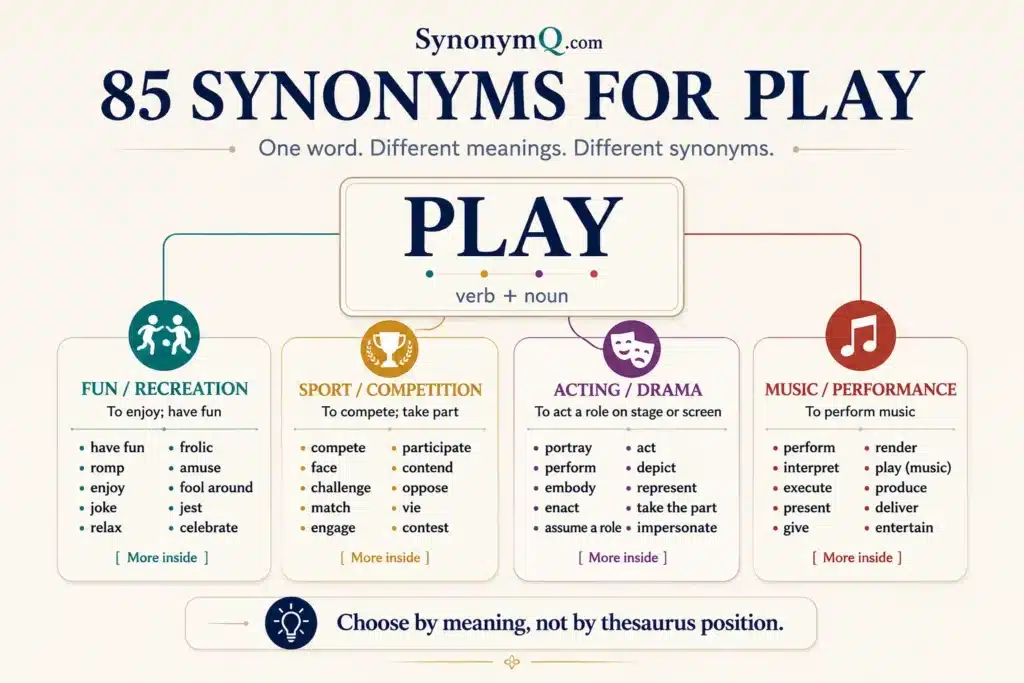
For a stage role, portray. For a recording, put on. For the noun, drama, recreation or slack.
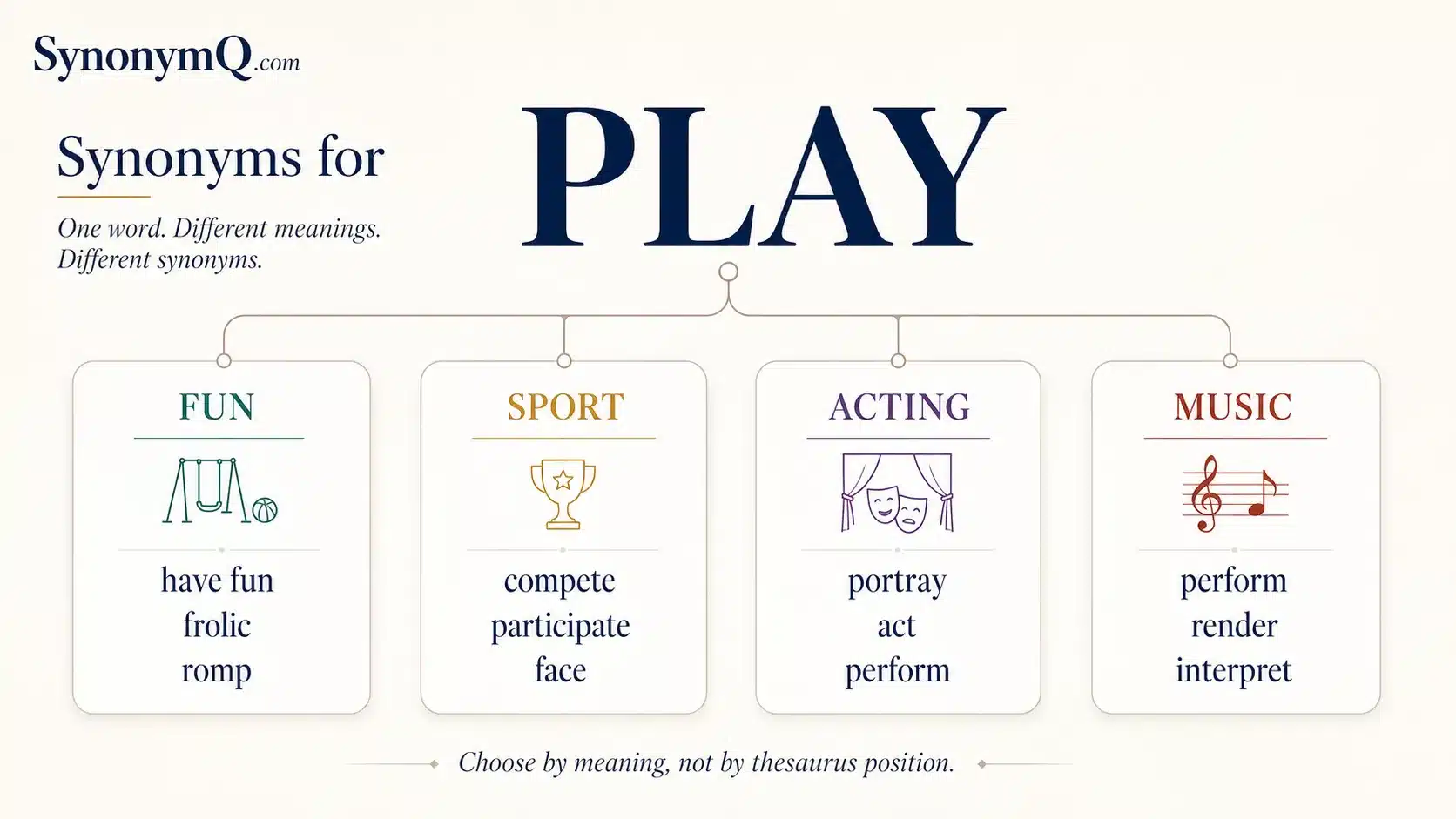
Start Here: Which Sense of Play Do You Mean?
Play is one of the hardest-working words in English. It covers a toddler in a sandpit, a striker facing Arsenal, a cellist at a recital, an actor in a wig and a DJ at 2am.
It also covers sunlight moving on a wall and the tiny wobble in a loose door handle. Almost no single replacement covers two of those, which is why a flat thesaurus list is useless here.
Find your sentence in the left column first. Everything after this is organized the same way.
| If your sentence means… | Strongest picks | Example of the sense |
|---|---|---|
| Children or animals amusing themselves | frolic, romp, cavort | The puppies played in the yard |
| Taking part in a sport or a match | compete, face, take on | Brazil plays Spain on Sunday |
| Producing music on an instrument | perform, render, strum | She plays the cello |
| Acting a character | portray, act, enact | He played Macbeth |
| Pretending to be something | feign, pretend, pose as | Don’t play innocent |
| Starting a recording or a film | put on, run, stream | Play the second track |
| Handling something idly | toy with, fiddle with, tinker with | He played with his napkin |
| Manipulating a person | manipulate, exploit, con | She played him for months |
| Light or water moving lightly | flicker, dance, ripple | Firelight played on the ceiling |
| A stage work (noun) | drama, production, piece | We saw a play at the Globe |
| Free time and fun (noun) | recreation, amusement, fun | All work and no play |
| A move in a game (noun) | move, maneuver, tactic | A brilliant play in the third quarter |
| Looseness in a mechanism (noun) | slack, give, leeway | There’s too much play in the steering |
Quick-Reference Table: The 15 Strongest Synonyms for Play
| Synonym | Register | Intensity (1–5) | Best used for |
|---|---|---|---|
| frolic | Neutral | 4 | Children or animals playing with visible joy |
| romp | Neutral | 4 | Fast, noisy, physical play |
| cavort | Neutral | 4 | Showy, leaping, slightly ridiculous play |
| gambol | Literary | 3 | Lambs, fawns, and prose that wants to sound pastoral |
| horse around | Casual | 4 | Rough, silly play between friends or siblings |
| mess around | Casual | 2 | Aimless, low-stakes pottering |
| compete | Neutral | 3 | Sport, contests, tournaments |
| perform | Neutral | 3 | Music or a role, in front of an audience |
| portray | Neutral | 3 | Playing a specific character |
| act | Neutral | 3 | Acting generally, or pretending |
| toy with | Neutral | 2 | Handling an object, or an idea, without commitment |
| fiddle with | Casual | 2 | Restless hands on a small object |
| drama | Neutral | 3 | A serious stage work (noun) |
| recreation | Formal | 2 | Leisure activity in policy or academic writing (noun) |
| slack | Neutral | 2 | Unwanted looseness in a mechanism (noun) |
Intensity is SynonymQ’s editorial judgment: 1 = mild, 5 = strongest. A guide, not a measurement.
For play, the scale tracks energy and exuberance rather than emotional weight.
What Does Play Actually Mean?
Play means activity carried on freely, for its own sake, rather than to produce a required result.
It works as a verb, both transitive and intransitive, and as a noun. The two behave differently enough that they need separate synonym sets.
That definition sounds abstract until you notice it explains every sense at once. A child plays because the activity is the point.
A pianist plays a sonata by moving freely inside a score. An actor plays Hamlet by moving freely inside a character.
A story plays across someone’s face when a smile moves without being willed. And a steering column has play in it when a part moves freely instead of being fixed.
Free movement is the thread. Once you see it, choosing a replacement gets much easier, because you can ask a single question: what exactly is moving freely in my sentence?
The senses that matter most for word choice are these:

- Amusing oneself — the recreational verb, usually intransitive: the children played outside.
- Taking part in a sport or game — she plays netball; United plays City.
- Producing music — he plays trumpet; play the opening bars again.
- Acting a part — she played Lady Macbeth; also the figurative play the victim.
- Running a recording — play the voicemail; the film is playing downtown.
- Handling or trifling with something — stop playing with your food; don’t play with me.
- Moving lightly over a surface — moonlight played on the water. Chiefly literary.
- A dramatic work — the countable noun: a play in three acts.
- Recreation — the uncountable noun: time for play.
- A move or tactic — chiefly North American: a running play.
- Free movement in a mechanism — half an inch of play in the cable.
The Full List: 85 Synonyms for Play by Sense
English gives us about eighty-five defensible alternatives to play across all its senses. That sounds like a lot until you split them by meaning and find that most groups hold six or seven.
The large thesaurus counts you see elsewhere are built by merging every sense into one pile.
Grouped honestly, the choice in front of you at any moment is narrow — and that is good news.
Each entry gives the register, the part of speech, a one-line meaning and an original example.
Playing for Fun — Children, Animals and Carefree Movement (Verb)
This sense covers unstructured, self-directed amusement, usually physical, usually with no goal beyond the activity itself.
1. frolic (Neutral, verb) — to play in a lively, joyful, visibly happy way — The lambs frolicked in the top field while the farmer mended the gate.
2. romp (Neutral, verb) — to play boisterously and fast, often noisily — Three cousins romped through the hallway until someone knocked the umbrella stand over.
3. cavort (Neutral, verb) — to leap and prance about in a showy, uninhibited way — The winning crew cavorted on the pontoon for a full ten minutes before anyone thought about the trophy.
4. gambol (Literary, verb) — to skip and spring about lightly, like young animals — In the second stanza the goats gambol down the scree, which is about the only place you meet this verb.
5. caper (Literary, verb) — to dance or skip about in a playful, faintly absurd way — He capered across the stage in a paper crown, and the front row lost it.
6. frisk (Neutral, verb) — to move about with quick, light, playful jumps — The terrier frisked around the postman’s ankles, delighted by the whole arrangement.
7. rollick (Literary, verb) — to move in a boisterous, carefree, exuberant way — The chorus rollicked through the final verse with more enthusiasm than accuracy.
8. lark about (Casual, verb phrase) — to play or fool around mischievously, chiefly British — They larked about at the back of the coach for two hundred miles.
9. horse around (Casual, verb phrase) — to play roughly and noisily, often where you shouldn’t — Stop horsing around near the pool edge before one of you goes in with your phone.
10. mess around (Casual, verb phrase) — to spend time in an aimless, pleasant way — The four of them messed around in the shallow end and called it a swimming lesson.
11. fool around (Casual, verb phrase) — to behave playfully and unseriously — They fooled around on the trampoline until somebody’s glasses came off.
12. disport (Archaic, verb) — to amuse oneself, usually reflexive as disport oneself — Georgian paintings are full of figures disporting themselves by ornamental lakes; nobody says it aloud now.
13. sport (Literary, verb) — to play or gambol energetically, said mainly of animals — A pair of otters sported in the shallows below the weir.
Playing a Sport or Game — Taking Part and Competing (Verb)
This sense is about entering a contest. Note that English lets you play a sport (she plays hockey) or play an opponent (we play Denmark), and different replacements suit each.
14. compete (Neutral, verb) — to take part in a contest against others — She has competed at national level since she was fourteen.
15. contend (Formal, verb) — to struggle against a rival for something — Four clubs are still contending for the final European place.
16. participate (Formal, verb) — to take part in an organized activity — Roughly a third of the year group participates in a team sport each term.
17. take part (Neutral, verb phrase) — to be one of the people doing an activity — He took part in the relay even though his ankle was strapped.
18. face (Neutral, verb) — to be matched against a particular opponent — Japan faces Morocco in the quarter-final.
19. take on (Neutral, verb phrase) — to compete against, often with an underdog flavor — A semi-pro team from Lincolnshire took on a top-division club and forced a draw.
20. meet (Neutral, verb) — to be scheduled against, standard in sports reporting — The two sides meet again in March on neutral ground.
Playing Music — Instruments and Performance (Verb)
This sense covers producing music yourself. It does not cover starting a recording, which is Sense 5, and mixing the two is the most common mistake readers make with play.
21. perform (Neutral, verb) — to present a piece of music to an audience — The quartet performed the Ravel from memory.
22. render (Formal, verb) — to perform a piece in a particular interpretive style — Her encore rendered the folk tune so slowly it was almost unrecognizable, and the hall loved it.
23. execute (Formal, verb) — to carry out a technically demanding passage — He executed the cadenza cleanly, which at that tempo is most of the battle.
24. strike up (Neutral, verb phrase) — to begin playing — The band struck up as soon as the doors opened.
25. strum (Neutral, verb) — to play a stringed instrument by sweeping the strings — He strummed the same four chords for an hour and called it songwriting. Guitars and ukuleles only.
26. bang out (Casual, verb phrase) — to play loudly and without much care — Someone was banging out show tunes on the upright in the corner.
27. sound (Formal, verb) — to make a horn or bell give out its note, never a melodic instrument — The steward sounded the bugle and the field moved off.
Playing a Part — Acting, Portraying and Pretending (Verb)
Two related ideas sit here: acting a character in a production, and pretending to be something in real life. Most of these words serve both, but not equally.
28. act (Neutral, verb) — to perform a part, or to behave as though something were true — He has acted since he was nine and still gets nervous in the wings.
29. portray (Neutral, verb) — to represent a specific character in a performance — He portrays a retired detective who is far less clever than he thinks.
30. enact (Formal, verb) — to act out a scene or role, often in a ritual or reconstruction — Volunteers enact the surrender every August in period uniform.
31. embody (Formal, verb) — to give full physical expression to a character or quality — She embodies the part so completely that the makeup barely matters.
32. impersonate (Neutral, verb) — to imitate a real, identifiable person — He impersonates three prime ministers in the first ten minutes.
33. pretend (Neutral, verb) — to behave as though something untrue were true — Don’t pretend you didn’t see the email.
34. feign (Formal, verb) — to fake a state or feeling deliberately — The striker feigned a stumble, which the referee did not buy.
35. pose as (Neutral, verb phrase) — to present yourself falsely as someone else — Two reporters posed as buyers and got a tour of the whole facility.
36. masquerade as (Neutral, verb phrase) — to go about under a false identity or character — The scheme masqueraded as a community fund for nearly a decade.
37. affect (Formal, verb) — to put on a manner or feeling you do not have — He affected boredom throughout the interview and fooled precisely nobody.
Playing a Recording, a Film or a Broadcast (Verb)
Here play means causing something already recorded to run. The subject can be a person, a device or a venue, and the best replacement changes depending on which.
38. run (Neutral, verb) — to show or let a recording proceed from start to finish — Run the last thirty seconds again; there’s something under the dialogue.
39. screen (Neutral, verb) — to show a film to an audience — The arts center is screening the restored print for one night only.
40. air (Neutral, verb) — to transmit a program or track on radio or television — The station aired the interview uncut, which surprised everyone.
41. broadcast (Neutral, verb) — to transmit widely to a general audience — The ceremony was broadcast in forty countries.
42. stream (Neutral, verb) — to deliver or receive audio or video continuously over a network — We streamed the whole set from a kitchen in Lahore.
43. spin (Slang, verb) — to play records, in DJ and radio usage — He spun the same B-side twice and nobody minded.
44. put on (Casual, verb phrase) — to start a track, album or film informally — Put on something quiet; I’ve had a day.
45. cue up (Casual, verb phrase) — to get a track ready to start, the step just before playing — She cued up the second movement while the speaker was still finishing.
Playing With Something — Toying, Tinkering and Manipulating (Verb)
Play with splits into three quite different actions: idle handling, curious adjustment, and deliberate manipulation of a person.
Getting the wrong one is how a sentence accidentally accuses someone.
46. toy with (Neutral, verb phrase) — to handle or consider something without commitment — She toyed with the idea of applying and then toyed with her keys instead.
47. fiddle with (Casual, verb phrase) — to touch or adjust something restlessly with your fingers — He fiddled with his cufflink through the entire best man’s speech.
48. tinker with (Neutral, verb phrase) — to make small adjustments, usually to improve something — They tinkered with the recipe for two years before it went on the menu.
49. twiddle (Casual, verb) — to turn or twist something idly between the fingers — She twiddled the dial past three stations of static.
50. trifle with (Formal, verb phrase) — to treat someone or something without the seriousness it deserves — This is not a man to trifle with.
51. dally with (Literary, verb phrase) — to treat casually, especially someone’s feelings — He dallied with her affections for a summer and then moved to Bristol without leaving an address.
52. manipulate (Neutral, verb) — to control someone unfairly to your own advantage — She manipulated two colleagues into requesting the change so that it would not have to come from her.
53. exploit (Neutral, verb) — to make unfair use of a person or situation — The scheme exploited people who had no way of checking the paperwork.
54. string along (Casual, verb phrase) — to keep someone hopeful with no intention of delivering — The label strung them along for eight months and then signed someone else.
55. hustle (Slang, verb) — to swindle someone, especially at a game — He hustled tourists at pool and retired at thirty-one.
56. con (Slang, verb) — to deceive someone for gain — They conned an entire street out of its roofing deposits.
Playing Over a Surface — Light, Water and Expression (Verb)
Mostly literary and descriptive. This is play as free, quick, ungoverned motion, and it takes an inanimate subject: light, water, wind, a smile, a shadow.
57. flicker (Neutral, verb) — to move or shine unsteadily, in brief bursts — Something like recognition flickered across her face and was gone.
58. dance (Literary, verb) — to move quickly and lightly in a way that suggests joy — Sunlight danced on the ceiling from the swimming pool below.
59. ripple (Literary, verb) — to move in a soft, wavelike pattern across a surface — Laughter rippled along the back row before the punchline had landed.
60. flit (Literary, verb) — to move quickly and lightly from place to place — Shadows flitted over the road as the clouds crossed the sun.
61. shimmer (Literary, verb) — to shine with a soft, wavering light — Heat shimmered on the asphalt all the way to the horizon.
62. dart (Literary, verb) — to move suddenly and rapidly in one direction — A grin darted across his face before he could stop it.
A Play — Theater and Drama (Noun)
The countable noun. A play is a work written to be performed by actors, and its close relatives are narrower than they look.
63. drama (Neutral, noun) — a serious play, or the art form as a whole — The theater programs two dramas and one comedy each season.
64. production (Neutral, noun) — one particular staging of a work, never the written work itself — This is the fourth production of the play in six years and easily the strangest.
65. show (Casual, noun) — any staged entertainment, spoken or musical — We got last-minute tickets to a show and had no idea what it was.
66. piece (Neutral, noun) — a single work of theater, music or writing — Her new piece runs eighty minutes without an intermission.
Play — Recreation, Fun and Free Activity (Noun)
The noun of free, enjoyable activity. Play itself is uncountable here, but several of its closest relatives are countable and name one specific activity.
That changes how they sit in a sentence. This sense matters most in education, child development and policy writing, where the register jump carries real weight.
67. recreation (Formal, noun) — activity done for enjoyment when you are not working — The report treats recreation as a measurable public health input.
68. amusement (Neutral, noun) — enjoyment, or something that provides it — The whole afternoon was arranged for the amusement of eleven six-year-olds.
69. fun (Casual, noun) — light enjoyment and pleasure — There is no rule that says learning to swim cannot also be fun.
70. diversion (Formal, noun) — a specific pastime that distracts you; countable, unlike play — Chess began as a diversion and quietly became the point of his week.
71. pastime (Neutral, noun) — a named activity done for pleasure; it labels the activity, not the state — Birdwatching is a slow pastime that rewards patience.
72. horseplay (Neutral, noun) — rough, boisterous fun — The email banned horseplay in the stairwell, which suggests something had happened.
A Play — A Move or Tactic in a Game (Noun)
Chiefly North American, and strongest in sport and business. Several close relatives carry a whiff of cunning that plain play does not.
73. move (Neutral, noun) — a single action taken in a game or plan — Trading the pick was a defensible move that aged badly.
74. maneuver (Neutral, noun) — a skillful, planned action, often to gain position — The whole bid was a maneuver to keep a rival out of the market.
75. tactic (Neutral, noun) — a method chosen to achieve a short-term aim — Pressing high is a tactic, not a philosophy.
76. ploy (Neutral, noun) — a cunning action designed to gain an advantage — Asking for a recess was a ploy to break the other side’s momentum.
77. gambit (Formal, noun) — an opening move that accepts a loss to gain position — Her resignation letter was a gambit, and the board called it.
78. stratagem (Formal, noun) — a scheme designed to outwit an opponent — The siege was lifted by a stratagem rather than by force.
Play — Slack, Give and Room to Move (Noun)
The sense almost every thesaurus handles worst. Here play is the amount something can move before it meets resistance.
The literal branch is mechanical and usually describes a fault. The figurative branch is freedom to act, and several of these words work in only one of the two.
79. slack (Neutral, noun) — looseness in something that should be taut — Take up the slack in the chain before you tighten the bolt.
80. give (Casual, noun) — the degree to which something yields under pressure — There’s a bit of give in the floorboard by the window.
81. leeway (Neutral, noun) — freedom to act or vary within limits — The brief allows enough leeway to change the color palette late.
82. looseness (Neutral, noun) — the state of not being firmly fixed — Looseness at the hinge was what made the door drop.
83. clearance (Formal, noun) — the designed gap between two parts — The manual specifies a clearance of two millimeters at the valve.
84. wiggle room (Casual, noun) — a small margin for adjustment, usually figurative — The deadline is Friday, but there’s wiggle room if the client is slow.
85. latitude (Formal, noun) — scope to act according to your own judgment; figurative only, never mechanical — Junior editors get more latitude here than the job title suggests.
Save the ones you want with SynonymQ Bookmarks, or run any of them back through the SynonymQ Synonym Finder to see the next ring of alternatives.
Play Synonyms by Register and Formality
Register is the single most useful filter for this word, because play itself is register-neutral and almost every replacement is not.
Connotation bites even where register matches. Cavort is neutral in formality but carries a showy, faintly ridiculous edge, which is why it makes a school newsletter sound sarcastic.
| Register | Words | What it signals to a reader |
|---|---|---|
| Formal | contend, participate, render, execute, sound, enact, embody, feign, affect, trifle with, recreation, diversion, gambit, stratagem, clearance, latitude | Reports, academic writing, program notes. Correct but cool; overuse reads as stiff |
| Neutral | frolic, romp, cavort, frisk, compete, take part, face, meet, take on, perform, strike up, strum, act, portray, impersonate, pretend, pose as, masquerade as, run, screen, air, broadcast, stream, flicker, toy with, tinker with, manipulate, exploit, drama, production, piece, amusement, pastime, horseplay, move, maneuver, tactic, ploy, slack, leeway, looseness | Safe almost anywhere. This is where to look first |
| Casual | lark about, horse around, mess around, fool around, bang out, put on, cue up, fiddle with, twiddle, string along, show, fun, give, wiggle room | Blogs, messages, dialogue, most journalism. Warm and unpretentious |
| Slang | spin, hustle, con | Very informal, and two of the three imply dishonesty. Handle with care in anything published |
| Literary | gambol, caper, rollick, sport, dally with, dance, ripple, flit, shimmer, dart | Fiction, poetry, descriptive nonfiction. Vivid in the right sentence, purple in the wrong one |
| Archaic | disport | Historical writing, or deliberate period flavor. Never neutral |
Two register traps are worth naming. Sport as a verb (Sense 1) reads as literary or dated, even though sport as a noun is completely ordinary.
And recreation is not a formal upgrade of fun: it means organized leisure activity, so the children had recreation in the garden is not quite English.
Which Word Should You Use? A Decision Guide
Work down this list until one line matches your sentence. The first match is almost always your word.

- Small children, animals, visible joy → frolic. It is the safest single replacement in the recreational sense and works in almost any register.
- Fast, loud, physical, slightly chaotic → romp. Add horse around if the tone is affectionate and informal.
- You want the reader to picture leaping → cavort for humans, gambol for young animals in literary prose, frisk for small quick creatures.
- A school newsletter, a report or a policy document → recreation (noun) or participate (verb). Keep the literary verbs out.
- A sport, a fixture, a named opponent → face or meet for the opponent, compete for the contest itself, take part in for a general activity.
- Someone producing music on an instrument → perform. Use render only if you are describing an interpretation, and strum only for strings.
- Someone starting a recording → put on in speech, stream if the medium matters, run if you want the sense of letting something proceed.
- An actor in a named role → portray. Use act when the role is unnamed or the point is the craft, and impersonate only when the character is a real person.
- Somebody faking a state → feign in formal writing, pretend everywhere else. Affect only for a manner, never for an action.
- Hands busy, mind elsewhere → fiddle with. Use tinker with if the fiddling is purposeful and toy with if the object is an idea.
- A person being used → manipulate if you want the accusation stated plainly, string along if the cruelty is in the delay, con if money changed hands.
- Light, water or an expression in motion → flicker for something brief, dance for something joyful, ripple for something spreading.
- A stage work → play is already the best word. Use drama only if the work is serious and production only if you mean one specific staging.
- A loose mechanical part → slack if something should be taut, give in speech, clearance if a spec sheet is involved.
- You are writing for people learning English → stay in the Neutral row of the register table. Every word there is safe in an exam essay.
One more rule saves more sentences than any of the above.
If the sense you need is the plain recreational one, and the register is anything other than literary, play is very often already the right word.
Reaching for cavort in a nursery admissions brochure is how good writing goes wrong.
Words That Are Not True Synonyms for Play
These five turn up in play synonym lists constantly. Each one overlaps enough to look safe and differs enough to change your meaning.
Game — A game has rules, a boundary and usually a winner; play is the free activity underneath it. That difference is the whole basis of early-years education.
So the swap fails hardest exactly where it gets attempted most. Free play is unstructured time a child directs; free game means something is available at no charge.
As a verb, game has drifted further still. To game a system is to exploit its rules, which is nearly the opposite of playing by them.
Script — The script is the text on the page. The play is the work, and the thing an audience watches.
A director can cut the script without cutting the play, and a play can be revived a century after its script was published.
Theater does use playscript for the text. But write she wrote a beautiful script about a stage work and many readers will still assume you mean screenwriting.
Musical — Awards, reviews and theater listings all keep these apart: a play is carried by spoken dialogue, a musical by songs.
Calling Hamilton a play is not a stylistic choice, it is a category error, and theater-literate readers will notice immediately.
Operate — You play an instrument and you operate a machine, and the two verbs almost never trade places. Operate the piano is not English.
The line falls roughly where craft ends and procedure begins: playing implies expressive control, operating implies correct use.
Exercise — Both are physical, both are non-work, and health writing swaps them freely. But exercise is done for an outcome, and play is done for itself.
A study measuring exercise and a study measuring play are measuring different things, which is why the substitution quietly damages any claim about children.
Head-to-Head: Play vs. Its Closest Rivals
Frolic vs. Romp vs. Gambol
| Word | Register | Typical subject | Feels like |
|---|---|---|---|
| frolic | Neutral | Children, dogs, lambs, adults on holiday | Joyful and light, no noise implied |
| romp | Neutral | Children, puppies, teams winning easily | Fast, loud, slightly out of control |
| gambol | Literary | Young animals, almost never people | Pastoral, springy, faintly old-fashioned |
Frolic is the default and the one to reach for when you are not sure. Romp adds volume and speed.
The same word also covers winning easily — United romped to a 5–0 win — because both senses share the idea of movement that meets no resistance.
Gambol is a specialist: it belongs to lambs in spring, and using it for adults is either poetry or a joke.
Play a Role vs. Act vs. Portray
| Phrase | Register | Best for | Example |
|---|---|---|---|
| play a role | Neutral | A named part, or a figurative function | She played the sister in the 2019 revival |
| act | Neutral | The craft itself, or unnamed performing | He has acted since he was nine |
| portray | Neutral | A specific, described character | He portrays a grieving father with no dialogue |
Play and portray both take a named character, but portray pulls attention toward the interpretation rather than the casting.
Act rarely takes a character as its object at all — he acted Hamlet is possible but archaic-sounding next to he played Hamlet.
Note the figurative branch too. Play a role in something means to contribute to it, and there portray is simply wrong.
Play vs. Perform vs. Render (Music)

| Word | Register | What it emphasizes | Natural object |
|---|---|---|---|
| play | Neutral | The act, the instrument, the ability | The cello, a tune, a request |
| perform | Neutral | The public occasion | A concerto, a set, a program |
| render | Formal | The particular interpretation | A piece, an aria, an arrangement |
Play is the only one of the three that takes an instrument as its object: you play the cello, you do not perform the cello. Perform needs a work or an event.
Render is a critic’s word. It carries a judgment about how the piece was shaped, which is why it sounds odd applied to a beginner.
A Play vs. A Drama vs. A Production
| Noun | Register | Refers to | Example |
|---|---|---|---|
| play | Neutral | The written work, performed | A new play opens Thursday |
| drama | Neutral | A serious work, or the art form | The season includes two dramas |
| production | Neutral | One specific staging of a work | The Berlin production ran four hours |
The distinction that trips people is play against production. A play is written once and staged many times; each staging is a production.
I saw a brilliant play praises the writing. I saw a brilliant production praises the direction, design and cast.
Reviewers are careful about this, and readers who love theater notice when a writer isn’t.
Common Collocations With Play
Play sits inside a large number of fixed expressions, and inside almost all of them no synonym can be substituted at all.
That is the single most useful thing to know about this word: the moment play is part of a set phrase, your thesaurus is no longer relevant.
- play a role / play a part — Local councils played a significant part in getting the scheme funded.
- play it safe — With two days left they played it safe and shipped the smaller update.
- play by the rules — She played by the rules for eleven years while three colleagues who didn’t were promoted ahead of her.
- play a joke on / play a trick on — Someone played a trick on the new hire involving four hundred sticky notes.
- play hard to get — He was not playing hard to get; he had simply lost his phone.
- play devil’s advocate — Let me play devil’s advocate for a second, because nobody in this room has argued the other side.
- play it by ear — We have a rough running order and will play the rest by ear.
- play second fiddle — After the merger the whole department played second fiddle to a team in another time zone.
- child’s play — Compared with the visa paperwork, the interview was child’s play.
- fair play — The tournament gives a fair play award, and this year it went to the team that finished last.
- bring into play — The new rule brings the away goal back into play only in the qualifying rounds.
- play down / play up — The statement played down the delay and played up the extra testing.
Two of those, fair play and play by the rules, sit next door to the vocabulary of integrity.
If that is the register you are working in, the synonyms for honor guide covers the neighboring word set.
Etymology and Origin of Play
Play is native English, not a borrowing, which is unusual for a word this heavily used.
The verb comes from Old English plegan or plegian, glossed as “move lightly and quickly, occupy or busy oneself, amuse oneself.”
It traces back to Proto-West Germanic plegōjanan, “occupy oneself about.”
The noun comes from Old English plega in West Saxon and plæga in Anglian, meaning quick motion, recreation or any brisk activity.
The relatives are strange company. Old Saxon plegan meant “vouch for,” Old Frisian plega meant “tend to,” and modern German pflegen means “take care of.”
So the family as a whole is about attending to something, and English is the branch that took it toward amusement.
The specialized senses arrived in a traceable order. Taking part in a martial or athletic game is recorded from around 1200.
The noun’s “dramatic performance” sense follows by the early 14th century, with the verb’s stage sense close behind by the late 14th.
Moving a piece in a contest is there for chess in the 1560s. Operating with continuous or repeated action dates from the 1590s.
That is the ancestor of the mechanical sense of free movement, recorded from the 1650s. Playing cards arrives later than chess, in the 1670s.
Causing a recording to reproduce what is on it appears by 1903 — the newest major sense, and now probably the one most of us use most often.
Dates in this section come from Etymonline. Merriam-Webster dates both the verb and the noun to before the 12th century.
Play Synonyms for Specific Writing Situations
Academic Writing and Essays
Academic prose wants the abstract noun and the formal verbs, and it wants the recreational verbs kept out entirely.
Reach for recreation, participate, diversion, pastime, enact and contend.
Write unstructured recreation rather than free play only if your field expects it. In education and developmental psychology, play is the technical term and replacing it is an error.
Two habits help. Define the sense you mean the first time you use it, since a reader in another discipline may assume a different one.
And keep an eye on length, because substituting formal alternatives inflates a paragraph fast.
Run the draft through the SynonymQ Word Counter and check it against the word count guidelines for essays, blogs and social posts before deciding the longer version is better.
Résumés, Cover Letters and Professional Email
This is the context where play needs the most care. The phrase played a key role appears on roughly every résumé ever written and now reads as filler.
It also hides what you did. Replace it with the actual verb: led, built, negotiated, rewrote, cut.
Where you do need this family of words, participate, contend, maneuver and latitude all work in professional register.
Avoid ploy, gambit and stratagem in anything a hiring manager reads. All three imply you outmaneuvered someone, which is a strange note to open on.
And keep hustle out of a cover letter entirely. The flattering sense is recent and regional, and the swindling sense is the one an older reader will hear first.
Creative Writing and Fiction
Fiction is the one place where the literary group earns its keep.
Gambol, caper, rollick, flicker, ripple, shimmer, flit and dart all do work that no neutral word does, because they carry a picture as well as a meaning.
The discipline is restraint. One gambol in a chapter is texture; three is pastiche.
And Sense 7 is the most quietly useful group here for fiction, because a smile played on her lips is a cliché while something like doubt flickered and was gone is not.
Everyday Conversation and Social Media
Speech runs on the casual group: mess around, fool around, horse around, lark about, put on, fiddle with, wiggle room, give.
These sound like people talking, which is the whole requirement.
Two notes for a global audience. Lark about is British and will read as an affectation elsewhere.
And play itself is perfectly good in a caption. The instinct to swap it for something fancier is usually wrong on social media, where plain words travel further.
Need a different angle on any word above? Run it through the SynonymQ Synonym Finder and compare the options side by side before you commit.
Antonyms of Play
Play has no single opposite, because it has no single meaning. Match the antonym to the sense, or the sentence will not land.
The SynonymQ Antonym Finder covers the full set, and Antonyms 101 explains why sense-matching matters more than most writers assume.
Opposites of play as recreation:
- work — the core opposite, and the one built into the proverb: all work and no play.
- labor — work as effort and obligation, heavier than work.
- toil — sustained, exhausting, unrewarded work.
- drudgery — dull, repetitive work with no pleasure in it at all.
- chore — a specific task you have to do.
Opposites of play as taking part:
- sit out — to deliberately not take part in a match or round.
- abstain — to formally decline to take part; standard in voting rather than in sport.
- withdraw — to pull out of a competition you had entered.
- forfeit — to lose by failing to play at all.
- spectate — to watch rather than take part.
Opposites of play as unseriousness:
- seriousness — the state of treating something as it deserves.
- earnestness — sincere, unplayful intent.
Opposites of play as mechanical looseness:
- tightness — the absence of unwanted movement.
- snugness — the absence of any gap between two fitted parts.
- tension — the pulling force that removes slack.
One caution. Rest and idleness look like opposites of play and are not.
Both sit on the same side of the line as play, against work. Resting is not playing, but it is not the reverse of playing either.
Using rest as an antonym is the most common error in this word’s opposite set.
Play in Spanish, French and Italian
[VERIFY-NATIVE] Register and regional usage in this section should be confirmed by a native speaker before you rely on it in published work.
The useful discovery here is that no Romance language has one verb doing the job English gives to play.
Spanish, French and Italian all split the senses across separate verbs.
That is exactly why learners find this word difficult in the other direction, and why translation tools get it wrong so often.
| Language | Word | Register | Notes |
|---|---|---|---|
| Spanish | jugar | Neutral | Games and sport only. Takes a preposition before a named sport: jugar al fútbol in Spain, jugar fútbol across much of Latin America |
| Spanish | tocar | Neutral | Musical instruments only. Never used for games |
| Spanish | interpretar | Neutral | Playing a character. Actuar covers acting as an activity rather than a specific part |
| Spanish | poner | Casual | Starting a recording. Reproducir is the formal or technical equivalent |
| Spanish | obra de teatro | Neutral | A play as a stage work. Juego is a game, never a drama |
| French | jouer à | Neutral | Games and sport. The preposition is not optional: jouer au tennis |
| French | jouer de | Neutral | Musical instruments. Same verb as games, different preposition, and swapping them is the classic learner error |
| French | jouer / interpréter | Neutral | Playing a role. Interpréter leans toward the interpretation, much as portray does in English |
| French | pièce de théâtre | Neutral | A play. Jeu means a game, and also the mechanical looseness sense |
| Italian | giocare | Neutral | Games and sport. Takes a preposition before the game: giocare a calcio |
| Italian | suonare | Neutral | Musical instruments, and also the sound a bell or phone makes |
| Italian | recitare / interpretare | Neutral | Playing a part. Recitare is the everyday choice for acting |
| Italian | opera teatrale | Neutral | A play. Commedia usually implies a comedy in modern usage, so it is not a safe general substitute |
| Italian | gioco | Neutral | A game, and also the mechanical play in a loose part |
One example sentence in each language, in the recreational sense:
- Spanish: Los niños juegan en el parque hasta que anochece.
- French: Les enfants jouent dans la cour pendant la récréation.
- Italian: I bambini giocano in giardino tutto il pomeriggio.
Notice that all three keep the same verb for children playing and for playing a sport, and all three change verb for a musical instrument.
English is the odd one out for merging them. Worth remembering for an international audience: a sentence built on a pun between two senses of play will not survive translation.
How to Avoid Repeating Play in Your Writing
Repetition of play is a real problem in match reports, education writing and theater reviews, where the word can appear five times in a paragraph across three different senses.
The fix is rarely a straight swap.
- Identify which sense each instance uses. Write the sense number next to each one. Half the time you will find you have used two different senses in adjacent sentences, and the repetition is much less noticeable to a reader than it looks to you.
- Change the sentence, not the word. The children played happily becomes the children spent the afternoon building something out of crates. Specificity beats substitution nearly every time, and it adds information instead of just avoiding a word.
- Convert between verb and noun. They played for an hour and an hour of play say the same thing with different grammar, which breaks the pattern without touching your vocabulary.
- Use a pronoun or drop the object. She plays the violin and she plays it beautifully becomes she plays the violin, and beautifully.
- Only then reach for a synonym, and take it from the correct sense group above. Check the register against your surrounding paragraph before you commit.
- Read the paragraph aloud. Unnatural substitutions are almost inaudible on the page and immediately obvious in the mouth. If you stumble on the new word, put the old one back.
For longer passages, the SynonymQ Paraphrasing Tool rewrites whole sentences rather than swapping single words, which is usually what this problem actually needs.
If the writing is being submitted or published, read how to paraphrase without plagiarizing first.
Frequently Asked Questions About Play Synonyms
What is another word for plays a role?
Use portray when an actor plays a named character, and act when the point is the craft rather than the part.
In the figurative sense — plays a role in the decision — the best replacements are contributes to, factors into, shapes or influences.
Choose by asking whether a stage is involved.
The figurative use is worth being ruthless about in professional writing. Played a key role is one of the most-deleted phrases in résumé editing.
It names an involvement without naming an action. State what you actually did instead: led, designed, negotiated, rebuilt.
What is a synonym for play an instrument?
Perform is the closest general substitute: she performed the Elgar concerto.
Use render for a distinctive interpretation, execute for a technically demanding passage, strike up for beginning to play, and strum for guitars and other strings.
Note that play is the only general-purpose verb here that takes the instrument itself as its object. Sound manages it, but only for horns and bells.
That last point catches out a lot of writers. She plays the cello is correct; she performs the cello is not.
If the instrument is your object, play is your verb and no synonym will do the job. Substitutions only work once you switch the object to a piece of music.
What is a synonym for play music?
For starting a recording, use put on, stream, run, cue up or, in DJ and radio contexts, spin. For a venue or station, use air or broadcast.
These are all different from playing an instrument yourself, which needs perform, render or execute instead.
Confusing the two is the most common mistake with this word.
The café played jazz all evening almost certainly means recordings; the trio played jazz all evening means people with instruments.
Your synonym has to match which one you mean, and the two sets share no words at all.
What is a synonym for play game?
For taking part, use compete, participate or take part in. For facing a named opponent, use face, meet or take on: Italy faces Croatia on Tuesday.
English also lets you play a game (we played chess), where have a game of is the most natural informal alternative.
Be careful with game as a verb, which has moved away from this sense entirely. Gaming a system means exploiting its rules, and gaming on its own now usually means video games.
Neither is a safe substitute for playing a game in ordinary prose.
What is a synonym for play as in theatre?
The closest nouns are drama for a serious work, production for one particular staging, piece for a single work of any length, and show in casual speech.
There is no exact one-word synonym, which is why play survives unchallenged as the standard term in theater listings and reviews.
The spelling varies but the word does not. British and Commonwealth writing uses theatre, American writing uses theater, and both mean the same thing.
What does change is production versus play. A play is the written work, a production is one staging of it, and confusing them is the fastest way to lose a theater-literate reader.
What is a synonym for play in English?
English play covers eleven distinct senses with one word, so its synonyms only make sense once you pick a sense.
Use frolic for children, compete for sport, perform for music, portray for acting, put on for a recording, toy with for idle handling, and drama, recreation or slack for the noun.
This question is asked most often by people working between languages, and the reason is structural.
Spanish, French and Italian all split these meanings across separate verbs, so a translation tool has to guess which English sense you want.
It frequently guesses wrong. Naming your sense first solves the problem.
How do you use a synonym for play in a sentence?
Swap the word and then check the sentence still means what you intended. The children played in the yard becomes the children frolicked in the yard.
She plays the piano becomes she performs on the piano — note that the preposition has to change too, which is the step most people skip.
Three more worked examples. He played Hamlet becomes he portrayed Hamlet. Put the film on becomes screen the film, but only in a public venue.
There’s play in the steering becomes there’s slack in the steering. In every case the grammar around the word shifts, and that shift is where substitutions break.
What is a synonym and an antonym for play?
The most useful pair is frolic as a synonym and work as an antonym, in the recreational sense that most people mean.
Both change with the sense: compete opposes sit out in sport, slack opposes tightness in a mechanism, and pretend opposes be sincere.
Matching the sense matters more here than in almost any other word pair. Work is not the opposite of play when play means starting a recording or acting a part.
Lists that give one generic opposite are giving you an answer that is wrong in nine cases out of eleven.
What is another word for role play?
For the training and therapy sense, use simulation, enactment, rehearsal or scenario work. For the tabletop and video game sense, the term is fixed and has no substitute.
As a verb, act out is the closest everyday alternative: the group acted out the customer complaint.
The word carries different baggage in different fields, so pick your replacement for your audience.
Simulation is right in medical and aviation training, enactment in historical reconstruction, and scenario work in corporate learning.
In each case the alternative sounds more professional than role play, which is often the reason people search for one.
What is parallel play?
Parallel play is a developmental stage in which young children play alongside one another with similar materials but without much direct interaction.
It is a technical term from child development, not a general vocabulary word, and it has no true synonym. Side-by-side play is the nearest plain-English description.
The term also gets borrowed into adult contexts, where it describes companionable activity without conversation: two people reading in the same room.
That use is figurative and informal. In professional writing about children, the technical sense is the only one readers will assume.
What is a synonym for played, in the past tense?
Pick your word by sense first, then put it in the past. Most take -ed: frolicked, romped, competed, performed, portrayed, streamed, toyed with.

The irregulars in this article are run to ran, meet to met, strike up to struck up, spin to spun, string along to strung along, and put on and broadcast, which do not change.
Searching for played as though it were a separate word is a habit worth dropping.
Thesauruses list it separately because their databases index surface forms, not because the past tense has its own vocabulary. Look up the base verb, choose there, and then inflect.
Is play a formal or an informal word?
Play is register-neutral, which means it is correct in an academic paper, a legal contract and a text message alike.
That neutrality is its main advantage over every alternative here, since almost all of them lean formal, casual, literary or archaic and will shift a tone you meant to leave alone.
This is the reason so many play substitutions go wrong.
Readers reach for a synonym expecting a neutral swap and get cavort, disport or recreation, all of which carry a strong register signal.
If your only goal is to avoid repeating a word, restructure the sentence rather than replacing it.
Choose the Play Synonym That Matches Your Sentence
Play is not a word with a shortage of alternatives. It is a word with too many, spread across eleven meanings that share almost nothing but a spelling.
The one question worth asking before you swap it is which of those meanings your sentence is actually using.
Once you have answered that, the shortlist is usually five or six words, not eighty-five.
Test a candidate with the SynonymQ Synonym Finder, check its register against the table above, and read the new sentence aloud before you keep it.
More word-choice guides are in the SynonymQ vocabulary section.
About the Author and Sources
Written by Naveed Akhtar, founder of SynonymQ, who writes about vocabulary and clear writing.
Published: August 18, 2026. Last updated: August 18, 2026.
Sources consulted: Etymonline, for the Old English forms and the dated sense developments in the etymology section.
Merriam-Webster, for the sense inventory and first-known-use dates.
Register labels, intensity ratings, example sentences and all word-choice guidance are SynonymQ editorial judgment.
Further reading: Merriam-Webster and Cambridge Dictionary both have full entries for this word.

Naveed Akhtar writes every guide on SynonymQ. He is an SEO content writer with ten years of article-writing experience, working on the question a thesaurus never answers: which of these words belongs in this sentence, for this reader. Every page cites the dictionary entries it draws on and the date they were read.