Experience means practical knowledge gained by doing something, or a single event you live through. For knowledge, use expertise, proficiency, know-how or background.
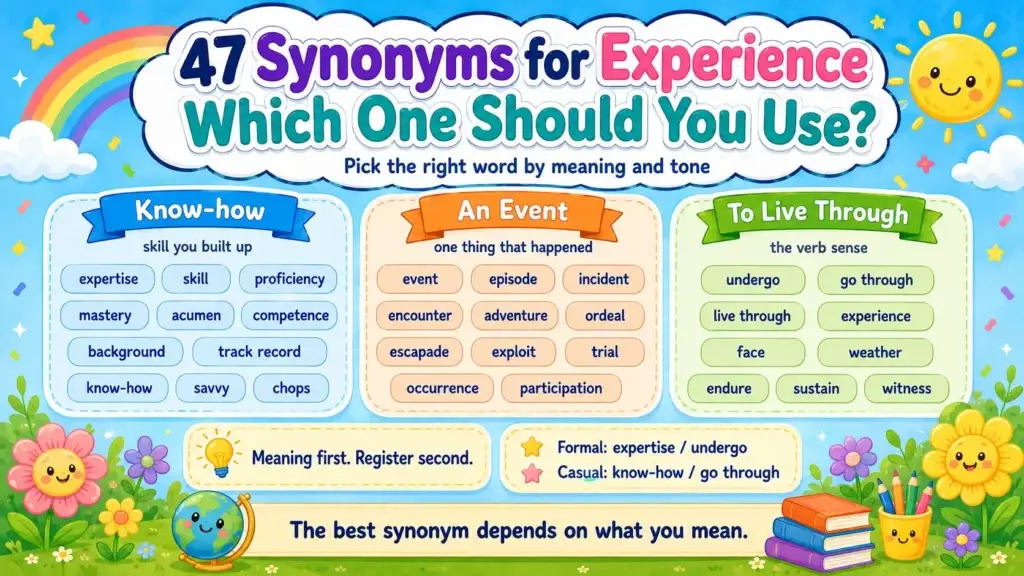
For an event, use episode, encounter, ordeal or adventure. As a verb, use undergo, go through or feel. The right word depends on which sense you mean.
Quick Reference: The 12 Strongest Alternatives
| Synonym | Register | Intensity (1-5) | Best used for |
|---|---|---|---|
| expertise | Formal | 4 | Proven, specialist skill on a CV or bio |
| proficiency | Formal | 3 | Measurable ability in a named tool or language |
| know-how | Casual | 3 | Practical, hands-on ability in conversation |
| background | Neutral | 2 | Someone’s history in a field, without claiming skill |
| track record | Neutral | 4 | Results you can point to and verify |
| competence | Formal | 2 | Meeting a required standard, nothing more |
| mastery | Formal | 5 | Genuine top-tier command, rarely justified |
| episode | Neutral | 2 | One bounded thing that happened |
| encounter | Neutral | 2 | A brief meeting with a person or situation |
| ordeal | Neutral | 5 | An experience that was genuinely awful |
| undergo | Neutral | 3 | The verb, for something done to you |
| go through | Casual | 3 | The verb, in speech and informal writing |
Intensity is SynonymQ's editorial judgment: 1 = mild, 5 = strongest. A guide, not a measurement.
The Full List of Synonyms for Experience, Grouped by Meaning
English gives us about fifty defensible alternatives here, not the two thousand some thesauri advertise. Most of that inflated count comes from mixing three senses into one list, so a writer reaches for a word that means the opposite of what they intended.
The groups below keep the senses apart. Save the ones you want with SynonymQ bookmarks, and search any of them further in the SynonymQ synonym finder.
Skill and know-how built up by doing
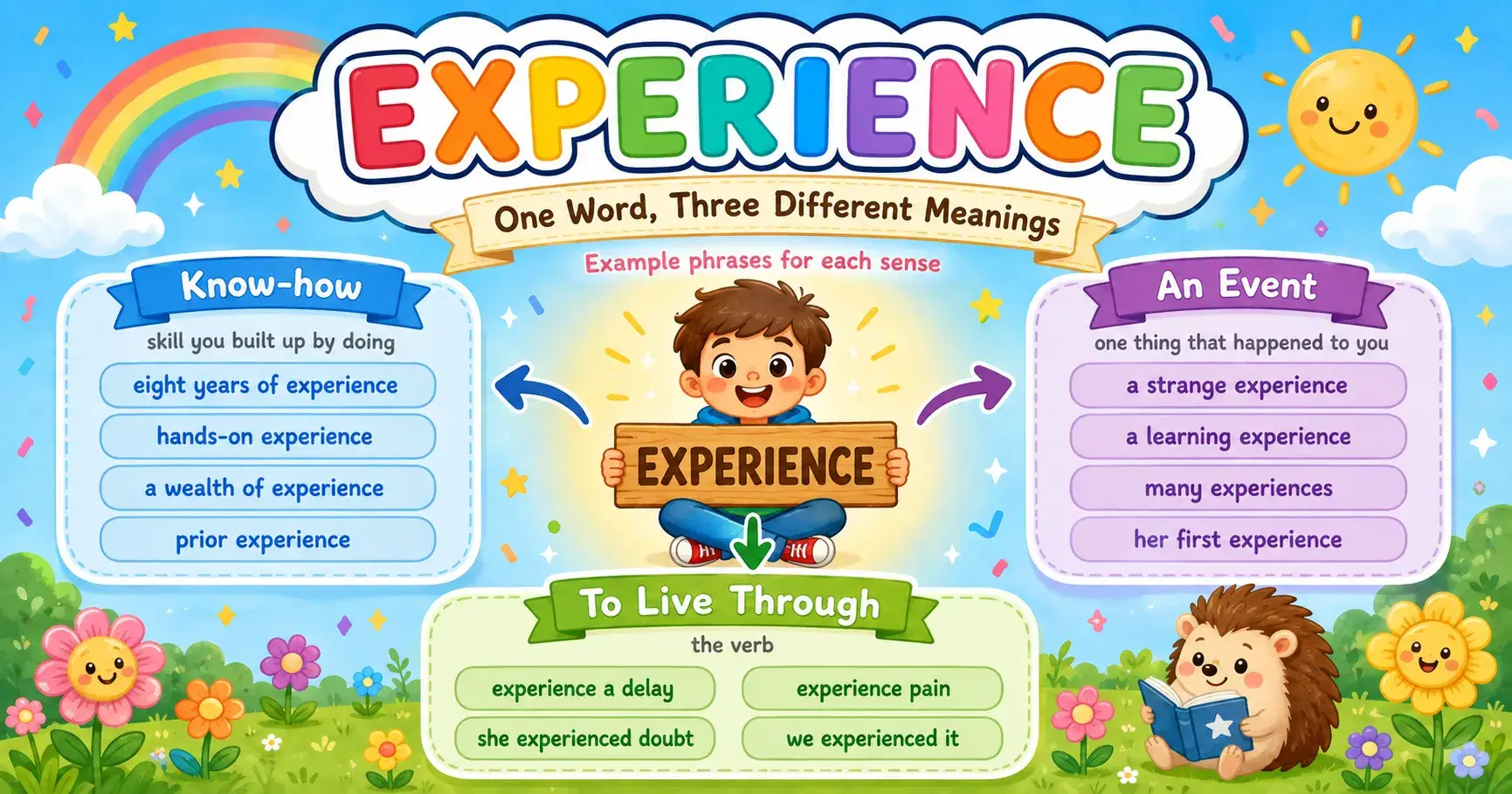
This sense is uncountable: the accumulated ability a person carries, as in “eight years of experience.”
1Expertise (Formal, noun) — deep specialist skill in a defined area — Her expertise in tax law is the reason the firm keeps the account.
2Proficiency (Formal, noun) — demonstrated ability at a measurable level — The role requires proficiency in Python and SQL.
3Know-how (Casual, noun) — practical ability to actually get something done — He has the know-how to rewire the whole workshop in a weekend.
4Skill (Neutral, noun) — trained ability, learned rather than accumulated — Editing is a skill you build one manuscript at a time.
5Competence (Formal, noun) — enough ability to meet the standard — The audit confirmed her competence, though it stopped short of praise.
6Mastery (Formal, noun) — complete command of a difficult field — Forty years at the bench gave him a mastery no course could teach.
7Command (Formal, noun) — confident control of a subject or language — She has an easy command of Mandarin after six years in Taipei.
8Acumen (Formal, noun) — sharp practical judgment, especially in business — His commercial acumen saved the company two bad acquisitions.
9Savvy (Casual, noun) — street-level practical understanding — You need real political savvy to get anything through that committee.
10Chops (Slang, noun) — the skill to perform, borrowed from music — The new drummer has the chops for a live tour.
11Practice (Neutral, noun) — repeated doing, as the source of ability — Twelve years of practice made the diagnosis look like a guess.
12Background (Neutral, noun) — a person’s history in a field — We hired someone with a background in public health.
13Track record (Neutral, noun phrase) — a documented history of results — Her track record on delivery dates won the contract.
14Familiarity (Neutral, noun) — comfortable acquaintance with something — A familiarity with hospital scheduling helped enormously.
15Grounding (Formal, noun) — solid basic training in a subject — The apprenticeship gave him a grounding in structural work.
16Wisdom (Formal, noun) — judgment distilled from a lifetime of living — She spoke with the wisdom of someone who had rebuilt twice.
17Tenure (Formal, noun) — the length of time served in a post — During her tenure the department doubled in size.
One thing that happened to you
This sense is countable, and it is the reason “experiences” is a perfectly correct plural. Watch the emotional charge: several of these words are not neutral.
18Event (Neutral, noun) — something that occurs, with no emotional loading — The flood was the defining event of his childhood.
19Episode (Neutral, noun) — a bounded stretch of time treated as one unit — The whole episode lasted three days and taught her nothing.
20Incident (Neutral, noun) — a single, usually minor or unwelcome occurrence — The incident at the gate was written up and forgotten.
21Occurrence (Formal, noun) — a thing that happens, stated at a distance — Power cuts were a monthly occurrence that winter.
22Encounter (Neutral, noun) — a brief meeting with a person or a situation — A ten-minute encounter with the head of research changed her plans.
23Adventure (Neutral, noun) — an exciting experience, positively charged — Two weeks off-grid turned into the adventure they still talk about.
24Ordeal (Neutral, noun) — a painful, drawn-out experience — The eight-hour layover became an ordeal once the air conditioning failed.
25Trial (Formal, noun) — a testing hardship, often one of several — The first year of the business was a trial none of them expected.
26Escapade (Casual, noun) — a reckless, slightly funny adventure — Their midnight escapade on the golf course made the local paper.
27Exploit (Literary, noun) — a daring, admirable deed, usually plural — His wartime exploits filled two chapters.
28Baptism of fire (Literary, noun phrase) — a brutal first experience of something — Her first shift in the emergency room was a baptism of fire.
The process of living through and noticing
Here the word names the act of perceiving something rather than the thing perceived. This group is small because few words really cover it.
29Perception (Formal, noun) — the act of becoming directly aware of something — The study measured the perception of pain, not the injury itself.
30Awareness (Neutral, noun) — conscious registering of what is happening — He described a slow awareness of the room going quiet.
31Observation (Formal, noun) — knowledge taken from watching closely — Her conclusions came from observation, not from the manual.
32Participation (Formal, noun) — taking part, as opposed to watching — The course grades participation rather than attendance.
33Involvement (Neutral, noun) — being caught up in something personally — His involvement in the merger was closer than he admitted.
Verbs: to live through or feel something
The verb “experience” is transitive in Merriam-Webster and in Oxford Learner’s Dictionaries, which means it always takes an object. Most of its replacements lean negative, so check the charge before you swap.
34Undergo (Neutral, verb) — to have something done to you, often unpleasant — She underwent three rounds of treatment that spring.
35Go through (Casual, phrasal verb) — to live through something difficult — Nobody should have to go through that alone.
36Live through (Neutral, phrasal verb) — to survive a long, significant period — My grandparents lived through two currency collapses.
37Endure (Formal, verb) — to bear something painful without giving in — The crew endured nine weeks of storms.
38Suffer (Neutral, verb) — to be harmed by something — The region suffered its worst drought on record.
39Sustain (Formal, verb) — to receive an injury or loss — He sustained a fractured wrist in the second half.
40Feel (Neutral, verb) — to be conscious of an emotion or sensation — She felt a relief she could not explain.
41Witness (Neutral, verb) — to see something significant happen — The village witnessed the last of the old ferries leave.
42Taste (Literary, verb) — to get a first, brief experience of something — For one season they tasted real independence.
43Know (Neutral, verb) — to have lived through something, used of hardship — She has known hunger, and it shows in how she cooks.
44Weather (Neutral, verb) — to come through a difficult period intact — The firm weathered two recessions without layoffs.
45Face (Neutral, verb) — to meet something difficult head-on — Graduates now face a market nobody prepared them for.
46Meet with (Formal, phrasal verb) — to encounter a particular reception or outcome — The proposal met with resistance from the board.
47Enjoy (Neutral, verb) — to have the benefit of something good — The city enjoyed a decade of unusual growth.
Register and Formality Table
Every alternative above sorted into the six registers SynonymQ uses across the site. This is the fastest way to check that a word will not sound wrong in the document you are actually writing.
| Register | What it signals | Words from this list |
|---|---|---|
| Formal | Professional, academic or legal writing | expertise, proficiency, competence, mastery, command, acumen, grounding, wisdom, tenure, occurrence, trial, perception, observation, participation, endure, sustain, meet with |
| Neutral | Safe almost anywhere, including work email | skill, practice, background, track record, familiarity, event, episode, incident, encounter, adventure, ordeal, awareness, involvement, undergo, live through, suffer, feel, witness, know, weather, face, enjoy |
| Casual | Speech, blogs, social posts, friendly email | know-how, savvy, escapade, go through |
| Slang | Informal speech only, never a CV | chops |
| Literary | Fiction, essays, deliberate style | exploit, baptism of fire, taste |
| Archaic | Older texts; recognize it, do not write it | none in this list |
No word in this list is genuinely archaic, which is unusual for a word this old. That is worth knowing: whatever you pick here, a modern reader will recognize it.

Which Word Should You Use?

Work from what you are trying to say, not from the length of the list. Each line below pairs a situation with one recommendation, so you can stop at the first match.
- Writing a CV or bio and you can prove it → expertise or track record
- Writing a CV and you cannot prove it → keep experience, and add a number
- Naming a tool or language you can use → proficiency
- Describing someone’s history without claiming skill → background
- Talking to a colleague about practical ability → know-how
- Describing one bad thing that happened → ordeal if it was awful, incident if it was minor
- Describing one good thing that happened → adventure
- Describing one neutral thing that happened → episode
- Writing about pain, emotion or sensation as a process → perception or awareness
- Using the verb, for something done to you → undergo
- Using the verb, in speech → go through
- Reaching for maximum weight → mastery, and only if it is true
Three decision rules worth remembering:
- If the sentence contains a number of years, keep “experience.” Eight years of expertise is not idiomatic English; eight years of experience is.
- If the word will sit next to “a” or take a plural, you want the event sense: episode, encounter, incident, ordeal.
- If the replacement carries a feeling the original did not, you have changed the sentence, not improved it. Ordeal, adventure and escapade all do this.
Experience Substitution Test: Will the Word Actually Drop In?
A thesaurus implies every entry is interchangeable. Most are not. Here is what really happens when you swap the word in a live sentence.
| Alternative | Substitutability | What the sentence becomes | Watch out for |
|---|---|---|---|
| expertise | Swap with adjustment | She has ten years of expertise is awkward; write She has ten years of experience or She has deep expertise | Does not take a span of years |
| proficiency | Swap with adjustment | Experience in Excel becomes proficiency in Excel | Needs a named skill after it |
| know-how | Direct swap | He has the experience becomes He has the know-how | Drops the register a level |
| background | Direct swap | A candidate with experience in law becomes a candidate with a background in law | Claims history, not ability |
| episode | Requires rewrite | It was a strange experience becomes It was a strange episode | Only works for the event sense |
| ordeal | Direct swap | A terrible experience becomes an ordeal | Adds real suffering |
| adventure | Direct swap | An amazing experience becomes an adventure | Adds excitement and risk |
| undergo | Swap with adjustment | She experienced surgery becomes she underwent surgery | Sounds clinical with emotions |
| go through | Swap with adjustment | He experienced a divorce becomes he went through a divorce | Informal, and implies difficulty |
| feel | Requires rewrite | She experienced relief becomes she felt relief | Only for emotions and sensations |
| wisdom | Requires rewrite | Her experience showed becomes her wisdom showed | Changes skill into judgment |
| chops | Direct swap | He has the experience becomes he has the chops | Slang; wrong in any application |
Words That Are Not True Synonyms of Experience
These five turn up in thesaurus lists for “experience” and cause specific, repeatable mistakes. Each one overlaps the target word somewhere, which is exactly why the swap looks safe until a reader notices the claim has changed.
Knowledge — Knowledge is what you know; experience is what you have done. You can hold complete knowledge of a procedure you have never performed, which is exactly the distinction a hiring manager is testing for.
Writing “knowledge of emergency intubation” when you mean “experience with emergency intubation” understates you badly. The reverse overstates you.
Exposure — Exposure means you were near the work, not that you did it. Several résumé guides recommend it as an upgrade on “experience,” which is backwards.
“Exposure to financial modelling” reads as watched someone else do it. Use it only when the weaker claim is the honest one.
Qualification — A qualification is a credential someone awarded you. Experience is unaccredited by definition. “Qualified” and “experienced” are not degrees of the same thing, and treating them as interchangeable will confuse anyone reading a job spec.
Maturity — Maturity describes emotional development and judgment about people. It has no necessary relationship to time spent on a task. “Twenty years of maturity” is meaningless; “twenty years of experience” is a claim you can check.
Experiment — This is the trap for Spanish, French and Italian speakers, because experiencia, expérience and esperienza all cover “experiment” too. In English they are separate words, and “I did an experience in the lab” is one of the most recognizable errors in ESL scientific writing.
Experience vs Expertise, Knowledge and Exposure
The three comparisons readers actually search for, each with the boundary drawn explicitly. Every table ends with a verdict rather than a summary, because a comparison that refuses to choose has not helped you.
Experience vs expertise
| Experience | Expertise | |
|---|---|---|
| What it claims | You have done the thing | You are unusually good at the thing |
| Takes a time span | Yes: five years of experience | No: five years of expertise is not idiomatic |
| Register | Neutral | Formal |
| Best for | Job specs, CV section headers, honest self-description | Bios, consultant profiles, specialist claims |
Experience is a record; expertise is a verdict. That is why “experience” survives on a CV where “expertise” starts to sound like self-promotion. Use expertise when a third party would agree with you, and experience when you simply want to say what you have done.
Experience vs knowledge
| Experience | Knowledge | |
|---|---|---|
| Source | Doing | Learning, reading, being told |
| Implies practice | Yes | No |
| Countable form | experiences = individual events | Uncountable, no plural |
| Best for | Practical roles, hands-on claims | Theory, subject-matter familiarity |
You can have knowledge without experience and, more often than people admit, experience without much knowledge. Pick the one that matches what you actually did, because the reader is using that word to decide something.
Experience vs exposure
| Experience | Exposure | |
|---|---|---|
| Level of involvement | You performed the work | You were present near the work |
| Strength of claim | Strong | Weak, and deliberately so |
| Typical use | three years of experience in audit | some exposure to audit |
| Best for | Anything you can defend in an interview | Honest hedging when the claim is thin |
Exposure is the weakest word in this whole article, and that is its usefulness. It says I have seen this done without pretending more. Choose it on purpose, never as decoration.
Common Collocations With Experience
These pairings are fixed enough that swapping the noun for a synonym makes them sound wrong. Learn them as units.
- gain experience — She took the internship mainly to gain experience.
- acquire experience — Engineers acquire most of their experience on site, not in lectures.
- have experience in — Do you have experience in commercial leasing?
- draw on experience — He drew on twenty years of experience to talk the family down.
- years of experience — The posting asks for four years of experience.
- a wealth of experience — The new chair brings a wealth of experience in public finance.
- hands-on experience — Nothing replaces hands-on experience with the equipment.
- first-hand experience — She has first-hand experience of how slowly the system moves.
- prior experience — No prior experience is necessary for the entry-level track.
- relevant experience — List only the relevant experience and cut the rest.
- work experience — He spent a fortnight on work experience at the paper.
- a learning experience — The failed launch was, at minimum, a learning experience.
Two of these are worth flagging. A wealth of experience cannot become a wealth of expertise without sounding odd. And a learning experience is locked: a learning episode means nothing to a native reader.
Etymology and Origin of Experience
Etymonline dates the noun to the late 14th century, with the senses “observation as the source of knowledge; actual observation; an event which has affected one.”
It arrived from Old French esperience, which Etymonline dates to the 13th century and glosses as “experiment, proof, experience.” Behind that sits Latin experientia, “a trial, proof, experiment; knowledge gained by repeated trials,” which traces to experiri, “to try, test.”
That “try, test” root explains two things about the modern word. It explains why English kept experiment as a separate descendant of the same family.
It also explains the sense Etymonline records from the late 15th century, “state of having done something and gotten handy at it” — the meaning most people search for today. The verb is later.
Etymonline records it from the 1530s meaning “to test, try, learn by practical trial or proof.” The familiar sense “feel, undergo” is first recorded in the 1580s. Merriam-Webster gives the noun’s first known use as the 14th century and the verb’s as circa 1533.
Experience Synonyms by Writing Situation
Academic Writing and Essays
Formal registers reward precision over variety. Use observation when your evidence came from watching, participation when you were inside the thing you describe, and perception for the act of noticing.
Empirical experience is the standard phrase for contrasting with theory, and prior experience works well in methods sections.
Avoid know-how, savvy and chops entirely. Checking length against a word limit? The SynonymQ word counter is faster than your processor’s status bar.
Résumés, Cover Letters and Professional Email
Six words carry weight here: expertise, proficiency, track record, competence, background and command. Use proficiency for named tools, expertise for a specialism you could be interviewed on, and track record whenever you can attach a result.
Keep experience itself for the section header, and for any sentence containing a number of years. That is the phrasing applicant tracking systems and hiring managers both expect.
Three words to strike: savvy and chops are too informal for an application, and mastery reads as puffery unless your career supports it. Skip exposure too, unless you are deliberately making a modest claim.
Also worth resisting is the advice, common on résumé blogs, to cap how many times “experience” appears. Recruiters do not count repetitions. They look for specifics, so “experience” plus a number beats a synonym plus a vague adjective.
Creative Writing and Fiction
Fiction wants the charged words the résumé cannot use. Ordeal and trial carry suffering. Adventure and escapade carry delight and mischief.
Exploit suits a character whose deeds are half legend, and baptism of fire does a lot of work in a single phrase. For the verb, taste is the most useful literary option here: they tasted a freedom that did not last says something experienced cannot.
Everyday Conversation and Social Media
Short and plain wins. Go through for anything difficult, know-how for practical ability, story where you would have written experience in a caption.
In speech, most native speakers keep “experience” and change the sentence around it: that was rough rather than that was a difficult experience. For a shorter phrasing on a specific line, run it through the SynonymQ synonym finder and compare the options.
The “Experienced” Bridge: Describing a Person
“Experience” is a noun and a verb; “experienced” is an adjective. Different searches, different words. These are the twelve worth knowing.
| Word | Register | Best for | Avoid when |
|---|---|---|---|
| seasoned | Neutral | Long service in a demanding field | The person is early-career |
| veteran | Neutral | Decades in one industry | It could be read as military service |
| skilled | Neutral | Trade and technical roles | You mean judgment, not technique |
| proficient | Formal | A named tool, system or language | No specific skill follows |
| adept | Formal | Quick, capable handling of complexity | Plain speech |
| accomplished | Formal | A record of visible achievement | You cannot point to the achievements |
| well-versed | Neutral | Broad familiarity with a subject | You mean hands-on ability |
| practiced | Neutral | A repeated, polished action | Describing a whole career |
| qualified | Neutral | Credentials specifically | You mean unaccredited experience |
| competent | Formal | Meeting the standard | You intend praise |
| savvy | Casual | Practical shrewdness, in speech | Any formal application |
| expert | Neutral | Genuine authority | The claim is about yourself |
Oxford Learner’s Dictionaries labels both know-how and savvy informal, and Merriam-Webster labels moxie informal and old-fashioned. Those labels are the reason none of the three belongs in an application, however often résumé blogs suggest them.
Antonyms of Experience by Meaning
For the knowledge sense, the opposite is an absence of practice:
- inexperience — the direct, neutral antonym
- ignorance — absence of knowledge, and blunter than you may intend
- unfamiliarity — the mildest option, and the safest in professional writing
- naivety — inexperience plus poor judgment
- innocence — inexperience with a positive or protective shading
- incompetence — a judgment, not a description
- ineptitude — formal, and harsher than incompetence
- amateurism — lack of professional standards rather than lack of hours
For the “learned by doing” sense, the opposite is knowledge that came from somewhere else:
- theory — the standard contrast: theory and experience
- speculation — reasoning with no grounding at all
- hearsay — knowledge taken second-hand
- immaturity — the antonym of the life-experience sense
Look up any of these in the SynonymQ antonym finder, or read Antonyms 101 for how opposites sharpen a sentence.

Experience in Spanish, French and Italian
| Language | Word | Register | Notes |
|---|---|---|---|
| Spanish | experiencia | Neutral | Feminine noun, la experiencia. Covers both the knowledge sense and the event sense, and also “experiment” in some scientific contexts. |
| Spanish | vivencia | Formal | Feminine noun. Specifically a lived, personal experience; more literary than experiencia and not used for job history. |
| French | expérience | Neutral | Feminine noun, l’expérience. Also the ordinary word for a scientific experiment, which is the source of the English error. |
| French | vécu | Formal | Masculine noun, le vécu. The sum of what someone has lived through; common in psychology and sociology writing, rare in speech. |
| Italian | esperienza | Neutral | Feminine noun, l’esperienza. Covers knowledge, event and work history; also used for “experiment” in older or formal scientific texts. |
| Italian | vissuto | Formal | Masculine noun, il vissuto. Lived experience as a body of memory; a specialist term, not an everyday alternative. |
One native example per language:
- Spanish: Tiene ocho años de experiencia en el sector.
- French: Elle a acquis son expérience sur le terrain.
- Italian: Ha molta esperienza nel settore edilizio.
Register and regional usage in this table need a native speaker’s confirmation before publication. Latin American and European Spanish differ on how formal vivencia sounds, and vécu carries an academic weight no English gloss captures.
How to Avoid Repeating Experience
Repetition is usually a structural problem, not a vocabulary problem, so reaching for a synonym first is what makes writing sound strained. Work through it in this order.
- Count the repetitions first. If “experience” appears three times in a paragraph, at least one of those sentences is saying the same thing twice.
- Cut before you substitute. “Experience working in retail” is almost always better as “worked in retail.” The noun was doing nothing.
- Replace with a specific, not a synonym. “Five years of experience in payroll” becomes “ran payroll for a 200-person company.” Concrete detail beats any word on this page.
- Change the sentence, not the word, when the register is wrong. That was a difficult experience becomes that was hard in speech, with no synonym needed.
- Only then reach for a synonym, and check the sense group before you do.
- Read the paragraph aloud. Substitutions that sound over-formal are obvious to the ear long before they are obvious on screen.
For longer passages, the SynonymQ paraphrasing tool rewrites whole sentences rather than swapping single words, which is the right level to work at.
And if you are rewriting sourced material, read how to paraphrase without plagiarizing first, because a synonym swap is not a defence.
Frequently Asked Questions
What does experience mean?
Experience means practical knowledge or skill gained by doing something over time, and it also means a single event that happened to you. Merriam-Webster defines the first as “practical knowledge, skill, or practice gained from direct observation of or participation in events.”
The second it defines as “something personally encountered, undergone, or lived through.” As a verb it means to undergo or feel something.
What is another word for experience?
The best single replacement depends on the sense. For skill built up by doing, use expertise, proficiency, know-how or background. For one event, use episode, encounter, incident or ordeal.
For the verb, use undergo, go through or feel. No word covers all three senses at once, which is why generic thesaurus lists mislead.
What are examples of experiences?
Examples of experiences are individual events a person has lived through: a first job interview, a hospital stay, a solo trip abroad, a school play, a wedding.
In this countable sense the plural is correct and common. Note the contrast with the uncountable sense, where “eight years of experience” never becomes “experiences.”
How do you explain experience?
Explain experience as knowledge you could not have got any other way than by doing the thing. That single sentence separates it from knowledge, which you can get from a book, and from qualification, which someone awards you.
On a CV or in an interview, name the task, the duration and the outcome rather than the word itself.
What can I say instead of experienced?
Instead of “experienced,” use seasoned, skilled, proficient, adept, accomplished, well-versed or qualified, depending on what you mean. Use proficient with a named tool, seasoned for long service, accomplished when you can point to results, and qualified only for credentials.
Avoid savvy in any formal application, since Oxford Learner’s Dictionaries labels it informal. The full table is in the “experienced” bridge above.
What is correct, experience or experienced?
Both are correct, but they are different words. “Experience” is the noun and the verb; “experienced” is the adjective and the past form of the verb.
Write “she has ten years of experience” and “she is an experienced nurse.” Write “I experienced a delay” for the past tense. “Experienced in Excel” is the adjective pattern and is also correct.
What does “I have experienced” mean?
“I have experienced” means you have personally lived through or felt something, at some point up to now. The present perfect leaves the time vague on purpose: “I have experienced burnout” says it happened without saying when.
Because the verb is transitive, it always needs an object after it, so “I have experienced” cannot stand alone.
Is experience countable or uncountable?
It is both, with different meanings. Oxford’s learner dictionaries mark the skill sense and the “things that have happened to you” sense as uncountable, and the individual-event sense as countable.
So “much experience” and “a lot of experience” are right for skill, while “three experiences” and “many experiences” are right for events. “Many experience” is always wrong.

What is the difference between experience and expertise?
Experience is a record of having done something; expertise is a claim to be unusually good at it. Experience takes a time span, so “five years of experience” is idiomatic while “five years of expertise” is not.
Expertise is also the more formal of the two. The full comparison is in experience vs expertise above.
Is savvy a good replacement for experience on a CV?
No. Oxford Learner’s Dictionaries labels savvy informal, and it names practical shrewdness rather than accumulated skill. On a CV it reads as a stylistic choice a reader did not ask for. Use proficiency for tools, expertise for specialisms, or keep experience with a number attached.
Your Final Word-Choice Guide for Experience
The useful question is never “what is another word for experience” but “which sense am I in.” Get the sense right and the choice narrows to two or three words, and the labels in this article will settle it. Get it wrong and you can turn an adventure into an ordeal with one swap.
For side-by-side comparisons of any word here, or of a word this article missed, use the SynonymQ synonym finder. Liked this kind of breakdown? The same treatment exists for fancy, play and honor.
About This Article
Author: Naveed Akhtar, Founder of SynonymQ, writes about vocabulary and clear writing.
Published: August 20, 2026
Last updated: August 20, 2026
Sources consulted: Merriam-Webster for definitions, transitivity and first-known-use dates.
Oxford Learner’s Dictionaries for countability labels, transitivity and the informal marking on know-how and savvy.
Etymonline for the origin chain and dates in the etymology section. Register, intensity and substitutability judgments are SynonymQ editorial guidance, not dictionary labels.
