
39 Synonyms for Quickly (Register and Usage Guide)
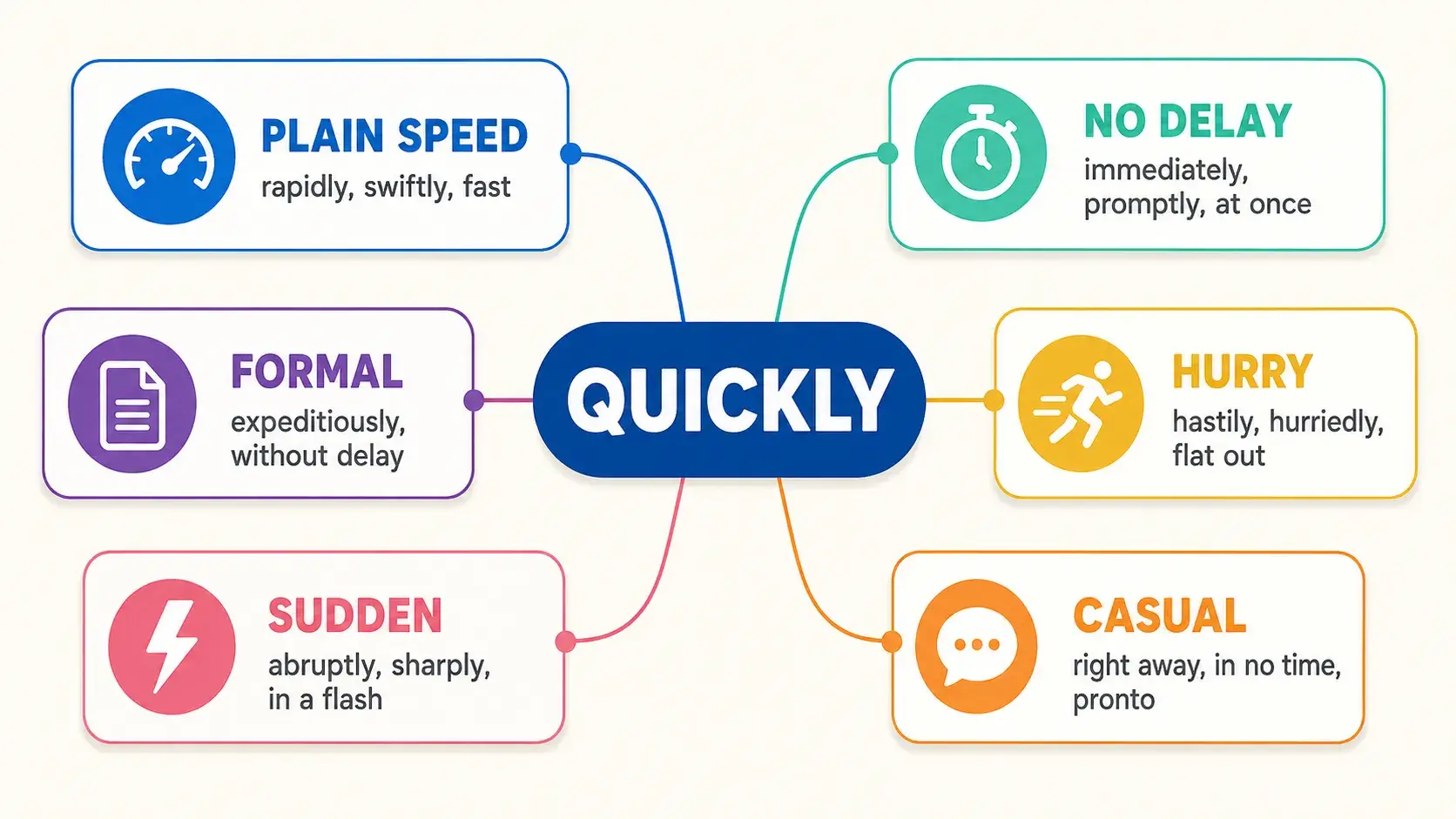
The best synonyms for quickly are rapidly, swiftly, promptly, immediately, fast, speedily, and expeditiously. Choose by what you mean: rapidly and swiftly describe motion, promptly and immediately describe no delay, and expeditiously fits formal writing. Hastily adds carelessness, so use it only when you mean it.
Quick-Reference Table: The 13 Strongest Alternatives
| Synonym | Register | Intensity (1-5) | Best used for |
|---|---|---|---|
| rapidly | Neutral | 4 | Movement, growth, change |
| swiftly | Neutral | 4 | Smooth, controlled speed |
| immediately | Neutral | 5 | Zero gap before action |
| promptly | Formal | 3 | Business email, deadlines |
| instantly | Neutral | 5 | Events with no measurable delay |
| expeditiously | Formal | 3 | Legal, official, procedural writing |
| fast | Neutral | 3 | Physical speed, speech, dialogue |
| at once | Neutral | 5 | Instructions and urgency |
| right away | Casual | 4 | Speech, texts, friendly email |
| hastily | Neutral | 4 | Speed that caused mistakes |
| briskly | Neutral | 2 | Energetic, purposeful pace |
| in no time | Casual | 3 | Short duration, informal tone |
| pronto | Slang | 4 | Jokes, commands, dialogue |
Intensity is SynonymQ’s editorial judgment: 1 = mild, 5 = strongest. A guide, not a measurement.
The Full List of Synonyms for Quickly, Grouped by Meaning
English gives us about three dozen genuine adverb alternatives here, not the two hundred a thesaurus will show you. So the rest of this guide is about choosing between them well rather than collecting more of them.
Every word below is an adverb or a fixed adverbial phrase, so each one does the same grammatical job as quickly. Register labels come from the six-bucket system further down the page.
One thing to settle before you pick. Oxford Learner’s Dictionaries records two senses for quickly — “fast” and “soon; after a short time” — and most wrong choices on this page come from taking a word built for one sense and dropping it into a sentence that meant the other.
Where a claim below comes from a dictionary, the dictionary is named. Where it is our own judgment, it says so. Commonness and intensity notes are SynonymQ editorial guidance, not corpus measurements.
Plain speed: how fast something moves or happens
This group answers “at what rate?” and nothing else. No urgency, no judgment, no implication about the result.
1. rapidly Neutral adverb — at a high rate, especially of change or growth — The infection spread rapidly through the ward.
2. swiftly Neutral adverb — fast and smoothly, with a hint of skill or control — She swiftly cleared the table before the guests arrived.
3. fast Neutral adverb — at high physical speed; the plainest option there is — He talks fast when he is nervous.
4. speedily Neutral adverb — with noticeable speed, often about a process being resolved — The complaint was speedily resolved by the front desk.
5. briskly Neutral adverb — at an energetic, purposeful pace, without any sense of panic — She walked briskly to the station in the cold.
6. apace Literary adverb — steadily and rapidly; almost always with continue, proceed or grow, and rare in speech — Work on the bridge continued apace through the summer.
7. fleetly Literary adverb — lightly and swiftly, of movement; genuinely rare, so save it for poetry — The deer moved fleetly across the clearing.
Without delay: the gap between the request and the action
These words say nothing about the speed of the action itself. They say the action started with no waiting, which is a different claim.
8. immediately Neutral adverb — with no delay at all before starting — Call me immediately if the fever returns.
9. instantly Neutral adverb — in an amount of time too small to notice — The screen went black instantly.
10. promptly Formal adverb — without delay, and on time; the standard choice in business writing — She promptly forwarded the invoice to accounts.
11. at once Neutral adverbial phrase — right now, with a note of authority — The manager asked us to stop at once.
12. without delay Formal adverbial phrase — with no waiting permitted; common in contracts and notices — Payment must be made without delay.
13. right away Casual adverbial phrase — immediately, in relaxed speech and email — I will send the file right away.
14. straight away Casual adverbial phrase — immediately; Merriam-Webster gives the one-word straightaway as “without hesitation or delay” with no regional label, so treat it as standard rather than British-only — He noticed the mistake straight away.
15. forthwith Formal adverb — immediately; now confined to legal and administrative writing — The tenancy is terminated forthwith.
16. posthaste Archaic adverb — with the greatest possible speed; survives mainly as a joke — She rode posthaste to the capital.
17. anon Archaic adverb — soon, shortly; you will meet this in older text, not write it — I shall return anon.
Formal and professional speed: reports, email and official writing
Use these when the reader is an employer, a client or an institution, and quickly would sound too plain for the document.
18. expeditiously Formal adverb — quickly and efficiently, with the process handled properly — The claim was processed expeditiously once the forms arrived.
19. summarily Formal adverb — immediately and without the usual formalities; Merriam-Webster’s entry carries no warning label, but its own examples (summarily relieved of his command) show where the peremptory tone comes from — He was summarily dismissed after the audit.
20. with dispatch Formal adverbial phrase — promptly and efficiently; slightly dated but still used in official prose — The committee handled the objections with dispatch.
21. with alacrity Formal adverbial phrase — quickly and eagerly; Merriam-Webster defines alacrity as “promptness in response: cheerful readiness,” so the willingness is inside the word — She accepted the transfer with alacrity.
22. in short order Neutral adverbial phrase — very soon afterwards, with the matter settled — The leak was patched in short order.
Hurry and pressure: speed that shows
This group carries the cost of the speed. Something was rushed, and the reader is meant to notice.
23. hastily Neutral adverb — quickly and without enough care — The report was hastily assembled the night before.
24. hurriedly Neutral adverb — quickly because time was short, with less blame than hastily — She hurriedly packed a bag and left.
25. in haste Neutral adverbial phrase — in a hurry; slightly formal, common in written apologies — Written in haste, so forgive the typos.
26. flat out Casual adverbial phrase — at maximum speed or effort — They worked flat out for three days.
27. at full tilt Casual adverbial phrase — at top speed, usually of movement — He came round the corner at full tilt.
28. hell for leather Slang adverbial phrase — at full speed, with what Merriam-Webster calls determined recklessness; no regional label in that entry — She rode hell for leather down the lane.
Suddenness: speed with a sharp edge
Here the speed is abrupt rather than merely high. The change is quick and unexpected, which is why quickly often sounds too soft.
29. abruptly Neutral adverb — suddenly and without warning, often unpleasantly — The music stopped abruptly.
30. sharply Neutral adverb — suddenly and markedly, especially of turns and numbers — Sales fell sharply after the recall.
31. like a shot Casual adverbial phrase — instantly and eagerly — He was out of the door like a shot.
32. in a flash Casual adverbial phrase — in an instant — The whole afternoon went by in a flash.
33. like lightning Casual adverbial phrase — extremely fast, of movement or reaction — Her hand shot out like lightning.
Casual and idiomatic: speech, texts and dialogue
These are the ones that make writing sound like a person. They are also the first to look wrong in an essay.
34. in no time Casual adverbial phrase — very soon, in a short while — We had the shelves up in no time.
35. in a jiffy Slang adverbial phrase — in a very short time; light and old-fashioned — I will be back in a jiffy.
36. lickety-split Slang adverb — at great speed; playful in tone, and listed in Merriam-Webster with no regional label despite its American reputation — The kids ran lickety-split down the hill.
37. pronto Slang adverb — right now; borrowed from Spanish and used mostly in commands — Get that off the stove, pronto.
38. on the double Casual adverbial phrase — immediately, with military flavor — Report to the office on the double.
39. PDQ Slang adverb — Merriam-Webster gives it as an informal abbreviation of “pretty damned quick,” meaning as quickly as possible — You had better fix that PDQ.
Save the ones you want with SynonymQ’s bookmark tool, or search related words in the SynonymQ synonym finder.

Register and Formality Table
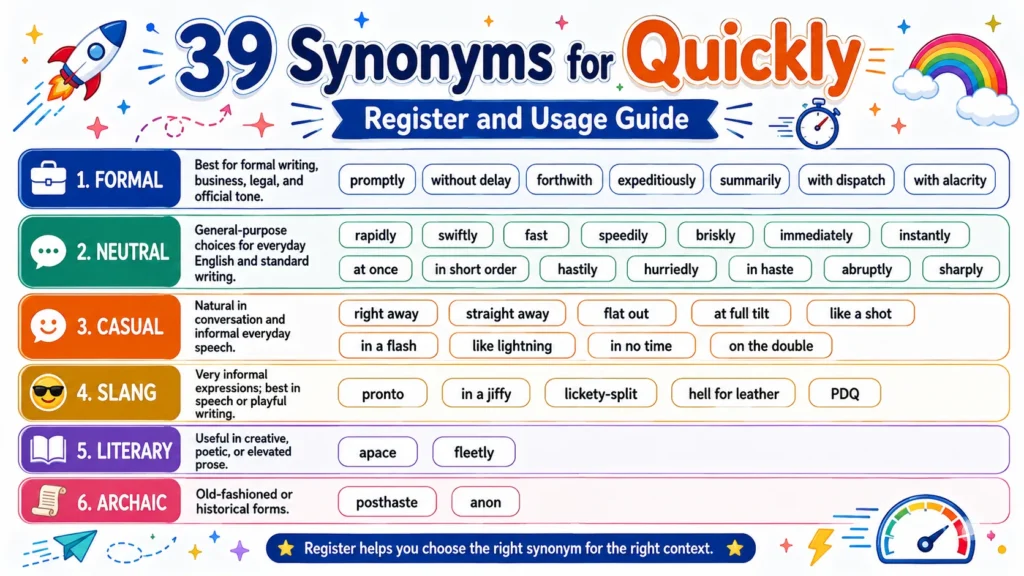
Register is the single most useful filter on this page, because most wrong word choices are register mistakes rather than meaning mistakes. Every major alternative sorts into exactly six buckets.
| Register | Words | What it signals |
|---|---|---|
| Formal | promptly, without delay, forthwith, expeditiously, summarily, with dispatch, with alacrity | Institutional, careful, on the record |
| Neutral | rapidly, swiftly, fast, speedily, briskly, immediately, instantly, at once, in short order, hastily, hurriedly, in haste, abruptly, sharply | Safe in almost any document |
| Casual | right away, straight away, flat out, at full tilt, like a shot, in a flash, like lightning, in no time, on the double | Speech, email to colleagues, blog prose |
| Slang | pronto, in a jiffy, lickety-split, hell for leather, PDQ | Dialogue, jokes, social posts |
| Literary | apace, fleetly | Fiction, poetry, deliberate style |
| Archaic | posthaste, anon | Historical writing, or quoting older text |
The practical rule: a Formal word in a text message sounds pompous, and a Slang word in a cover letter costs you the interview. Neutral is where you land when you are not sure.
Quickly is an easy word to sort this way because every alternative is an adverb. For a word where register does almost all the work, see 84 synonyms for fancy, which runs the same six buckets across an adjective, a verb and a noun.

Which Word Should You Use?
Pick by what you actually mean, not by which word sounds most impressive.
- You mean fast movement → rapidly, swiftly, fast, briskly
- You mean no waiting → immediately, promptly, at once, right away
- You mean it happened before anyone could react → instantly, in a flash, abruptly
- You are writing a business email → promptly, without delay, at your earliest convenience
- You are writing a contract or formal notice → forthwith, expeditiously, without delay
- You are writing a college essay → rapidly, swiftly, promptly, abruptly, sharply
- You are writing dialogue → right away, in no time, pronto, like a shot
- You want the reader to see the rush as a problem → hastily, hurriedly, at full tilt
- You want maximum intensity → instantly, immediately, at once
- You want the softest option → briskly, in short order, speedily
Two short decision rules worth remembering:
- If the speed is about when it started, use immediately or promptly. If it is about how fast it went, use rapidly or swiftly.
- If the reader should admire the speed, use swiftly. If the reader should worry about it, use hastily.

Can You Swap the Word Straight In?
A thesaurus implies every alternative drops into your sentence unchanged. Most do not. Take one sentence — She finished the report quickly — and watch what each alternative actually requires.
| Alternative | Substitutability | Example | What changes |
|---|---|---|---|
| rapidly | Direct swap | She finished the report rapidly. | Slightly more clinical |
| swiftly | Direct swap | She finished the report swiftly. | Adds skill and smoothness |
| speedily | Direct swap | She finished the report speedily. | Faintly bureaucratic |
| expeditiously | Direct swap | She finished the report expeditiously. | Formal, procedural |
| hastily | Direct swap | She finished the report hastily. | Meaning shifts to careless |
| promptly | Direct swap | She promptly finished the report. | Shifts to “without delay” |
| in no time | Swap with adjustment | She finished the report in no time. | Phrase must sit at the end |
| with dispatch | Swap with adjustment | She finished the report with dispatch. | Reads as official prose |
| immediately | Requires rewrite | She started the report immediately. | Marks the start, not the duration |
| instantly | Requires rewrite | The screen refreshed instantly. | Needs an event, not a task |
| pronto | Requires rewrite | Finish that report, pronto. | Works in commands only |
| forthwith | Requires rewrite | The report is to be submitted forthwith. | Needs an instruction, not a narrative |
| apace | Requires rewrite | Work on the report continued apace. | Pairs with continue or proceed |
The two rows worth reading twice are immediately and instantly. Both look like stronger versions of quickly, and neither can describe how long a task took.

Words That Are Not True Synonyms for Quickly
These six turn up in thesaurus results for quickly and cause real errors. Each one means something adjacent, not the same, and the first two are documented disputes rather than opinions.
Momentarily — The dictionaries split on this one. Oxford Learner’s Dictionaries labels the “very soon; in a moment” sense as North American English, while Merriam-Webster lists both “for a moment” and “at any moment; in a moment” without any regional label and marks the older “instantly” sense archaic.
The practical consequence is real. The plane will land momentarily reads as reassurance to one reader and as a crash to another, so avoid it in writing for a global audience.
Presently — Merriam-Webster gives three senses: “at once” (archaic), “without undue delay; before long,” and “at the present time; now.” Its usage note records that many commentators object to the “now” sense even though it has been in continuous use since the fifteenth century.
That leaves she will arrive presently genuinely ambiguous and the report is presently under review perfectly safe. Neither reading means “at speed.”
Efficiently — Means without wasted effort or resources, which is not the same as fast. A slow process can be highly efficient, so write quickly and efficiently when you mean both and keep the two claims separate.
Cursorily — This is the closest thing quickly has to a trap. Merriam-Webster defines cursory as “rapidly and often superficially performed or produced: hasty,” so the word carries the neglect of detail inside it.
She cursorily reviewed the contract is a criticism, not a compliment. Reach for it only when you mean the review was too thin.
Shortly — Says when something will begin, not how fast it will go. We will begin shortly promises a soon start and makes no promise about pace, so swapping it for quickly changes what you have committed to.
Readily — Means willingly or easily. She readily agreed describes attitude and she quickly agreed describes timing, so using them interchangeably misreports someone’s motive.

Quickly vs Fast, Rapidly, Promptly and Hastily
Four comparisons cover almost every real decision. Each table is the difference in one glance; the sentences under it are the part a thesaurus leaves out.
Quickly vs Fast
| Aspect | quickly | fast |
|---|---|---|
| Part of speech | Adverb only | Adverb and adjective |
| Emphasis | Short time taken | High rate of motion |
| Best with | Actions and decisions | Physical movement and speech |
| Formality | Neutral, safe in writing | Neutral, leans conversational |
Fast is the better word for bodies in motion: he runs fast, not he runs quickly, is what a native speaker says. Quickly is the better word for tasks and decisions, because it measures elapsed time rather than velocity. In formal writing, quickly is the safer default of the two.
Quickly vs Rapidly
| Aspect | quickly | rapidly |
|---|---|---|
| Emphasis | Little time was needed | The rate itself is high |
| Typical subject | A person doing something | A process, number or condition |
| Register | Neutral, everyday | Neutral, slightly technical |
| Common pairing | act, learn, respond | grow, spread, decline |
Rapidly belongs to things that change on their own — prices, infections, temperatures. Quickly belongs to things people do. That is why the tumor grew rapidly sounds clinical and correct, while the tumor grew quickly sounds like a conversation about it.
Quickly vs Promptly
| Aspect | quickly | promptly |
|---|---|---|
| What it measures | Duration of the action | Delay before the action |
| Implied standard | None | An expected time was met |
| Register | Neutral | Formal, professional |
| Common pairing | finished, moved, learned | replied, paid, submitted |
Promptly carries an obligation inside it: you replied when you were supposed to. Quickly carries no such promise, which is why she replied promptly is a compliment in a reference letter and she replied quickly is merely a fact.
Quickly vs Hastily
| Aspect | quickly | hastily |
|---|---|---|
| Judgment | Neutral | Critical |
| Implies about quality | Nothing | Corners were cut |
| Typical use | Praise or plain report | Explaining a mistake |
| Safe in a résumé | Yes | No |
Hastily is the word you use when the speed is the reason something went wrong. Never reach for it as a fancier quickly — describing your own work as hastily completed is an admission, not a boast.

Common Collocations with Quickly
These pairings are what native speakers actually say. A synonym that fits the meaning can still break the collocation, so check the pairing before you swap.
Adverbs are relatively forgiving here. Verbs are not, and 85 synonyms for play shows how far it can go: across eleven senses, the collocation decides the word more often than the meaning does.
- act quickly — We need to act quickly if the offer expires tonight.
- move quickly — The council moved quickly to close the footpath.
- learn quickly — She learns quickly and rarely needs the same instruction twice.
- respond quickly — Support responded quickly, which is why I renewed.
- spread quickly — The rumor spread quickly through the department.
- grow quickly — The plant grows quickly in poor soil.
- quickly become — The pilot episode quickly became the most watched of the season.
- quickly realize — I quickly realized the address was wrong.
- work quickly — The team worked quickly to reopen the road.
- fade quickly — The dye fades quickly in sunlight.
Locked expressions: do not substitute
In these phrases the word is fixed. Replacing it produces something that no fluent speaker would say, even though the replacement is a genuine synonym elsewhere.
| Fixed expression | Do not write | Why it fails |
|---|---|---|
| think on your feet | think swiftly on your feet | The idiom carries the speed already |
| a quick word | a rapid word | Quick here means brief, not fast |
| quick fix | swift fix | Set compound noun with a critical tone |
| get rich quick | get rich quickly | The adverbial quick is locked in the phrase |
| double-quick time | double-rapid time | Fixed military expression |
| come quick | come rapidly | Informal imperative; the bare form is the idiom |
The Origin of Quick and Quickly
Quick began life meaning “alive,” not “fast.” Etymonline’s entry for quick traces it to Old English cwic, “living, alive, animate,” from Proto-Germanic *kwikwaz and the Indo-European root gwei-, “to live.”
The speed sense arrived later, and in stages. Etymonline dates “lively, active, swift, speedy, hasty” to around 1300, built on the idea of being full of life. By the late 1400s it described people who were “mentally active, prompt to perceive or respond,” and by the 1540s it described actions and processes “done in little time.”
Two fossils preserve the original meaning. The quick and the dead pairs the living with the dead, a pairing Etymonline links to the wording of the Nicene and Apostles’ creeds. Cut to the quick refers to the tender living flesh under a nail, recorded from the late 1300s, with the figurative sense following in the 1520s.
One oddity of modern usage sits alongside that history. Quick still works as an adverb in casual speech — come quick, get rich quick — in exactly the places where careful writing would use quickly.
Synonyms for Quick: The Adjective Forms
Many readers searching for quickly actually need the adjective. These are not counted in the 39 above, because they do a different grammatical job, but they are the words you want in front of a noun.
| Adjective | Register | Intensity (1-5) | Best used for |
|---|---|---|---|
| rapid | Neutral | 4 | rapid growth, rapid decline |
| swift | Neutral | 4 | a swift response, a swift kick |
| fast | Neutral | 3 | a fast car, a fast learner |
| speedy | Neutral | 3 | a speedy recovery |
| prompt | Formal | 3 | prompt payment, a prompt reply |
| expeditious | Formal | 3 | an expeditious resolution |
| immediate | Neutral | 5 | immediate effect, immediate family |
| brisk | Neutral | 2 | a brisk walk, brisk trade |
| nimble | Neutral | 3 | nimble fingers, a nimble mind |
| snappy | Casual | 3 | a snappy comeback, snappy service |
| hasty | Neutral | 4 | a hasty decision |
| abrupt | Neutral | 4 | an abrupt ending |
| breakneck | Neutral | 5 | breakneck speed |
For anyone arriving from a crossword or a word game, five letters gives you rapid, swift, hasty, brisk and fleet. Six letters gives you speedy, nimble, abrupt, sudden and snappy.
For casual speech, snappy and zippy are the closest thing quick has to slang, and both describe style as much as speed.
Quickly Synonyms by Writing Situation
Academic Writing and Essays
Academic prose wants precision about what was fast, so the vague options thin out fast. Reach for rapidly, swiftly, abruptly, sharply, promptly, markedly for numbers, and in short order for sequences of events.
Avoid in no time, like a shot, pronto and PDQ entirely. Also watch the temptation to replace a plain quickly with expeditiously to sound scholarly — it reads as legal boilerplate, not scholarship.
If you are cutting an essay to a limit, run it through the SynonymQ word counter first, and check the word count guidelines for essays, blogs and social posts before you decide what to trim.
Résumés, Cover Letters and Professional Email
Employers read quickly as a claim about your work, so choose the word that claims the right thing. Promptly, efficiently paired with quickly, expeditiously, without delay, swiftly, in short order and with alacrity all land well.
Never write hastily about your own work, and skip summarily unless you are describing a dismissal. Promptly is the highest-value word in this group: it says you met the expected time, which is what a hiring manager is checking for.
While you are rewriting that paragraph, the other word doing too much work on most résumés is experience. Our guide to 47 synonyms for experience splits it by whether you mean skill, an event, or the act of perceiving something.
Creative Writing and Fiction
Fiction needs speed the reader can see, which rules out the abstract options. Abruptly, sharply, like a shot, in a flash, like lightning, at full tilt, flat out, apace and fleetly all give the sentence a body.
Hastily and hurriedly are the useful pair for characters under pressure, because both let the reader feel the mistake coming. Keep posthaste and anon for period dialogue, where they read as texture rather than error.
Everyday Conversation and Social Media
Here the plain words win and the formal ones sound strange. Right away, straight away, in no time, in a flash, pronto, in a jiffy, on the double, flat out and PDQ all sound like speech.
Nobody says expeditiously out loud. If a word would look odd in a text message, it will look odd in a caption.
Need a different shade of meaning than any of these? Search the word in the SynonymQ synonym tool and compare the options side by side.

Antonyms of Quickly
The opposite of quickly splits three ways: slow pace, delayed start, and unhurried manner. Choosing the wrong branch is the most common antonym error with this word.
- slowly — the plain opposite, at a low rate
- gradually — over a long period, in stages
- sluggishly — slowly and without energy, mildly critical
- leisurely — slowly and by choice, positive
- unhurriedly — without rushing, calm and deliberate
- deliberately — slowly on purpose, with care
- lazily — slowly through lack of effort, critical
- at a snail’s pace — extremely slowly, informal and exasperated
- little by little — in small increments, informal
- eventually — in the end, after a delay
- belatedly — later than it should have happened
- tardily — late; formal and faintly disapproving
- languidly — slowly and softly, literary
Note the split: slowly opposes the pace, while belatedly and eventually oppose the timing. Browse more pairs in the SynonymQ antonym finder, or read Antonyms 101: how opposite words sharpen your meaning for the wider pattern.

Quickly in Spanish, French and Italian
[VERIFY-NATIVE]
The nearest equivalents in each language split along the same lines English does — pace versus no delay — but the everyday choice is often not the textbook one.
| Language | Word | Register | Notes |
|---|---|---|---|
| Spanish | rápidamente | Neutral | Correct everywhere, but long; speech often uses rápido adverbially instead |
| Spanish | deprisa | Neutral | Also written de prisa; carries a sense of hurry |
| Spanish | en seguida | Casual | Means “right away,” about delay rather than pace |
| French | rapidement | Neutral | The standard written choice |
| French | vite | Casual | Far more common in speech than rapidement |
| French | promptement | Formal | Official and administrative; rare in conversation |
| Italian | velocemente | Neutral | The everyday adverb |
| Italian | rapidamente | Neutral | Slightly more formal or technical than velocemente |
| Italian | subito | Casual | Means “right away”; extremely common in speech |
One native example per language:
- Spanish: Terminó el informe rápidamente.
- French: Elle a terminé le rapport rapidement.
- Italian: Ha finito la relazione velocemente.
Two false friends to flag. Spanish pronto means “soon,” not “quickly,” despite English having borrowed it as a slang word for “right now.” Italian presto also means “soon” or “early,” so it is not the word for speed either.
How to Avoid Repeating Quickly
Repetition is usually a symptom rather than the problem. The same word appearing five times often means five different ideas are being flattened into one. Work through it in five steps.
- Highlight every instance in the draft, then read only those sentences. Repetition you cannot see, you cannot fix.
- Label what each one means — pace, no delay, suddenness, or brevity. Most drafts turn out to use two or three senses, not one.
- Replace by sense, not by sound. Pull the pace instances from the first group on this page, the delay instances from the second.
- Cut rather than substitute where you can. Sprinted already contains speed; sprinted quickly is a redundancy, not a description.
- Restructure the third instance. If a paragraph needs the idea three times, the sentence order is usually the real issue.
- Read it aloud. A synonym that fits on paper but trips your tongue is the wrong register for the piece.
The SynonymQ paraphrasing tool handles step three at the sentence level. For the longer version of this method, see how to paraphrase without plagiarizing.
Frequently Asked Questions
How Do You Say Quick in a Professional Way?
Use prompt, expeditious, timely or swift for the adjective, and promptly or expeditiously for the adverb. In business email, a prompt response is the standard phrasing and prompt payment is the standard phrasing for invoices. Expeditious fits procedural and legal writing but sounds stiff in ordinary correspondence.
What Are 5 Synonyms for Fast?
The five strongest are rapid, swift, speedy, quick and brisk as adjectives, or rapidly, swiftly, speedily, quickly and briskly as adverbs. Rapid suits processes and numbers, swift suits controlled action, speedy suits recovery and resolution, and brisk is the mildest of the group.
How Do You Say Very Quick?
Use a single stronger word rather than an intensifier. Instant, immediate, lightning-fast, breakneck and near-instantaneous all carry more force than very quick, and they read better in formal writing. In speech, super quick and lightning quick are the natural informal options.
Is Fast a Synonym of Quick?
Yes, for most purposes, but they are not interchangeable everywhere. Fast emphasizes a high rate of motion and works as both adjective and adverb; quick emphasizes a short time taken and needs quickly to work as an adverb in careful writing. See the comparison table above for the specific split.
How Do You Professionally Say Quickly?
Write promptly for business email, expeditiously for procedural or legal documents, without delay for notices and contracts, and swiftly for reports and reviews. Promptly is the highest-value option because it implies you met an expected time, not merely that you were fast.
What Is Another Word for Very Quickly?
Instantly, immediately, in a flash, at once and like lightning all outrank very quickly. For a formal register, use without delay, forthwith or with the utmost dispatch. In each case a single strong word beats very plus a mild one, which is a general rule of English rather than a rule about this word.
What’s a Better Word Than Fast?
It depends on what is moving. For growth or decline use rapid; for controlled action use swift; for a response use prompt; for danger use breakneck; for a person’s mind use nimble. Fast is rarely wrong, so replace it only when one of these adds information rather than syllables.
What Is Another Way to Say So Quickly?
Use so fast, so soon, in such a short time or at such speed, depending on the sense. So quickly usually carries surprise, and in such a short time keeps that surprise while sounding more formal. In questions, how did you finish so fast? is the more natural spoken form.
Which Synonyms for Quickly Start With the Letter C?
The C options are genuinely thin. Cursorily is the closest single word, but Merriam-Webster defines cursory as “rapidly and often superficially performed or produced: hasty,” so it criticizes rather than describes. If you need a different letter, A gives you apace, abruptly, at once and anon.
What Is the Antonym of Quickly?
Slowly is the direct opposite. Choose gradually for change over time, leisurely for slowness by choice, sluggishly for slowness without energy, and belatedly for something that happened later than it should have. The split matters: slowly opposes the pace, belatedly opposes the timing.
Is Quickly Too Informal for Academic Writing?
No. Quickly is a neutral adverb and perfectly acceptable in essays, dissertations and journal articles. What academic readers object to is imprecision, so replace it when a more specific word exists — rapidly for measured rates, abruptly for sudden change, sharply for numbers — and keep it when the plain meaning is what you want.
Choosing Your Next Word
The useful question is never “what is another word for quickly?” but “which sense of quickly do I mean?” Once you know whether you are describing pace, a missing delay, or a sudden change, the list narrows to two or three real candidates and the choice becomes easy. Register does the rest of the work: Neutral for most writing, Formal when an institution is reading, Casual when a person is.
Compare any of these words side by side in the SynonymQ synonym finder, and save the ones you want to reuse.
How This Page Was Checked
Every claim on this page falls into one of two categories, and the page tells you which. Dictionary claims are named where they appear. Editorial claims are ours, and labelled as such.
What a dictionary confirmed
| Claim | Source consulted |
|---|---|
| Origin of quick, and the dated sense shifts to 1300, the late 1400s and the 1540s | Etymonline, entry for quick |
| Quickly has two senses, “fast” and “soon; after a short time” | Oxford Learner’s Dictionaries, entry for quickly |
| The “in a moment” sense of momentarily is labelled North American English | Oxford Learner’s Dictionaries, entry for momentarily |
| Momentarily carries both senses with no regional label, and “instantly” is archaic | Merriam-Webster, entry for momentarily |
| Presently has three senses, and the “now” sense is objected to despite fifteenth-century use | Merriam-Webster, entry for presently |
| Cursory means “rapidly and often superficially performed or produced: hasty” | Merriam-Webster, entry for cursory |
| Alacrity is “promptness in response: cheerful readiness” | Merriam-Webster, entry for alacrity |
| PDQ abbreviates “pretty damned quick” and is informal | Merriam-Webster, entry for PDQ |
| Straightaway means “without hesitation or delay”, with no regional label | Merriam-Webster, entry for straightaway |
| Hell for leather means at full speed, marked by determined recklessness | Merriam-Webster, entry for hell-for-leather |
| Lickety-split means “at great speed”, with no regional label | Merriam-Webster, entry for lickety-split |
Three regional labels we removed
Other vocabulary pages call straight away British, lickety-split American and hell for leather British. None of the dictionaries consulted here attaches a regional label to any of the three, so this page does not either. Where a source disagrees with a widely repeated claim, we follow the source.
Regional differences in spelling are a different matter, because they are documented rather than inferred. Honor and honour are the clean example, and 59 synonyms for honor handles that split alongside the harder question of separating respect from standing from integrity.
What is our judgment, not a dictionary’s
Intensity scores, the six register buckets, the substitution verdicts, the collocation list and the locked-expression table are SynonymQ editorial judgments. They are defensible and testable by reading the examples aloud, but no dictionary publishes them, and this page does not pretend otherwise.
The Spanish, French and Italian table is stamped [VERIFY-NATIVE] and is pending native-speaker review. Treat its register notes as provisional until that line is removed.
Further reading: the four entries above are worth reading in full on Etymonline, Merriam-Webster and Oxford Learner’s Dictionaries.
About the Author
Naveed Akhtar — Founder of SynonymQ, writes about vocabulary and clear writing. Ten years of experience writing and editing SEO articles, which is where the register and substitution guidance on this page comes from: the wrong adverb in a cover letter or an essay is the mistake that costs a reader most often.
Published: August 21, 2026 Last updated: August 21, 2026
Corrections log for this article: four claims were changed before publication — the expansion of PDQ, and the removal of unsupported regional labels from straight away, lickety-split and hell for leather.

Naveed Akhtar writes every guide on SynonymQ. He is an SEO content writer with ten years of article-writing experience, working on the question a thesaurus never answers: which of these words belongs in this sentence, for this reader. Every page cites the dictionary entries it draws on and the date they were read.