
Best Practice Synonym: Choose by What You Can Prove
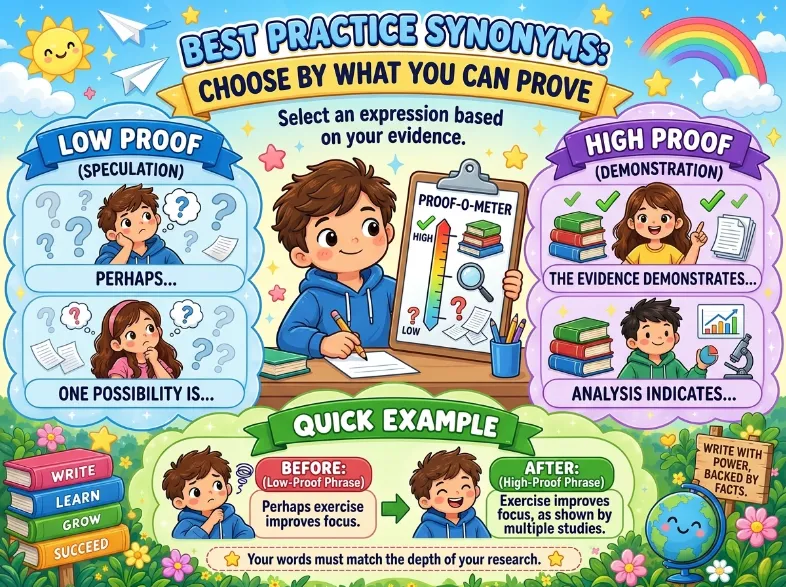
A best practice synonym should be chosen by what you can actually prove. Use common practice when it is simply what most people do, good practice when it works but is unproven, and evidence-based practice when research backs it.
By Naveed Akhtar, an SEO content writer with 10 years of article-writing experience · Updated 11 September 2026 · About 9 minutes
What “Best Practice” Actually Claims
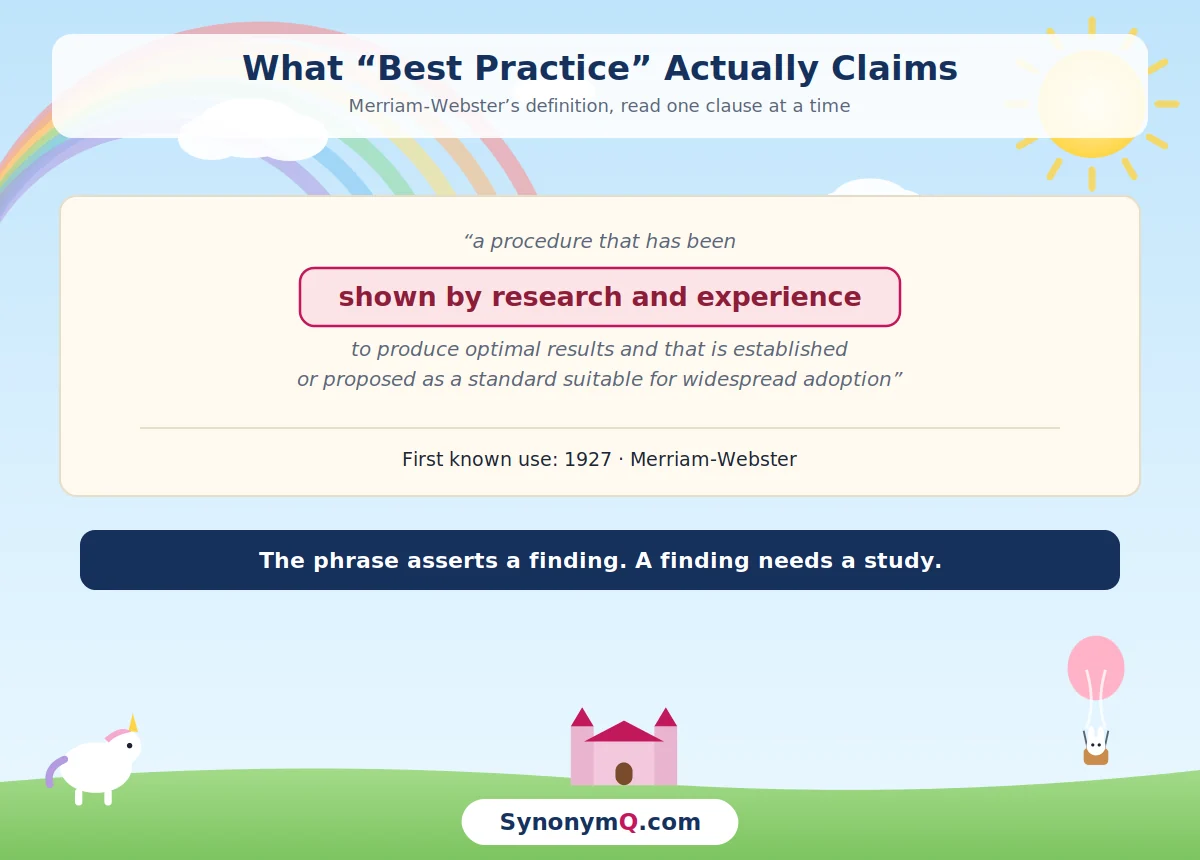
Merriam-Webster defines a best practice as “a procedure that has been shown by research and experience to produce optimal results and that is established or proposed as a standard suitable for widespread adoption”.
Read the first clause again. Shown by research and experience. The phrase is not a soft compliment; it asserts that somebody did the work and the work came out in favour.
Merriam-Webster dates the term to 1927, so it is older than the management consulting that made it ubiquitous.
That is the whole problem with replacing it. Most alternatives either repeat the evidence claim or quietly drop it, and the two are not interchangeable in a document someone may act on.
The Claim Is Rarely Earned
The term has a documented body of criticism, and the criticism is about exactly this gap.
“Designating something a ‘best practice’ is a marketing ploy, not a scientific conclusion. Calling something ‘best’ is a political and ideological assertion dressed up in research-sounding terminology.”
Michael Quinn Patton, Impact Evaluation: Best Practices Aren’t, published on BetterEvaluationPatton is an evaluation methodologist, so his objection is professional rather than stylistic. The word promises a finding, and a finding needs a study.
He is not alone. Eugene Bardach has argued that the work required to establish something as best is rarely finished, and that practitioners usually identify good or smart practices instead.
Scott Ambler proposes contextual practice, on the grounds that no single method is optimal everywhere. Eric Darling puts it more bluntly: it is not best practice, it is common practice.
Where these critics came from. I found this group through Wikipedia’s survey of criticism of the term, then read Patton’s own post directly. The Patton quotation is his; the summaries of Bardach, Ambler and Darling are reported at one remove and are named here so you can check them.Sort the Alternatives by What You Can Prove
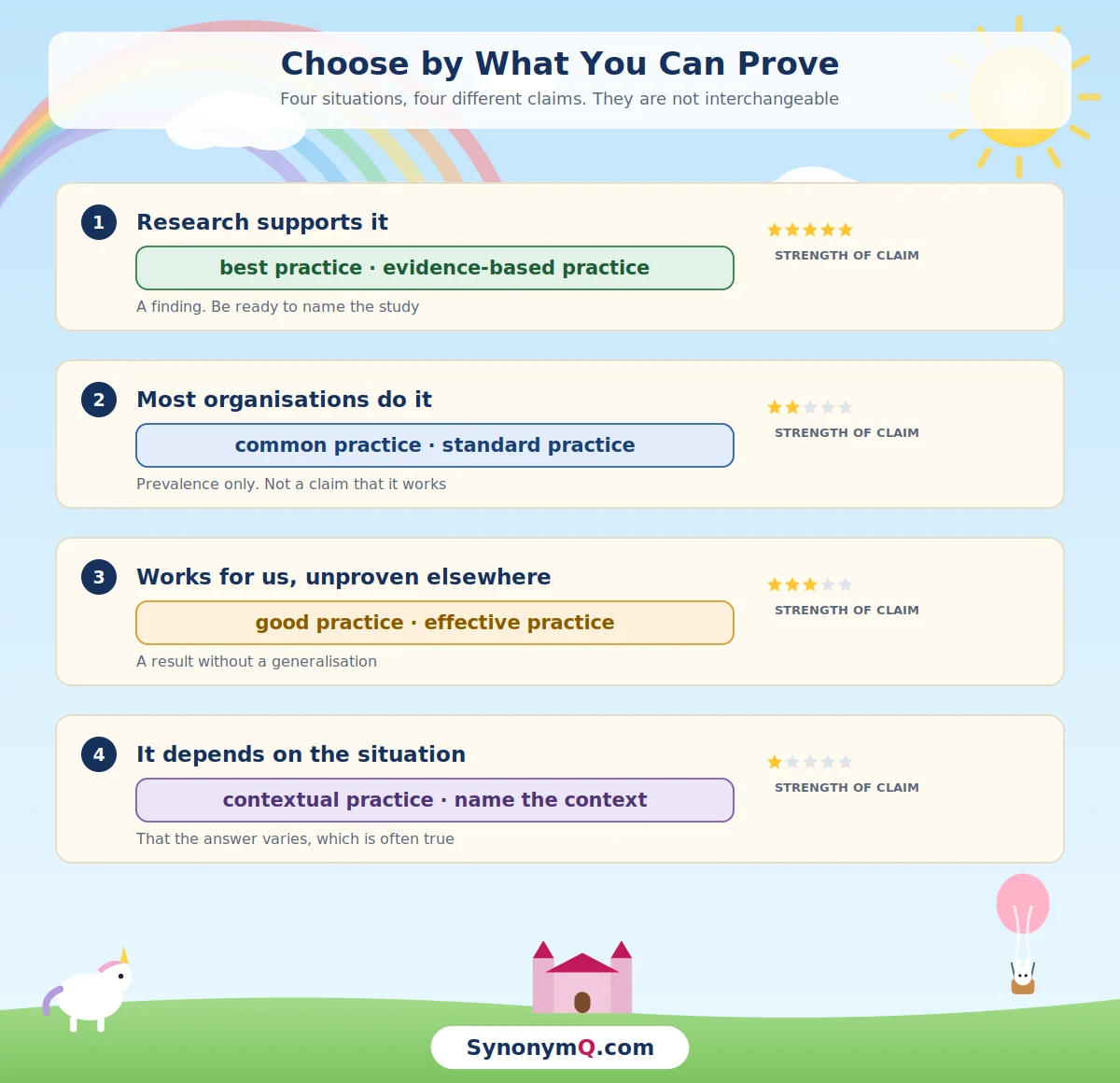
This is the decision the synonym lists skip. Before choosing a word, decide which of four things is true about the procedure you are describing.
| What is actually true | Use | What that word claims | Label |
|---|---|---|---|
| Research supports it | best practice · evidence-based practice | A finding. Keep the phrase, and be ready to name the study | Keep |
| Most organisations do it | common practice · standard practice | Prevalence only. Says nothing about whether it works | Direct Swap |
| It works for us, unproven elsewhere | good practice · effective practice · promising practice | A result without a generalisation | Direct Swap |
| It depends on the situation | contextual practice, or name the context | That the answer varies, which is often the honest answer | Swap With Adjustment |
Every row is a different claim, not a different tone. Choosing between them is a decision about what you are willing to defend in a meeting.
When It’s Just What Everyone Does
Common practice and standard practice are the most useful and most underused alternatives, because prevalence is usually the only thing the writer actually knows.
Claims a findingWeekly one-to-ones are a best practice for engineering managers. Claims only what you knowWeekly one-to-ones are common practice for engineering managers.The second sentence is weaker and more accurate, and a reader who wants to push back has to argue with a fact rather than with your framing.
Standard practice adds a note of expectation: not just that people do it, but that departing from it would be noticed. Useful in policy documents, too strong for a suggestion.
When It Works but Isn’t Proven
Good practice is the workhorse here, and it is the alternative most often missed because it looks like a weaker version of the same phrase. It is not. It drops the comparative.
Best says nothing beats it. Good says this one works. The first invites the question “compared with what?”, and in most documents there is no answer.
Promising practice and effective practice are the terms the evaluation field reaches for when results exist but generalisation does not. They are precise, and they sound careful rather than weak.
Recommendation. If you are writing a playbook, a process document or an internal guide, good practice is almost always the correct phrase, and it is the one nobody reaches for.When You Actually Have the Evidence
Sometimes the research does exist, and then the phrase is doing its job. In that case the stronger move is usually to be specific rather than to keep the label.
LabelCode review before merge is a best practice. The evidence the label was standing in forTeams that review before merge report fewer production defects, which is why we require it.Evidence-based practice is the honest formal alternative, and it carries an obligation: a reader may reasonably ask which evidence. Use it when you can answer.
Why Regulated Industries Say “Good Practice”, Not “Best”
There is a pattern worth noticing in the most heavily regulated fields, where wording is chosen carefully and then written into law.
Pharmaceutical manufacturing has Good Manufacturing Practice. Clinical trials have Good Clinical Practice, overseen by bodies including the European Medicines Agency. Laboratories have Good Laboratory Practice, and engineering has Good Engineering Practice.
Not one of them is called best. These are standards with regulators, inspections and legal force behind them, and they still use the word good.
This one is an observation, not a sourced claim about intent. I am reporting what these standards are named, which is checkable. Why the drafters chose good over best is not something I retrieved, and this page does not claim to know it.Best Practice Synonym Lists: What Each Recommendation Costs
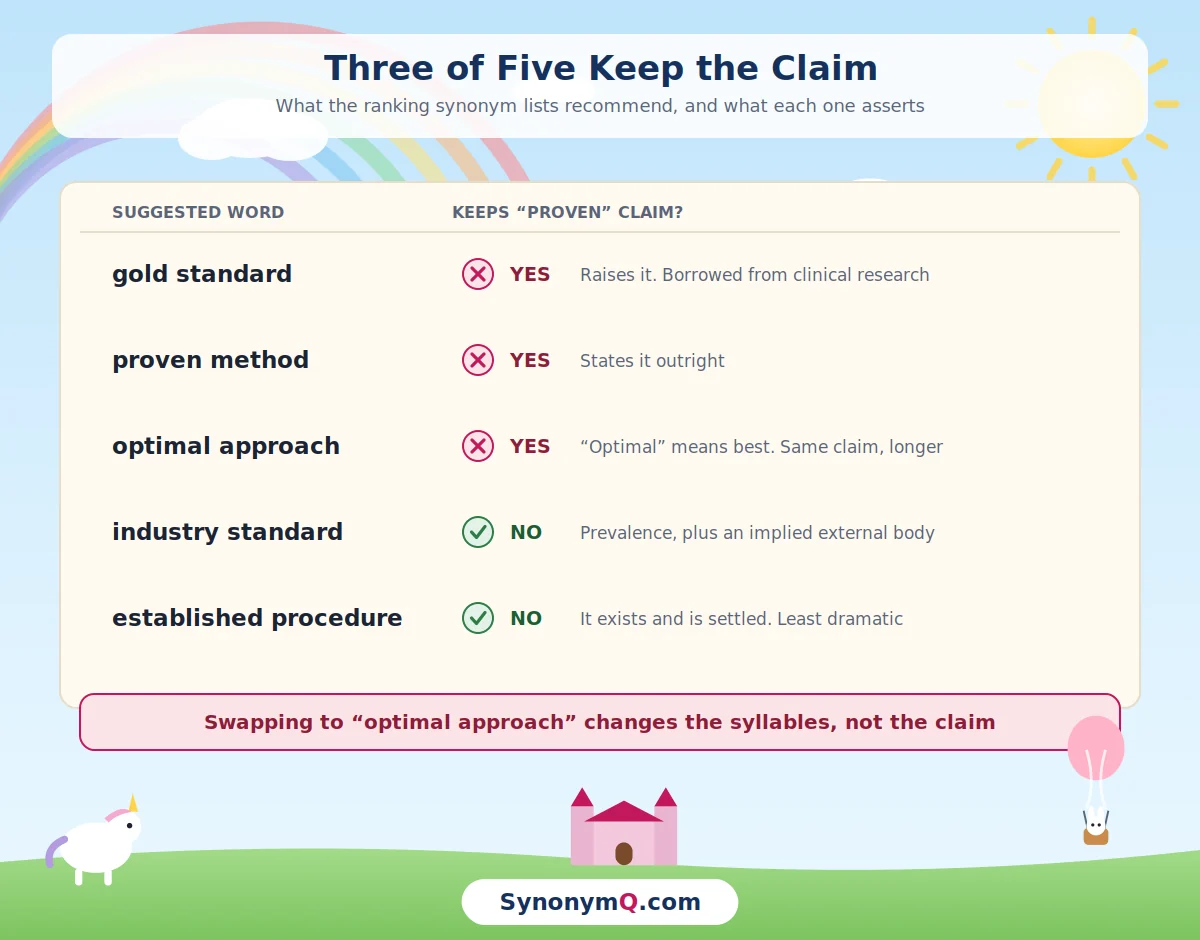
The pages ranking for this question offer between ten and thirty-five alternatives each. The recurring ones fall into two groups, and the grouping is the useful part.
| Suggested alternative | Keeps the “proven” claim? | What it costs | Label |
|---|---|---|---|
| gold standard | Yes, and raises it | A stronger claim than best practice, borrowed from clinical research where it means the reference test | Requires Rewrite |
| proven method | Yes, explicitly | States the claim outright, so it is more honest than best practice only if the proof exists | Swap With Adjustment |
| optimal approach | Yes | Optimal means best by definition. This is the same claim in longer words | Requires Rewrite |
| industry standard | No | Prevalence, like common practice, but implies an external body defined it. Only accurate if one did | Swap With Adjustment |
| established procedure | No | Says it exists and is settled. Often exactly right, and the least dramatic option available | Direct Swap |
Three of the five recurring recommendations keep or increase the very claim that made the writer uneasy. Swapping best practice for optimal approach changes the syllable count and nothing else.
This is the same failure as other business phrases that quietly assign a judgement, such as the alternatives to an aggressive timeline, where the replacement decides who is at fault.
Frequently Asked Questions
Is it “best practice” or “best practices”?
Merriam-Webster’s headword is the singular best practice, with best practices listed as the plural. Both are standard; the plural is more common in American corporate writing, the singular in British usage and in named frameworks.
What is a more formal word for best practice?
Evidence-based practice or established procedure, depending on whether you have evidence. Formality is rarely the real problem with this phrase. The unearned claim is, and a more formal word usually keeps it.
What can I say instead of best practice in a policy document?
Standard practice if departure would be unusual, required procedure if it is mandatory, good practice if it is recommended but optional. Policy writing rewards saying which of those three you mean, much as given and provided are not interchangeable in a contract.
Is calling something a best practice wrong?
Not if research supports it and you can point to the research. It becomes a problem when it is used to end a discussion rather than to report a finding, which is the substance of Patton’s objection.
How This Page Was Checked
Read from the sources attributed, on 11 September 2026:
- The definition, the 1927 first-known-use date and the singular headword — Merriam-Webster.
- The Patton quotation — his post Impact Evaluation: Best Practices Aren’t on BetterEvaluation.
- The names of the Good Manufacturing, Clinical, Laboratory and Engineering Practice standards were confirmed as existing regulatory terms; the EMA publishes guidance on Good Clinical Practice.
Two limits are stated where they appear. The Bardach, Ambler and Darling positions reached this page through Wikipedia’s survey of criticism rather than from their own writing.
The reason regulated standards use good rather than best is an observation about naming, not a claim about the drafters’ intent.
No claim is made here about which word ranks better or which any employer prefers. Those are editorial judgements about meaning.
Written by Naveed Akhtar, an SEO content writer with 10 years of article-writing experience.
Target topic: writing a playbook that recommends without overclaiming

Naveed Akhtar writes every guide on SynonymQ. He is an SEO content writer with ten years of article-writing experience, working on the question a thesaurus never answers: which of these words belongs in this sentence, for this reader. Every page cites the dictionary entries it draws on and the date they were read.