

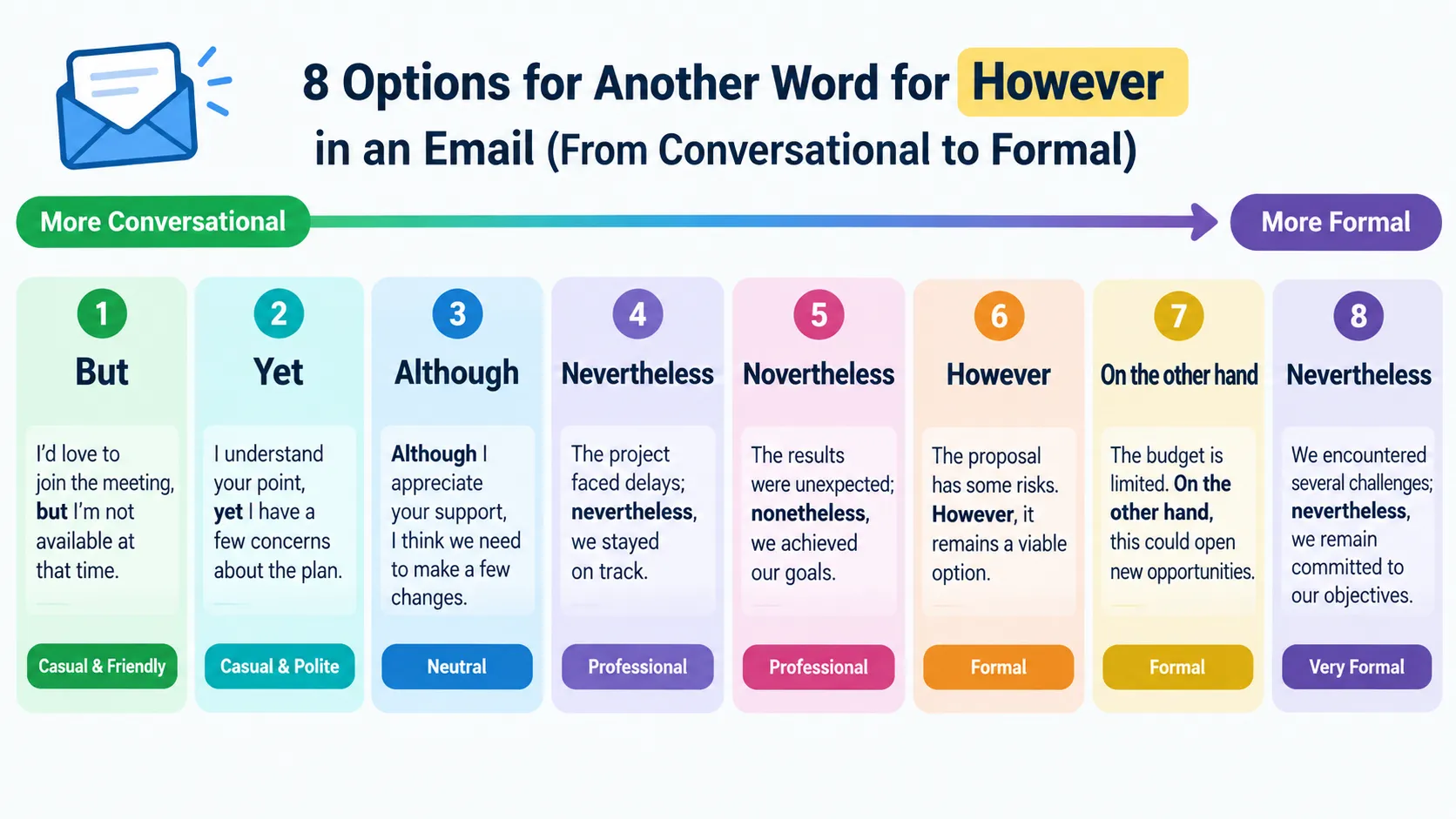
Another word for however in an email is usually that said, still, though, nevertheless or on the other hand. That said is the safest swap in professional email, because it softens the contrast without sounding stiff. But most replacements change your punctuation as well as your tone, and sometimes however is already the right word.

What however is doing in your sentence
Before you replace it, check which however you have written. Merriam-Webster lists two live adverb senses, and only one of them has synonyms worth reaching for.
The first is the contrast sense: Merriam-Webster defines it as “in spite of that: on the other hand.” That is the one in We received your invoice. However, the PO number is missing. Every thesaurus list you have seen is a list for this sense.
The second is the manner-or-degree sense. Merriam-Webster gives “in whatever manner or way” and “to whatever degree or extent.” That is the however in However you file it, send me the reference. Swap nevertheless into that sentence and it stops meaning anything.
The quick check
Read your sentence and ask whether however could be replaced by but. If yes, you have the contrast sense and this page applies. If it could be replaced by no matter how or in whatever way, you have the second sense, and the alternatives below will break your sentence.
Another word for however: the alternatives that fit a work email
One caveat first, and it matters more than any list. Merriam-Webster attaches no formal or informal label to however, nevertheless, nonetheless, though, still or that said. Any page that groups these words by register, including this one, is offering editorial judgement rather than a dictionary label. The register column below is mine, based on how these words behave in business correspondence, and I have marked it as such rather than dressing it up as a lookup.
| Alternative | Relationship | Register (editorial) | What it signals |
|---|---|---|---|
| that said | Near-Synonym | Neutral, conversational-professional | Acknowledges what you just wrote before qualifying it. Merriam-Webster defines the phrase as “despite what one just said.” The least abrupt option |
| still | Near-Synonym | Neutral, slightly warmer | Concedes the point and holds your position anyway. Short, so it reads as unbothered rather than combative |
| though | Near-Synonym | Conversational | The most relaxed of the set, especially at the end of a sentence. Fine with colleagues; thin for a first email to a client |
| nevertheless | Exact Synonym | Formal | Merriam-Webster defines it as “in spite of that: however.” The closest true equivalent, but heavier than however, not lighter, so it rarely solves a stiffness problem |
| nonetheless | Exact Synonym | Formal | Interchangeable with nevertheless in practice. Choose one and be consistent within a thread |
| on the other hand | Contextual Alternative | Neutral | Only works when you are genuinely presenting a second side. Not a general-purpose swap, because it promises a balanced comparison the rest of your email has to deliver |
| that being said | Near-Synonym | Neutral, wordier | Same job as that said with three more words. Prefer the shorter form in email |
| even so | Near-Synonym | Neutral | Concessive: signals you have heard the objection and are proceeding anyway. Useful when you are declining something politely |
Can you swap it in? The substitution test
A thesaurus listing is not proof that a word drops into your sentence. Here is what each alternative actually requires, using one test sentence: We can approve the request. However, we need the signed form first.
| Alternative | Substitutability | Result in the test sentence | What has to change |
|---|---|---|---|
| that said | Direct Swap | We can approve the request. That said, we need the signed form first. | Nothing |
| still | Direct Swap | We can approve the request. Still, we need the signed form first. | Nothing |
| nevertheless | Direct Swap | We can approve the request. Nevertheless, we need the signed form first. | Nothing |
| nonetheless | Direct Swap | We can approve the request. Nonetheless, we need the signed form first. | Nothing |
| even so | Direct Swap | We can approve the request. Even so, we need the signed form first. | Nothing |
| though | Swap With Adjustment | We can approve the request. We need the signed form first, though. | Moves to the end of the clause. Sentence-initial Though, reads as an error to many readers |
| on the other hand | Swap With Adjustment | We can approve the request. On the other hand, we need the signed form first. | Grammatically fine, but it now promises a two-sided comparison. If there is no second side, rewrite |
| but | Requires Rewrite | We can approve the request, but we need the signed form first. | The two sentences must become one clause, and the punctuation changes with it. See the next section |
The recommendation. For a routine work email where you are adding a condition, use that said. Avoid nevertheless unless the surrounding email is already formal, because it is heavier than the word you were trying to lighten. It makes a stiff sentence stiffer, not warmer.
Where however sits changes your punctuation
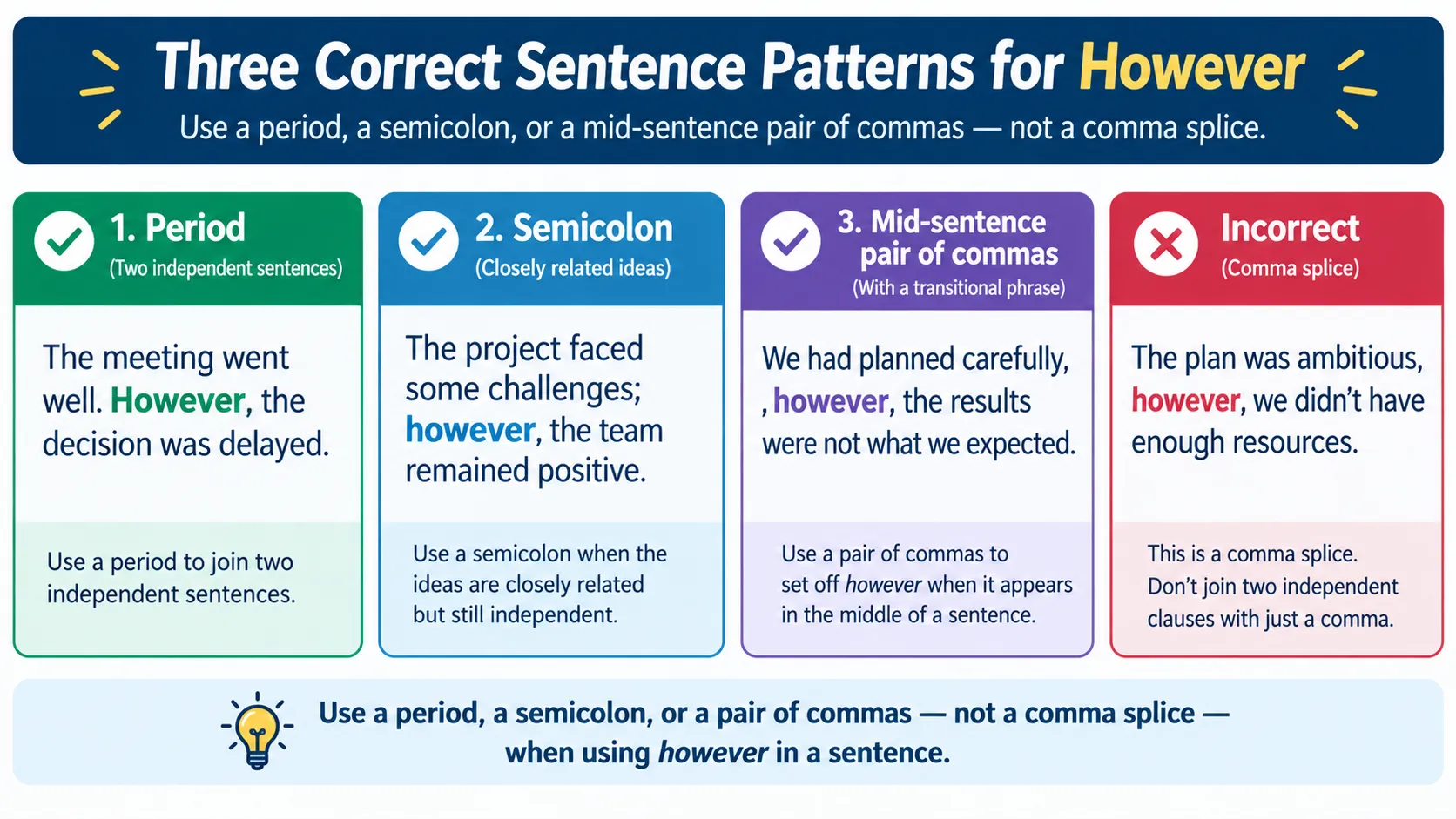
This is the part every synonym list leaves out, and it is where the swap most often goes wrong. However is a conjunctive adverb, not a conjunction. It cannot join two independent clauses with a comma.
The University of Toronto’s writing advice states the rule plainly: “Never try to join two sentences with a comma followed by a conjunctive adverb.” It gives both correct forms:
- I completed my essay. However, I have not submitted it.
- I completed my essay; however, I have not submitted it.
The same page lists however, nevertheless, furthermore, moreover, hence, therefore, similarly, by contrast, in other words and in addition as conjunctive adverbs that behave this way. So the punctuation rule you learn here transfers to most of the alternatives above, and it is exactly why swapping but for however is a rewrite rather than a swap. But is a coordinating conjunction and takes a comma before it; however takes a period or semicolon.
Merriam-Webster also carries a usage note on starting a sentence with however: some guides discourage it when the word means nonetheless, but the dictionary notes that many established writers do exactly that, and it advises letting your own judgement decide. In email, sentence-initial However, is safe and common.
One more placement worth knowing: however can sit inside the clause between two commas: The invoice, however, is missing a PO number. That version lands more gently than putting it first, because the contrast arrives after the subject rather than at the top of the sentence.
Softening bad news without sounding evasive
Most people searching for another word for however in an email are not solving a vocabulary problem. They are trying to say no, or to add a condition, without sounding cold. The word choice does some of that work, but placement and framing do more.
Positive-leaning alternatives
When you want the contrast to feel collaborative, that said and still are the two to reach for. Both acknowledge the previous sentence before qualifying it, which is why they read as warmer than however.
For example: Thanks for turning this around so quickly. That said, could you add the reference number before we file it? The request is identical to one introduced by However, but it does not open with a contrast.
When you need the contrast to land harder
Sometimes softening is the wrong goal. If a deadline has slipped twice, a warm connective undercuts you. Nevertheless and even so both signal that you have heard the explanation and are holding the line anyway.
For [a second missed deadline], use even so. Avoid that said, because its acknowledging tone reads as though you are conceding the point rather than restating the requirement.
When however is already the right word
Rare words are not automatically better, and neither are softer ones. Three situations where replacing however makes your email worse:
- The reader needs the contrast to be unmissable. However is the clearest contrast marker in professional English. Burying it behind that said can leave a condition looking optional.
- You are writing to a mixed or international audience. Though at the end of a sentence and that said are both idiomatic; however is the version every English-medium reader parses instantly.
- You have already used the alternative. Three that saids in one email is more distracting than one however. Variety for its own sake is not a goal.
The University of Toronto page makes a related point: conjunctive adverbs like however create “more formal, emphatic transitions” than coordinating conjunctions such as but. If emphasis is what your sentence needs, however is doing its job.
Words that are not replacements
These come up on synonym lists for however and cause real errors, because each one is a different grammatical animal. Word pairs that look interchangeable but behave differently in a sentence are a recurring trap in professional writing — impressive vs impressed is the same problem in a different word class.
| Word | Relationship | Why it is not a swap |
|---|---|---|
| but | Related Word | A coordinating conjunction. It joins clauses with a comma; however cannot. Swapping either way changes the punctuation |
| although / while | Related Word | Subordinating conjunctions. They open a dependent clause, as in Although the invoice arrived, the PO number is missing, so the sentence has to be restructured, not just relabelled |
| whereas | Related Word | Marks a direct contrast between two parallel facts, and reads as legal or academic in email |
| in contrast | Contextual Alternative | Needs two things genuinely being contrasted. It is a comparison marker, not a concession marker |
| regardless | Related Word | Dismisses the previous point rather than qualifying it. In email that shift in tone is usually not what you wanted |
FAQ
Is however too formal for an email?
No dictionary consulted here labels it formal. Merriam-Webster attaches no register label to however at all. It reads as neutral-to-professional in email; what makes it feel stiff is usually its position at the head of the sentence, not the word. Moving it between commas, as in The timeline, however, has slipped, softens it without changing a word.
What is the opposite of however?
However has no true antonym. It is a connective that marks contrast, and the nearest functional opposites are additive connectives such as furthermore, moreover and in addition, words that continue your point instead of qualifying it. Any list presenting those as antonyms is stretching the term.
Can I start an email sentence with However?
Yes. Merriam-Webster’s usage note records that some guides discourage it but that many established writers do it, and advises using your own judgement. Follow it with a comma.
What is a more positive way to say however?
That said and still. Both acknowledge what you have just written before you qualify it, which is what makes them read as more collaborative than an opening However,.
Where to go next
If you want to browse contrast connectives beyond the email context this page covers, the SynonymQ synonym tool takes any word and returns its alternatives. Treat what it gives you the same way you would treat a thesaurus entry: a list of candidates, not a list of drop-in replacements. Run anything it suggests through the substitution test above before you send the email.
How this page was checked
Senses, definitions and the phrase entry for that said were taken from Merriam-Webster on September 7, 2026. The punctuation rule and the conjunctive-adverb list come from the University of Toronto’s writing advice. Register placements are SynonymQ’s editorial judgement and are labelled as such in the page, because no dictionary consulted publishes formal or informal labels for these connectives. Related SynonymQ pages: given vs provided, actually vs really and another word for deployed on a resume.
