Impressive vs Impressed: 7 Stronger Words, 1 Simple Rule
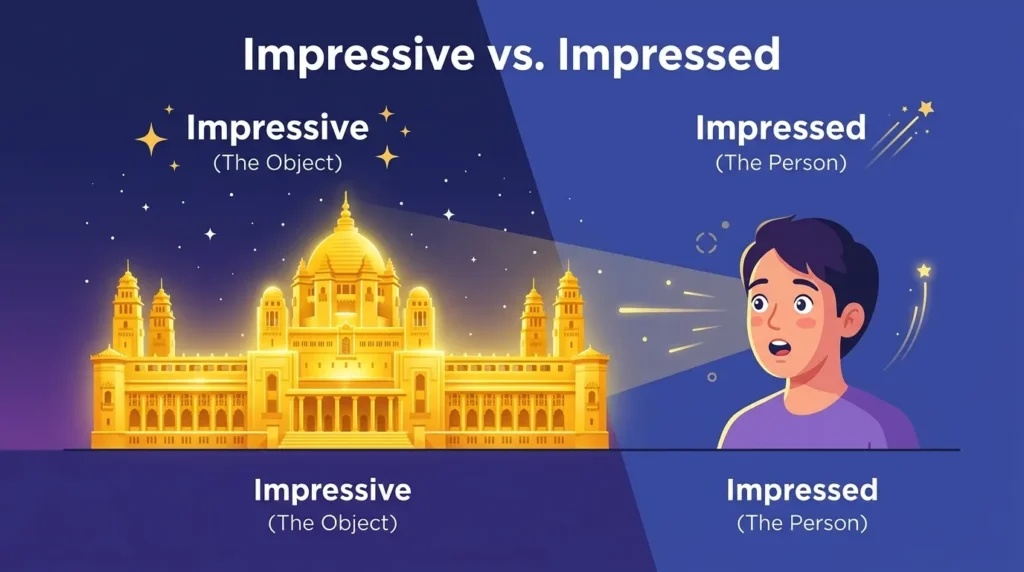
Impressive vs impressed comes down to one rule: impressive describes the thing, impressed describes you. The presentation was impressive; you were impressed by it. To replace very impressive, pick by object: outstanding for work, exceptional for talent, striking for a feature, staggering for a number, formidable for a rival.
The One Rule: -ive Describes the Thing, -ed Describes You
Merriam-Webster defines impressive as “making or tending to make a marked impression: having the power to excite attention, awe, or admiration.” Read the phrase having the power closely: the power belongs to the object. A building has it. A set of results has it. You do not.
Oxford Learner’s Dictionaries defines impressed as “admiring somebody/something because you think they are particularly good, interesting, etc.,” and classes it as an adjective at CEFR level B2. That word sits with the person doing the admiring.
Neither dictionary states the contrast as a rule. Their two definitions build it:
Impressive describes the thing being looked at. Impressed describes the person looking. A résumé can be impressive; only a reader can be impressed.
Impressive or Impressed in Real Sentences
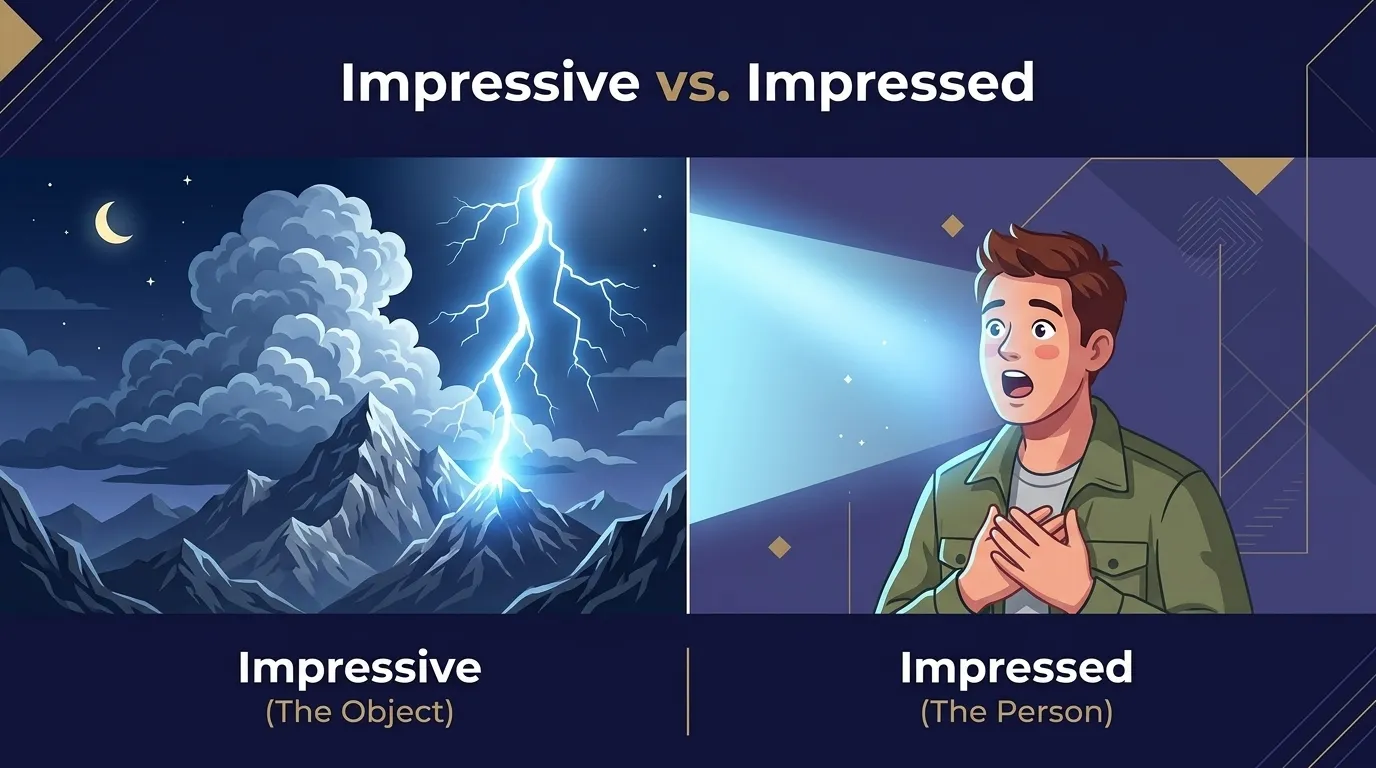
The four mistakes that pass a spell-checker
| Wrong | Right | Why |
|---|---|---|
| I was very impressive by your work. | I was very impressed by your work. | You are the one admiring, so you take the -ed form. |
| Your presentation was impressed. | Your presentation was impressive. | The presentation holds the power to impress. |
| The team’s numbers are impressed. | The team’s numbers are impressive. | Numbers cannot admire anything. |
| She looked impressive when she read the report. | She looked impressed when she read the report. | Both are grammatical, but they mean opposite things. Only the second says she liked it. |
That last pair is the one worth memorising, because both versions clear a spell-checker and only one says what most writers mean. She looked impressive is a comment on how she appeared to others. She looked impressed is a comment on what she thought of the report.
The unrelated impressed you can ignore
There is a second, entirely separate impressed. Merriam-Webster’s entry for the verb impress also carries the sense “to apply with pressure so as to imprint,” which is why an impressed pattern in the clay is correct English with no admiration in it at all. The same entry traces the word to Latin imprimere, “to press into,” first recorded in English in the 14th century. Context separates the two senses cleanly, so this almost never causes trouble in practice.

7 Stronger Words for “Very Impressive” (and What Each Claims)
Very impressive is not wrong. It is vague: it reports that you were affected without saying what did the affecting. A single adjective chosen for the object says more in less space. Below, each word is grouped by the noun it actually takes, with its substitution label.
For work, results and performance
Outstanding is the default. Oxford’s first sense is simply “excellent,” with player, achievement, success and natural beauty among the nouns it takes. Direct Swap: the quarter was very impressive becomes the quarter was outstanding with no other change.
For talent and quality
Exceptional means “unusually good,” and Oxford gives outstanding as its own synonym for that sense at level B2. It suits talent, quality and a standard of work. Direct Swap, with one caution covered in the warnings section below.
Remarkable shifts the claim slightly. Oxford defines it at C1 as “unusual or surprising in a way that causes people to take notice,” and pairs it with achievement, career, talent, discovery and speed. Direct Swap, but it claims the thing was noticed, not that it was good.
For numbers and scale
Staggering is the one to reach for when the subject is a figure. Oxford defines it as “so great, shocking or surprising that it is difficult to believe,” illustrating it with they paid a staggering £5 million for the house and the exhibition cost a staggering $30 million. Direct Swap in casual and journalistic writing, with a register caution below.
For things you can actually see
Imposing is the trap in this group. Oxford defines it as “impressive to look at,” at level B1, and lists building, figure and presence as its nouns. The eye is inside the definition. Requires Rewrite for anything you cannot see, because an imposing vocabulary asks a reader to look at something they can only read.
Striking is the safer visual choice, defined by Oxford at C1 as “interesting and unusual enough to attract attention,” with feature, resemblance, contrast and good looks among its collocations. Swap With Adjustment: it moves the claim from good to noticeable, which is a different compliment.
For rivals, obstacles and credentials
Formidable describes something that inspires fear or respect, and Oxford lists opponent, obstacles, qualifications, combination and task as its nouns. Swap With Adjustment: the tone shift is real, and the warnings section explains why.
| Word | What it actually claims | Best object | Substitution |
|---|---|---|---|
| Outstanding | Excellent in quality | Work, performance, achievement, results | Direct Swap |
| Exceptional | Unusually good | Talent, quality, standard of work | Direct Swap |
| Remarkable | Unusual enough that people take notice | An achievement, a career, a discovery, speed | Direct Swap |
| Striking | Attracts attention; stands out by contrast | A feature, a resemblance, a contrast, an example | Swap With Adjustment |
| Staggering | So great it is hard to believe | A sum, a number, a scale, a response | Direct Swap in casual writing |
| Formidable | Inspires fear or respect | An opponent, an obstacle, a list of qualifications | Swap With Adjustment |
| Imposing | Impressive to look at | A building, a figure, a physical presence | Requires Rewrite if unseen |
Every object list above comes from the collocation boxes on Oxford Learner’s entries for remarkable, striking, formidable, imposing, exceptional and staggering.

Which Words Take “Very” and Which Refuse It
Here is a pattern the dictionaries do not state but their data reveals. Oxford prints a collocation box on each entry listing the adverbs that word actually appears with. Set them side by side:
| Word | Adverbs Oxford lists | Does very appear? |
|---|---|---|
| Striking | extremely, fairly, very | Yes |
| Formidable | extremely, fairly, very | Yes |
| Exceptional | highly, pretty, really | No |
| Staggering | absolutely, quite, simply | No |
| Breathtaking | absolutely, quite, simply | No |
| Remarkable | absolutely, just, most | No |
| Amazing | absolutely, pretty, rather | No |
The reading is ours rather than Oxford’s, and the boxes report what is attested rather than what is forbidden. But the split is consistent enough to use: words that already contain their own maximum take absolute intensifiers such as absolutely, quite and simply, while words that describe a scale take degree intensifiers like very.
So very striking is well attested, and very staggering fights the word it is trying to strengthen. If you find yourself writing very in front of one of the bottom five, the very is doing nothing. Delete it.

Formal, Neutral or Casual: Placing the Seven
Only one of the seven carries an explicit register label, and it is the one writers most often misplace.
| Register | Words | Evidence |
|---|---|---|
| Safe in formal writing | outstanding, exceptional, remarkable, striking, formidable, imposing | No register label on any Oxford entry |
| Rather informal | staggering | Oxford’s own label, printed on the entry |
| Informal in its praise sense | amazing | Oxford marks the “excellent” sense informal |
A performance review, a grant application or a client report is not the place for staggering, however accurate the figure. Substantial or exceptional carries the same weight and keeps the register. For a headline, a newsletter or a message to a teammate, staggering is the better word precisely because it is informal.
Closely related words drift apart in feeling as well as formality, the same effect we traced across grief, sorrow and sadness, where three near-neighbours carry three different weights. Praise words behave the same way. If you are writing about someone’s growth or contribution at work, synonyms for empowered covers the neighbouring register problem.

Saying You Were Impressed: By, With, At or That
The five patterns
The word most people actually need for a compliment is impressed, and it takes five patterns. All five, and the examples below, come from Oxford Learner’s entry:
- impressed by somebody or something: We were all impressed by her enthusiasm.
- impressed with something: She was suitably impressed with the painting.
- impressed at something: He was impressed at the way the team had played.
- impressed that…: I was impressed that she remembered my name.
- impressed to see, hear or find: We were impressed to see how well they’d done already.
By and with are close enough to swap in most sentences. At wants a manner or a way of doing something, which is why impressed at the way the team had played reads better than impressed at the team. The that and to patterns take a whole clause, which makes them the most specific of the five: they name the exact thing that impressed you.
Is “highly impressed” correct?
One honest note. Oxford illustrates the word with particularly impressed and suitably impressed, and does not show highly. That is not a ban, and highly impressed is understandable and common in speech. But if you want a stronger form in writing, particularly impressed and deeply impressed are the shapes the dictionary actually models.

Words That Sound Like Praise but Carry a Warning
Formidable means fear as well as respect
Oxford defines formidable as inspiring fear or respect, and traces it to Latin formidare, “to fear.” Written about a rival, a challenge or a set of credentials it works well: a formidable opponent, formidable obstacles, a formidable list of qualifications. Written about a colleague you like, it can land as a warning rather than a compliment.
Exceptional has a second life
Oxford’s second sense of exceptional is simply rare, which is why this deadline will be extended only in exceptional circumstances promises nothing good at all. The praise reading needs a clearly positive object beside it. Exceptional talent is unambiguous, exceptional situation is not.
Outstanding does too
Outstanding also describes a debt nobody has paid, and that ambiguity matters most on a job application. We covered the trap in full on another word for remarkable on a resume, so the short version here is this: on a résumé line that already mentions budgets, invoices or unfinished work, pick a different adjective.
Is “Amazing” the Same as “Very Impressive”?
Close, but not interchangeable. Oxford gives amazing two senses at level C1: “very surprising, especially in a way that you like or admire,” and a second, marked informal, glossed word for word as “very impressive.”
That informal label is the whole answer. Amazing carries enthusiasm; impressive carries assessment. A manager writing your Q3 numbers were amazing sounds delighted. Writing your Q3 numbers were impressive sounds like a judgement, which is usually what a performance document needs.
Five synonyms of amazing that hold up in writing
Merriam-Webster’s thesaurus entry defines amazing as “causing a strong emotional reaction because of unexpectedness” and lists surprising, stunning, startling, wonderful, shocking, incredible, astonishing and awesome. Five that survive into formal prose: astonishing, incredible, stunning, extraordinary and remarkable.
Note what they share: every one of them claims unexpectedness. That is the difference between the two word families. Amazing and its synonyms say you did not see it coming. Impressive and its synonyms say the thing was good. A result can easily be one without being the other.
Before and After: Three Rewrites
| Before | After | What changed |
|---|---|---|
| Your presentation was very impressive and I was very impressed by the data. | Your presentation was outstanding, and the data was the strongest part. | Two vague intensifiers become one specific claim and one named reason. |
| The company reported very impressive growth of 340% this year. | The company reported staggering growth of 340% this year. | The object is a figure, so the number word fits, in a newsletter. In the annual report, use substantial. |
| She has a very impressive vocabulary and an imposing command of the subject. | She has an exceptional vocabulary and a formidable command of the subject. | Imposing needed something visible; formidable fits a command of a subject, and here the respect reading is the intended one. |
None of these rewrites is longer than the original. Precision usually costs fewer words than vagueness, not more. If you are reworking a longer passage rather than a sentence, our paraphrasing tool handles the structural part; the word choice is what this page is for.
When “Very Impressive” Is Still the Right Choice
Merriam-Webster’s own example sentence for the word is “Her first performance was very impressive.” The phrase is ordinary, correct English, and swapping it out is a style decision rather than a correction.
Keep it when the object is mixed or unnamed, since the whole quarter was very impressive covers results, hiring and delivery at once, where any single adjective would pick one and drop the rest. Keep it when you are quoting speech, because people say it. And keep it when a stronger word would overclaim: calling a solid, competent piece of work outstanding spends a word you will want later.
A rarer synonym is not automatically a better one. The seven words above earn their place by being more specific than very impressive, not by being less common. If none of them fits your object, the plain phrase is doing its job. Our synonym tool is useful for widening a shortlist; the object test on this page is what narrows it back down.
If you are on the receiving end of this kind of praise, the reply has its own traps, and we looked at the most common one in is “I’m humbled” correct.
Frequently Asked Questions
What are 5 synonyms of amazing? Astonishing, incredible, stunning, extraordinary and remarkable. Merriam-Webster’s thesaurus defines amazing as “causing a strong emotional reaction because of unexpectedness,” which is what all five share. Oxford marks the “excellent” sense of amazing as informal, so in formal writing one of the five above is usually the safer choice.
Is “very impressive” bad English? No. Merriam-Webster uses the exact phrase in its own example sentence for impressive. It is vague rather than incorrect, and a more specific adjective usually says more in the same space.
Can a person be impressive? Yes. Merriam-Webster’s examples include He has an impressive manner. The rule is about role, not about people versus objects: a person is impressive when others are admiring them, and impressed when they are the one admiring.
Is “highly impressed” correct? It is understandable and widely used in speech. Oxford’s own examples reach for particularly impressed and suitably impressed instead, so those are safer choices in formal writing.
What is the strongest word for very impressive? It depends on the object, which is why this page groups the seven by noun rather than ranking them. For work and results, outstanding. For a figure, staggering. For a rival or a challenge, formidable. A single strongest word does not exist, and any list claiming one is ignoring what the word has to describe.
How This Page Was Checked
Definitions, register labels, CEFR levels, example sentences and collocation boxes were read from the live dictionary entries on 31 August 2026: Merriam-Webster for impressive, impressed and amazing; Oxford Learner’s Dictionaries for impressed, remarkable, exceptional, striking, staggering, formidable, imposing, breathtaking and amazing.
Two entries could not be read: Oxford Learner’s page for impressive and Cambridge’s entry for impressive both returned a 403 error on the day of writing. Nothing here is claimed from either, which is why the definition of impressive is attributed to Merriam-Webster alone and no pronunciation guidance appears on this page.
The very collocation pattern is our reading of Oxford’s collocation boxes, not a rule Oxford states, and it is marked as such where it appears. More on how these pages are researched is on our about page.

Naveed Akhtar writes every guide on SynonymQ. He is an SEO content writer with ten years of article-writing experience, working on the question a thesaurus never answers: which of these words belongs in this sentence, for this reader. Every page cites the dictionary entries it draws on and the date they were read.