
Systemic vs Systematic: The Overlap the Rule Misses
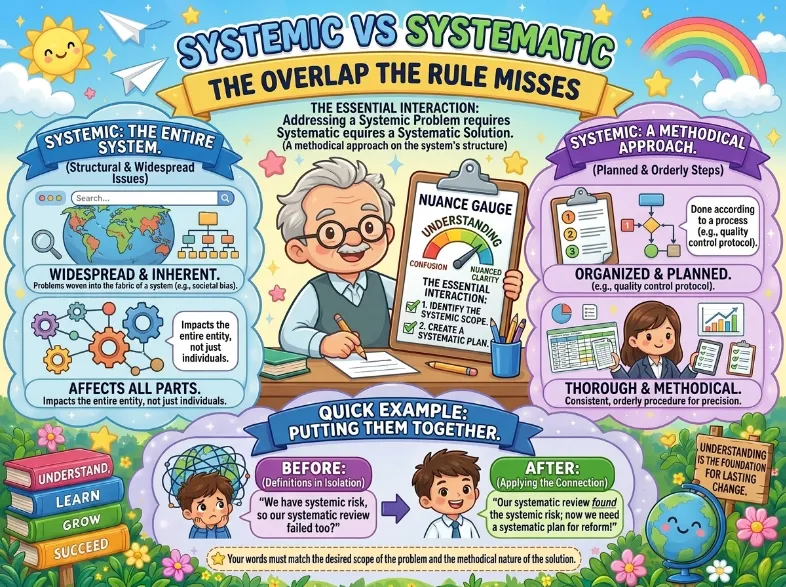
On systemic vs systematic, the usual rule holds: systematic means done by a method, systemic means present throughout a whole system. It still leaves people hesitating, because Merriam-Webster glosses both words as relating to a system at sense one.
By Naveed Akhtar, an SEO content writer with 10 years of article-writing experience · Updated 15 September 2026 · About 8 minutes
Systemic vs Systematic: The Rule, and the Line It Does Not Cover
Every guide gives the same rule, and the rule is correct. Systematic is about method. Systemic is about extent.
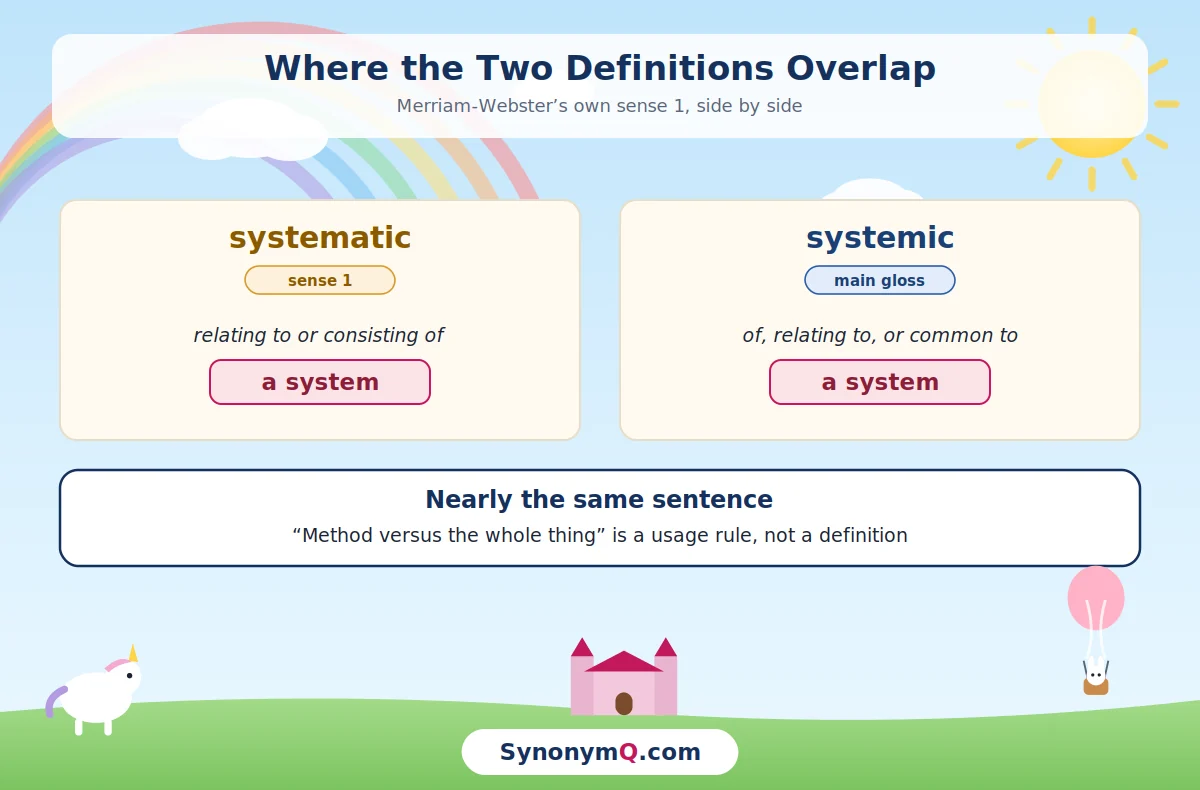
So why does anyone still hesitate? Because the dictionaries do not draw the line where the rule does. Put the two entries side by side and sense one is almost identical.
systematic, sense 1: “relating to or consisting of a system.”
systemic, main gloss: “of, relating to, or common to a system.”
Merriam-WebsterBoth words genuinely mean “to do with a system”. The method-versus-extent split is a rule about how the words are used, not a difference the definitions themselves enforce.
Which is why the rule alone does not settle hard cases. You need something the definitions do enforce. There are three such things, and the rest of this page is those three.Read the Order the Senses Come In
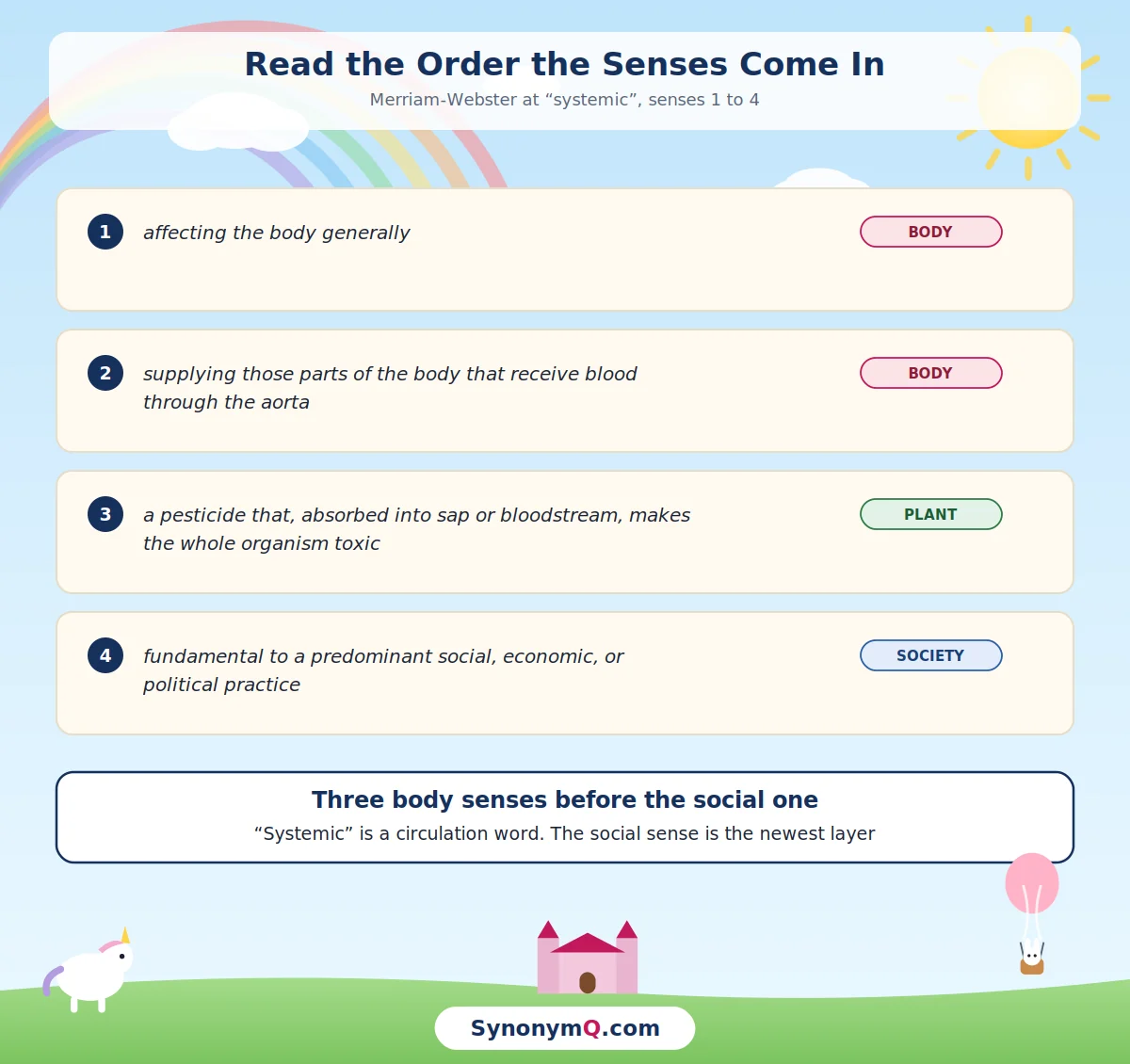
Dictionaries order senses deliberately. Merriam-Webster’s four senses of systemic are worth reading in sequence, because three of them are not about society at all.
| # | Sense | Domain |
|---|---|---|
| 1 | “affecting the body generally” | Body |
| 2 | “supplying those parts of the body that receive blood through the aorta rather than through the pulmonary artery” | Body |
| 3 | A pesticide that, absorbed into sap or bloodstream, “makes the entire organism toxic to pests” | Plant |
| 4 | “fundamental to a predominant social, economic, or political practice” | Society |
Oxford agrees and adds a label. Its entry marks systemic as specialist, and its second sense is entirely about drugs and chemicals spreading through a plant or animal.
Systemic is a circulation word. Its home senses describe something absorbed into a body and carried everywhere, reaching tissue that was never the target.
That is the metaphor, and it is doing real work. When the word is applied to an organisation, it imports the claim that something has spread through the whole structure by circulation rather than by design.Why “Systemic” Carries More Weight
The circulation sense explains a difference in force that the method-versus-extent rule does not.
Systematic attributes a method, so it implies someone chose it. Systemic attributes a distribution, so it implies no one needs to have chosen anything.
Claims a method, and therefore intentSystematic exclusion from the hiring shortlist. Claims distribution, and no intent is requiredSystemic exclusion from the hiring shortlist.Those two sentences accuse different things. The first says someone ran a process. The second says the outcome is produced by the structure whether or not anyone intends it.
This is a claim about the words, not about any particular case. The dictionary tells you what each term asserts. Whether the assertion is true of a given organisation is a factual question the dictionary cannot answer, and this page does not try to.It also explains why the two are rarely interchangeable in careful writing even when both sound plausible. Swapping them changes what you are alleging, not how formally you are saying it.
One Word Has a Working Adverb. The Other Has a Medical One.
This is the test that resolves most real sentences, and it takes about five seconds.
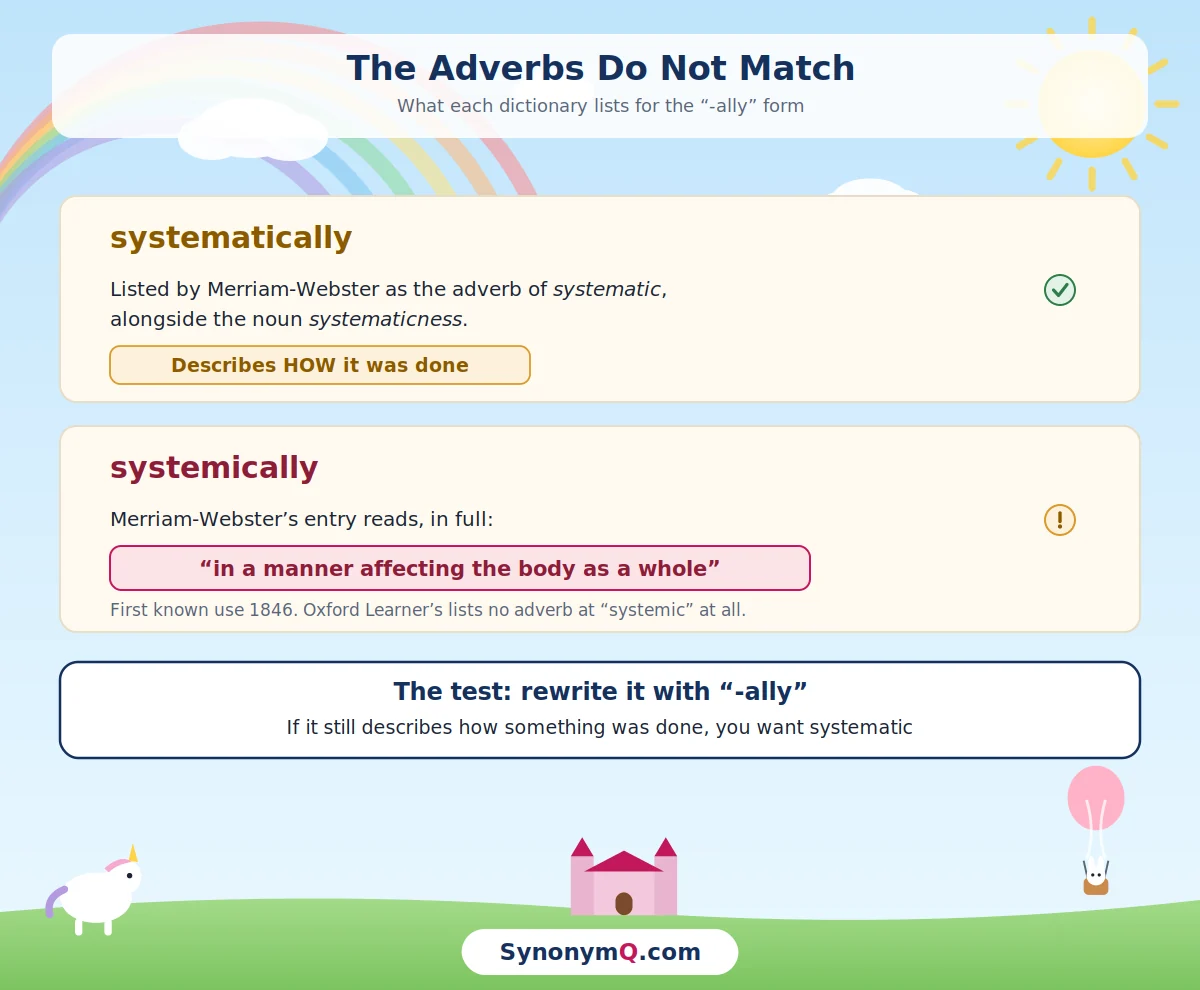
Merriam-Webster lists systematically as the adverb of systematic, alongside the noun systematicness. That adverb is ordinary and it describes how something was done.
Now look at the other one. Merriam-Webster’s entry for systemically reads, in full: “in a manner affecting the body as a whole.” First known use 1846.
Oxford Learner’s goes further and lists no adverb at systemic at all. The general-purpose adverb English writers reach for is barely documented as one.
The test. Rewrite your sentence with the -ally form. If it still makes sense as a description of how something was done, you want systematic. If it does not, you want systemic.“The records were reviewed systematically” works, so the adjective is systematic. “The problem is systemically embedded” is not describing a method, so the adjective is systemic.
Testing a pair by what the grammar allows rather than by what sounds right is the same method that separates impressive and impressed.
They Were Coined 137 Years Apart
These two are not a matched pair that drifted apart. They arrived a long way from each other, for different jobs.
| Word | First known use | What that tells you |
|---|---|---|
| systematic | 1666 | The older word by well over a century |
| systemic, adjective | 1803 | Coined for anatomy, not for argument |
| systemically, adverb | 1846 | Still medical: “affecting the body as a whole” |
| systemic, noun | 1951 | Means a systemic pesticide |
Read down that column. The word spends a century and a half inside medicine and agriculture before it becomes a common term in social writing.
That is why it still feels like a technical borrowing, and why Oxford keeps the specialist label on it.
Sorting Your Own Sentence
Three tests, applied in order. Most sentences resolve on the first one.
| Ask | If yes | Why | Label |
|---|---|---|---|
| Does the -ally form still describe how it was done? | systematic | Only that adverb carries manner | Decides most cases |
| Are you describing where a problem lives rather than how it is carried out? | systemic | Extent, not method | Decides most cases |
| Would the sentence survive if no one intended the outcome? | systemic | Distribution needs no agent | Decides the hard ones |
| Is it a named institution doing it under its own rules? | institutional | See the next section | Neither word |
| Do you just mean “of a system”, plainly? | Rewrite | This is the overlap zone. Name the system instead | Requires Rewrite |
The last row is the honest one. When you land in the sense-one overlap, neither word is wrong and neither is informative, so the fix is to say which system you mean.
Choosing between two words that a dictionary partly equates is the same problem as given versus provided.
The Pairings That Are Already Fixed
Some combinations are settled by convention rather than by the rule, and reaching for the other word in those slots reads as an error even when the logic would allow it.
| Fixed phrase | Does -ally describe a method? | Why it settled that way |
|---|---|---|
| systematic review | Yes. Reviewed systematically | Names a defined procedure, so the method reading is the point |
| systematic approach | Yes. Approached systematically | Approach is a method word already |
| systemic barriers · systemic inequality | No | Describes where the problem sits, not how it is produced |
| systemic risk | No | Finance term. Risk to the whole system, not a method of risking |
| systemic change | Ambiguous, and worth a pause | Change to the whole system, or change carried out methodically? These are different projects |
That last row is the one to watch. Systemic change and systematic change both parse, and a reader cannot tell which you meant, so name the system or name the method.
Where “Institutional” Fits
There is a third word in this family, and it is often the one people actually need. Writer’s Digest treats all three together.
“Systemic is a part of the actual system (or body), systematic is the implementation of the system, and institutional is tied to an actual institution.”
Writer’s Digest, on systemic, systematic and institutionalInstitutional is the most specific of the three, because it names a body that can be identified: a university, a company, a league, a court.
If you can point at the institution and quote its rules, institutional is more precise and more defensible than either alternative. It also puts a named subject behind the claim.
Precision usually comes from narrowing, which is also what separates near neighbours like hate, dislike and loathe.
Frequently Asked Questions
Is it systemic racism or systematic racism?
They assert different things. Systemic claims the outcome is distributed through the structure. Systematic claims a method was followed, which implies intent. Most writers mean the first.
Can systemic and systematic ever be swapped?
Only in the narrow sense-one overlap, where both mean “of a system”. There the swap is harmless and both words are vague, so naming the system is better than either.
Is systemically a real word?
Yes, but narrower than most people assume. Merriam-Webster’s full entry is “in a manner affecting the body as a whole”, dated 1846, and Oxford Learner’s lists no adverb at systemic.
Which word is older?
Systematic, by 137 years. Merriam-Webster dates it to 1666 and systemic to 1803, when it was an anatomical term.
What is the quickest way to choose?
Rewrite the sentence with the -ally form. If it still describes how something was done, use systematic. The same kind of grammar check settles actually versus really.
How This Page Was Checked
Read from the sources attributed, on 15 September 2026:
- All four senses of systemic, the noun sense, the usage comparison and the 1803 and 1951 dates — Merriam-Webster.
- The senses of systematic, its listed forms systematically and systematicness, and the 1666 date — Merriam-Webster.
- The full entry for systemically and its 1846 date — Merriam-Webster.
- The specialist label, the two senses and the absence of an adverb — Oxford Learner’s Dictionaries.
- The three-way comparison including institutional — Writer’s Digest.
What could not be checked. Oxford’s entry for systematic and both Cambridge entries returned errors on the day of writing, so the British side of systematic is unverified here. Nothing on this page rests on it.
One argument is reasoning rather than a retrieved fact, and it is labelled where it appears: that the difference in force between the two words follows from the circulation senses.
No claim is made about whether any particular institution or outcome is systemic. That is a factual question about the world, not about the word. A related question about words that assert a version of events is covered at reality, truth and fact.
Written by Naveed Akhtar, an SEO content writer with 10 years of article-writing experience.
Target topic: choosing between systemic, systematic and institutional when the word changes the claim

Naveed Akhtar writes every guide on SynonymQ. He is an SEO content writer with ten years of article-writing experience, working on the question a thesaurus never answers: which of these words belongs in this sentence, for this reader. Every page cites the dictionary entries it draws on and the date they were read.