
Another Word for Ability on a Resume (Most Need a Rewrite)

Another word for ability on a resume has to be a noun, and most suggestions are not. The closest are capability, capacity, competence, proficiency, expertise, aptitude and command, but only capability keeps the “to do something” pattern. The rest change the preposition, and ability itself claims what you could do rather than what you have done.
What a Recruiter Hears in “Ability To”
Oxford Learner’s Dictionaries gives the pattern for ability as ability to do something. That infinitive is the whole problem. An infinitive names an action that has not happened yet, so the grammar of the word points forward in time no matter what you attach to it.
Compare two lines that describe the same person:
The second is not better because it uses stronger vocabulary. It is better because it is in the past tense. A hiring manager moving quickly through a stack reads the first as a hope and the second as a record. No amount of synonym-swapping moves a line from one column to the other.
This matters before any word list does, because most advice on this question skips it. Replace ability with capability and you still have a forward-facing claim, and a slightly heavier one.
Worth noting what the problem is not. Oxford marks ability at CEFR level A2, which puts it among the first couple of thousand words an English learner meets. It is a plain word, and plainness is a virtue on a resume. Vagueness is the defect, and a longer word does not fix it.
The Part-of-Speech Problem Nobody Mentions
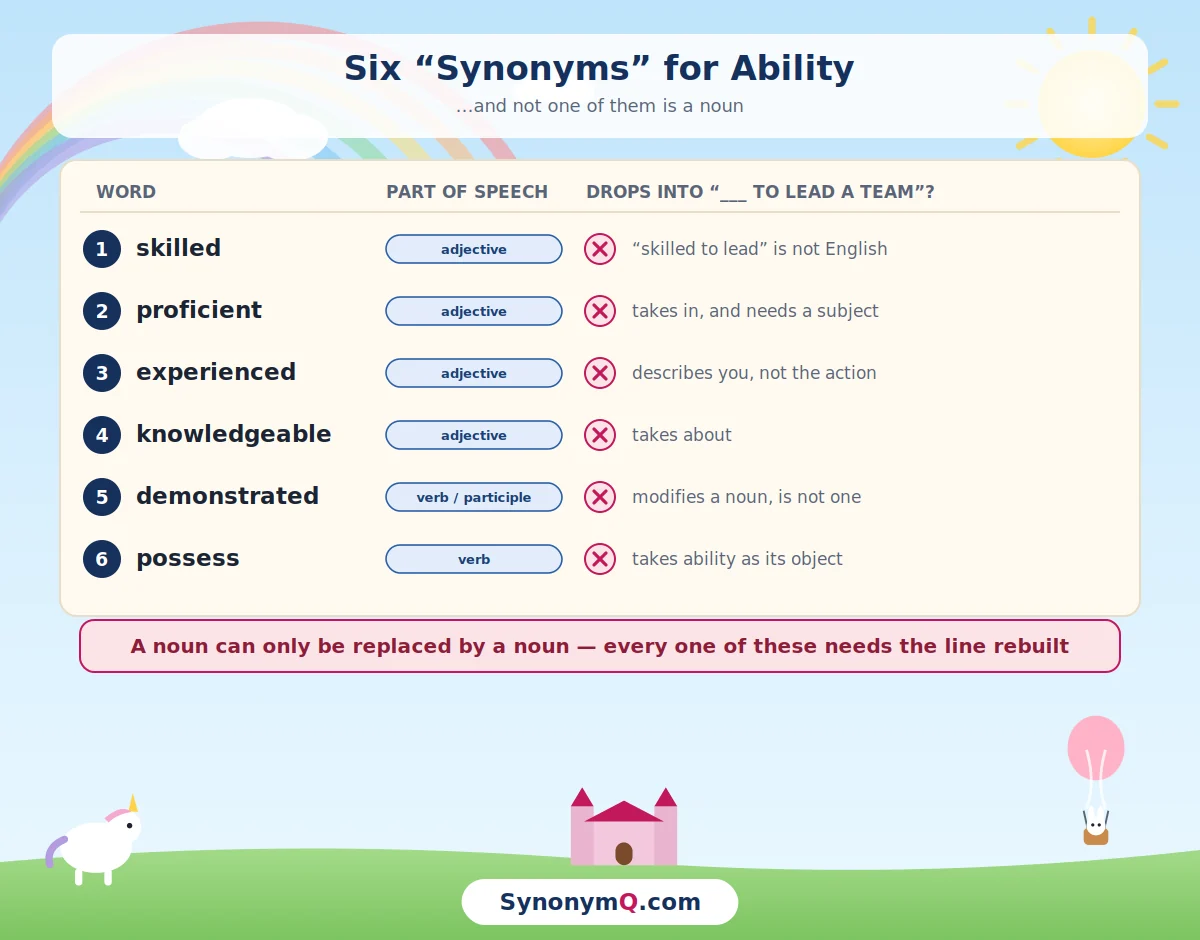
Read the pages currently ranking for this question and you will collect a list something like this: possess, skilled, experienced, proficient, knowledgeable, demonstrated. Between them the top results offer a couple of dozen more.
Ability is a noun. Of those six, four are adjectives and two are verbs. Not one of them is a noun, which means not one of them can be dropped into “ability to lead a team” without the sentence coming apart.
| Suggested word | Part of speech | Drops into “___ to lead a team”? | Label |
|---|---|---|---|
| skilled | adjective | No. “Skilled to lead” is not English | Requires Rewrite |
| proficient | adjective | No. Takes in, and needs a subject | Requires Rewrite |
| experienced | adjective | No | Requires Rewrite |
| knowledgeable | adjective | No. Takes about | Requires Rewrite |
| demonstrated | verb / participle | No. Modifies a noun, it is not one | Requires Rewrite |
| possess | verb | No. It takes ability as its object | Requires Rewrite |
One of the ranking pages shows the correct fix and never names it. It rewrites “ability to lead a team to exceed sales targets” as “proficiency in guiding a team to surpass sales targets”, and two separate things changed there. The word class moved from adjective to noun (proficient became proficiency), and the preposition moved from to to in.
A reader who takes the headline list at face value and does not notice either change writes proficient to lead a team, which is worse than the sentence they started with.
The Nouns That Can Stand In for Ability
Seven nouns do the job. Each claims something slightly different, and the differences are not decorative. Two of them can misrepresent you.
| Word | What the dictionary says it means | What it claims about you |
|---|---|---|
| capability | “the ability or qualities necessary to do something” | Almost exactly what ability claims, in a heavier register |
| capacity | “the ability to understand or to do something” | Room or headroom to do it, often potential rather than practice |
| competence | “the ability to do something well” | You clear the bar. Adequacy, not distinction |
| proficiency | “the ability to do something well because of training and practice” | You were trained, and you practised. Strongest resume claim of the seven |
| expertise | “expert knowledge or skill in a particular subject, activity or job” | You are an expert. Highest claim, and the easiest to over-reach with |
| aptitude | “natural ability or skill at doing something” | That it came naturally. Talent, not work |
| command | “your knowledge of something; your ability to do or use something, especially a language” | Mastery of a subject or a language, not of an action |
The two that can work against you
Aptitude claims you were born with it. Oxford’s definition is “natural ability”, and on a resume that quietly undercuts the case you are trying to make. “Aptitude for financial modelling” says the modelling comes easily to you. “Proficiency in financial modelling” says you learned it and did it. For a document whose purpose is evidence of work, the second claim is stronger and the first is a strange thing to volunteer.
Capacity carries luggage. Oxford lists five senses for it, and the resume-relevant one competes with the size-of-a-container sense and with in your capacity as something, meaning an official role. Written into a skills section, “capacity for project delivery” can read for a beat as a job title or as a workload measure before it resolves.
Each Replacement Brings Its Own Preposition
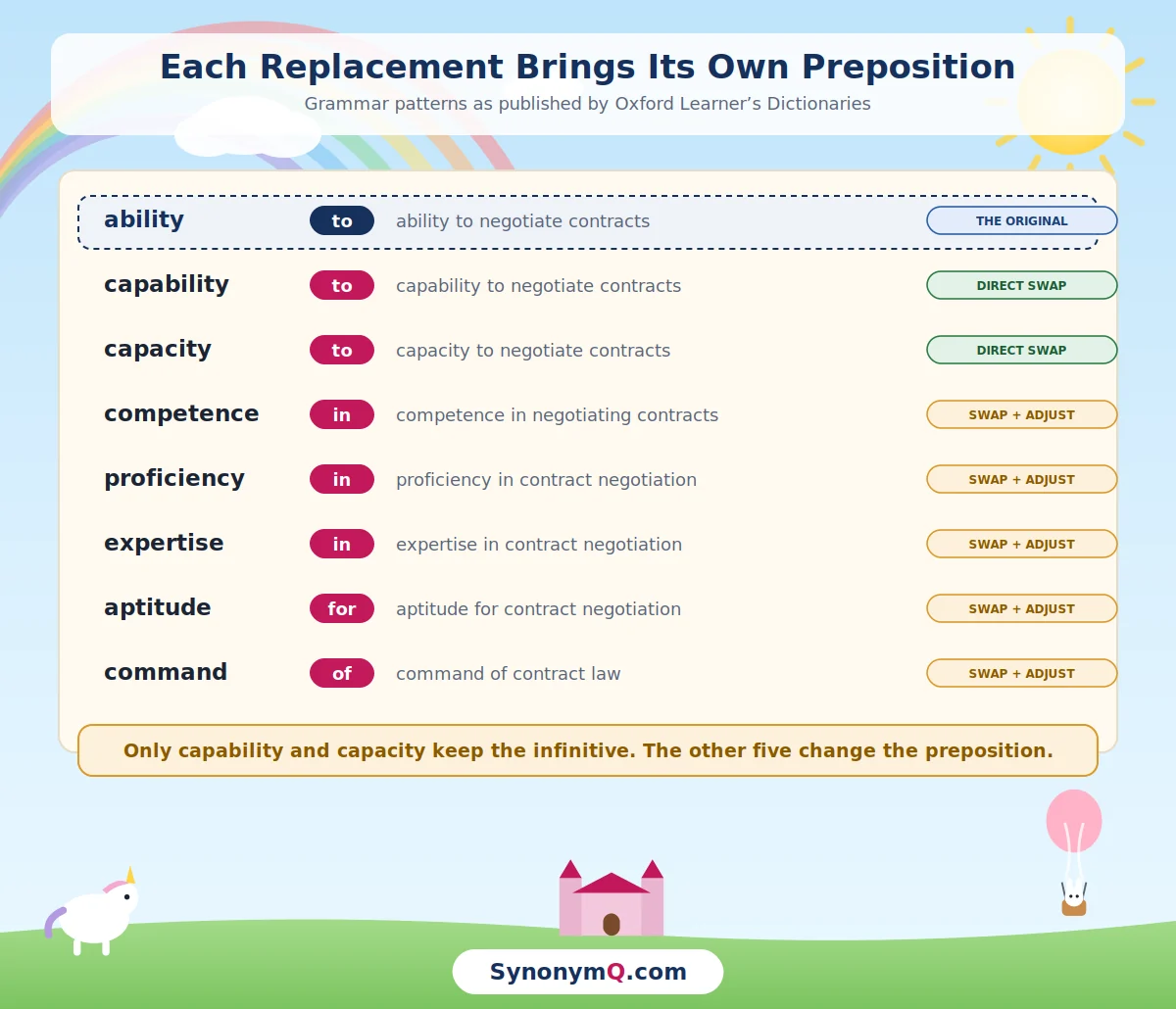
This is where most resume edits break. The seven nouns do not share a grammar pattern, so swapping the word without swapping the preposition leaves a line that reads as a typo.
| Word | Pattern the dictionary gives | Written out | Substitution label |
|---|---|---|---|
| ability | ability to do something | ability to negotiate contracts | the original |
| capability | capability to do somethingcapability of doing something | capability to negotiate contracts | Direct Swap |
| capacity | capacity to do somethingcapacity for something | capacity to negotiate contracts | Direct Swap |
| competence | competence in somethingcompetence in doing something | competence in negotiating contracts | Swap With Adjustment |
| proficiency | proficiency in something / in doing something | proficiency in contract negotiation | Swap With Adjustment |
| expertise | expertise in something / in doing something | expertise in contract negotiation | Swap With Adjustment |
| aptitude | aptitude for something / for doing something | aptitude for contract negotiation | Swap With Adjustment |
| command | command of something | command of contract law | Swap With Adjustment |
Two of the seven, capability and capacity, keep the infinitive and can be swapped in place. The other five change the preposition, and three of them also want the verb turned into a noun or a gerund: negotiate becomes negotiating or negotiation.
That is the difference between a swap and an adjustment, and it is why a flat list of synonyms is not enough to edit a resume with. If you want to check whether a rewritten line still scans, paste it into the word counter and read it aloud once.
Adjectives and Verbs: What the Line Has to Become
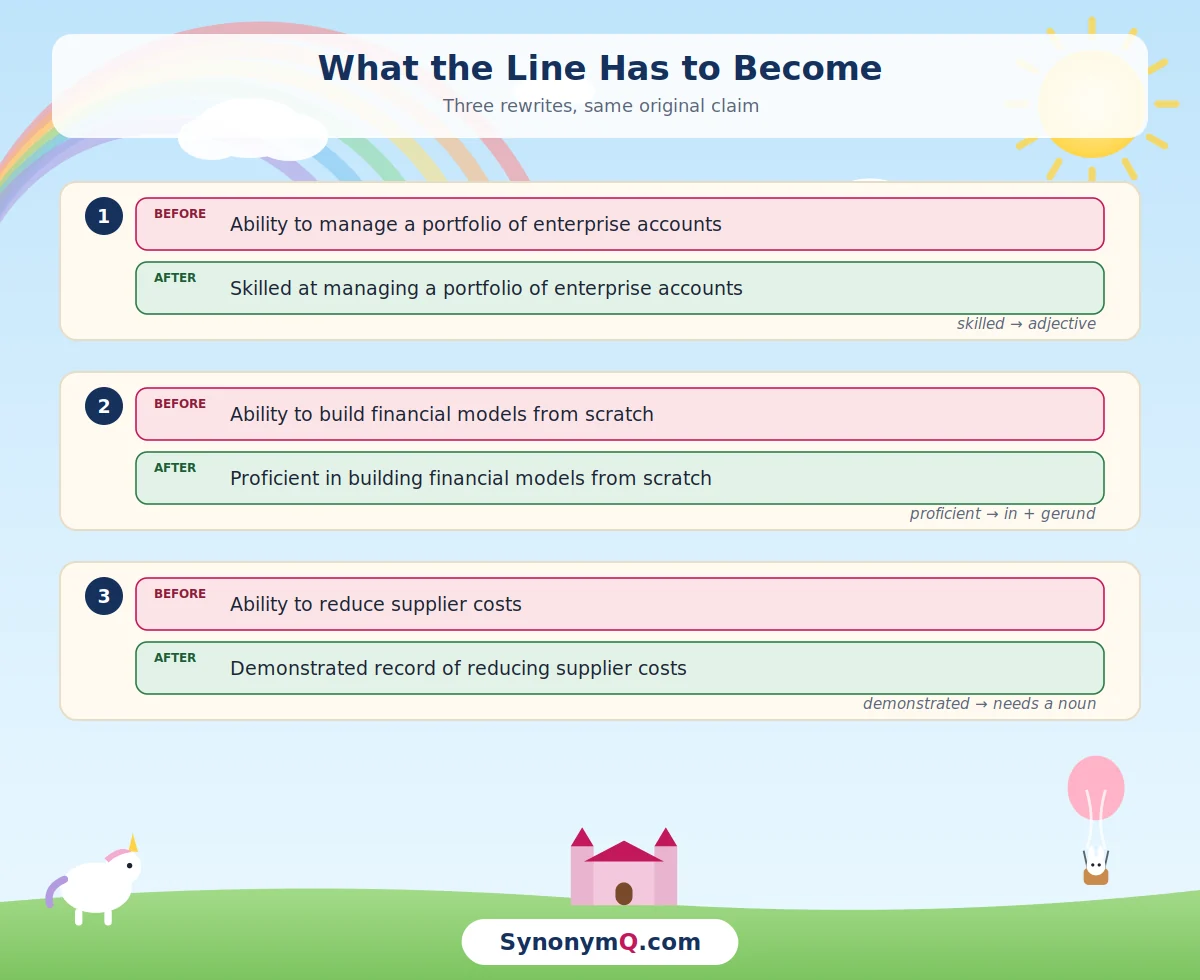
The adjectives are not bad words. They are simply a different sentence, and usually a shorter one. Here is what each rebuild looks like against the same original.
The third rewrite is instructive. Demonstrated cannot stand alone as a replacement because it is a participle, so the sentence recruits a noun for it to attach to: record, track record, history. That is three words of scaffolding to avoid one plain noun.
Another Word for Ability on a Resume, Section by Section
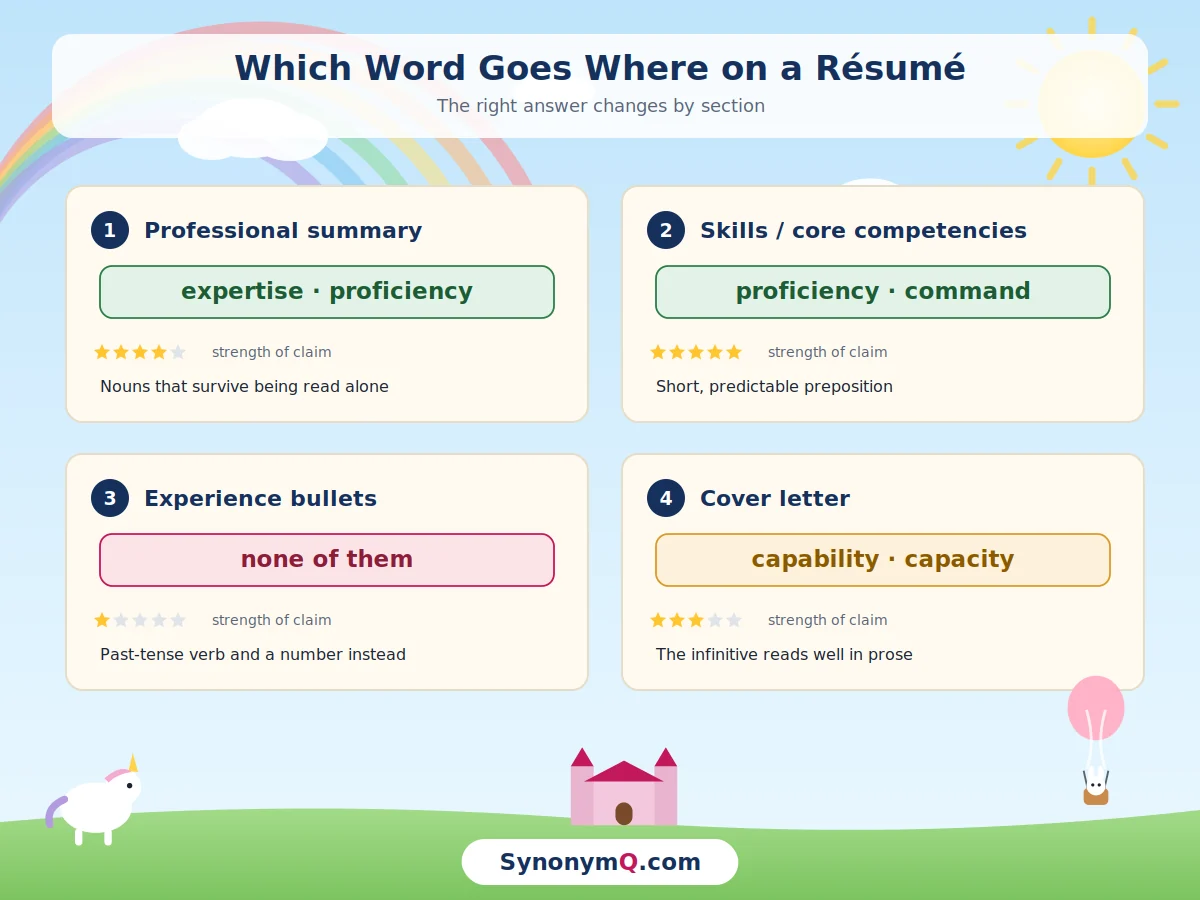
The right answer changes depending on where the line sits, which is why a single recommended synonym is never quite right.
| Section | What that section is for | Best choice | Why |
|---|---|---|---|
| Professional summary | A two-line claim about who you are | expertise or proficiency | Both are nouns that survive being read in isolation |
| Skills / core competencies | Scannable, often not full sentences | proficiency, command (languages, subjects) | Short, and the preposition is predictable |
| Experience bullets | Evidence of things you did | None of them | Use a past-tense verb and a number. This is the section where a synonym is the wrong tool entirely |
| Cover letter | Argument, in sentences | capability, capacity | The infinitive reads naturally in prose and awkwardly in a bullet |
If you are choosing between ability and a word about your track record rather than your potential, the distinction between experience and its alternatives is the more useful comparison.
Ability Is Right When the Work Isn’t Finished Yet
Keeping the word is sometimes the honest choice, and swapping it out would be a small lie. Four cases:
Transferable skills in a career change. If you are moving from teaching into instructional design, “ability to translate curriculum goals into learning modules” is accurate. You have not yet done it under that job title, and proficiency would claim you had.
Entry level, where the record is short. A forward-looking claim is the only honest kind available. Inflating it to expertise is the classic entry-level resume mistake, and interviewers test for it.
Fixed institutional phrases. “Ability to obtain a security clearance” and “ability to travel up to 30%” are locked expressions in job descriptions. Rewrite them and an applicant tracking system stops matching your resume to the posting. Leave these exactly as the listing words them.
Where the job description used the word. Mirroring a posting’s own phrasing is reasonable, and one clean “ability to” is not a defect.
Frequently Asked Questions
What is a professional word for ability?
Proficiency in most cases. It is a noun, it takes a predictable preposition (proficiency in), and Oxford defines it as ability that comes “because of training and practice”, which is the claim a resume is meant to support. Expertise is a step up and should be reserved for areas you could be interviewed on.
Is there another word for “have the ability to”?
Usually the phrase should disappear rather than be replaced. “Have the ability to analyse large datasets” becomes “analyse large datasets” in a skills list, or “Analysed 40M-row datasets” in an experience bullet. Where you need the auxiliary, can is shorter and reads better than any noun phrase.
What is another word for “give the ability”?
Enable, equip or empower, depending on what was given. If you are describing what you did for a team, see the alternatives to empowered, which splits them by whether you gave permission, tools or confidence.
Should I remove every “ability to” from my resume?
No. Remove the ones describing work you have already done, because those lines are stronger in the past tense. Keep the ones describing work you could do, since that is what the phrase is for. A resume with one or two is normal; a resume with eight is a resume with no evidence in it.
How This Page Was Checked
Every definition, grammar pattern and preposition on this page was read from the dictionary entry it is attributed to, on 9 September 2026:
- Grammar patterns and definitions for ability, capability, capacity, competence, proficiency, expertise, aptitude and command, from Oxford Learner’s Dictionaries, entry by entry.
- Sense range and the noun’s first recorded use, from Merriam-Webster.
- The part-of-speech comparison in section two describes word lists published on pages currently ranking for this question, checked on the same date.
No claim here about which word a specific recruiter prefers is presented as measured data. Those are editorial judgements based on what each word denotes. Where a dictionary carries no register label for a word, none is claimed for it.
Written by Naveed Akhtar, an SEO content writer with 10 years of article-writing experience.
Target topic: choosing between capability and capacity in business writing

Naveed Akhtar writes every guide on SynonymQ. He is an SEO content writer with ten years of article-writing experience, working on the question a thesaurus never answers: which of these words belongs in this sentence, for this reader. Every page cites the dictionary entries it draws on and the date they were read.