
Hate vs Dislike vs Loathe: 3 Words, 3 Different Meanings
Hate vs dislike vs loathe comes down to strength and kind. Merriam-Webster groups hate, detest, abhor, abominate and loathe as strong aversion, and leaves dislike out, because dislike is mild disapproval rather than aversion at all. Use dislike for preference, hate for felt hostility, loathe for disgust, abhor for moral objection.
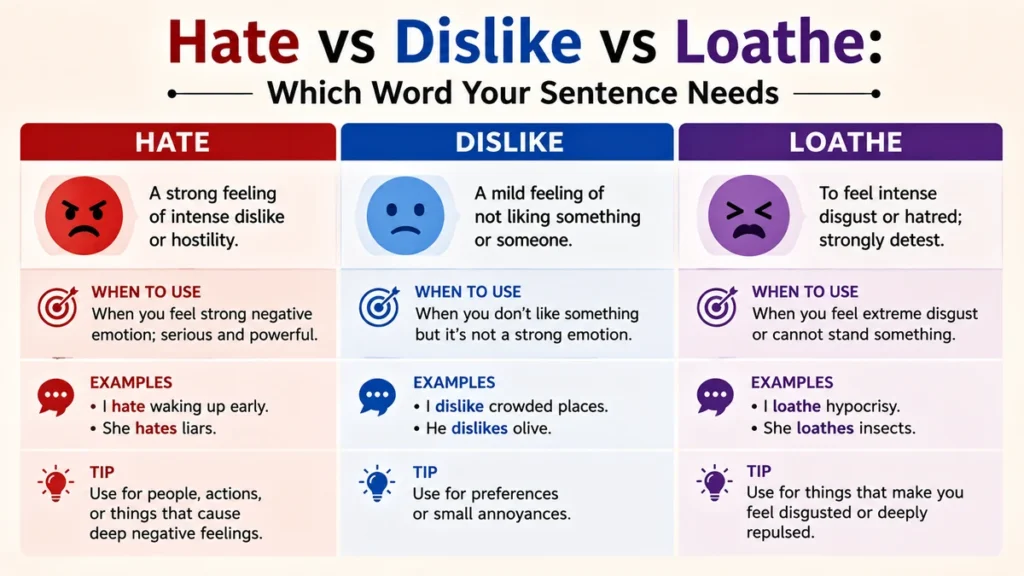
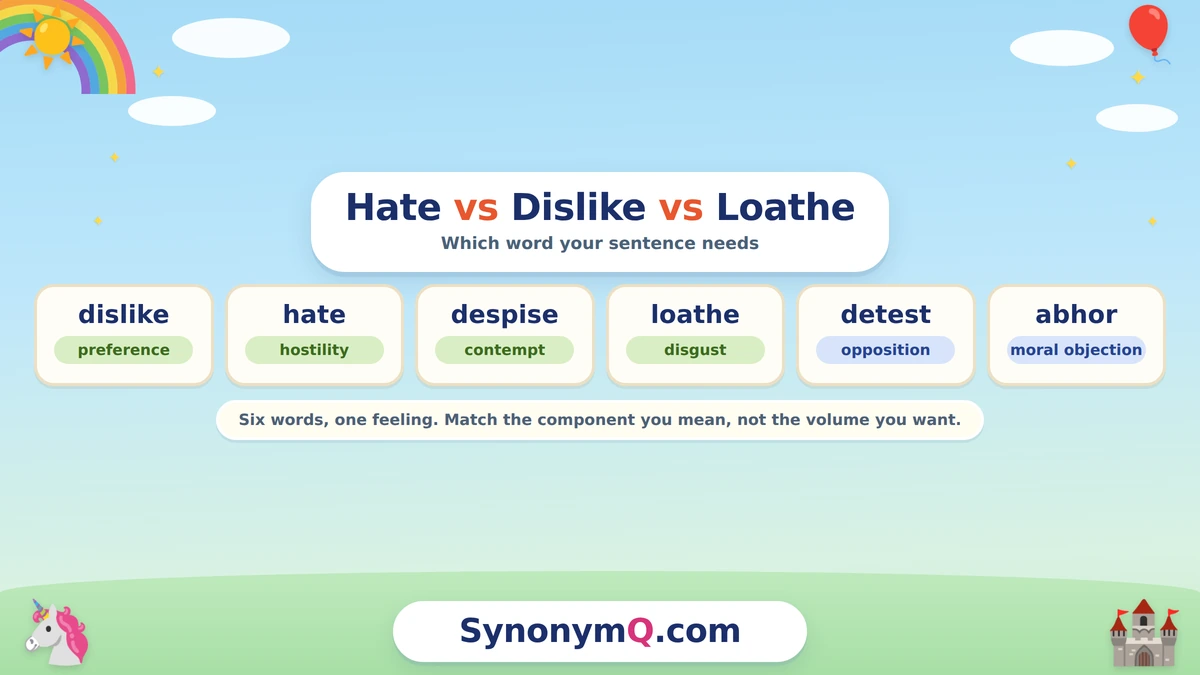
Hate vs Dislike vs Loathe at a Glance
Six words cluster around this feeling, and they are not graded copies of one another. Two dictionaries between them settle most of the question, so here is what each source actually says before any interpretation is added.
| Word | What it adds, per Merriam-Webster | Oxford register label | Oxford CEFR | Progressive tenses |
|---|---|---|---|---|
| dislike | Not in the group at all | Not retrieved | Not retrieved | Not stated |
| hate | Emotional aversion, often coupled with enmity or malice | None | A1 | Permitted |
| despise | Not in the group; Oxford defines it as dislike plus no respect | None | B1 | Not used |
| loathe | Utter disgust and intolerance | None | B2 | Not stated |
| detest | Violent antipathy | Rather formal | C1 | Not used |
| abhor | Deep, often shuddering repugnance | Formal | C2 | Not used |
| abominate | Strong detestation, often moral condemnation | Formal, per Merriam-Webster | Not retrieved | Not stated |
Two cells read “Not retrieved” because Oxford’s dislike and abominate entries did not load when this page was built. Nothing was estimated to fill them.
Why Merriam-Webster Leaves Dislike Out
Merriam-Webster’s synonym discussion opens by naming its own scope: “hate, detest, abhor, abominate, loathe mean to feel strong aversion or intense dislike for.” Five words. Dislike is not one of them, and its absence is the most useful thing on the page.
Merriam-Webster defines the noun dislike as “a feeling of aversion or disapproval” and the verb as “to regard with dislike: disapprove.” Disapproval is a judgment. Aversion in the strong sense is a reaction. That is why dislike sits outside the group rather than at the bottom of it: it is a different kind of feeling, not a weaker dose of the same one.
The practical consequence is that dislike and hate are not interchangeable at different volumes. “I dislike his tone” reports a preference. “I hate his tone” reports hostility. Turning one into the other changes what you are claiming about yourself, not how loudly you are claiming it.

What Separates the Strong Words
Merriam-Webster’s five distinctions are short enough to quote and specific enough to use. Each one names a different component, and once you can see which component you mean, the choice makes itself.
Detest: violent antipathy
Merriam-Webster gives detest “violent antipathy.” Oxford Learner’s Dictionaries labels it rather formal and rates it C1. Oxford’s own example is “He detests having his photograph taken,” which shows the register: this is the word for stated, deliberate aversion rather than a flash of feeling.
Loathe: disgust and intolerance
Merriam-Webster gives loathe “utter disgust and intolerance.” Oxford attaches no register label and rates it B2, so it is neither formal nor casual, and Oxford’s example “He loathed hypocrisy” carries the physical edge that detest lacks. Reach for loathe when the feeling is closer to revulsion than to opposition.
Abhor: the shudder is in the word
Merriam-Webster gives abhor “a deep often shuddering repugnance,” and the shudder is not a metaphor the dictionary invented. Oxford traces abhor to Latin abhorrere, from ab- meaning “away from” and horrere meaning “to shudder.” The etymology and the modern definition are describing the same recoil.
Oxford also marks abhor formal and C2, its highest band, and its examples point at objects rather than people: “Most decent people abhor corruption in government” and “She abhors any form of cruelty towards animals.” Oxford’s definition specifies hating something particularly for ethical reasons. That is the constraint worth remembering. Abhor takes principles, practices and behavior. It does not take broccoli.
Abominate: moral condemnation
Merriam-Webster gives abominate “strong detestation and often moral condemnation,” labels it formal, and dates it to 1597. It overlaps heavily with abhor; the difference is that abhor leans on revulsion and abominate leans on judgment.
Despise: a different axis entirely
Oxford defines despise as “to dislike and have no respect for somebody/something.” Merriam-Webster does not include it in the aversion group, and Oxford’s definition explains why: despise is about contempt, and contempt is a verdict on someone’s worth rather than a measure of how strongly you object to them.
This is the substitution that goes wrong most often. “She despised gossip” and “She loathed gossip” are not the same sentence. The first looks down on gossip. The second recoils from it.
The Difficulty Ladder Is Not the Intensity Ladder
Oxford’s CEFR levels line up suspiciously neatly: hate A1, despise B1, loathe B2, detest C1, abhor C2. It is tempting to read that as a strength scale. It is not one.
CEFR levels describe when a learner typically acquires a word, which tracks how common and how formal it is. Strength is a separate question, and despise proves it: at B1 it is the second-easiest word here, yet it expresses contempt, which is not on the same axis as aversion at all. Loathe at B2 is stronger than despise at B1 in aversion terms while being harder to acquire, and both facts are true for unrelated reasons.
The rule that follows from this: use the CEFR column to judge whether a word suits your reader, and Merriam-Webster’s distinctions to judge whether it suits your meaning. Merriam-Webster and Oxford do not state this pairing as a rule. It is a reading of what their two datasets show when you set them side by side.

Which Word Your Sentence Needs
- For a preference or a mild objection, use dislike. Avoid hate, because it claims hostility you probably do not mean in professional writing.
- For ordinary felt aversion, use hate. Avoid detest, because Oxford’s rather formal label makes it sound stiff in casual prose.
- For revulsion, use loathe. Avoid despise, because it swaps disgust for contempt and quietly changes the accusation.
- For contempt, use despise. Avoid abhor, because Oxford ties it to ethical objection rather than low regard.
- For a moral or ethical objection, use abhor. Avoid hate, because it reads as personal feeling where you want principled objection.
- In academic and formal writing, prefer detest or abhor. Both carry Oxford register labels that fit; hate at A1 can read as underpowered next to a formal argument.
The Substitution Test
Take one sentence: “I hate the new policy.” Here is what each alternative does to it.
| Alternative | Label | What changes |
|---|---|---|
| loathe | Direct Swap | Adds disgust. Same grammar, stronger reaction. |
| detest | Direct Swap | Adds formality and deliberate opposition. |
| despise | Direct Swap | Meaning shifts to contempt for the policy’s worth. |
| dislike | Direct Swap | Drops to disapproval. Often the right professional choice. |
| abhor | Swap With Adjustment | Grammatically fine, but needs an ethical object. “I abhor the cruelty in the new policy” works; the bare policy does not. |
| abominate | Swap With Adjustment | Same constraint, plus a formality most prose cannot absorb. |
| can’t stand | Requires Rewrite | Register drops to spoken English, and the contraction reshapes the sentence’s tone. |

Grammar: Which Patterns Each Word Accepts
This is where substitution breaks even when the meaning fits, and it is the part no thesaurus entry covers. Oxford lists eight patterns for hate and fewer for every alternative.
| Pattern | hate | dislike | loathe | detest | despise | abhor |
|---|---|---|---|---|---|---|
| … somebody or something | Yes | Yes | Yes | Yes | Yes | Yes |
| … doing something | Yes | Yes | Yes | Yes | Yes | Not listed |
| … to do something | Yes | Not listed | Not listed | Not listed | Not listed | Not listed |
| … it when … | Yes | Yes | Not listed | Not listed | Not listed | Not listed |
| Progressive tenses | Permitted | Not stated | Not stated | Not used | Not used | Not used |
Three words never take the progressive
Oxford states plainly that detest, despise and abhor are “not used in the progressive tenses.” So “I’m hating this weather” is available in informal English, while “I’m detesting this weather” and “I’m abhorring this weather” are not. Swapping a stronger word into a progressive sentence produces an error, not emphasis.
Only hate takes the to-infinitive
Oxford’s shared pattern box lists “I hate/dislike/can’t stand/can’t bear/loathe/detest doing something” but restricts the to-infinitive frame to “I hate/can’t bear to do something.” So Oxford’s own example is “He detests having his photograph taken,” never “He detests to have his photograph taken.” If your sentence uses to plus a verb, hate is close to your only option in this set.
The “it when” frame is narrower still
Oxford’s frame reads “I hate/dislike/can’t stand/can’t bear it when…” and stops there. Loathe, detest, despise and abhor are absent from it. “I hate it when he interrupts” is standard; “I detest it when he interrupts” is not a pattern Oxford records.
The One Frame Where None of Them Work
Oxford gives the verb hate a second sense that has nothing to do with aversion: “used when saying something that you would prefer not to have to say, or when politely asking to do something.” It takes no passive form.
This is the hate in “I hate to bother you, but could you resend that file?” The speaker is being polite, not hostile. Every substitution in this article fails here, because the sense being used is not the aversion sense at all:
- “I loathe to bother you” is not English.
- “I detest to bother you” is not English either, and the to-infinitive is barred anyway.
- “I dislike to bother you” is grammatically odd and pragmatically wrong: it reports a preference where the sentence needs an apology.
If a thesaurus sends you to loathe for this sentence, it has matched the word and missed the sense. Look up any of these in the SynonymQ synonym finder and the same caution applies: a listing identifies a candidate, never a guarantee that it fits your frame.
Do Not Substitute: Hate Speech, Hate Crime, Hate Mail
Merriam-Webster records a distinct noun sense of hate, “a systematic and especially politically exploited expression of hatred,” and notes that it is used attributively, as in hate mail and hate groups. In these expressions hate is locked.
| Expression | Why it is locked |
|---|---|
| hate speech | A legal and policy term of art. Nearby words such as incitement, vilification and slur have their own technical definitions and are not synonyms of it. |
| hate crime | A statutory category. “Loathing crime” is not English, and no near-synonym carries the legal definition. |
| hate mail | A fixed compound recorded by Merriam-Webster. “Detestation mail” is not available. |
| hate group | Same attributive pattern, same lock. |
If you searched for another word for hate speech, this is the honest answer: there is not one. The phrase names a defined category, and replacing hate inside it either breaks the English or changes the legal claim.
When Hate Is Already the Right Word
A stronger word is not automatically a better one. Hate is direct, universally understood, and the only word in this set that accepts all eight of Oxford’s grammar patterns. In dialogue, in personal essays and in any sentence using the to-infinitive or the “it when” frame, it is the correct choice and the alternatives are worse.
The failure this page is trying to prevent is not using hate too often. It is reaching for abhor to sound serious, and landing on a word that promises an ethical objection the sentence does not contain. If you want the same effect for a softer feeling, the vocabulary around isolation and the grief, sorrow and sadness distinction work the same way: match the component, not the volume.

Frequently Asked Questions
What is a fancy word for hatred?
Animosity, enmity, antipathy, rancor and odium all raise the register of the noun. Merriam-Webster lists hatred and distaste among the noun synonyms of dislike, which is a useful reminder that the noun family and the verb family do not map onto each other one for one. For the verb, abhor and abominate are the formal options, both labelled formal.
What can I say instead of hate?
In professional writing, dislike is usually the right substitute, because it reports disapproval without claiming hostility. If you need to keep the strength, loathe is the closest direct swap. Avoid abhor unless the object is genuinely an ethical matter.
Is loathe stronger than hate?
In component terms, yes. Merriam-Webster gives loathe “utter disgust and intolerance” against hate‘s “emotional aversion often coupled with enmity or malice,” so loathe adds revulsion. It is also more restricted grammatically, so it is stronger and less flexible at the same time.
How This Page Was Checked
Every definition, register label, CEFR level, grammar pattern and etymology on this page was read from the source entry on the day of publication, September 3, 2026, and is attributed in the sentence that uses it. Merriam-Webster supplied the five-way synonym discussion at its entry for hate, the dislike and abominate definitions, and the attributive noun sense behind the locked expressions. Oxford Learner’s Dictionaries supplied register labels, CEFR levels, grammar patterns and the politeness sense at its entry for hate and the entries for each alternative.
Two cells in the first table read “Not retrieved” because Oxford’s dislike and abominate pages did not load, and nothing was estimated to fill them. Where this page draws a conclusion the dictionaries do not state, such as the point that acquisition level and intensity are separate axes, it says so at that point rather than presenting the reading as a published rule. Pronunciation was deliberately omitted: these words are phonetically transparent, and a respelling would add nothing to a word-choice decision.
Target topic: a full hub covering every synonym and antonym of hate, including the reflexive and internet-slang senses.

Naveed Akhtar writes every guide on SynonymQ. He is an SEO content writer with ten years of article-writing experience, working on the question a thesaurus never answers: which of these words belongs in this sentence, for this reader. Every page cites the dictionary entries it draws on and the date they were read.