
Another Word for I Believe in an Essay (Usually None)
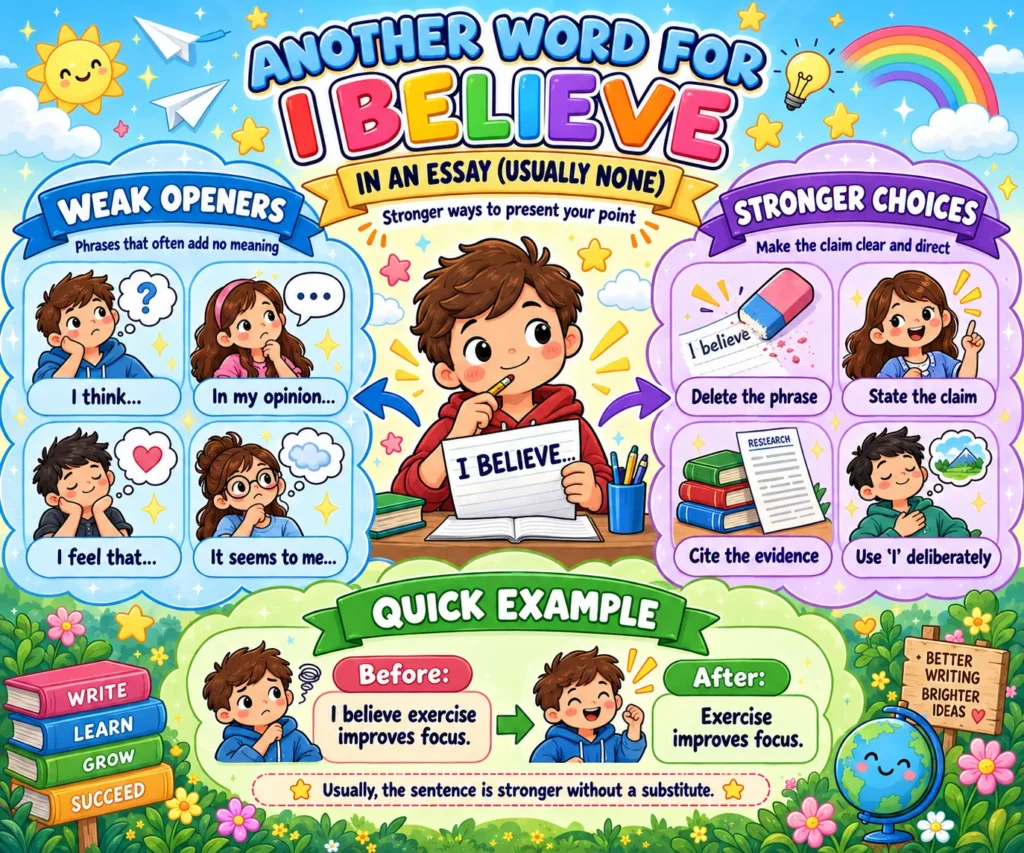
Another word for I believe in an essay is usually not the fix. University writing centres say the phrase fails because it stands in for evidence, not because it is informal. Delete it and let the evidence carry the claim, attribute the claim to your source, or keep the first person deliberately where it makes the sentence clearer.
By Naveed Akhtar, an SEO content writer with 10 years of article-writing experience · Updated 11 September 2026 · About 9 minutes
What Writing Centres Actually Say About “I”
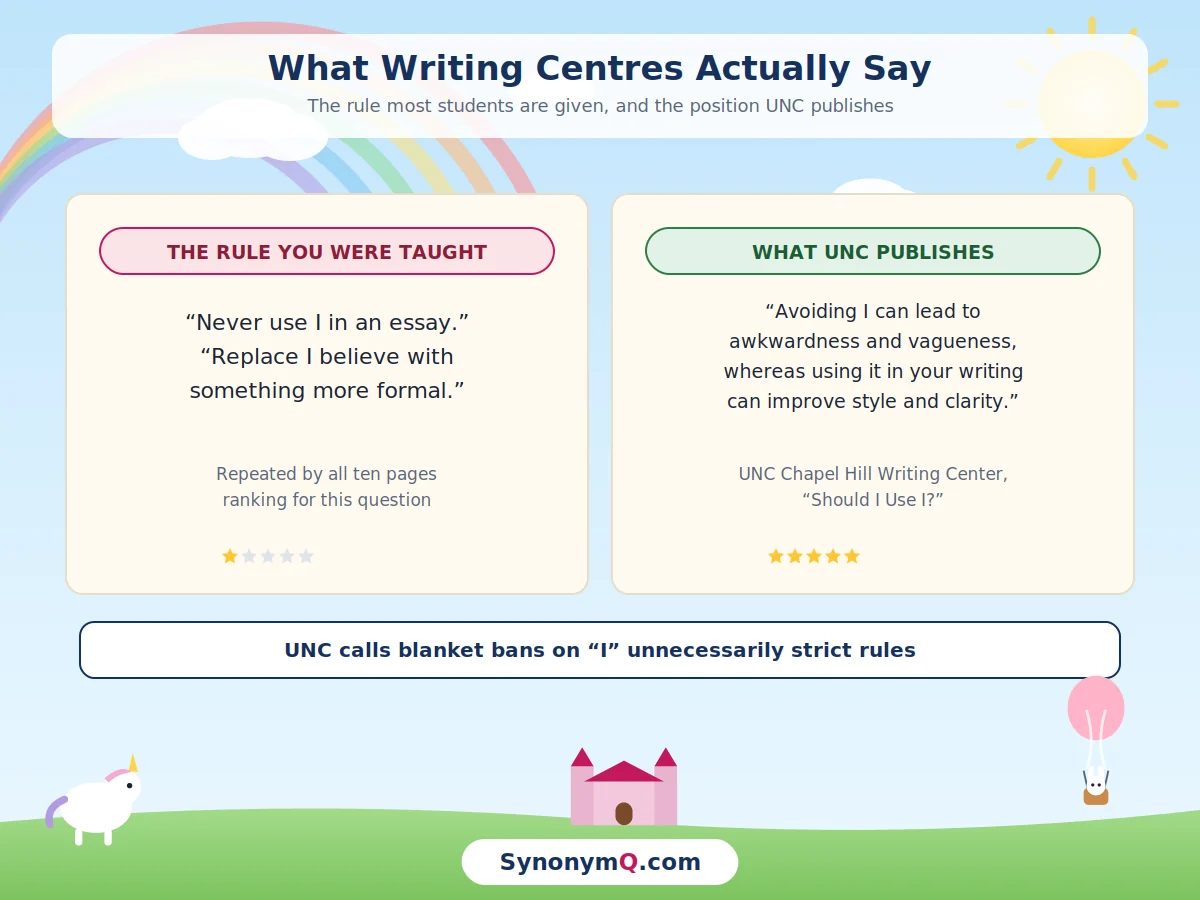
The advice you have probably been given is that first person does not belong in academic writing. The people who run university writing programmes are more divided about that than the rule suggests.
“Avoiding ‘I’ can lead to awkwardness and vagueness, whereas using it in your writing can improve style and clarity.”
The Writing Center, University of North Carolina at Chapel Hill, Should I Use “I”?The same handout describes blanket bans on the first person as “unnecessarily strict rules” that grew out of good advice. Purdue Global’s writing centre published its guidance under the title To Use “I” or Not to Use “I”: That Is Not Really a Question. Berkeley’s graduate teaching resources discuss “the scholarly I” as a legitimate move in humanities research writing. Brandeis maintains a first-person handout for its own faculty.
None of that means your instructor agrees. Departments differ, and a marking rubric beats a writing centre every time. But the flat rule that “I believe” must be swapped for something grander is not what the field actually says, and it matters, because the swap does not fix the thing your marker is objecting to.
The Problem Is Not the Word
UNC is specific about what goes wrong, and it is not vocabulary:
“Sometimes writers use the first person in a less effective way, preceding an assertion with ‘I think,’ ‘I feel,’ or ‘I believe’ as if such a phrase could replace a real defense of an argument.”
“Personal belief or opinion is generally not sufficient in itself; you will need evidence of some kind.”
The Writing Center, UNC Chapel HillRead that carefully and the diagnosis changes. “I believe” is not a style problem. It is a load-bearing problem: the phrase is holding up a claim that has nothing underneath it. Every alternative the internet recommends leaves that gap exactly where it was.
OriginalI believe that social media has damaged teenage attention spans. The usual adviceI contend that social media has damaged teenage attention spans.Nothing improved. The sentence still asserts a contested empirical claim on the authority of the person writing it, and now it does so in a register that does not match the rest of an undergraduate essay. The marker’s objection survives the edit intact.
Fix One: Delete It
Most of the time the phrase can simply go. An academic sentence is already understood to be the writer’s claim, so announcing it adds words without adding information.
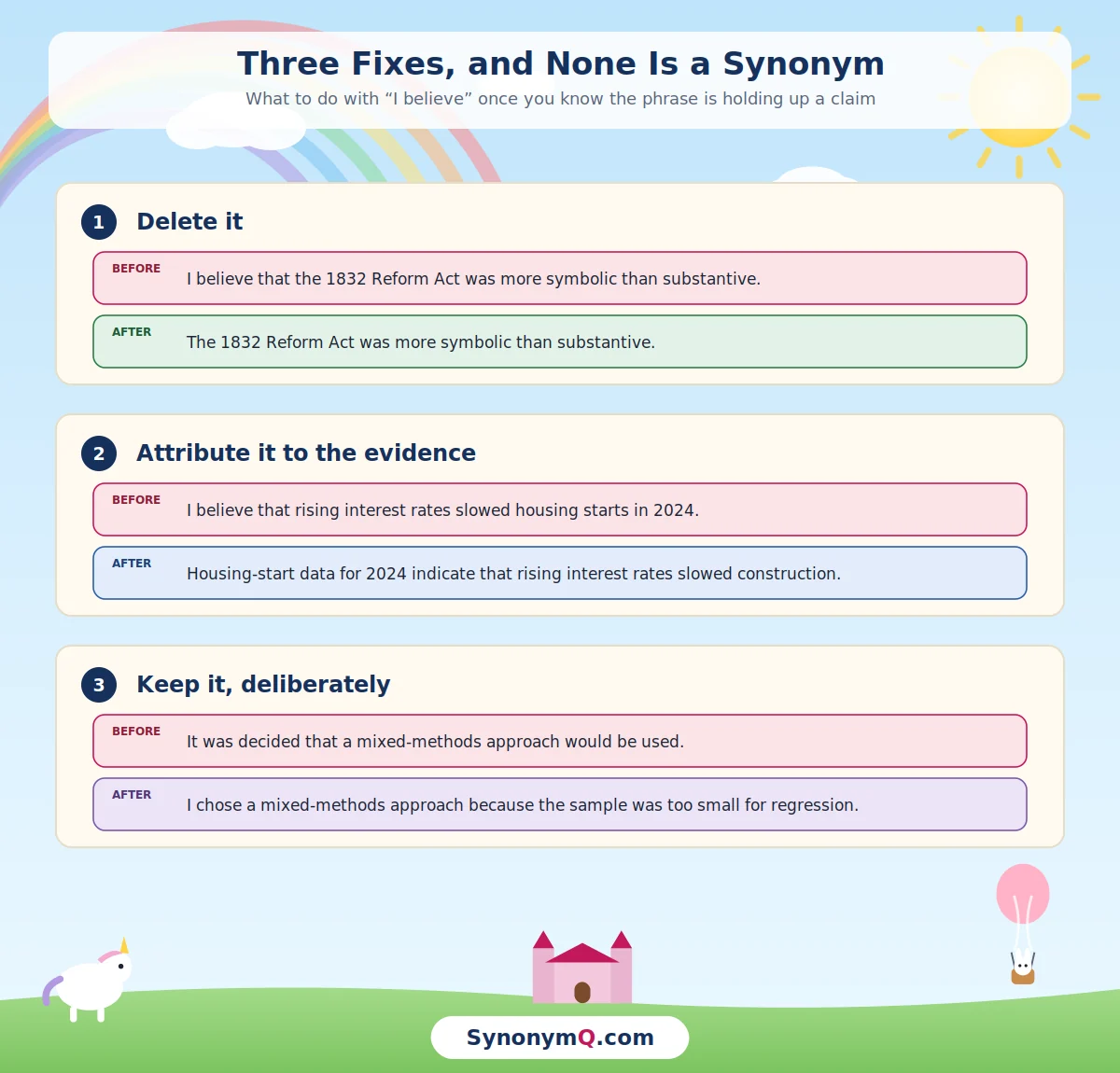
BeforeI believe that the 1832 Reform Act was more symbolic than substantive. AfterThe 1832 Reform Act was more symbolic than substantive.The second sentence is shorter, more confident, and says the same thing. If deleting the phrase makes you uneasy about the claim, that unease is useful information: it usually means the claim needs support rather than a hedge.
Try this first, always. Read the sentence with the phrase removed. If it still works, you never needed a replacement, and you have found the answer to the question you came here with.Fix Two: Attribute It to the Evidence
When the claim genuinely does need a source, move the stance from you to the material. This is the construction that does the work the hedge was pretending to do.
BeforeI believe that rising interest rates slowed housing starts in 2024. AfterHousing-start data for 2024 indicate that rising interest rates slowed construction.Useful frames: the data indicate, the results suggest, this evidence points to, Author (year) shows that. Each one names what is doing the believing, and none of them is a synonym for anything. That is why they work.
Fix Three: Keep It, Deliberately
There are places where first person is the clearer choice, and UNC names two of them: when you want to emphasise agency, and when you need to explain how your work departs from someone else’s.
In practice that covers reflective writing, methodology sections describing what you did, positioning your reading against a published one, and any sentence where removing “I” would produce a limp passive. “It was decided that” is worse writing than “I decided”, and marking rubrics rarely reward the first.
Check the rubric before you rely on this. Some departments, particularly in the sciences, do prohibit first person outright. A writing-centre position is guidance, not permission. If your brief says no first person, that instruction wins.Is “Believe” Even Informal?
The premise behind every substitution list is that believe is too casual for academic prose. Oxford Learner’s Dictionaries does not support it.
Oxford gives believe five senses. The three relevant ones are “to feel certain that something is true”, “to think that something is true or possible, although you are not completely certain”, and “to have the opinion that something is right or true”. None carries a formality label. The only sense Oxford marks informal is the one meaning surprise or annoyance, as in “you’ll never believe what happened”, which nobody is writing in an essay.
All three relevant senses are marked A1, the most basic level on the CEFR scale. That is a statement about how common the word is, not how casual it is. Plain and informal are different properties, and academic prose is supposed to be plain.
Another Word for I Believe in an Essay: What Each Option Costs
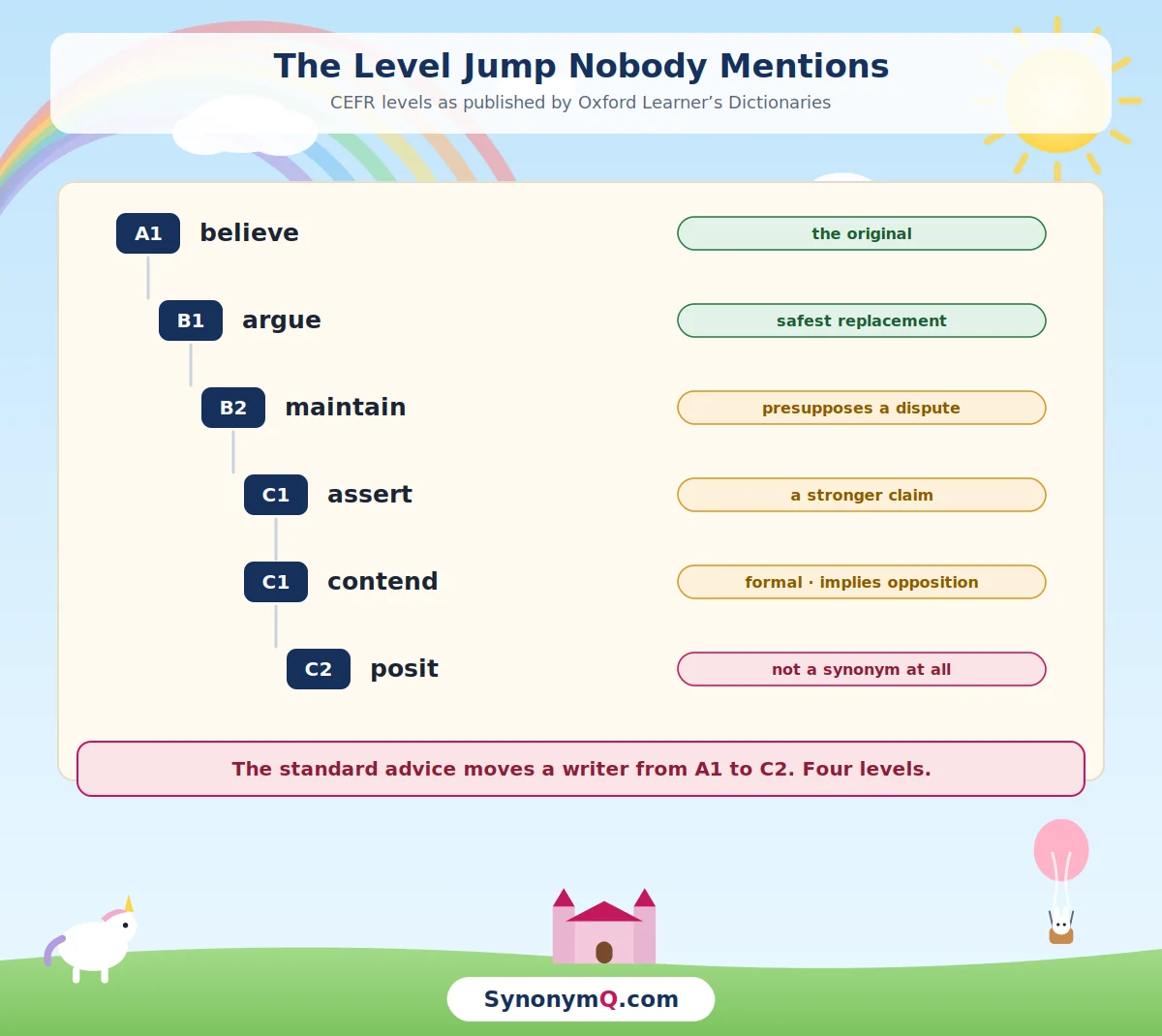
If you have decided the first person stays and you want a different verb, here is what the usual recommendations actually cost, with the level Oxford assigns each one.
| Verb | Level | What Oxford says it means | What it costs you | Label |
|---|---|---|---|---|
| believe | A1 | “to have the opinion that something is right or true” | The original. No register problem | — |
| argue | B1 | “to give reasons why you think that something is right/wrong, true/not true” | Almost nothing. It also promises reasons, which commits you to supplying them | Direct Swap |
| maintain | B2 | “to keep stating that something is true, even though other people do not agree or do not believe it” | It presupposes a dispute. Used where nobody has disagreed yet, it sounds defensive | Swap With Adjustment |
| assert | C1 | “to state clearly and definitely that something is true” | A stronger claim than you may intend, and a level jump | Direct Swap |
| contend | C1 | “to say that something is true, especially in an argument” · marked formal | Formal register, and it also implies opposition | Direct Swap |
| posit | C2 | “to suggest or accept that something is true so that it can be used as the basis for an argument” · marked formal | It is not a synonym. Positing means assuming a premise in order to build on it, which is a different act from stating a belief | Requires Rewrite |
Two things fall out of that table. The first is the level jump: the standard advice moves a writer from an A1 word to C1 and C2 words, and much of the audience for this question is writing in a second language. Reaching four levels above your working vocabulary is how a sentence starts sounding translated.
The second is that posit is the wrong word. Oxford defines it as suggesting something is true so that it can be used as the basis for an argument. “I posit that social media harms attention spans” claims you are setting up a premise, not stating a conclusion. It appears on most of the lists anyway.
If you want one verb, use argue. It is B1, carries no register label, and its definition already includes giving reasons, which nudges the sentence toward the thing that was missing.What About “I Strongly Believe”?
Adding strongly intensifies the wrong half of the sentence. It makes your believing more emphatic; it does nothing to the claim. A reader who was not persuaded by “I believe X” is not persuaded by “I strongly believe X”, because the extra word is about you.
BeforeI strongly believe that remote work improves retention. AfterThe retention evidence for remote work is stronger than the productivity evidence.If you want a stronger word than believe, the honest options are the ones above, and each raises the claim rather than the conviction. Intensity in academic writing comes from what you can show, which is also why actually and really weaken sentences in the same way when they are used for emphasis.
Frequently Asked Questions
What can I say instead of “I believe” in an essay?
Most often, nothing. Delete the phrase and state the claim, or move the stance to your evidence with a frame like the data indicate. If you want a verb, argue is the safest: Oxford puts it at B1 with no register label, and its meaning already includes giving reasons.
How do you say “I believe” in a formal way?
Contend and posit are the formal options and Oxford labels both formal. Contend works but implies you are arguing against someone. Posit means assuming a premise so you can build on it, so in most essay sentences it is simply the wrong verb. Formality is rarely what the marker wanted.
Is “I believe” too informal for academic writing?
Oxford attaches no formality label to the relevant senses of believe, and marks them A1, which measures how common a word is rather than how casual. The objection to “I believe” in essays is about unsupported claims, not register. Whether a phrase is correct or merely common is a separate question from whether it belongs.
Can I use first person in an essay at all?
It depends on your department, and your rubric overrides any general guidance. UNC’s writing centre argues that avoiding “I” can cause awkwardness and vagueness, and treats blanket bans as unnecessarily strict. Science departments are more likely to prohibit it than humanities ones. When the brief is silent, use first person where it makes the sentence clearer and not as a substitute for evidence. The same register judgement applies to choosing transitions in formal writing.
How This Page Was Checked
Everything quoted here was read from the source it is attributed to, on 11 September 2026:
- All quotations on first person, and the description of blanket bans as “unnecessarily strict rules” — The Writing Center, University of North Carolina at Chapel Hill.
- Definitions, register labels and CEFR levels for believe, argue, maintain, assert, contend and posit — Oxford Learner’s Dictionaries, entry by entry.
- The titles of the Purdue Global, Berkeley and Brandeis resources were read from search results on the same date; their full arguments were not, and nothing is quoted from them.
One thing this page does not claim: it makes no statement about what any specific exam board requires. A section on exam writing was planned and cut, because no official source could be retrieved for it. Departmental rubrics vary and are not summarised here.
Written by Naveed Akhtar, an SEO content writer with 10 years of article-writing experience.
Target topic: hedging verbs in academic writing, and when a hedge is correct

Naveed Akhtar writes every guide on SynonymQ. He is an SEO content writer with ten years of article-writing experience, working on the question a thesaurus never answers: which of these words belongs in this sentence, for this reader. Every page cites the dictionary entries it draws on and the date they were read.