
Empathy vs Sympathy: Which One Do You Actually Need? 5 Examples
Empathy vs Sympathy: Which One Do You Actually Need? 5 Examples
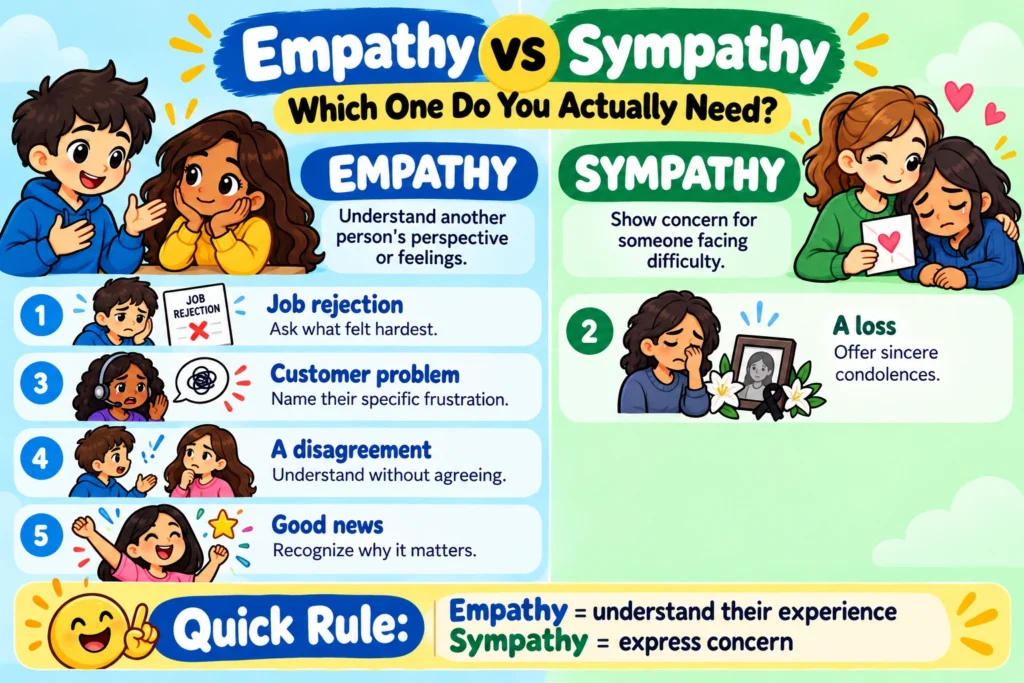
Empathy vs sympathy is a choice about meaning: empathy emphasises understanding or sharing another person’s feelings; sympathy emphasises concern for someone facing difficulty. Use empathy for perspective-taking and sympathy for condolences. Neither word automatically describes a kinder person, and both responses can occur together.
Written by Naveed Akhtar, an SEO content writer with 10 years of article-writing experience.

Empathy vs sympathy: the difference that matters
If you are choosing a word for an email, essay or conversation, start with the response you want to describe. Are you naming someone’s understanding of another person’s experience, or their concern about that person’s difficulties?
Cambridge’s entry for empathy centres on imagining another person’s situation and sharing their feelings or experiences. Its sympathy entry describes care and understanding directed towards someone’s suffering.
These meanings overlap. Merriam-Webster’s comparison highlights concern in sympathy and participation in another person’s emotional experience in empathy. That is a useful distinction, but it does not make sympathy empty, dismissive or insincere.
| Your intended meaning | Best starting word | Original example |
|---|---|---|
| Understanding someone’s perspective | Empathy | The teacher showed empathy for the nervous newcomer. |
| Expressing concern after a loss | Sympathy | We sent a message of sympathy to the family. |
| Recognising another person’s excitement | Empathy | Her empathy helped her understand why the small success mattered. |
| Expressing agreement with a position | Sympathy, in a different sense | I have sympathy for their argument. |
The last row is easy to miss. Sympathy can also mean support or agreement. In that sense, replacing it with empathy changes the claim: understanding a viewpoint does not necessarily mean supporting it.
Does empathy require the same experience?
No. The APA Dictionary of Psychology describes empathy through another person’s frame of reference or through experiencing their feelings indirectly. An identical personal history is not a condition in that definition.
For example, a supervisor who has never moved abroad can still ask a new colleague what feels unfamiliar. In your writing, describe that effort specifically: “She tried to understand his uncertainty” says more than simply calling her an empathetic supervisor.
Can empathy be understanding without shared emotion?
Yes. The Greater Good Science Center at UC Berkeley distinguishes cognitive empathy, which concerns understanding another perspective, from affective empathy, which concerns an emotional response to another person’s feelings.
For a cognitive-empathy example, imagine a tutor recognising why a student fears reading aloud, even though the tutor feels calm. An affective example would involve the tutor also feeling some of the student’s unease. Both concern empathy; they emphasise different aspects.
For ordinary writing, you rarely need a numbered taxonomy of empathy. Name the particular ability you mean instead. “She understood why he was hesitant” is clearer than assigning him or her a category without explaining the behaviour.
5 everyday examples: which response do you actually need?
The following situations are original writing examples. Their labels describe the emphasis of each response, not a test of the speaker’s character. One sentence can express concern, invite understanding and offer help at the same time.
1. Writing a condolence message
Situation: A colleague tells you that their father has died. You want to send a short, respectful note, and you do not know the family well.
A suitable message: “Please accept my deepest sympathy. I am thinking of you and your family.” Here, sympathy names the condolence you are offering. It is already the right word; replacing it with empathy would make the phrase unusual for this purpose.
If you want to leave room for conversation, you could add: “If you would like to talk about him, I would be glad to listen.” You do not have to announce that you are showing empathy. The invitation communicates your willingness to listen.
Avoid “I know exactly how you feel” when that is more than you can honestly claim. Even a similar loss does not tell you everything about this person’s experience. For related vocabulary, see our guide to grief, sorrow and sadness.
2. Responding to a friend’s job rejection
Situation: A friend prepared carefully for an interview and did not get the role. You want to acknowledge the disappointment without deciding for them how serious it is.
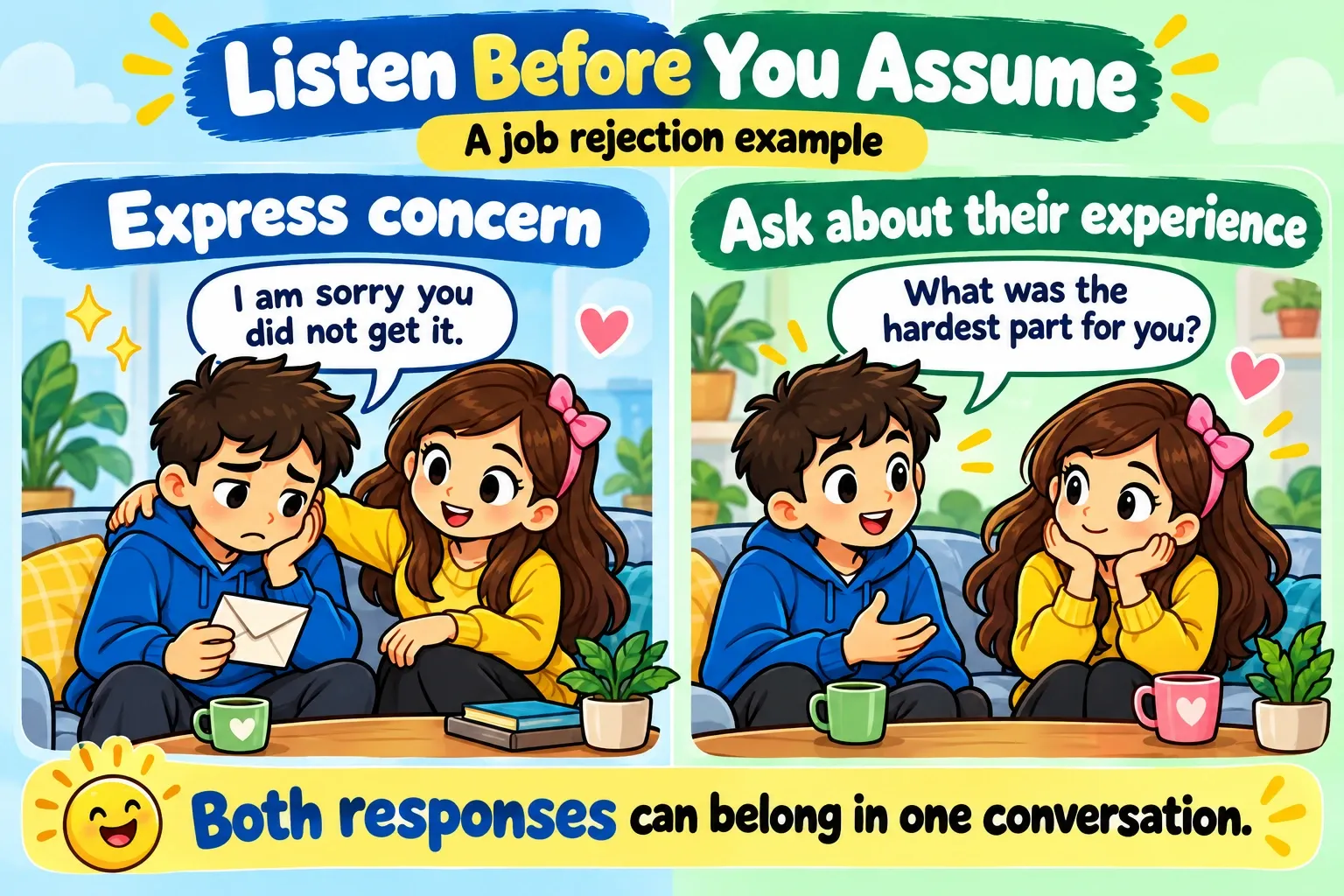
A sympathetic response: “I am sorry you did not get it. That is disappointing news.” This directly expresses concern. It does not become a bad response just because it is brief.
An empathy-focused response: “You put a lot into that interview. Is the hardest part losing this opportunity, or having to start the search again?” The question gives your friend a chance to explain what the rejection means to them.
For a description of that conversation, write “She responded with empathy” if the perspective-taking is your point. Write “She expressed sympathy” if the expression of concern is your point. Choose according to the evidence you actually describe.
“You will definitely get something better” makes a prediction you cannot support. A more grounded alternative is: “Would you like company tonight, or help reviewing the application tomorrow?” Offer only what you can realistically provide.
3. Answering a customer complaint
Situation: A customer’s delivery did not arrive before an important event. You need to acknowledge the effect of the delay and explain what can happen next.
A possible reply: “I understand that you ordered this for Saturday’s event, so a Monday delivery will not solve the problem. I can check the available refund or replacement options.”
The first sentence demonstrates attention to the customer’s circumstances. In a training document, you could describe it as an empathy-focused acknowledgement. The second sentence offers a practical next step rather than another emotional label.
“We sympathise with your inconvenience” is less useful here because it leaves the specific problem unnamed. Try writing about the missed event directly. If you cannot offer a refund, do not imply that you can; explain the options your policy actually permits.
For the final email, you may need neither noun. The customer can read that you understood the timing problem without encountering the words empathy or sympathy. Clear language often works better than a statement about how caring the company intends to be.
4. Understanding someone you disagree with
Situation: Two neighbours disagree about changing a shared parking arrangement. One depends on a nearby space because their work begins very early.
A possible response: “I can see why losing that space would make your mornings harder. I still think we need an arrangement that gives both households access.” This acknowledges a perspective while keeping a different position.
Choose empathy when your sentence is about that effort to understand. If you write “I am in sympathy with the proposal,” readers may understand that you support the proposal. That wording would misrepresent someone who understands the reasons but still disagrees.
In a report, separate the two claims: “She understood his concerns but opposed his preferred solution.” That sentence avoids asking a single emotional word to carry both understanding and agreement.
5. Recognising why good news matters
Situation: A friend completes a short course after repeatedly doubting that they could manage it. The certificate may look modest to someone who does not know the background.
A possible response: “You kept going even when the assignments felt difficult. I can see why finishing means so much to you.” The emphasis is on understanding the significance of the achievement.
Empathy fits that interpretation of the friend’s experience. Sympathy would usually introduce an unwanted suggestion of difficulty or misfortune in this congratulatory context. If you are writing directly to the friend, “Congratulations” is the simpler choice.
Compare “He congratulated her” with “He understood why she felt so proud.” The first reports what he said or did; the second describes his understanding. Select the wording that matches the information you want the reader to notice.
Natural phrases and substitutions that change the meaning
Knowing a definition does not make every phrase interchangeable. Read the whole sentence before replacing either word. Ask whether the replacement preserves the purpose, whether it needs a grammatical change, and whether it introduces a different claim.
| Original wording | Proposed alternative | Verdict |
|---|---|---|
| She showed empathy for the newcomer. | She showed understanding of the newcomer’s feelings. | Swap With Adjustment: makes the object of understanding explicit. |
| Please accept my sympathy. | Please accept my condolences. | Direct Swap in a bereavement message; not a general replacement in every context. |
| I sympathise with your situation. | I empathise with your situation. | Grammatical swap, but a changed emphasis: concern becomes perspective-taking or shared feeling. |
| I am in sympathy with the proposal. | I understand why you support the proposal. | Requires Rewrite; the new sentence deliberately stops short of agreement. |
Use a with-phrase when naming the person after the verbs: “I empathise with her” or “I sympathise with him.” The empathize and sympathize dictionary entries provide usage patterns. Do not write “I empathy you”: empathy is a noun, not the verb.
As an editing check, finish the sentence “By this word, I mean…” If your answer is “I want to offer condolences,” keep sympathy or use condolences. If it is “I want to describe understanding her point of view,” empathy is the more precise starting point.
Empathy, sympathy and compassion are related, not identical
Cambridge defines compassion in terms of concern for suffering together with a wish to help. That motivation makes compassion useful when the sentence specifically emphasises wanting to relieve someone’s difficulty.
Consider a neighbour whose home has been damaged. You might write, “She understood his worry,” “She expressed sympathy,” or “Her compassion moved her to offer a spare room.” These sentences spotlight different parts of a possible response.
The offer is an original illustration, not a requirement that compassion must involve accommodation or money. Likewise, a sympathetic message does not prove that the sender refused to help. Avoid treating the words as three steps that everyone must follow in order.
| Alternative | Relationship | Useful context |
|---|---|---|
| Understanding | Contextual Alternative to empathy | Specify understanding of a person’s feelings; understanding alone has a much broader meaning. |
| Concern | Near-Synonym of sympathy in a caring response | Use when care is central; check that readers will not mistake it for personal worry. |
| Condolences | Contextual Alternative to an expression of sympathy | Fits bereavement messages, not ordinary disappointment about a delayed order. |
| Compassion | Related Word | Use when the wish to relieve suffering is part of your intended meaning. |
None is an exact substitute across all uses. In particular, the grammar matters: “She has empathy” describes a capacity, while “She offered condolences” reports an expression. Replacing just one word would not preserve that difference.
Which word should you choose?
For a condolence card, use sympathy. For a description of perspective-taking, use empathy. For support for an argument, sympathy may fit, but agreement is clearer if emotional concern is irrelevant. For a wish to relieve suffering, consider compassion.
Before sending a personal message, ask what the recipient actually needs from that sentence. Acknowledgement, a question and an offer of practical help perform different jobs. You can write each plainly without naming the feeling behind it.
Try this final editing exercise: “The manager showed sympathy by asking what made the new schedule difficult.” If the question and effort to understand are central, empathy is more precise. If the paragraph describes sorrow about the employee’s difficulty, sympathy may remain appropriate.
Then check the evidence around your chosen word. “He was empathetic” is a broad description. “He asked which part of the journey frightened her and listened to the answer” lets readers see what you mean. A specific action can make the emotional label unnecessary.
How this page was checked
Definitions and usage were checked against Cambridge Dictionary, Merriam-Webster, the APA Dictionary of Psychology and UC Berkeley’s Greater Good Science Center. Sources are linked beside the relevant claims. The five situations and sample messages are original editorial examples, not quotations or research findings.
Frequently asked questions
Can I use empathy and sympathy in the same sentence?
Yes, if each word contributes something: “Her empathy helped her understand his fear, and she expressed sympathy for his difficult situation.” Avoid pairing them merely to sound more caring. If the distinction is unimportant, describe what the person actually said or did.
Does saying “I am sorry” always express sympathy?
No. “I am sorry your trip was cancelled” expresses concern about another person’s disappointment. “I am sorry I cancelled our trip” can be an apology for your own action. The surrounding words identify the purpose; “sorry” alone does not settle it.
Should I write “I empathise” in a supportive text?
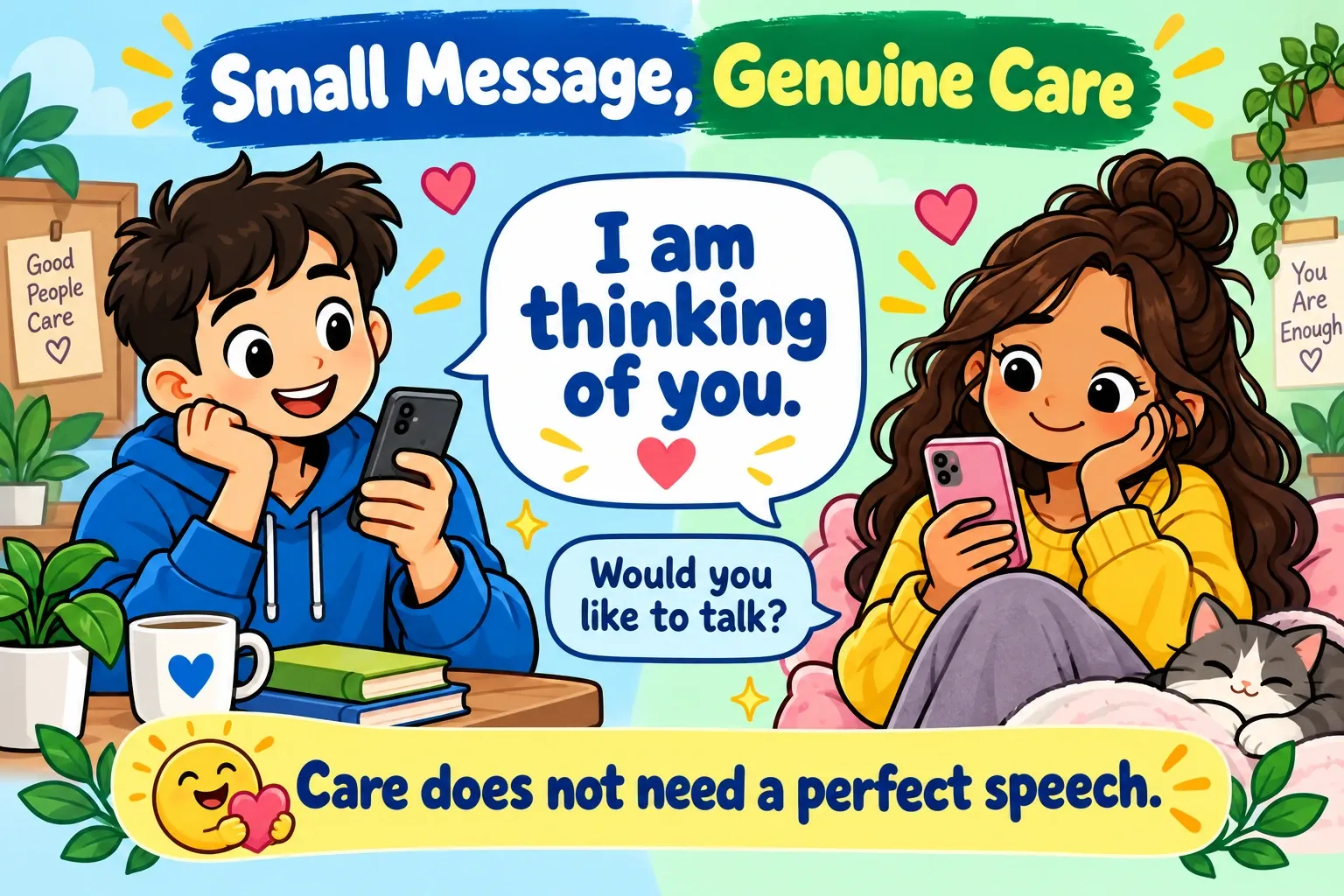
You can, but it is not necessary. “That sounds difficult. Would you like to talk?” may be a more direct invitation. Choose wording you would naturally use with that person, and avoid claiming to understand details they have not shared.
Can sympathy be plural?
Yes. “Please accept my sympathies” is an established way to express condolences, as Cambridge’s sympathy entry shows. Keep the plural for a meaning and phrase that support it; do not mechanically change every use of “sympathy” to “sympathies”.

Naveed Akhtar writes every guide on SynonymQ. He is an SEO content writer with ten years of article-writing experience, working on the question a thesaurus never answers: which of these words belongs in this sentence, for this reader. Every page cites the dictionary entries it draws on and the date they were read.