
Opposite of Risk Averse: 3 Answers, and 1 Common Trap
The opposite of risk averse is risk-taking in plain English and risk-seeking in finance. It is not reckless. Oxford defines risk-averse as unwilling because something bad might happen, and reckless as showing a lack of care about danger, and those are not opposites.
Written by Naveed Akhtar, an SEO content writer with 10 years of article-writing experience. About 8 minutes to read.
Which Half of the Word Are You Negating?
Most answers to this question give one word and stop. The reason there is no single word is that risk-averse is a compound, and you can negate either half of it.
| What you negate | What you get | Example |
|---|---|---|
| The averse half | Still a stance on risk, just the other stance | risk-taking, risk-seeking, risk-tolerant |
| The risk half | Not a stance at all, but an absence of one | reckless, rash, cavalier |
The first row is what people mean. The second row is what they often write, and §4 shows why the dictionary will not let the two stand as equivalents.
The Opposite of Risk Averse in Finance Is a Scale
If you are writing about investing, the terminology is not a pair. It is three positions, and the one in the middle is the one most answers leave out.
| Term | Stance toward risk |
|---|---|
| risk-averse | Evaluates the risk first, and prices safety above return |
| risk-neutral | Decides on expected gain, and is indifferent to the risk attached |
| risk-seeking | Accepts, and may prefer, the uncertain outcome |
Leaving out the middle term is what makes so many answers to this question feel wrong. The opposite of one end of a three-point scale is the other end, but the space between them is where most real behaviour sits.
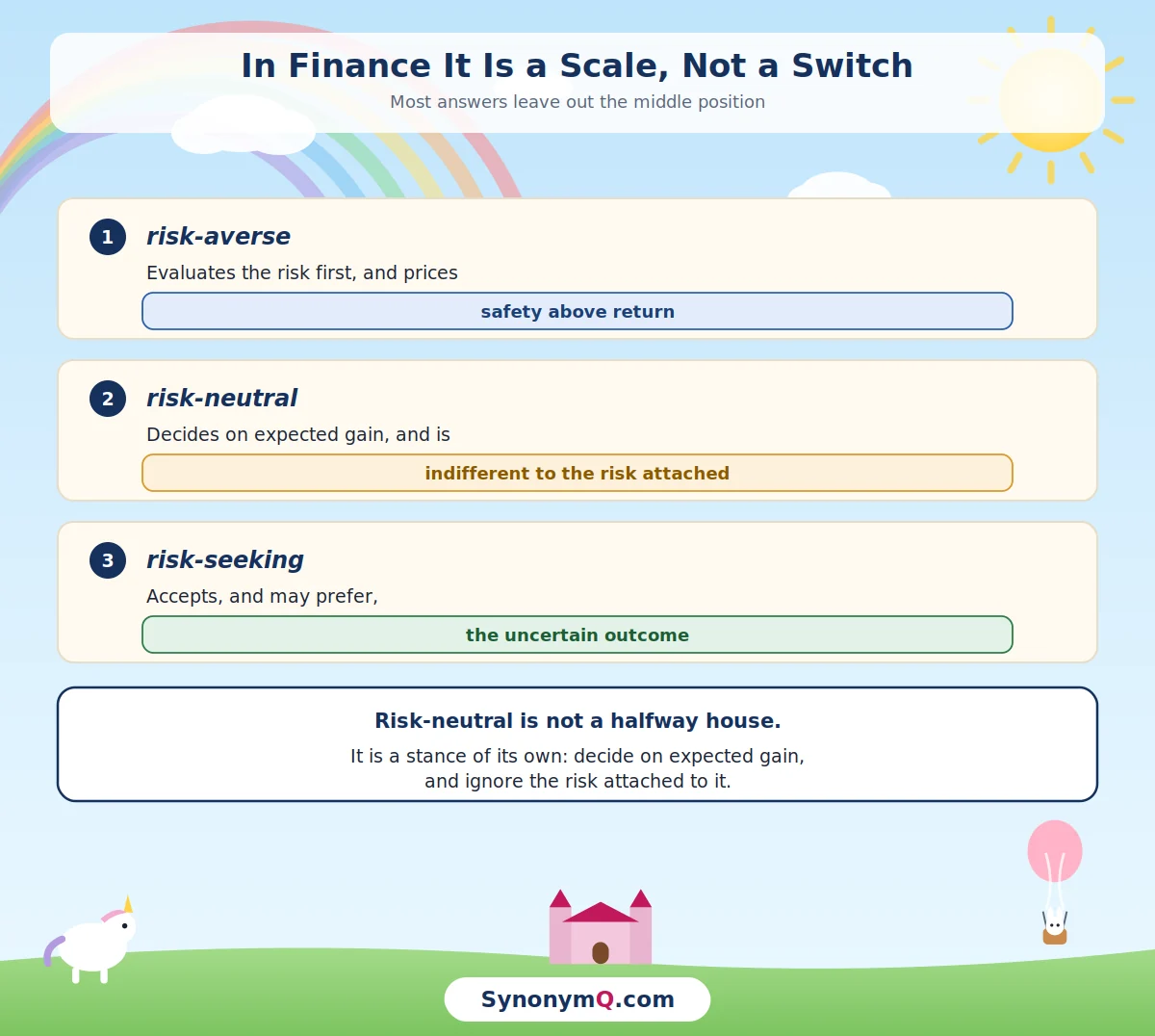
Note also that risk-neutral does not mean moderate. It means indifferent to the risk itself, deciding on expected gain alone, which is a specific stance rather than a halfway house.
“Not Risk-Averse” Does Not Mean the Opposite
There is a shortcut people reach for instead of finding an antonym: just put not in front. It does not land where they expect, and Oxford explains why.
The dictionary gives not averse to (doing) something its own entry, separate from the plain form, and glosses it as “liking something or wanting to do something; not opposed to doing something.”
That is a mild positive, not a strong one. It sits closer to fine with it than to keen on it, which is exactly how the English understatement works in I’m not averse to a second helping.
| Phrase | Where it puts the person |
|---|---|
| risk-averse | Declines the risk |
| not risk-averse | Does not decline it. Nothing more than that |
| risk-seeking | Actively wants it |
So not risk-averse is the negation of the stance, not the reversal of it. If you mean somebody actively pursues risk, the negative will not carry that and you need the far-end word.
Oxford also marks the plain averse to as formal, which is why the negative form is the one you hear far more often in ordinary speech.
The Neutral English Answer Is Risk-Taking
Outside finance, the word you want is usually risk-taking, and the reason is worth seeing in the dictionary text.
Oxford defines it as “the practice of doing things that involve risks in order to achieve something.”
Read that clause again: in order to achieve something. The risk is being accepted for a reason. That is the exact mirror of accepting no risk for a reason, which is what risk-averse describes.
Risk-averse itself is an ordinary English word, not a finance-only one. Oxford’s own examples are “We live in a risk-averse culture” and “In business you cannot be innovative and risk-averse at the same time.”
Reckless Is Not the Opposite, and Here Is the Proof
This is the mistake worth the whole page, and it is settled by putting the two definitions next to each other.
| Word | Definition | What it says about judgement |
|---|---|---|
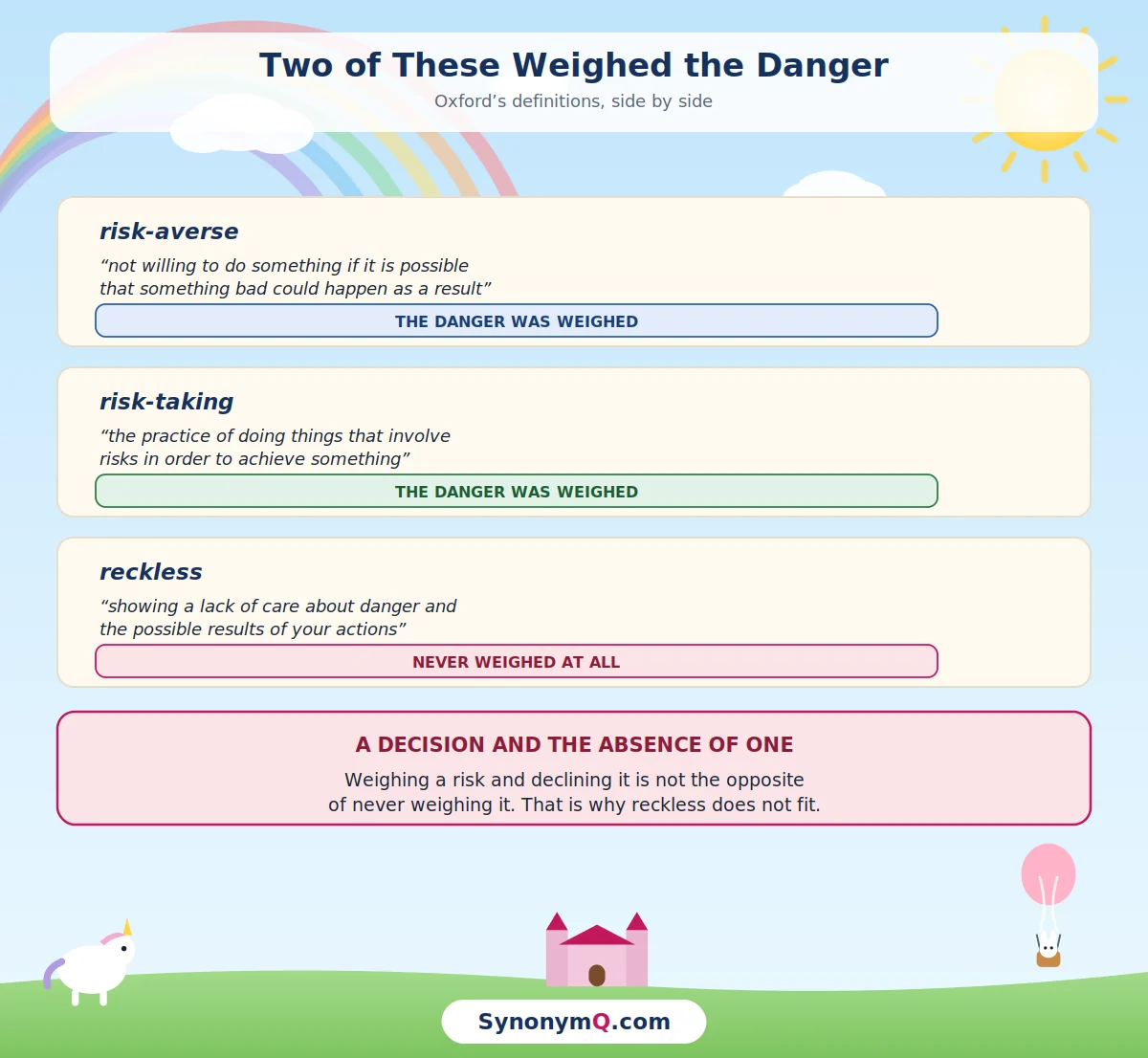
| risk-averse | “not willing to do something if it is possible that something bad could happen as a result” | The danger was weighed, and declined |
| reckless | “showing a lack of care about danger and the possible results of your actions” | The danger was not weighed at all |
Weighing a risk and declining it is not the opposite of never weighing it. One is a decision; the other is the absence of a decision.
The true opposite of weighed it and said no is weighed it and said yes. That is risk-taking, and it is why the dictionary puts in order to achieve something in the definition.
Calling a cautious colleague’s opposite reckless is therefore not a stronger way of saying the same thing. It is a different accusation, and one they can reasonably object to.
Words That Praise and Words That Condemn
Once you leave risk-taking behind, every candidate carries a verdict, and they do not all point the same way.
| Word | Oxford’s gloss | Verdict carried |
|---|---|---|
| risk-taking | “doing things that involve risks in order to achieve something” | None |
| bold | “brave and confident; not afraid… to take risks” | Approval |
| reckless | “showing a lack of care about danger” | Disapproval |
So the choice is not between a mild word and a strong one. It is between describing a stance and grading it, and two of the three common answers grade it.
Words that quietly attach a feeling you did not intend are the same hazard covered at synonyms for alone, and the same reason notable vs noteworthy turns on a single clause.
Choosing in a Real Sentence
Work down this list and stop at the first line that matches.
- Writing about investing or portfolio strategy? Use risk-seeking, and remember that risk-neutral exists between the two ends.
- Describing a person or a culture, neutrally? Use risk-taking. It is the only option with no verdict attached.
- Do you actually mean they are good at it? Use bold or adventurous, and accept that you have praised them.
- Do you actually mean they ignore consequences? Use reckless, but know you have changed the claim, not strengthened it.
- Unsure? Rewrite around the noun: willing to take risks says the thing plainly and commits you to nothing.
| Where | Verdict | Why |
|---|---|---|
| risk-taking and risk-seeking, describing a stance | Direct Swap | Same meaning; the second is simply the finance register |
| risk-taking to bold | Swap With Adjustment | Still accurate, but you have added approval the first word did not carry |
| Either of those to reckless | Requires Rewrite | The claim changes from accepting risk to ignoring it |

If you are weighing how strong a word is rather than which direction it points, the scale at hate vs dislike vs loathe covers that problem for a different emotion.
Frequently Asked Questions
What is the one-word opposite of risk averse?
Risk-taking. In finance writing, risk-seeking. Both describe somebody who has weighed a risk and accepted it, which is the mirror of weighing one and declining it.
Is reckless the opposite of risk averse?
No. Oxford defines reckless as “showing a lack of care about danger and the possible results of your actions.” That is an absence of judgement, not the other side of one, and it carries clear disapproval.
What is risk neutral?
The middle position on the finance scale. A risk-neutral decision is made on expected gain alone, indifferent to the risk attached. It is not a moderate version of the other two but a stance of its own.
Is risk averse a negative term?
Mildly, depending on context. Oxford’s own example, “In business you cannot be innovative and risk-averse at the same time,” uses it as a limitation, but “a risk-averse culture” is closer to neutral description.
Is it “risk averse” or “risk adverse”?
Risk-averse, hyphenated, and it is a headword in Oxford Learner’s. Adverse means unfavourable and describes things, so risk adverse is a common misspelling rather than a variant.
How This Page Was Checked
Read from the sources attributed, on 26 September 2026:
- Oxford Learner’s Dictionaries, risk-averse: the definition, the hyphenation, and both example sentences quoted above.
- Oxford Learner’s Dictionaries, risk-taking: “the practice of doing things that involve risks in order to achieve something.”
- Oxford Learner’s Dictionaries, averse: the separate entry for not averse to (doing) something, its gloss, and the marking of the plain form as formal.
- Oxford Learner’s Dictionaries, reckless: “showing a lack of care about danger and the possible results of your actions.”
- Oxford Learner’s Dictionaries, bold: sense 1, “brave and confident; not afraid to say what you feel or to take risks.”
- WallStreetMojo, Risk Neutral: the three-position scale and the description of risk-neutral as deciding on expected gain while indifferent to risk.
One source could not be retrieved: Investopedia’s entry on risk aversion returned a block. Nothing on this page rests on it, and no claim here has been sourced to a page that was not read.

Naveed Akhtar writes every guide on SynonymQ. He is an SEO content writer with ten years of article-writing experience, working on the question a thesaurus never answers: which of these words belongs in this sentence, for this reader. Every page cites the dictionary entries it draws on and the date they were read.