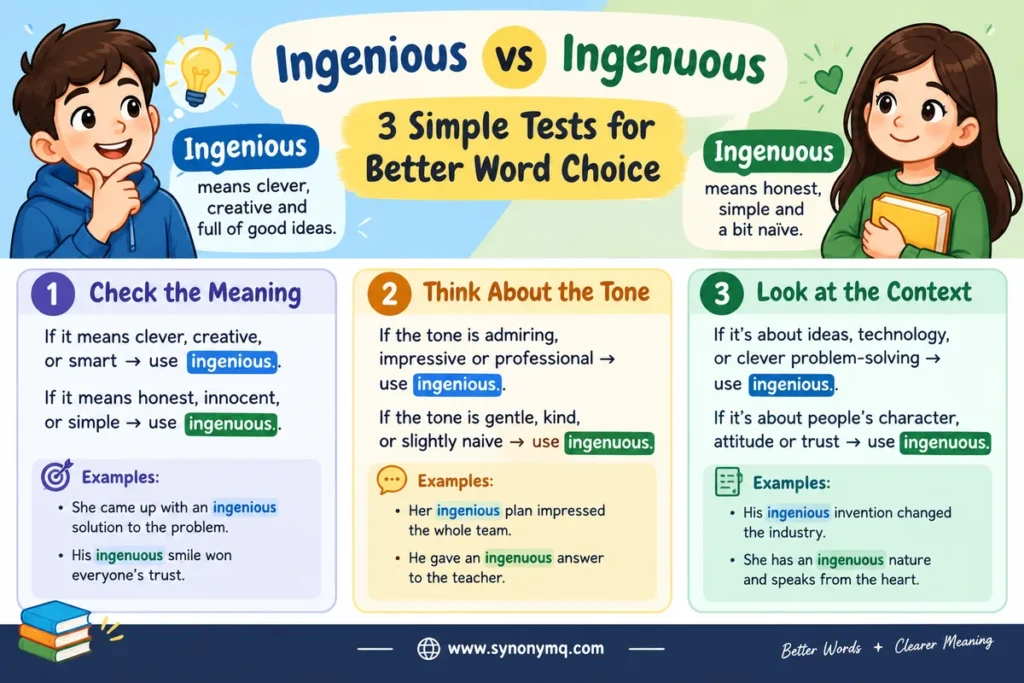
Ingenious vs Ingenuous 3 Simple Tests for Better Word Choice
Ingenious vs ingenuous is a choice between inventive cleverness and innocent openness. Use ingenious for a clever solution; use ingenuous for a candid, unsuspecting person or response. Neither word means the other.

Ingenious vs ingenuous: the central difference
Merriam-Webster’s entry for ingenious connects the word with inventing and finding original ways to accomplish something. The emphasis is on how a person thinks or how a solution works.
In “an ingenious storage system,” the writer is praising the arrangement. Perhaps a small apartment has shelves that fold into a desk. The adjective points to the thought behind the design, rather than simply saying the furniture looks attractive.
Merriam-Webster’s entry for ingenuous emphasizes innocent simplicity and candidness. Here the reader’s attention moves from inventive ability to an unguarded manner or attitude.
In “an ingenuous admission,” the speaker acknowledges something without a calculated attempt to protect their image. Whether that openness seems refreshing or unwise depends on the surrounding situation.
| Point of comparison | Ingenious | Ingenuous |
|---|---|---|
| Main idea | Inventive cleverness | Innocent openness |
| What you notice | The method or thinking | The attitude or manner |
| Illustrative phrase | An ingenious solution | An ingenuous confession |
| Useful paraphrase | Cleverly devised | Candid and unguarded |
| Possible risk | Praising cleverness without evidence | Suggesting naivety when you intend only honesty |
Both adjectives can describe a person. An ingenious mechanic finds an unusual repair; an ingenuous mechanic trusts a customer’s explanation without suspicion. The distinction follows the quality being described, not a people-versus-things rule.
3 simple tests for choosing the right adjective
Test 1: Identify what you are evaluating
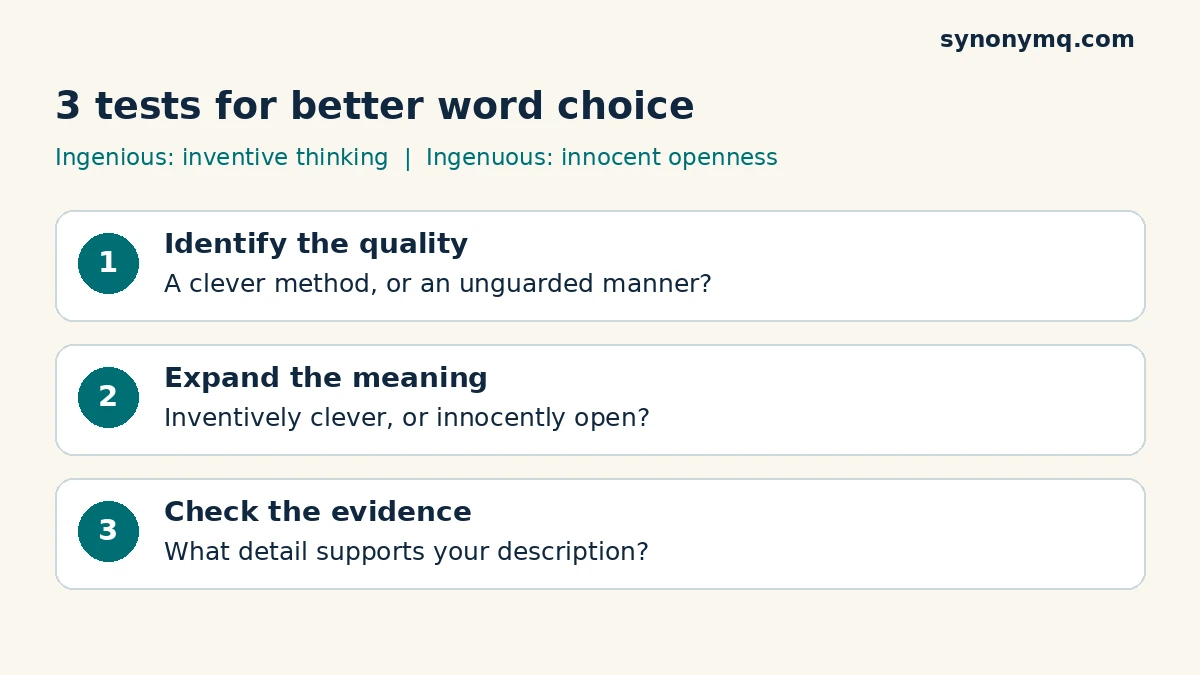
Ask whether the sentence evaluates a solution’s inventiveness or someone’s openness. A new mechanism, resourceful workaround or inventive plot points toward ingenious. A candid confession or unsuspecting reaction points toward ingenuous.
Imagine a colleague builds a simple spreadsheet that eliminates repetitive work. “That was ingenious” praises the solution. “That was ingenuous” would instead require a reason to describe their openness or innocence.
Now imagine the same colleague admits, without prompting, that they forgot to save the original file. An ingenuous admission concerns the manner of confessing. Their honesty does not establish that the admission was inventive.
Test 2: Replace the adjective with a short explanation
Try “inventively clever” in place of ingenious, and “innocently open” in place of ingenuous. These are checking tools rather than perfect replacements for every sentence. The surrounding details should support the explanation.
“She proposed an ingenious repair” becomes “She proposed an inventively clever repair.” If the repair uses an unexpected combination of available parts, the expanded version preserves the intended point.
“He gave an ingenuous answer” becomes “He gave an innocently open answer.” If he reveals his real opinion without realizing the question was a trap, that explanation fits the situation.
If neither paraphrase fits, choose another word. A routine procedure may be effective without being ingenious. A carefully considered truthful statement may be honest without being ingenuous.
Test 3: Check the evidence and the possible implication
Before calling a solution ingenious, identify the clever feature. Before calling a person ingenuous, identify the openness or lack of suspicion. This check prevents an impressive-looking word from replacing a more accurate description.
For a professional reference, “an ingenious approach to scheduling” works when the next sentence explains the inventive arrangement. “An ingenuous employee” can introduce an unintended suggestion of inexperience. Use honest if honesty is all you mean.
A sentence can legitimately contain both words: “The ingenuous inventor discussed her ingenious design before checking the agreement.” Her openness and the design’s inventiveness are separate claims. One does not cancel the other.
Phrase and sentence checks
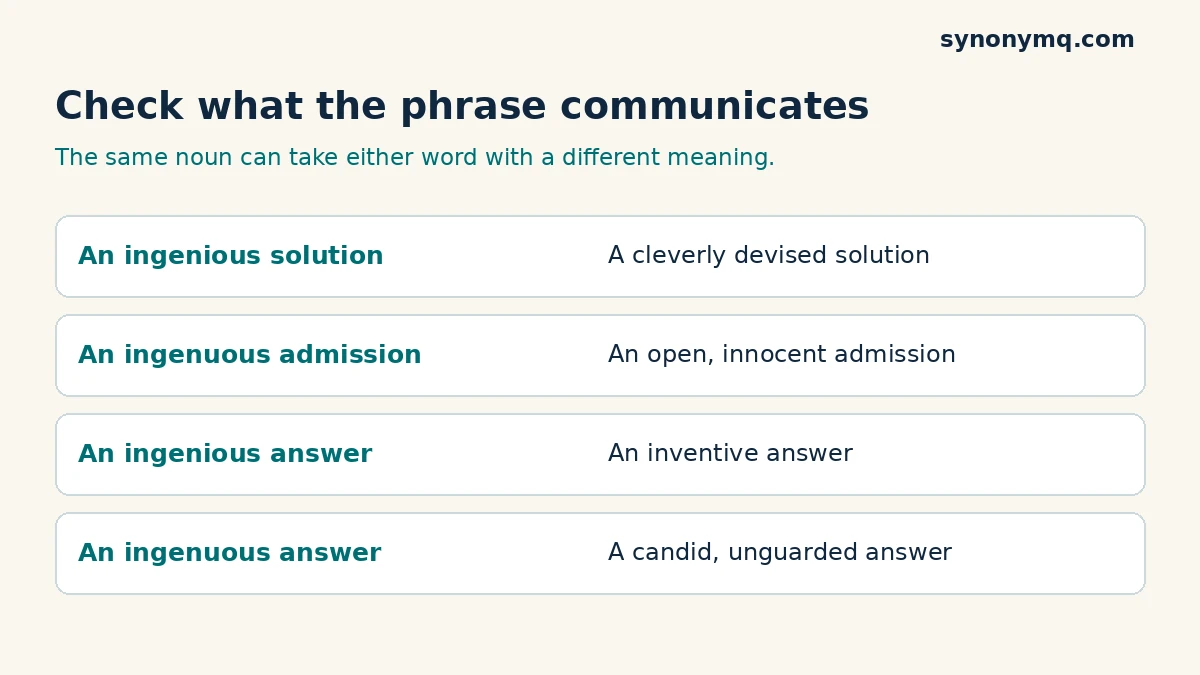
Some nouns take either adjective, but changing the adjective changes the message. An answer can show clever problem-solving or innocent candor. Decide which feature matters before choosing the word.
| Phrase | What the reader understands | Writing decision |
|---|---|---|
| An ingenious plan | The plan uses inventive thinking | Use when explaining a clever method |
| An ingenuous question | The question is innocent or unguarded | Use when the asker’s attitude matters |
| An ingenious answer | The answer cleverly solves or addresses something | Describe what makes it inventive |
| An ingenuous answer | The answer reveals candid simplicity | Check whether naivety is intended |
| An ingenious instrument | The device has a clever design | Useful for an inventive mechanism |
| An ingenuous smile | The expression appears open and innocent | Describes manner, rather than intelligence |
Repair a mistaken compliment
Before: “Your ingenuous solution made the filing system easier to use.”
After: “Your ingenious solution made the filing system easier to use.”
The surrounding claim concerns the solution’s effectiveness and design. Unless the writer intends to describe innocent simplicity, ingenuous sends the compliment in the wrong direction.
Repair a description of innocent trust
Before: “He was ingenious enough to believe the stranger’s unsupported promise.”
After: “He was ingenuous enough to believe the stranger’s unsupported promise.”
The revised adjective makes the intended lack of suspicion clear. However, if the real point is simply that he failed to verify the claim, “He accepted the promise without checking it” may be more precise and less judgmental.
Keep intentional ambiguity under control
“Her explanation was ingenious” can praise a clever account without endorsing its truth. “Her explanation was ingenuous” concerns its candid or innocent character. Neither sentence, by itself, proves that the explanation is factually correct.
Synonyms and alternatives that survive a sentence test
A synonym should preserve the point you want to make. The following suggestions are editorial sentence tests, not a claim that every listed word is interchangeable in every setting.
| Original context | Alternative | Relationship and substitution | What changes |
|---|---|---|---|
| An ingenious repair | A clever repair | Near-synonym; Direct Swap | Broader praise; less emphasis on invention |
| An ingenious designer | An inventive designer | Near-synonym; Direct Swap | Focuses on creating new ideas |
| An ingenious response to shortages | A resourceful response to shortages | Near-synonym; Direct Swap | Highlights making good use of limited resources |
| An ingenuous admission | A candid admission | Near-synonym; Direct Swap | Emphasizes frankness without necessarily suggesting innocence |
| An ingenuous young traveler | A naive young traveler | Near-synonym; Direct Swap | Makes the criticism of judgment more explicit |
| She gave an ingenuous answer | She answered without trying to hide her thoughts | Contextual Alternative; Requires Rewrite | Explains the intended openness directly |
For a design review, inventive or clever may be easier to read. For a performance review, candid or honest can avoid the possible implication that someone lacks experience.
Do not upgrade “clever” to “ingenious” merely to make a sentence sound more educated. Keep the original if it already communicates the right kind of praise. Likewise, choose “naive” only when you intend that criticism.
Word forms and misleading lookalikes
Both main words are adjectives, so either can appear before a noun or after a linking verb. “The method is ingenious” evaluates its design; “The speaker seems ingenuous” evaluates the speaker’s manner.
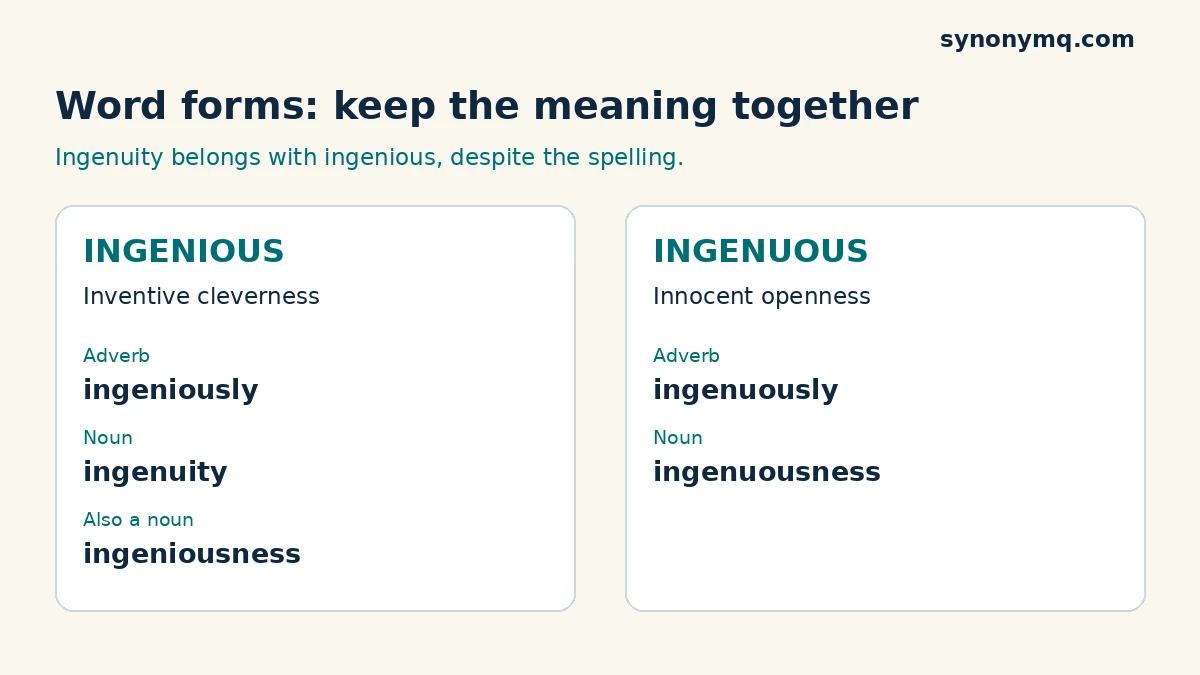
Ingenuity is a noun for inventive ability or cleverness. It belongs with the idea expressed by ingenious, despite the spelling resemblance to ingenuous.
Write “The repair showed ingenuity,” or “The repair was ingenious.” Do not write “The repair was ingenuity”: the linking verb needs an appropriate complement, and this noun does not function as the intended adjective.
| Function | Inventive cleverness | Innocent openness |
|---|---|---|
| Adjective | Ingenious | Ingenuous |
| Adverb | Ingeniously | Ingenuously |
| Noun | Ingenuity; ingeniousness | Ingenuousness |
| Example | They ingeniously redesigned the latch | She ingenuously admitted her mistake |
Genius names exceptional intellectual ability or someone who has it. Calling one workaround ingenious does not require calling its creator a genius. Praise the particular method when that is the evidence you have.
Disingenuous concerns a lack of candor, including a misleading display of innocence. It does not mean “uncreative.” A deliberately evasive answer can be disingenuous even if it is cleverly constructed.
Indigenous concerns originating or occurring naturally in a particular place, among its senses. It is a separate word. A plant’s relationship to its location is different from a design’s inventiveness.
Pronunciation and a reliable spelling reminder
Dictionary.com’s American pronunciation for ingenious can be read as “in-JEEN-yuhs.” Its American pronunciation for ingenuous is “in-JEN-yoo-uhs.” Listen to the linked entries if the contrast is difficult to hear.
The stressed sound differs: think JEEN in ingenious and JEN in ingenuous. Do not rely entirely on sound when proofreading; inspect the vowel after the second n: ingenious versus ingenuous.
As an editorial memory aid, connect “ingenious” with an inventive idea and “ingenuous” with an unguarded response. This is a remembering device, not an explanation of either word’s historical origin.
Practice: choose by the supporting detail
- The engineer’s _____ adapter let two incompatible parts fit together. Choose ingenious. The detail supports inventive problem-solving.
- Her _____ question revealed that she had never considered anyone might cheat. Choose ingenuous. The detail supports an unsuspecting outlook.
- His _____ reply exposed his real feelings before he noticed the room’s reaction. Choose ingenuous. The point is unguarded expression.
- The novelist created an _____ ending that resolved three separate mysteries. Choose ingenious. The praise concerns the construction of the ending.
Try removing the supporting detail from each example. “His answer was _____” does not give enough evidence to choose confidently. Add what the answer accomplished or revealed, and the distinction becomes easier to make.
For another example of adjectives changing a sentence’s focus, see impressive vs impressed.
Frequently asked questions
What is an ingenuous person?
An ingenuous person is openly sincere, innocent or unsuspecting. The description can appreciate unguarded honesty or suggest that the person is too trusting. If you intend only a straightforward compliment about truthfulness, “honest” is clearer.
Why is there an O in ingenious?
The spelling reflects its historical formation, rather than “in” added to the modern word “genius.” Merriam-Webster traces ingenious through French to Latin ingeniosus; Dictionary.com analyzes the Latin form with the adjective suffix -ōsus.
The practical spelling lesson is to retain the ending -ious. “Ingenius” is not the standard spelling of this adjective. The historical explanation does not turn ingenuous into a synonym.
Is ingenious positive or negative?
Ingenious usually praises inventive cleverness, but it does not certify good intentions. “An ingenious fraud” recognizes a scheme’s clever construction while the noun identifies wrongdoing. To judge the whole sentence’s tone, read the adjective with its noun.
What is the difference between ingenious and ingenuity?
Ingenious is an adjective: “an ingenious method.” Ingenuity is a noun: “a method that shows ingenuity.” They describe the same general area of inventive cleverness in different grammatical forms; ingenuity is not the noun for innocent openness.
How this page was checked
Definitions, word forms, pronunciation and the spelling explanation were checked against the linked Merriam-Webster and Dictionary.com entries. The scenarios and sentence replacements are original editorial examples showing how the distinction affects meaning.
Use ingenious when the evidence concerns inventive thinking. Use ingenuous when it concerns innocent openness. When a reader might mistake your intention, name the quality directly: clever, inventive, candid or unsuspecting.

Naveed Akhtar writes every guide on SynonymQ. He is an SEO content writer with ten years of article-writing experience, working on the question a thesaurus never answers: which of these words belongs in this sentence, for this reader. Every page cites the dictionary entries it draws on and the date they were read.