
Tortuous vs Torturous: 3 Simple Tests for Better Word Choice
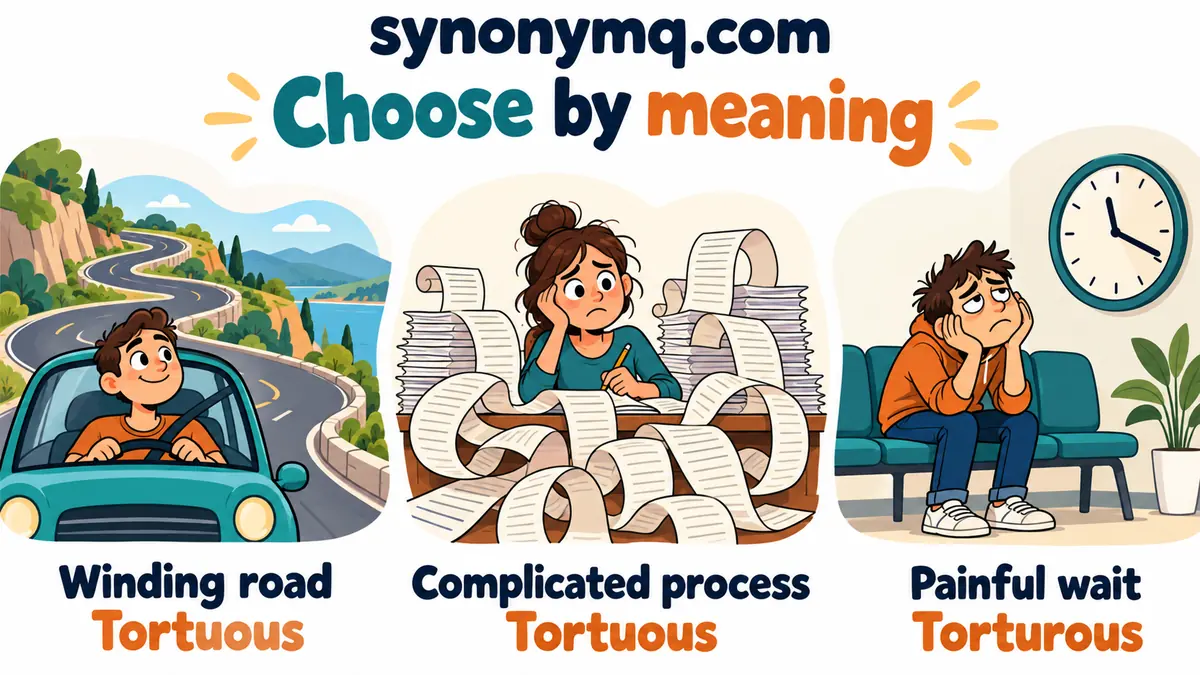
Tortuous vs torturous is a choice between twists and suffering. Use tortuous for a winding road or complicated process; use torturous for a painful or distressing experience. The same journey can fit both words, but each describes a different feature.


- Twisting route: choose tortuous.
- Complicated reasoning or procedure: choose tortuous when the complications resemble twists and turns.
- Painful or distressing experience: choose torturous.
Tortuous vs torturous: twists, complexity and suffering
Cambridge Dictionary’s entry for tortuous covers changes of direction and things that are indirect or complicated. Its physical meaning concerns a shape or course, rather than how that course feels.
A tortuous lane may bend around a hillside. A tortuous explanation may move through qualifications, digressions and exceptions before reaching its point. In the second example, the twists belong to the reasoning.
Merriam-Webster’s entry for torturous includes painful unpleasantness and painfully difficult or slow experiences. The adjective draws attention to suffering, including emotional distress.
A torturous wait might leave someone anxious and exhausted. The waiting room itself need not have a complicated layout. What matters is the person’s experience, so a straightforward event can still be torturous.
| Point of comparison | Tortuous | Torturous |
|---|---|---|
| Main focus | Twists, indirectness or complexity | Pain, distress or painful difficulty |
| Physical example | A winding mountain road | An exhausting, painful journey |
| Figurative example | A tangled explanation | An agonizing wait |
| Useful checking question | Where are the twists? | What causes the suffering? |
| What it does not establish alone | That someone is in pain | That the route is winding |
Merriam-Webster also records an indirect or devious sense of tortuous. A tortuous scheme may suggest crooked methods. Do not apply that implication automatically to every winding route or complicated explanation.
For a neutral description of paperwork, use tortuous when its convoluted structure is the problem. Avoid torturous unless you intend to emphasize distress; it makes a stronger claim about the experience.
3 simple tests that reveal the intended meaning
Test 1: Point to the twists
Look for repeated bends, detours, reversals or complicated stages. If you can identify them, tortuous may be appropriate. A road can have physical bends; a procedure can send an application back through several departments.
Consider: “The permit followed a tortuous approval process.” The sentence fits if each stage introduces another referral or exception. It does not automatically say that the applicant suffered throughout the process.
A simple delay does not establish a winding or complicated process. If an office takes ten days to answer one straightforward request, slow may be more accurate. Use the detail you actually have.
Test 2: Name the suffering
Try explaining what made the situation painful, distressing or extremely unpleasant. If that explanation carries your intended meaning, torturous is the stronger candidate. The source of distress can be physical or emotional.
“The uncertainty made the wait torturous” identifies the experience clearly. “The uncertainty made the wait tortuous” would need a different explanation, such as repeated changes of plan, rather than anxiety alone.
Keep the intensity proportionate. A mildly inconvenient appointment is not necessarily torturous. In a factual report, uncomfortable, frustrating or a precise description may communicate the problem more fairly.
Test 3: Rewrite the reason after “because”
Add a brief reason to your draft. “The route was tortuous because it repeatedly doubled back” identifies twists. “The journey was torturous because every step hurt” identifies suffering. Your reason should support your adjective.
If the reason names both features, decide which matters in this sentence. You can write about a tortuous route in one sentence and the torturous experience of traveling it in the next. Neither adjective cancels the other.
If the reason only says “because it was difficult,” explain the difficulty more precisely. Complicated instructions, physical strain and a long delay are different problems. Their shared inconvenience does not make the two adjectives interchangeable.
When the same journey supports both descriptions
The extra r changes the focus, even when the noun stays the same. A tortuous journey has twists or complications; a torturous journey causes suffering. Read the surrounding detail before deciding that one spelling is wrong.
| Phrase | What the writer emphasizes | Supporting detail |
|---|---|---|
| A tortuous route | The route’s winding course | The lane bends around several ridges. |
| A torturous journey | The traveler’s suffering | The traveler struggles with painful blisters. |
| Tortuous negotiations | Complicated bargaining | Each concession reopens an earlier agreement. |
| Torturous negotiations | Painfully difficult bargaining | The prolonged uncertainty causes severe distress. |
| A tortuous argument | Indirect reasoning | The explanation depends on several tangled exceptions. |
| A torturous argument | A distressing dispute | The exchange leaves both participants deeply upset. |
The last pair also shows why the noun matters. Argument can mean a line of reasoning or a disagreement. Explain which you mean, especially when a reader could interpret the adjective in more than one way.
“The negotiations were long” leaves both questions open. Length alone tells us neither how complicated the bargaining was nor how painful it felt. Add concrete evidence rather than choosing the more dramatic adjective.
For travel writing, describe a tortuous road when its bends shape the route. Use a separate sentence for nausea, exhaustion or discomfort. This gives readers both facts without asking one adjective to communicate everything.

Synonyms and alternatives that preserve your sentence
Choose a replacement for the particular meaning you intend. The labels below apply to the stated example, rather than promising that two words fit every sentence. A direct swap can still change the tone or emphasis.
| Alternative | Relationship | Substitution | Example and limitation |
|---|---|---|---|
| Winding | Near-Synonym: physical course | Direct Swap | “A tortuous road” becomes “a winding road.” Clearer in everyday description; does not express tangled reasoning. |
| Circuitous | Near-Synonym: indirect route | Direct Swap | “A tortuous route” becomes “a circuitous route.” Emphasizes indirectness; a circuitous detour need not have many bends. |
| Convoluted | Near-Synonym: tangled reasoning | Direct Swap | “A tortuous explanation” becomes “a convoluted explanation.” Focuses on complexity, rather than suffering. |
| Complicated | Near-Synonym: complex procedure | Direct Swap | “A tortuous process” becomes “a complicated process.” Broader and plainer; loses some suggestion of indirect turns. |
| Hard to follow | Contextual Alternative | Requires Rewrite | “A tortuous explanation confused us” becomes “The explanation was hard to follow and confused us.” Difficulty may have causes other than convoluted structure. |
For directions to a visitor, winding is usually the clearest choice for a road with many bends. For feedback on an explanation, convoluted points to its tangled construction. These are editorial recommendations for those contexts.
| Alternative | Relationship | Substitution | Example and limitation |
|---|---|---|---|
| Painful | Near-Synonym | Direct Swap | “A torturous recovery” becomes “a painful recovery.” Names pain directly; can sound less intense in this sentence. |
| Agonizing | Near-Synonym | Swap With Adjustment | “A torturous wait” becomes “an agonizing wait.” Preserves strong distress; adjust “a” to “an.” |
| Distressing | Near-Synonym: emotional suffering | Direct Swap | “A torturous experience” becomes “a distressing experience.” Identifies emotional upset without necessarily conveying extreme pain. |
Arduous is a Related Word for something requiring great effort, but effort alone is not suffering. A demanding hike can be enjoyable. Do not replace torturous with arduous when pain is the main fact you need to preserve.
Keep tortuous when the image of twists usefully describes your reasoning. Keep torturous when the distress and intensity are justified. A plainer alternative helps when it makes the intended problem easier to understand.
For other ways to describe complexity, see alternatives to complex. Choose them by the meaning of the sentence, rather than treating every related adjective as interchangeable.
Reading tortuous in a medical description
In its medical entry, Merriam-Webster uses tortuous for repeated bends or turns, including in a blood vessel. Here the adjective describes a course or shape.
Accordingly, “tortuous veins” describes veins with a winding or twisting course. The word itself does not mean “painful veins.” Replacing it with torturous would change an anatomical description into a statement about suffering.
Cleveland Clinic’s explanation of a tortuous aorta likewise describes twists or turns in the artery. This supports the shape-based meaning; it does not make every use of tortuous the same diagnosis.
When editing a medical report, retain its precise anatomical wording. The adjective alone does not establish the cause, severity or treatment of a finding. Those depend on the full report and clinical interpretation.
Tortuous, torturous and tortious in legal writing
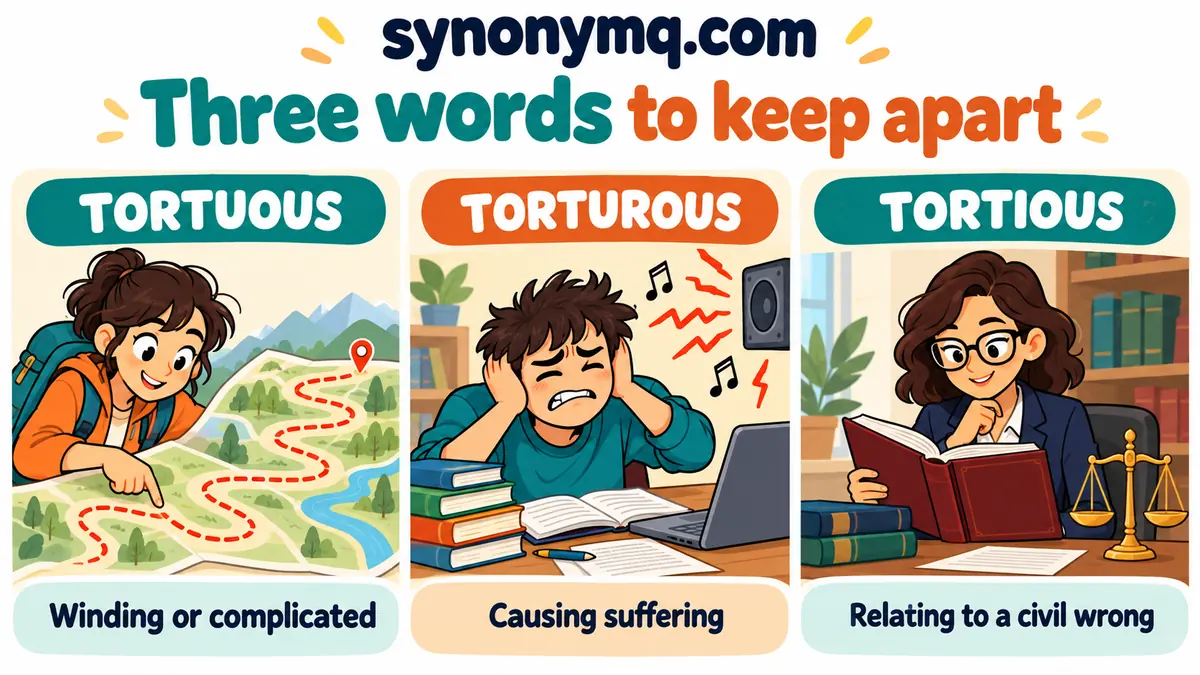
Tortious is a third word with a separate legal meaning. Cornell’s Legal Information Institute defines tortious as describing behavior that constitutes a tort, a civil wrong.
A tortuous legal explanation is complicated or indirect. A torturous legal experience is distressing. Alleged tortious conduct concerns a civil wrong. The shared opening letters do not make the three expressions equivalent.
- Tortuous: “The explanation of the procedure was tortuous.” The criticism concerns its complexity.
- Torturous: “The prolonged uncertainty was torturous for the family.” The sentence emphasizes suffering.
- Tortious: “The complaint alleged tortious conduct.” The sentence uses the legal adjective without deciding whether the allegation is proved.
For a sentence about a civil wrong, use tortious. Avoid tortuous because it directs the reader toward twists or indirectness. Do not call conduct tortious merely because a procedure is difficult or unpleasant.
Pronunciation, grammar and the extra r
Cambridge publishes the following UK and US pronunciations for tortuous and torturous. The plain respellings are approximate listening aids.
| Word | UK IPA | US IPA | Approximate sound |
|---|---|---|---|
| Tortuous | /ˈtɔː.tʃu.əs/ | /ˈtɔːr.tʃu.əs/ | TOR-choo-uhs |
| Torturous | /ˈtɔː.tʃər.əs/ | /ˈtɔːr.tʃər.əs/ | TOR-chuh-ruhs |
Both words have first-syllable stress in these pronunciations. The endings differ, but a hurried conversation may make the distinction hard to catch. Listen to the dictionary audio and inspect the spelling when proofreading.
Both are adjectives. Write “a tortuous path” or “the path is tortuous.” Write “a torturous experience” or “the experience was torturous.” Their grammatical position can match while their meanings remain different.
A search such as “what is a tortuous” usually needs the adjective’s meaning. In a full sentence, add the noun you intend: a tortuous route, process or explanation. The adjective does not itself name the object.
The corresponding adverbs are tortuously and torturously, recorded in the linked Merriam-Webster entries. In “tortuously worded instructions,” the adverb concerns the wording’s complexity. Often, “complicated instructions” is simpler.
As a spelling reminder, connect torturous with torture and its additional r. This is a memory aid for suffering, not a claim that literal torture must be involved whenever the adjective appears.
Four revisions for situations writers actually describe
A complaint about paperwork
Draft: “The booking form was torturous.” More precise: “The booking form was tortuous: each answer sent us to another section.” The revision identifies complicated structure rather than assuming severe distress.
A description of an unpleasant sound
Draft: “The squeal was tortuous to hear.” Correction: “The squeal was torturous to hear.” The intended complaint concerns a painfully unpleasant experience, not the sound’s route or structure.
A route that is simply long
Draft: “We took a tortuous train journey.” If duration is the only fact: “We took a long train journey.” Use tortuous for an indirect or complicated route; use torturous if the journey causes suffering.
A work message that needs a calmer tone
Draft: “Your approval system is torturous.” More useful: “The approval system has several confusing stages.” This rewrite names a fixable problem and avoids exaggerating the emotional impact.
Read the noun, adjective and supporting reason together. If you cannot point to twists or suffering, a more specific description may solve the sentence. For other spelling lookalikes, browse commonly confused English words.
How this page was checked
Definitions and word forms were checked against Cambridge and Merriam-Webster. Cambridge supplied the UK and US IPA; Cornell supported the legal distinction, and Cleveland Clinic supported the anatomical example.
The situations and replacement sentences are original editorial examples. Their recommendations depend on the stated context. The three tests are practical editing aids, rather than separate dictionary rules.
Frequently asked questions
What does “tortuous” mean?
Tortuous means winding, indirect or complicated. It can describe physical bends, as in a tortuous road, or figurative twists, as in a tortuous explanation. It does not by itself mean painful; use torturous when suffering is the intended focus.
What does tortuous mean in legal terms?
In legal writing, tortuous can describe complicated or indirect reasoning or procedure. For conduct involving a civil wrong, the word is tortious. A tortuous explanation is not automatically a tortious act; the words describe different things.
What does torturous mean?
Torturous means painfully unpleasant, distressing or painfully difficult. It can describe physical suffering or emotional discomfort, such as an agonizing wait. Literal torture is not necessary, but the word is stronger than inconvenient.
What is another word for tortuous?
For a road, winding is a clear alternative. For an indirect route, circuitous may fit. For tangled reasoning, try convoluted; for a procedure, complicated may be plainer. Choose by context, because each replacement preserves a different part of the meaning.

Naveed Akhtar writes every guide on SynonymQ. He is an SEO content writer with ten years of article-writing experience, working on the question a thesaurus never answers: which of these words belongs in this sentence, for this reader. Every page cites the dictionary entries it draws on and the date they were read.