
Another Word for Complex: Pick the Sense, Then the Word
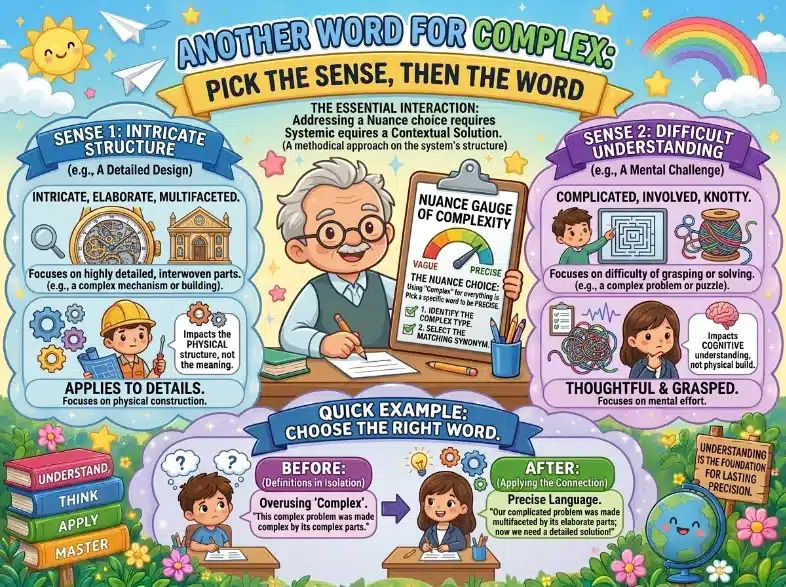
Another word for complex depends which sense you mean: Merriam-Webster lists fifteen, across three parts of speech. For the everyday adjective, complicated, intricate, involved and knotty all fit, and all four add a criticism that complex does not.
By Naveed Akhtar, an SEO content writer with 10 years of article-writing experience · Updated 16 September 2026 · About 8 minutes
Fifteen Senses, One List
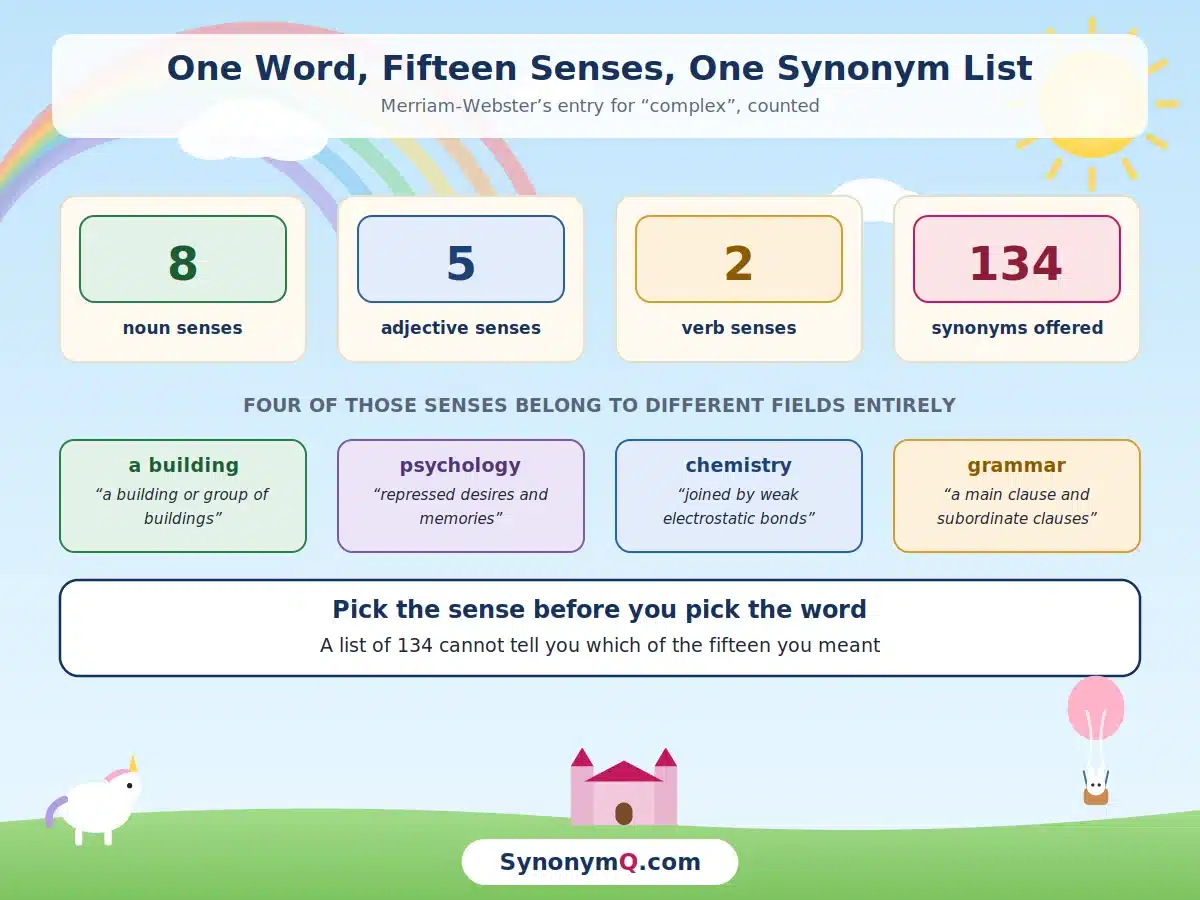
Count what Merriam-Webster actually records under this one word. Eight senses as a noun, five as an adjective, two as a verb.
Its thesaurus offers 134 synonyms. The list is not sorted by sense, so it cannot tell you which of the fifteen you meant, and most entries on it are wrong for your sentence.
So the useful first move is not to open a thesaurus. It is to decide which sense you are using. Once that is settled the shortlist is usually three or four words, and often none.Four of Those Senses Are Other Subjects Entirely
The reason the head term is so crowded is that four senses belong to fields with nothing in common.
| Field | What the dictionary says | Substitution |
|---|---|---|
| Buildings | “a building or group of buildings housing related units” | None. An apartment complex is not an apartment intricate |
| Psychology | “a group of repressed desires and memories that exerts a dominating influence upon the personality” | None. An inferiority complex is a fixed term |
| Chemistry | “a chemical association of two or more species joined usually by weak electrostatic bonds” | None. A technical term with a definition |
| Grammar | A sentence “consisting of a main clause and one or more subordinate clauses” | None. A complex sentence is a category, not a judgement |
That last one matters more than it looks. A complex sentence is not a difficult sentence. It is a sentence with a subordinate clause in it, and the shortest ones are three words long.
Worth knowing before you search. These senses are why a search for synonyms returns Wikipedia pages about buildings, psychology and mathematics alongside the thesaurus entries. The query has no single intent to satisfy.Merriam-Webster Ranks the Five. The Thesaurus Just Lists Them.
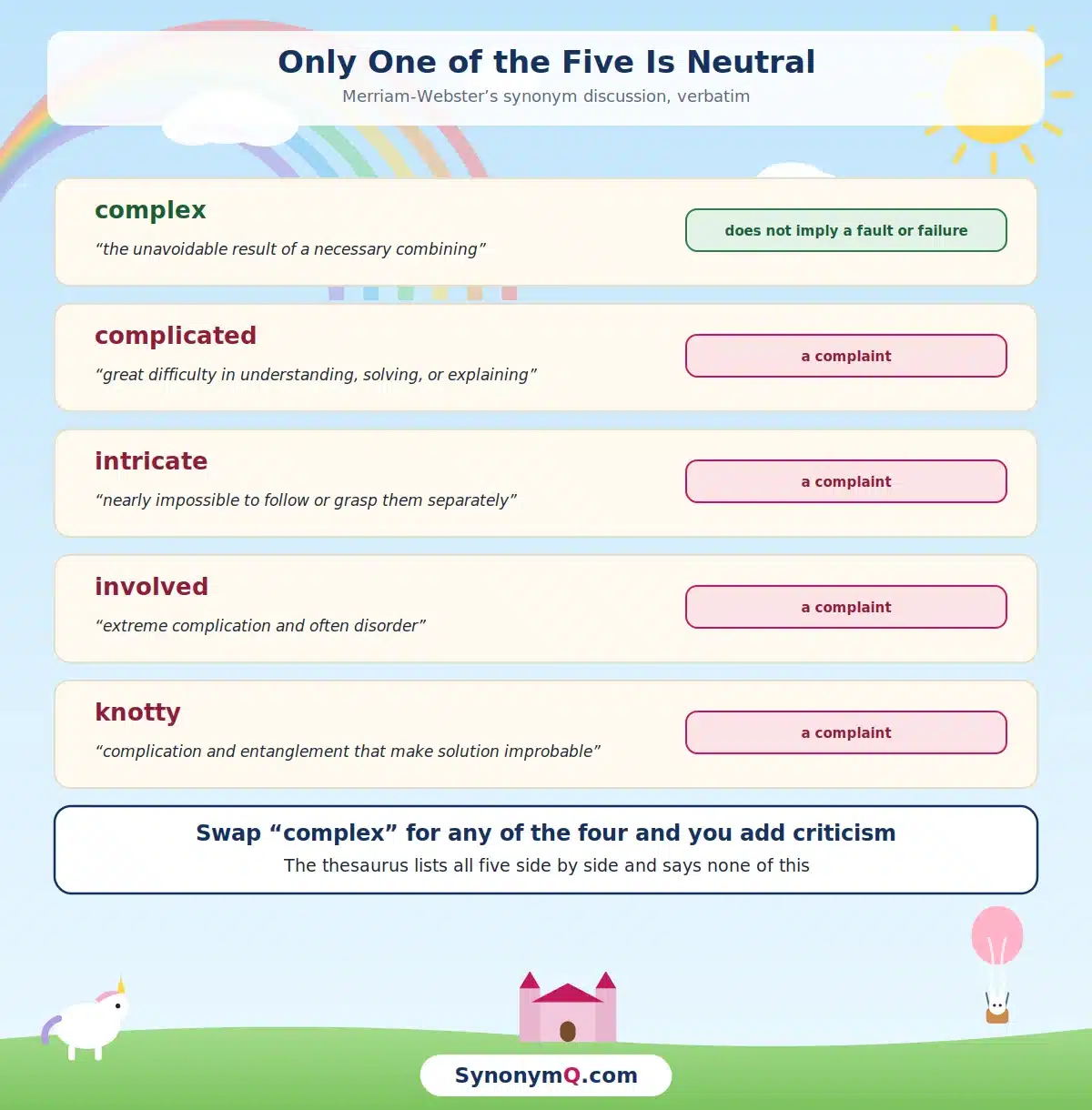
Merriam-Webster does not simply list the near neighbours. It separates them, and the separation is the most useful thing on this page.
complex, complicated, intricate, involved, knotty mean having confusingly interrelated parts.
Complex suggests the unavoidable result of a necessary combining and does not imply a fault or failure.
Complicated applies to what offers great difficulty in understanding, solving, or explaining.
Intricate suggests such interlacing of parts as to make it nearly impossible to follow or grasp them separately.
Involved implies extreme complication and often disorder.
Knotty suggests complication and entanglement that make solution or understanding improbable.
Merriam-Webster, synonym discussion at complexRead the first line again. Complex is the only one of the five that carries no complaint. The other four all describe a difficulty, a disorder or a failure to follow.
Neutral. Describes the thingThe approval process is complex. Now a criticism of the processThe approval process is complicated.Those two sentences do not differ in formality or strength. The second one blames somebody, and in a document that goes to the people who designed the process, that difference is not small.
Which reverses the usual advice. If you were told to vary your wording, varying it here inserts a judgement you may not have meant. Repeating complex is often the more accurate choice.“Many Parts” and “Hard to Follow” Are Different Claims
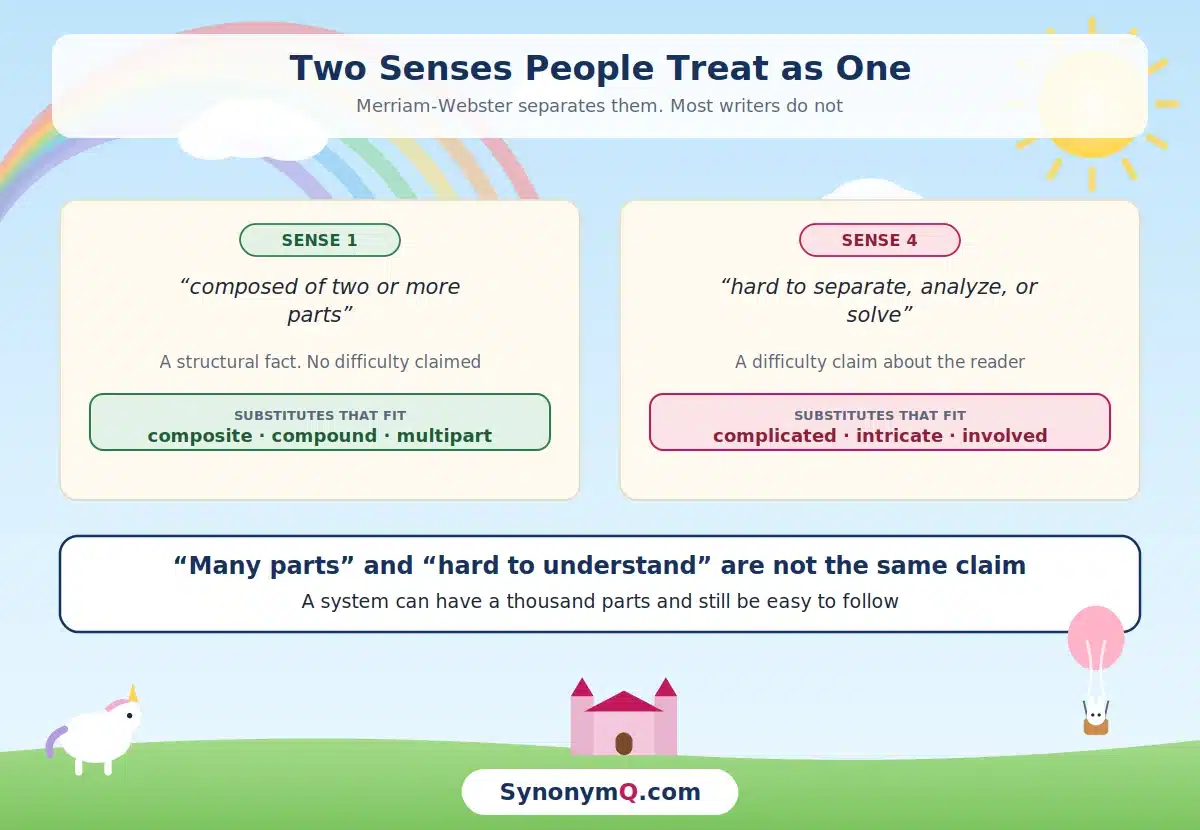
Within the adjective alone, Merriam-Webster gives two senses that look similar and are not.
| Sense | What it asserts | Words that fit |
|---|---|---|
| Sense 1: “composed of two or more parts” | A structural fact. No difficulty claimed | composite · compound · multipart |
| Sense 4: “hard to separate, analyze, or solve” | A difficulty, felt by whoever reads it | complicated · intricate · involved |
Oxford runs the two together in a single gloss, “made of many different things or parts that are connected; difficult to understand”. Merriam-Webster keeps them apart, and keeping them apart is more useful.
A system can have a thousand parts and still be easy to follow. A two-part rule can be impossible. Parts count and difficulty are separate facts about a thing.
This inference is mine, not a dictionary label. Merriam-Webster separates the senses; it does not say writers conflate them. That claim is testable on your own drafts by asking, each time, whether you meant “has parts” or “is hard”.Another Word for Complex, Sense by Sense
With the sense settled, the shortlist is short. Sorted by what you mean rather than by how the word sounds.
| What you mean | Use | Why | Label |
|---|---|---|---|
| Many interrelated parts, no complaint | Keep complex | The only neutral word in the set | Direct Swap |
| Built from parts, plainly | composite · compound · multipart | Structural, and no difficulty implied | Direct Swap |
| Genuinely hard to understand | complicated | “Great difficulty in understanding, solving, or explaining” | Swap With Adjustment |
| Finely detailed, admiringly | intricate | Carries craftsmanship as well as difficulty | Swap With Adjustment |
| Tangled, and you mean to say so | involved · knotty | “Extreme complication and often disorder” | Requires Rewrite |
| You cannot say which | Name the parts | Usually the real fix | Requires Rewrite |
The last row is the honest one. “The onboarding is complex” carries less information than “onboarding needs four approvals across three teams”, and the second is shorter than most of the alternatives.
Choosing by what a word commits you to, rather than by register, is the same method that separates aspect, factor and element.
Complex or Complicated?
This is the question most people arrive with, and the dictionary answers it in one line each.
| complex | complicated | |
|---|---|---|
| Core sense | “Composed of two or more parts” | “Consisting of parts intricately combined” |
| What it implies | No fault or failure | Difficulty in understanding, solving or explaining |
| First known use | Circa 1652 | 1656 |
| Use it when | The thing has parts and that is fine | The thing is hard, and you are willing to say so |
Four years apart, and both from the same period of borrowing from Latin. They did not diverge in meaning over centuries; they arrived carrying different weights.
An adjective pair that splits on what it commits the writer to is the same shape as systemic versus systematic.
When the Noun Takes No Substitute
If complex is a noun in your sentence, stop looking. The noun senses are names, not descriptions.
Apartment complex, sports complex, inferiority complex, complex numbers: each is a fixed term, and swapping the word produces something that is not English rather than something less formal.
The quick test. If you can put a or the in front of it, you have the noun, and no synonym applies. If it sits before another noun or after is, you have the adjective, and the shortlist above is yours.Checking the part of speech before the meaning saves a wasted search, which is the same first step as impressive versus impressed.
Frequently Asked Questions
What is the best single synonym for complex?
There is not one, because the word has fifteen senses. For the everyday adjective meaning “hard to understand”, complicated is closest, and it adds a criticism that complex avoids.
Is complex the same as complicated?
No. Merriam-Webster says complex “does not imply a fault or failure”, while complicated means “great difficulty in understanding, solving, or explaining”. One describes, the other complains.
What is a more formal word for complex?
Formality is the wrong axis. All five words in the set sit at a similar register, and they differ in what they accuse the thing of, not in how formal they sound.
Does complex mean difficult?
Only in one of its senses. Merriam-Webster’s first adjective sense is “composed of two or more parts”, which claims nothing about difficulty at all.
What is another word for complex in an essay?
The same shortlist applies, and the advice does not change for academic writing. If you cannot say which sense you mean, naming the parts beats every alternative, as it does at reality, truth and fact.
How This Page Was Checked
Read from the sources attributed, on 16 September 2026:
- All fifteen senses across three parts of speech, the subject-field senses for buildings, psychology, chemistry and grammar, the synonym discussion quoted above, and the circa 1652 dates — Merriam-Webster.
- The definitions of complicated and its 1656 date — Merriam-Webster.
- The single combined adjective gloss and the grammar sense — Oxford Learner’s Dictionaries.
- The count of 134 synonyms is the figure the Merriam-Webster Thesaurus reported for this headword on the day of writing.
One inference on this page is reasoning rather than a retrieved fact, and it is labelled where it appears: that writers merge the “many parts” and “hard to understand” senses. The dictionary separates them; it does not comment on what writers do.
No claim is made about which word a particular journal, style guide or supervisor prefers. Those vary, and a supervisor’s preference outranks a dictionary.
Written by Naveed Akhtar, an SEO content writer with 10 years of article-writing experience.
Target topic: choosing among near-identical adjectives when only one of them avoids blaming the thing

Naveed Akhtar writes every guide on SynonymQ. He is an SEO content writer with ten years of article-writing experience, working on the question a thesaurus never answers: which of these words belongs in this sentence, for this reader. Every page cites the dictionary entries it draws on and the date they were read.