
Aspect vs Factor vs Element: Which One Fits Your Sentence
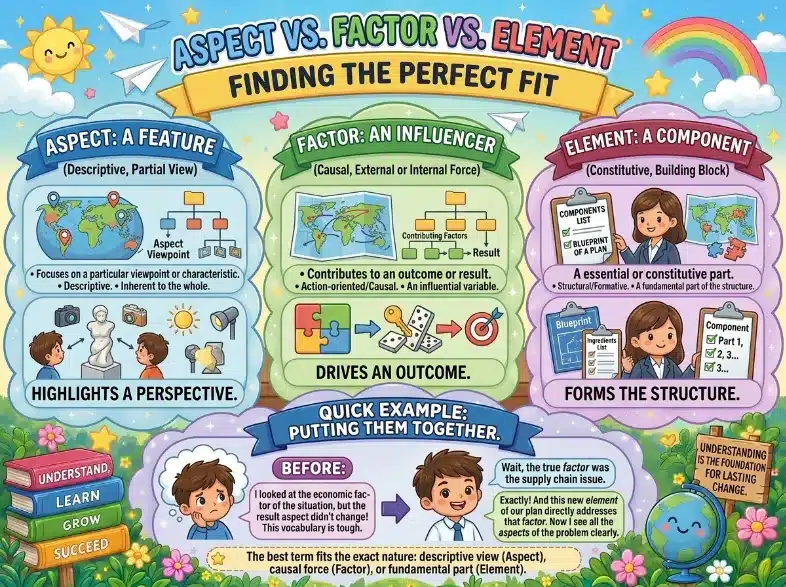
On aspect vs factor vs element, the three are not interchangeable. A factor causes or contributes to something. An element is a part of it. An aspect is a way of looking at it, and it asserts nothing at all.
By Naveed Akhtar, an SEO content writer with 10 years of article-writing experience · Updated 16 September 2026 · About 8 minutes
Three Words That Make Three Different Promises
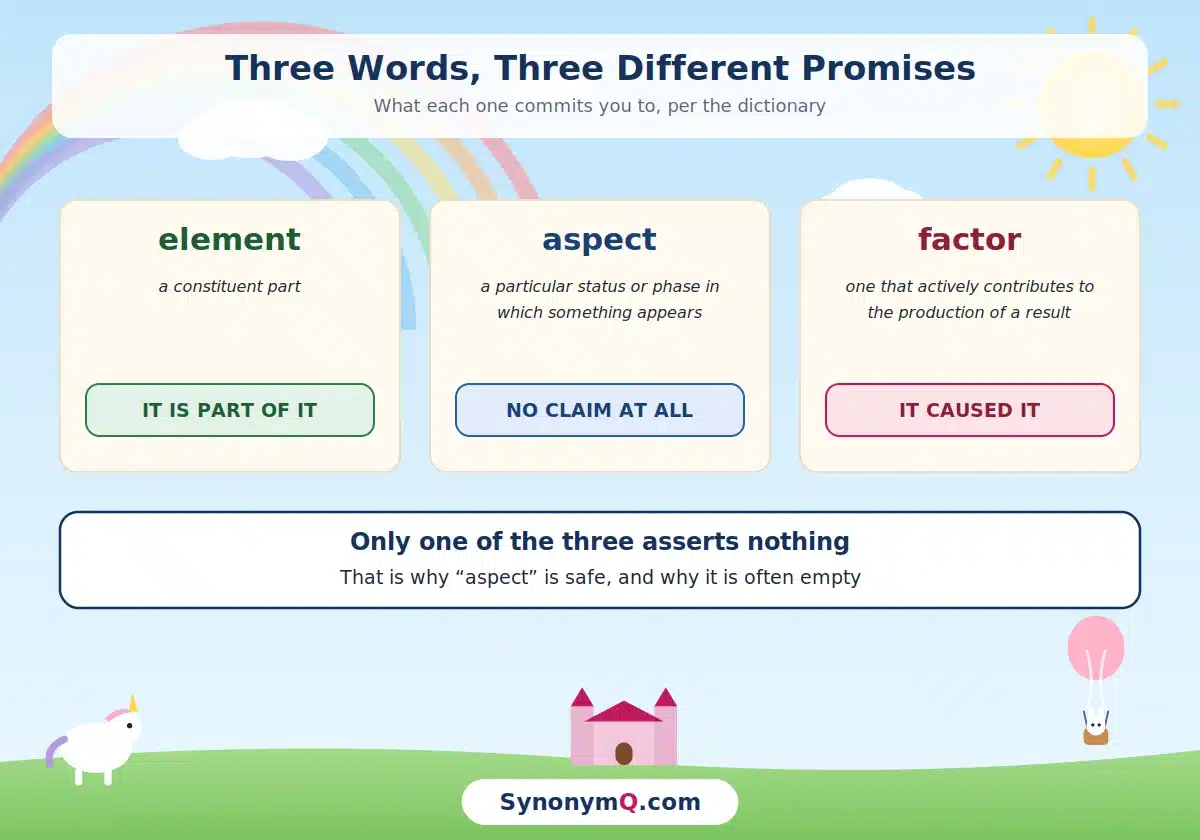
These words get treated as a menu of ways to say “thing about something”. The dictionaries attach each one to a different relationship, and each relationship is a different claim.
| Word | The dictionary anchor | What you are claiming |
|---|---|---|
| factor | MW: “one that actively contributes to the production of a result” · Oxford: “one of several things that cause or influence something” | Causation |
| element | MW: “a constituent part” · Oxford: “a necessary or typical part of something; one of several parts that something contains” | Composition |
| aspect | MW: “a particular status or phase in which something appears or may be regarded“ | Nothing |
Causation and composition are different relationships. Rain is a factor in the delay. The loading bay is an element of the site. Swapping those two round produces nonsense, not a synonym.
And aspect is not a weaker version of either. It sits outside the pair. It tells the reader where you were standing when you looked, and nothing about the thing you looked at.A Part, a Looking and a Doer
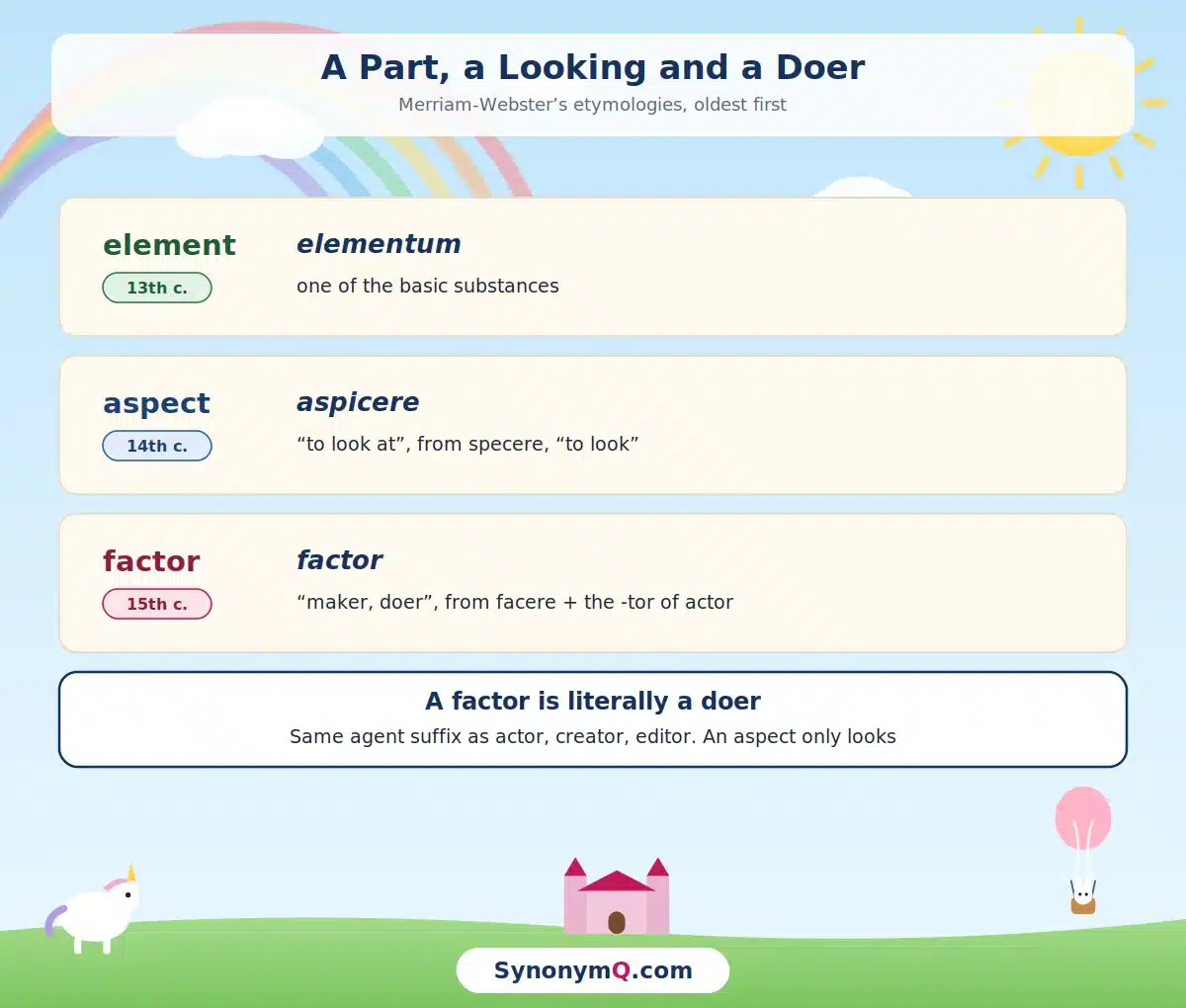
The etymologies are unusually clean here, and they carry the distinction better than any usage rule does.
| Word | First known use | Latin root | What the root means |
|---|---|---|---|
| element | 13th century | elementum | One of the basic substances things are made of |
| aspect | 14th century | aspicere | “To look at”, from ad- plus specere, “to look” |
| factor | 15th century | factor | “Maker, creator, perpetrator”, from facere, “to make, bring about, do” |
Look at the suffix on factor. It is -tor, the agent ending in actor, creator and editor. A factor is literally a doer.
Merriam-Webster’s first sense of factor is still a person: “one who acts or transacts business for another”, a broker. The causal sense grew out of an agent, which is why it carries agency.
Aspect has no agency anywhere in it. Its other senses are “appearance to the eye or mind”, “a position facing a particular direction”, and an archaic sense that is simply “an act of looking: gaze”.
The family resemblance is the giveaway. Aspect shares its root with inspect, spectator and perspective. Every one of those is about the viewer, not the thing viewed.Why “Aspects” Reads as Filler
This is the complaint behind most searches for a replacement, and the dictionary explains it exactly.
“The report examines various aspects of the problem” tells a reader that the report looked at the problem from some directions. It names none of them and claims nothing that could be checked.
That is not a stylistic weakness. It is the word working correctly. Aspect is built to describe a viewpoint, so a sentence whose only content is aspects has said that a viewpoint existed.
This part is reasoning, not a dictionary label. No dictionary calls aspects filler. The argument is that a word defined by appearance rather than substance will read as empty when it carries the weight of a sentence, and you can test it on your own drafts.A stance phrase that stands in for evidence is a related but separate problem, and it is covered at another word for I believe in an essay.
The Swap That Quietly Adds a Claim
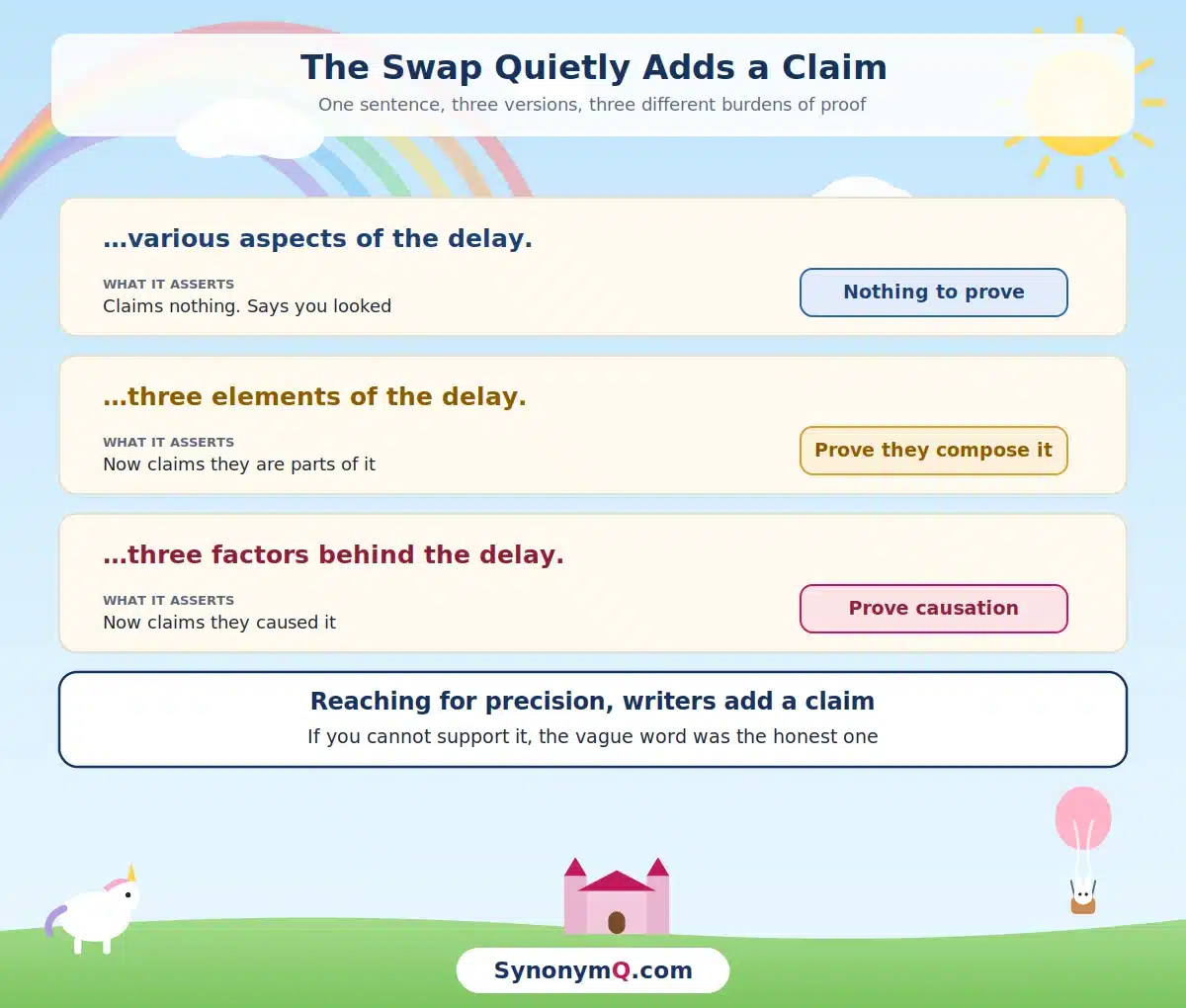
Here is the trap. A writer who feels aspects is vague reaches for a sharper word, and the sharper word smuggles in an assertion.
| Version | What it asserts | What you now have to support |
|---|---|---|
| We looked at various aspects of the delay. | That you looked | Nothing |
| We identified three elements of the delay. | That these are parts of it | That they compose it |
| We identified three factors behind the delay. | That these caused it | Causation |
The third sentence is the strongest and the most exposed. If the three things merely coincided with the delay, factors is an overclaim and a careful reader will say so.
The rule that follows. Upgrade from aspect only when you can support the upgrade. If you cannot, the vague word was the honest one, and the real fix is in the next section.Choosing a word by what it commits you to, rather than by how precise it sounds, is the same discipline as systemic versus systematic.
Aspect vs Factor vs Element: Choosing in Your Own Sentence
Four questions, in order. Most sentences settle on the first or second.
| Ask | If yes | Why | Label |
|---|---|---|---|
| Did it help produce the result? | factor | Causation is the word’s core sense | Direct Swap |
| Is it one of the parts the thing is made of? | element | “A constituent part” | Direct Swap |
| Are you naming a viewpoint, not a thing? | aspect | Correct, and it claims nothing | Swap With Adjustment |
| Can you name the thing instead? | Name it | Usually better than all three | Requires Rewrite |
The three words differ in kind, not in strength, which is what separates this pair of choices from a set like grief, sorrow and sadness.
Those three sit on a scale, so picking the wrong one overstates or understates. These three sit on different axes, so picking the wrong one says something untrue.
The Senses That Catch People Out
Each word has a second life that can ambush a sentence, and two of them explain odd search results.
| Word | The sense | Why it matters |
|---|---|---|
| factor | A number: “by a factor of ten” · Oxford also gives “a particular level on a scale of measurement” | In anything quantitative, readers may hear the numeric sense first |
| factor | A broker, and separately a gene | Both still listed by Merriam-Webster. Rare, but real in finance and biology |
| element | Oxford: “an element of surprise, truth, risk” means a small amount of a quality | Not a component. “An element of truth” does not mean truth is one of its parts |
| element | The chemical sense, and “the elements” for weather | Avoid elements unqualified in scientific or outdoor contexts |
| aspect | A grammar term: “the nature of the action of a verb as to its beginning, duration, completion, or repetition” | Merriam-Webster’s sense 3. It is why searching for synonyms of aspect returns linguistics pages |
The element of truth row is the one that trips careful writers. It is a quantity sense wearing the clothes of a part-whole sense, and it does not pluralise the same way.
When None of the Three Is the Answer
Often the sentence does not need a better abstract noun. It needs the actual things.
Three words for a viewpointThe review considered various aspects of the proposal. The things themselvesThe review considered the cost, the timeline and the staffing.The second version is shorter, checkable, and does not require the reader to trust that something was examined. It also removes the choice entirely.
That is usually the right answer when a general noun feels weak, and it is the same conclusion reached at reality, truth and fact.
One exception worth keeping. Abstract cover nouns earn their place in a summary or a heading, where naming every item would bury the point. The problem is using one where the list would have fitted.Frequently Asked Questions
What is another word for aspects?
It depends what you mean. Factors if they caused something, elements if they are parts of it, features or characteristics if they are properties. None is a free swap.
Can I use factor instead of aspect?
Only when causation is true. Merriam-Webster defines a factor as something that “actively contributes to the production of a result”, so the swap adds a claim you then have to support.
Does “an element of truth” mean truth is a part of it?
No. Oxford gives that as a separate sense meaning a small amount of a quality or feeling. It is a quantity, not a component, which is why the phrase resists pluralising.
Why does “aspects” sound vague in academic writing?
Because the word is defined by how something appears rather than what it is. A sentence carried by aspects reports that a viewpoint existed and asserts nothing checkable.
Is “aspect” a grammar term as well?
Yes. Merriam-Webster’s sense 3 covers verb aspect, meaning whether an action is beginning, ongoing, completed or repeated. Unrelated to the everyday noun, and a source of confusing search results.
How This Page Was Checked
Read from the sources attributed, on 16 September 2026:
- All senses of aspect, including the grammar sense and the archaic “act of looking”, plus the aspicere etymology and the 14th-century date — Merriam-Webster.
- The senses of factor including broker and gene, the facere etymology with its agent suffix, and the 15th-century date — Merriam-Webster.
- “A constituent part”, the elementum etymology and the 13th-century date — Merriam-Webster.
- The countable senses of factor and element, and the separate “element of surprise, truth, risk” sense — Oxford Learner’s Dictionaries.
What could not be checked. Oxford’s entry for aspect returned an error on the day of writing, so no countability label for that word is claimed here. Merriam-Webster covers the same ground and is cited instead.
One argument is reasoning rather than a retrieved fact, and it is labelled where it appears: that a word defined by appearance will read as filler when it carries a sentence.
No claim is made about which word any particular style guide or journal prefers. Those vary, and a supervisor’s preference outranks a dictionary.
Written by Naveed Akhtar, an SEO content writer with 10 years of article-writing experience.
Target topic: choosing between three general nouns when each one asserts a different relationship

Naveed Akhtar writes every guide on SynonymQ. He is an SEO content writer with ten years of article-writing experience, working on the question a thesaurus never answers: which of these words belongs in this sentence, for this reader. Every page cites the dictionary entries it draws on and the date they were read.