
Alternate vs Alternative: 3 Meanings and the Best Fit
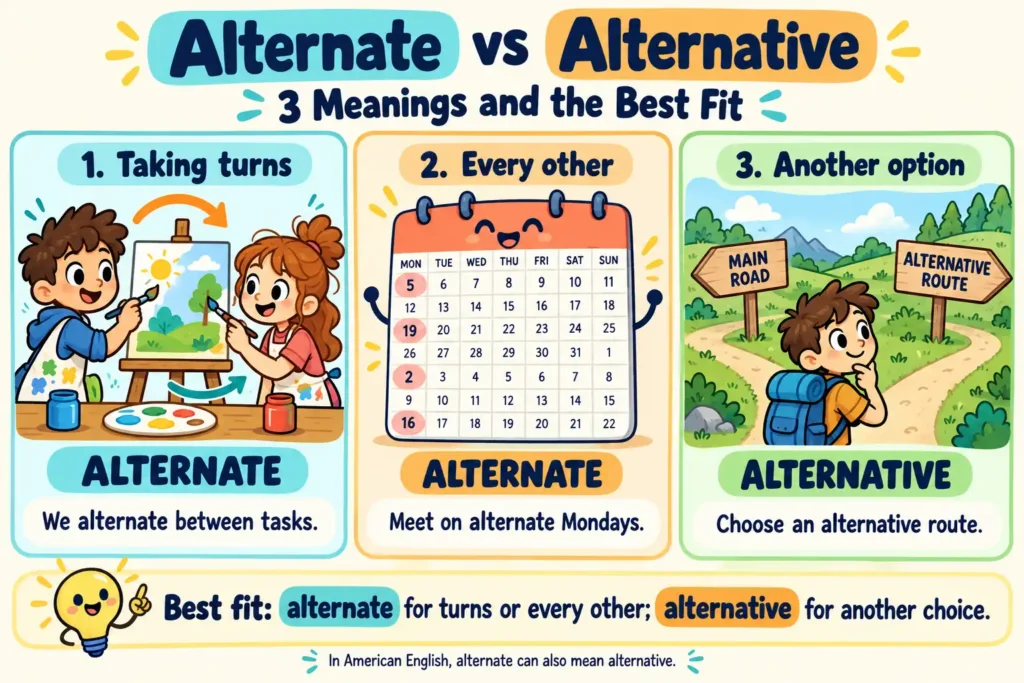
Alternate vs alternative depends on meaning. Use alternate for taking turns or every other item, and alternative for another choice. American English also accepts alternate for an option; alternative is usually clearer for an international audience.

Alternate vs alternative at a glance
Start with what your sentence describes. These three practical meaning families cover the main choices in everyday writing; they are not an exhaustive count of either word’s dictionary senses.
| Your meaning | Best starting choice | Original example |
|---|---|---|
| Every other item or a repeating pattern | Alternate | The workshop runs on alternate Saturdays. |
| Another possibility | Alternative; alternate also works in US choice-related uses | Could you suggest an alternative route? |
| Someone designated to substitute | An alternate, or a substitute | The team selected Maya as an alternate. |
Merriam-Webster’s alternate entry includes adjective, verb and noun uses. Alternative normally works as an adjective or noun, so the two words cannot exchange every grammatical job.
When alternate describes a pattern
Every other day or week
In a repeating schedule, alternate means every second unit. If a class meets on alternate Mondays, it meets one Monday, skips the next and meets the following Monday. The instruction specifies a pattern rather than a free choice.
“The volunteers work on alternate weekends.”
For a schedule that readers must follow, every other weekend is an especially transparent rewrite. Changing “alternate weekends” to “alternative weekends” can suggest different available weekends instead of the intended rhythm.
The noun usually changes to singular after every other: “alternate days” becomes “every other day.” That is a Swap With Adjustment, because you must adjust the noun as well as replace the adjective.
Taking turns
The verb alternate describes repeated movement between things or actions. It can make the repetition explicit where a general verb such as change would leave the pattern unstated.
“We alternate between the city office and the studio.”
Alternative is not the verb for taking turns. To describe two people sharing a task, write “We alternate who leads the meeting” or rewrite it as “We take turns leading the meeting.”
Both rewrites can communicate shared responsibility, but take turns needs a different sentence structure. Do not replace one word and leave the rest of the sentence untouched.
For alternating activities, use alternate. Avoid alternative in a schedule instruction when it could make the reader look for another option rather than follow the repeating pattern.
When either word describes another option
As adjectives describing another possibility, the words overlap. An alternate plan can be another plan, and an alternative plan can serve the same purpose. American usage particularly supports this choice-related sense of alternate.
“The bridge is closed, so we need an alternative route.”
“The bridge is closed, so we need an alternate route.”
The second sentence is natural in American English. The first is a clear choice for a broad audience. Neither sentence requires the route to rotate with another route on a repeating schedule.
Merriam-Webster’s comparison accepts overlapping choice-related uses. Whether the original option remains available does not create a universal rule separating the two adjectives.
That matters when editing alternate arrangements, an alternate solution or an alternate method. Check the intended meaning and audience before treating an established choice-related use as an error.
For a noun naming an option, alternative makes the meaning clear: “The train is an alternative to driving.” The pattern an alternative to introduces the thing being replaced or considered alongside it.
Merriam-Webster also records a broader option sense for the noun alternate. Nevertheless, choosing alternative for a general possibility helps distinguish it from a person designated to fill in.
When an alternate is a substitute person
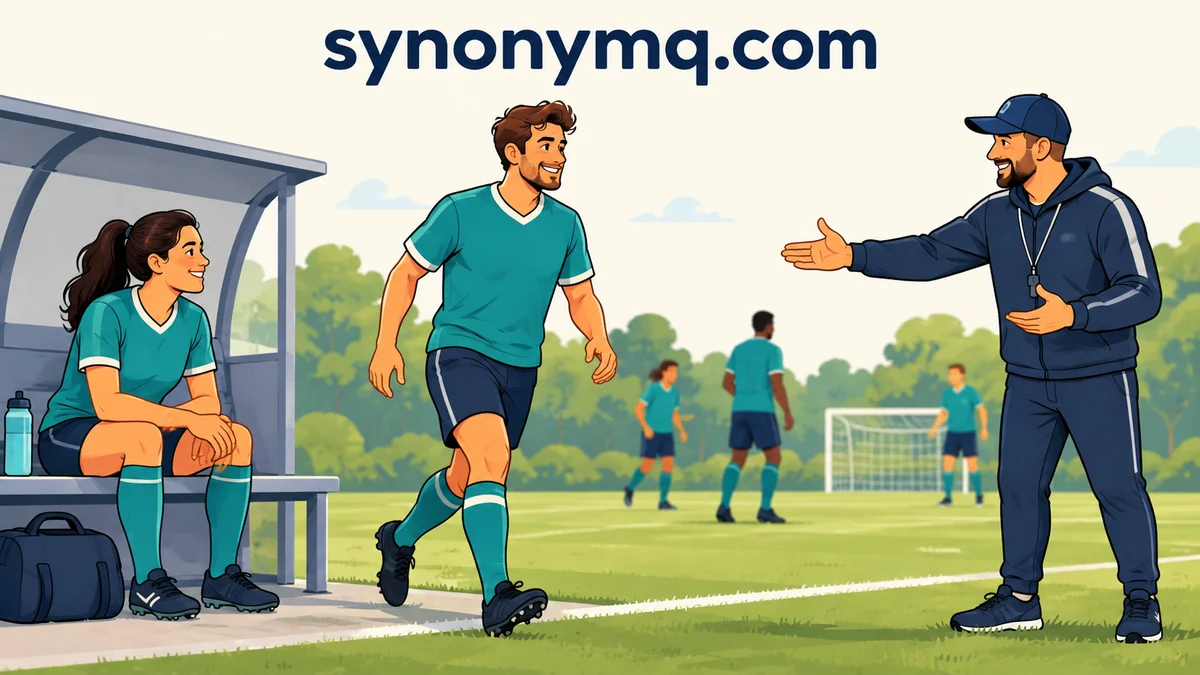
An alternate can be someone designated to act in another person’s place. In that setting, it identifies a role rather than simply naming another possible choice.
“Maya is the team’s alternate and will join if another player is unavailable.”
Calling Maya an alternative would present her as another option rather than preserve that designated role. If the role matters, keep alternate or use a clear description such as substitute team member.
The same issue arises with a host. “We have an alternate host” may identify someone ready to fill in. “We are considering an alternative host” presents another person the organizers might choose.
For international readers, explain the role directly: “Maya will stand in if needed.” This is a Requires Rewrite alternative; it expresses the job without relying on the reader’s interpretation of a noun.
US and UK choices that avoid ambiguity
Cambridge Dictionary labels the plan-or-method choice sense of alternate as US, with UK alternative. That supports acknowledging the American usage instead of declaring it wrong.
For an international audience, this guide recommends alternative for another option and alternate for a repeating pattern. This is an editorial clarity rule, not a claim that all other uses are ungrammatical.
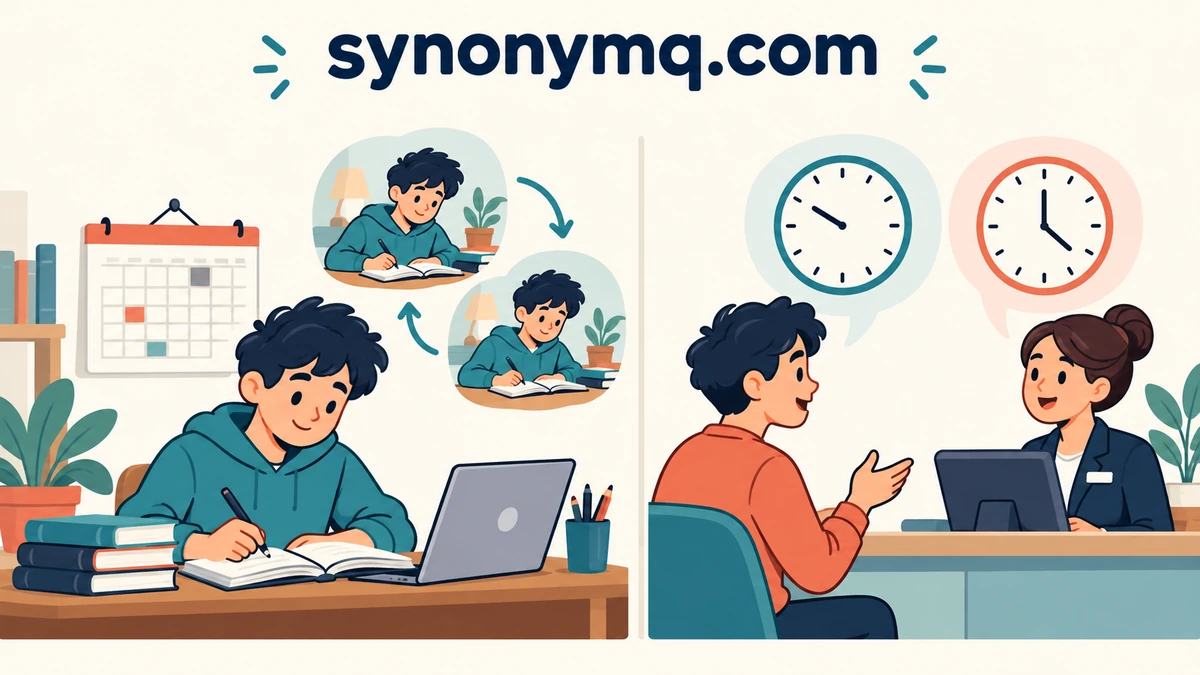
“Alternative times are available” clearly offers appointment choices. “The sessions run at alternate times” may need more explanation because readers could understand a repeated change between scheduled times.
When the schedule matters, state it: “Sessions are at 9 a.m. one week and 2 p.m. the next.” When you are offering a choice, write: “You can choose a 9 a.m. or 2 p.m. appointment.”
Context can make an existing sentence clear enough. Keep a natural alternate route in American copy unless the publication’s style or an international readership gives you a reason to change it.
Phrases where substitution needs care
A shared adjective sense does not make every established phrase interchangeable. Some phrases identify a field’s terminology or a conventional category rather than an ordinary backup option.
| Context | Recommended wording | Reason or boundary |
|---|---|---|
| Route, plan or arrangements | Alternative route, plan or arrangements | A clear international choice; alternate also serves the option sense in US usage. |
| Solution, method or way | Alternative solution, method or approach | Signals another possibility. Use another way if that wording is more natural in your sentence. |
| Another contact number | Alternative contact number or backup number | Makes the contact purpose explicit; alternate number is also understandable as another number in US usage. |
| Every second number in a sequence | Alternate numbers | Names a selection pattern. State the starting number when the instructions require precision. |
| A host who can fill in | Alternate host or substitute host | Describes a replacement role; another possible host is a different decision. |
| A statistical test | Alternative hypothesis | Preserves the established technical term. |
| A non-mainstream music category | Alternative music | Keep the conventional category name. |
| A different version of a story’s ending | Alternate ending or alternative ending | Either can express a different version; keep the wording consistent. |
Use alternative hypothesis in statistics. NIST’s explanation of statistical tests uses that term for the hypothesis paired with the null hypothesis. Casual adjective overlap is not a reason to rename it.
The MLA Style Center also distinguishes ordinary options from conventional non-mainstream expressions. Alternative music names a category; alternate music can suggest different music to use instead.
Universes, histories and realities
Cambridge records alternate universe as a collocation. Its use in fiction does not require worlds to take turns. Here, alternate can describe a different imagined version.
The Encyclopedia of Science Fiction recognizes alternate history and notes alternative history as another designation. Treat that as established genre wording rather than a scheduling distinction.
For alternate reality or alternative reality, make the intended different reality clear from the surrounding sentence. Preserve an established title or a story’s chosen terminology; do not substitute inside a name merely to enforce your preferred adjective.
Alternating, alternately and alternatively
Alternating belongs to the verb alternate. In “The design has alternating green and white stripes,” it describes a repeated pattern; it does not mean the designer is choosing a different set of stripes.
Cambridge’s word-family guidance distinguishes a repeated sequence from another choice. For clear instructions, use alternately for taking turns and alternatively when introducing another option.
- “The two lamps flash alternately.” One flashes, then the other.
- “Alternatively, we could use one brighter lamp.” Another option is being offered.
Some usage allows overlap, so this is a clarity recommendation rather than a claim that only one reading has ever existed. If the distinction is essential, replace the adverb with in turns or as another option.
Sentence replacements and meaning shifts
A Direct Swap keeps the sentence structure. A Swap With Adjustment changes nearby grammar, and Requires Rewrite means the idea needs a different construction. None of these labels promises identical nuance in every context.
| Original sentence | Replacement | Swap type and effect |
|---|---|---|
| We need an alternate plan. | We need an alternative plan. | Direct Swap. Preserves the option sense and reads clearly across audiences. |
| We meet on alternate Fridays. | We meet on every other Friday. | Swap With Adjustment. Fridays changes to Friday; the repeating schedule stays explicit. |
| We alternate between the two rooms. | We take turns using the two rooms. | Requires Rewrite. Recasts the activity; use it only if people are actually sharing turns. |
| Maya is our alternate. | Maya is our substitute. | Direct Swap. Fits a substitute-person context; explain separately whether she is waiting or already filling in. |
The third replacement shows why checking the whole situation matters. Moving yourself repeatedly between rooms is not necessarily the same as sharing those rooms with other people.
Before replacing either word, expand the sentence in plain language. If “another possible choice” preserves your meaning, alternative is a useful starting point. If “every other” or “taking turns” fits, start with alternate.
Which word should you use?
Choose alternate for a repeating pattern or turn-taking. Choose alternative for another possibility when you want a clear international default. Keep an alternate for an established substitute role when that role is the point.
Check conventional phrases before swapping: alternative hypothesis and alternative music need their own context. Keep a natural American choice-related alternate when the sentence and audience already make its meaning clear.
For another pair whose similar spelling hides different grammatical jobs, see respectfully vs respectively.
How this page was checked
Definitions and grammatical roles were checked against Merriam-Webster, Cambridge Dictionary and the MLA Style Center. NIST supports the statistical term; the Encyclopedia of Science Fiction supports the history labels.
The example sentences are original. Recommendations about clearer international wording are editorial guidance; they do not turn every regional difference into a grammar error.
Frequently asked questions
Why do Americans say “alternate” instead of “alternative”?
American English accepts alternate as an adjective meaning another option, including an alternate route or plan. This is an established usage, not necessarily a mistake. Alternative remains clear for an international audience.
Which is correct: “alternate times” or “alternative times”?
Use alternative times for other appointment options. Use alternate times when you mean a repeating change between times, and explain the schedule if needed. American alternate can also mean another option.
Is it an alternative or alternate number?
For another contact number, alternative contact number or backup number is clear. Alternate number also works for that purpose in American usage. For every second number in a sequence, use alternate numbers.
What does “alternate” mean?
Alternate can describe every other item or a repeating pattern, act as a verb for taking turns, or name a substitute. In American English, the adjective also describes another option.

Naveed Akhtar writes every guide on SynonymQ. He is an SEO content writer with ten years of article-writing experience, working on the question a thesaurus never answers: which of these words belongs in this sentence, for this reader. Every page cites the dictionary entries it draws on and the date they were read.