
Respectfully vs Respectively: 3 Simple Tests for Better Writing
Respectfully vs respectively separates courtesy from ordered matching. Respectfully means with respect; respectively pairs items in the order given. Write “I respectfully disagree” for a courteous response, and use “respectively” when two lists need matching.
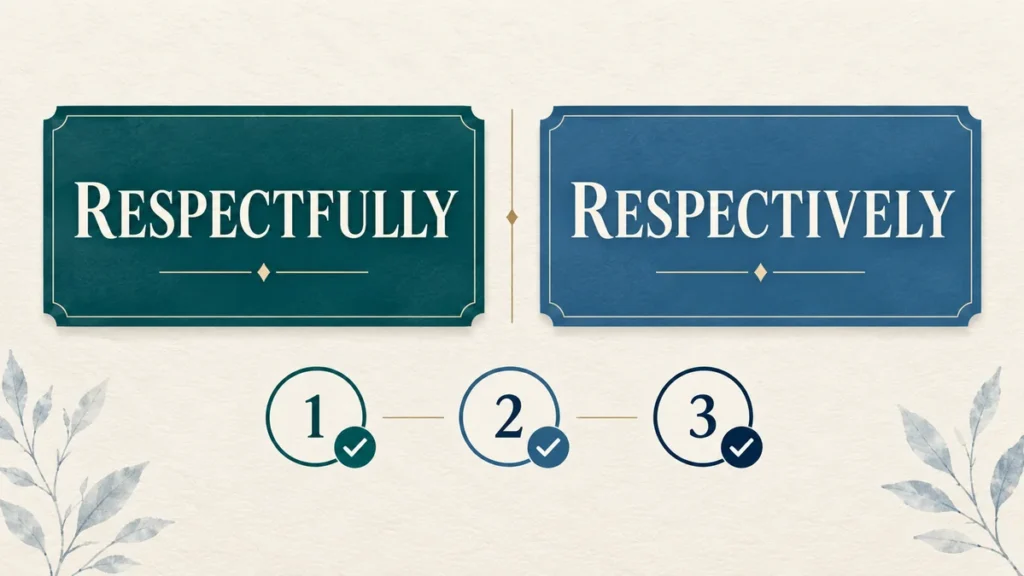
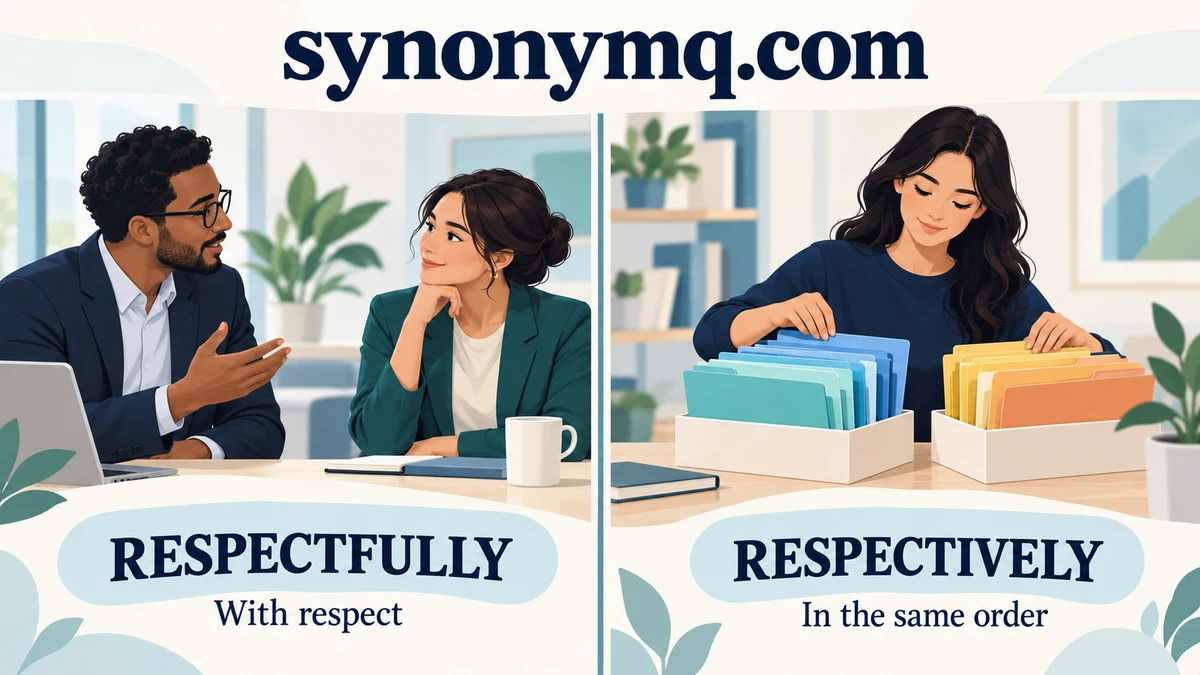
Respectfully vs respectively: courtesy or correspondence?
Merriam-Webster lists respectfully as the adverb formed from respectful. It describes conduct that shows regard or deference. It can describe speaking, listening, declining or disagreeing.
“The student respectfully questioned the decision” describes the manner of questioning. The student can challenge the decision while treating the person who made it with consideration. Respect does not require agreement.
Merriam-Webster defines respectively in its ordered sense as matching the order already given. In “Mina and Omar chose tea and coffee, respectively,” Mina chose tea and Omar chose coffee.
The second sentence says nothing about either person’s manners. It tells the reader how the names connect to the drinks. Replacing respectively with respectfully would remove that explicit pairing and introduce an unrelated description.
| Question | Respectfully | Respectively |
|---|---|---|
| What does it do? | Describes respectful behavior or tone | Connects listed items in corresponding order |
| Useful expansion | In a way that shows respect | The first with the first, the second with the second |
| Example | She respectfully declined | Mina and Omar chose tea and coffee, respectively |
| Letter closing? | Yes, when that tone suits the letter | No, it does not express courtesy |
| Part of speech | Adverb | Adverb |
The shared beginning makes these words easy to confuse, but they are not modern synonyms in these uses. Choose by the job the sentence needs, rather than by which spelling looks familiar.
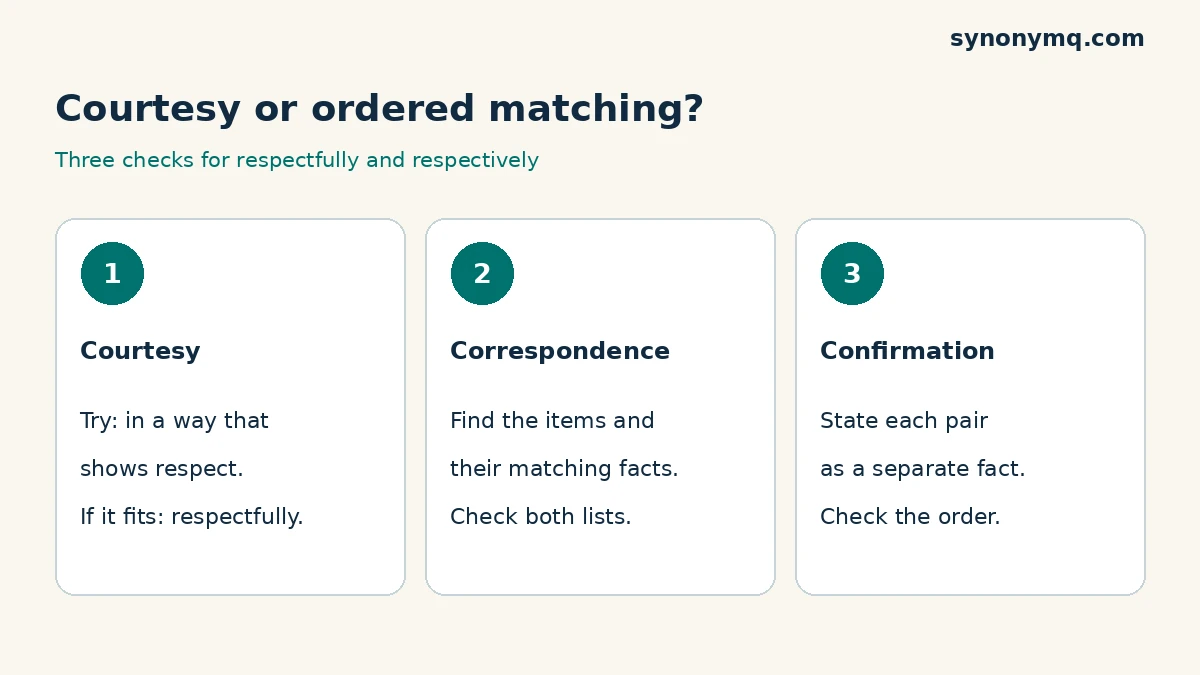
3 checks that prevent a mistaken swap
Check 1: Try the courtesy expansion
Replace the uncertain word with “in a way that shows respect.” If the sentence still says what you intended, respectfully is the likely choice. This checks meaning before you worry about punctuation or placement.
“We respectfully request a review” becomes “We request a review in a way that shows respect.” The expansion is wordier, but it preserves the intended attitude. There are no ordered lists to connect.
Do not assume every request needs the adverb. “Could you review the attached file?” can already be courteous. Add respectfully when its explicit statement of regard serves the situation.
Check 2: Look for a matching relationship
For the ordered use of respectively, identify the items being matched and the corresponding facts. The first item must connect to the first fact, the second to the second, and so on.
“The basic and premium plans cost $12 and $20, respectively” gives two plans and two prices. The basic plan costs $12; the premium plan costs $20. These figures are illustrative examples, not a real product offer.
Simply having two nouns is not enough. “The basic and premium plans are available online” gives no separate second list to match. Adding respectively would not clarify a relationship.
Check 3: Expand the sentence into separate facts
Turn a sentence with respectively into individual statements. If you cannot do that confidently, the original order may be unclear. Rewrite the sentence before relying on the adverb to carry the explanation.
“North, Central and South offices opened in 2018, 2020 and 2023, respectively” expands into three statements: North opened in 2018; Central opened in 2020; South opened in 2023.
If the expansion produces the wrong facts, reorder one list. The word confirms the written order; it does not discover the intended pairing or repair incorrect information.
Read respectively as a set of paired facts
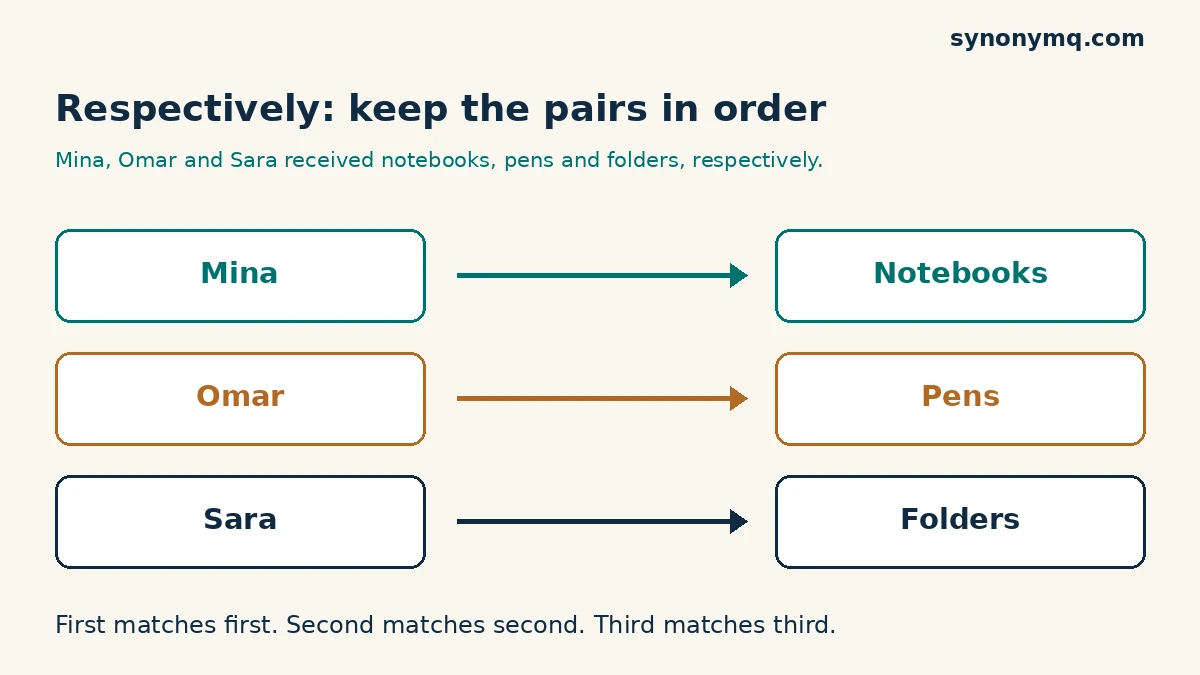
A short table makes the correspondence visible. This is an editorial reading aid: it does not change the sentence’s grammar. It helps you check that the lists have compatible lengths and the intended order.
Sentence: “Mina, Omar and Sara received notebooks, pens and folders, respectively.” Read it as the following assignments, not as three people each receiving all three kinds of supplies.
| Position in each list | Person | Assigned item |
|---|---|---|
| First | Mina | Notebooks |
| Second | Omar | Pens |
| Third | Sara | Folders |
For a straightforward one-to-one pairing, give each named item a corresponding fact. “Mina, Omar and Sara received notebooks and pens, respectively” leaves the third assignment unresolved. Name it explicitly instead of asking the reader to guess.
Shared results need a different construction. If Mina received notebooks while Omar and Sara both received pens, write exactly that. The intended relationship is not the simple three-item mapping suggested by the original list.
ISO’s house style advises using respectively when it prevents uncertainty. That is guidance for ISO documents, not a universal ban on other uses; it is also a useful clarity check for ordinary reports.
Keep the word when it makes a compact sentence easier to interpret. For a long list of unfamiliar names and figures, a table or separate clauses may make the same information easier to check.
Where these adverbs belong in a sentence
Respectfully before or after the action
“She respectfully declined the invitation” and “She declined the invitation respectfully” both describe how she declined. The first puts the manner beside the verb; the second adds it after the action and its object.
At the start of a sentence, “Respectfully, I disagree with that conclusion” presents a courtesy signal before the disagreement. Our editorial advice is to use this opening only when the rest of the sentence maintains the same restraint.
A comma is not needed merely because respectfully is an adverb. Compare “He spoke respectfully” with the introductory “Respectfully, I cannot support the proposal.” The punctuation reflects the construction.
Respectively after the lists or before the paired facts
Merriam-Webster’s comparison guide illustrates both final placement and placement before the corresponding values. The word does not have to be the final word of every sentence.
Final: “The blue and green boxes hold 6 and 9 files, respectively.”
Before the values: “The blue and green boxes hold respectively 6 and 9 files.”
The final version is our preferred wording here because the reader sees both complete lists before the matching signal. That is an editorial choice, not a claim that the second arrangement is ungrammatical.
Use a comma before sentence-final respectively in the examples on this page. Do not turn that presentation choice into “always put a comma before respectively”: the alternative placement above shows why that shortcut is unreliable.
Also avoid interrupting a long clause with the word when the reader may lose track of the pairing. Place it close to the relevant lists, or name each relationship directly.
What respectfully can and cannot do in an email
“I respectfully disagree” states that you intend to disagree without dismissing the other person. It can be useful in a formal discussion. It cannot make an insulting explanation respectful.
Less helpful: “Respectfully, your explanation is ridiculous.”
More constructive: “I respectfully disagree because the figures exclude the delivery charge.”
The second version identifies a specific problem the recipient can examine. Its effectiveness comes from that explanation as well as the courtesy word. The judgment about tone here is editorial guidance, rather than a dictionary rule.
For a routine request, try “Could you confirm the delivery date?” For a formal objection, “I respectfully request reconsideration” may better express the intended deference. Choose wording that fits the relationship and the purpose.
If you are introducing a contrast in the same message, see SynonymQ’s guide to alternatives to however in an email. Contrast wording and courtesy wording solve different problems.
“Respectfully stated” means stated in a respectful manner, but it may leave the actual statement unclear. Prefer a complete example such as “The panel respectfully stated its disagreement with the recommendation.”
Alternatives that preserve the intended meaning
There is no useful swap that turns ordered matching into courtesy or the reverse. For alternatives within each meaning, test the full sentence rather than accepting a thesaurus entry as automatic permission.
| Original wording | Alternative | Relationship and substitution | Meaning to check |
|---|---|---|---|
| She spoke respectfully | She spoke politely | Near-Synonym; Direct Swap | Polite emphasizes courteous manners |
| He respectfully acknowledged the objection | He courteously acknowledged the objection | Near-Synonym; Direct Swap | Courtesy does not necessarily imply deference |
| They listened respectfully | They listened with respect | Contextual Alternative; Swap With Adjustment | An adverb becomes a prepositional phrase |
| A and B cost $12 and $20, respectively | A costs $12; B costs $20 | Contextual Alternative; Requires Rewrite | The ordered relationship becomes explicit |
| The two groups scored 7 and 9, respectively | The two groups scored 7 and 9 in that order | Contextual Alternative; Direct Swap in this sentence | Keep both group names identifiable in context |
Separately is not a reliable substitute for the ordered-matching meaning. It may say that events happened apart, while leaving the assignments unspecified. Similarly, sequentially may describe events occurring one after another.
For example, “The two applicants were interviewed separately” describes separate interviews. It does not identify which applicant received which score. Keep respectively when that ordered correspondence is the information you need.
Before-and-after fixes for common mistakes
A courtesy sentence with the wrong adverb
Before: “I respectively ask you to review the calculation.”
After: “I respectfully ask you to review the calculation.”
The request concerns manner, not matching. If the exchange is informal, “Could you review the calculation?” may be a more natural rewrite than retaining the explicit courtesy marker.
A paired sentence with the wrong adverb
Before: “The red and yellow labels identify urgent and routine files, respectfully.”
After: “The red and yellow labels identify urgent and routine files, respectively.”
The correction says red identifies urgent files and yellow identifies routine files. Respectful behavior is irrelevant to this classification, so adding respectfully gives the reader the wrong kind of information.
A correct word with an incorrect list order
Intended facts: Mina has notebooks; Omar has pens.
Wrong order: “Mina and Omar received pens and notebooks, respectively.”
Corrected: “Mina and Omar received notebooks and pens, respectively.”
The word was spelled correctly in both versions. The first sentence still asserted the wrong assignments. Proofreading must check the facts and the order, not just the spelling.
Respectful, respective, and respected
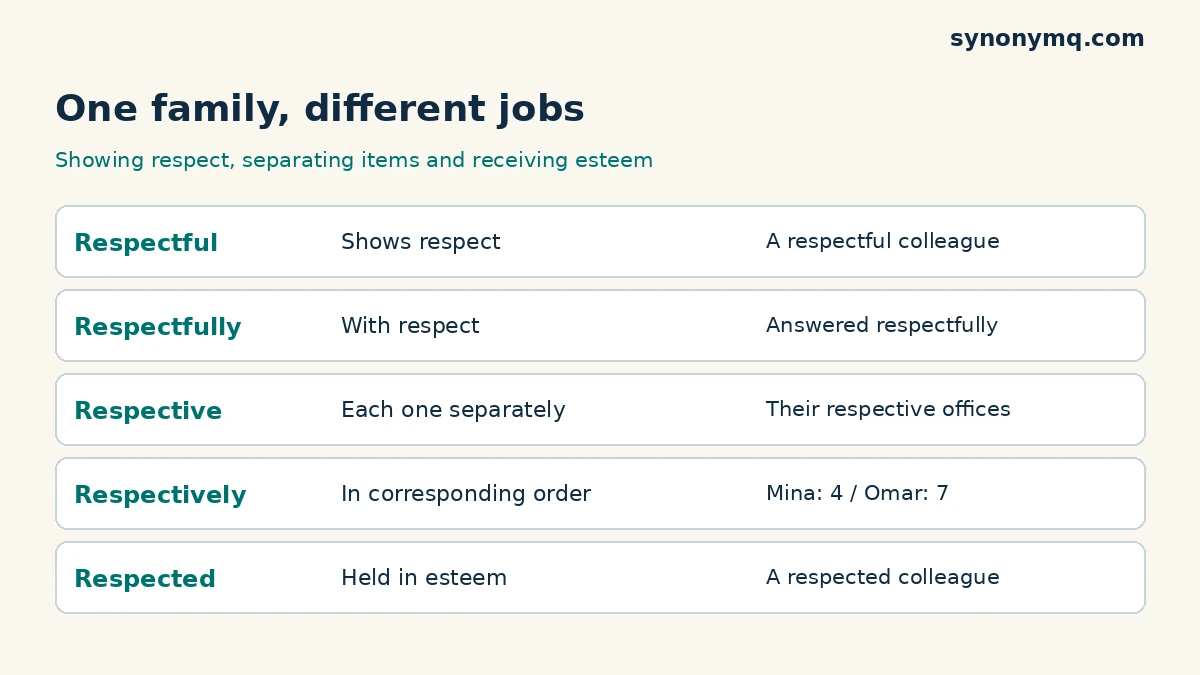
Respectful describes someone or something showing respect. Respective identifies what belongs to each person or thing separately. Respected can describe someone held in esteem, and is also a form of the verb respect.
| Word | Example | What it communicates |
|---|---|---|
| Respectful | A respectful colleague | The colleague treats others with regard |
| Respectfully | The colleague answered respectfully | The answer was given with respect |
| Respective | Their respective offices | Each person’s own office |
| Respectively | Mina and Omar use offices 4 and 7, respectively | Mina uses office 4; Omar uses office 7 |
| Respected | A respected colleague | Others hold the colleague in esteem |
Merriam-Webster’s respective entry supports the separate-item meaning. Its respect entry supplies the verb meaning behind respected. These word forms are related, but they do different grammatical jobs.
Quick practice with reasons
- “The receptionist _____ explained the delay.” Choose respectfully when the intended point is courteous conduct.
- “Mina and Omar ordered tea and coffee, _____.” Choose respectively: Mina ordered tea, and Omar ordered coffee.
- “We _____ decline your invitation.” Choose respectfully to express regard while declining.
- “The first and second rooms seat 20 and 35 people, _____.” Choose respectively: the first seats 20, and the second seats 35.
After choosing respectively, say each pair separately. After choosing respectfully, check that the rest of the message supports the claimed courtesy. Those checks catch different errors.
How this page was checked
Meanings and word forms were checked against the linked Merriam-Webster and Dictionary.com entries. The ordered-list guidance was compared with ISO’s house style. All sample names, prices, dates and assignments are original teaching examples.
Sentence rewrites, preferred placement and email-tone recommendations are SynonymQ editorial guidance. They are offered to help readers choose clearly, without presenting personal style preferences as universal grammar rules.
Frequently asked questions
Do you end a letter with “respectively” or “respectfully”?
Between these two words, use Respectfully, when you want a closing that expresses regard. Respectively links items in order and is not a courtesy closing. For an ordinary business letter, Sincerely, may also suit the message.
Cambridge labels “Respectfully yours” a very formal, polite letter ending. Choose it when that level of formality fits the relationship.
How do you use respectively correctly?
For ordered matching, list the items and their corresponding facts in the same order: “Mina and Omar chose tea and coffee, respectively.” Mina chose tea; Omar chose coffee. Check every pair, and rewrite if the relationship is not clear.
Is it polite to say respectfully?
It can express a polite intention, especially in a request or disagreement. The surrounding wording still matters. “I respectfully disagree with the calculation” can be courteous; adding the word to an insult does not remove the insult.
What is the difference between respective and respected?
Respective means relating separately to each person or thing: “their respective roles.” Respected can mean held in esteem: “a respected teacher.” Neither form can replace the other without changing the meaning.

Naveed Akhtar writes every guide on SynonymQ. He is an SEO content writer with ten years of article-writing experience, working on the question a thesaurus never answers: which of these words belongs in this sentence, for this reader. Every page cites the dictionary entries it draws on and the date they were read.