
Simple vs Simplistic: Avoid 4 Common Word-Choice Mistakes
Simple vs simplistic: simple can mean plain, clear, easy or straightforward. Simplistic usually means oversimplified, with key details missing. Use simple for praise; choose simplistic to criticise an explanation that leaves out what readers need to know.
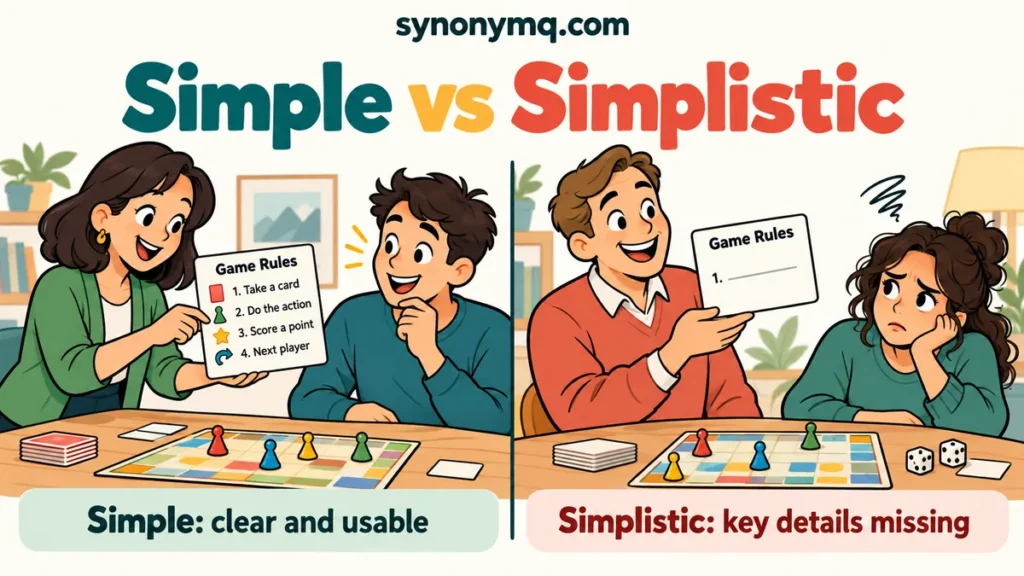
Simple vs Simplistic: What Changes in the Meaning?
A board game can have simple instructions: wait for your turn, move the number shown on the die, and reach the finish to win. The wording is brief, but it gives players the rules they need.
“Roll and win” is shorter. If those are the only instructions, players still do not know when to move or how to win. Calling that explanation simplistic criticises what it leaves out, rather than its length alone.
In Oxford Learner’s Dictionaries, a central meaning of simple concerns something that is not complicated and is easy to understand or do.
Merriam-Webster’s entry for simplistic connects the word with excessive simplification that overlooks complicating factors. The problem is a loss of necessary detail.
| Word | What you are describing | Example |
|---|---|---|
| Simple | Something uncomplicated or easy to follow | “The guide gives a simple explanation of the rules.” |
| Simplistic | A treatment that makes the subject seem easier than it is | “The guide’s explanation is simplistic: it leaves out how turns work.” |
For instructions you want to praise, use simple. Avoid simplistic because it can turn the compliment into a complaint about missing information.
The noun after the adjective matters. A simple cover may be undecorated; a simple task may be easy. Neither description, by itself, accuses anyone of faulty reasoning.
A simple explanation also need not cover every possible detail. It needs enough detail for its purpose. An introduction for beginners and a specialist reference book can reasonably include different amounts of information.

Why Simplistic Usually Sounds Critical
“Your explanation is simple” can praise its accessibility. “Your explanation is simplistic” usually says that the explanation falls short. The second sentence judges the treatment of the subject.
Oxford labels simplistic disapproving. That is a useful warning when you are writing a review, commenting on an essay or responding to a colleague’s proposal.
There is a usage wrinkle. Merriam-Webster records occasional neutral use meaning uncomplicated, while warning that the word is generally understood critically.
The American Heritage Dictionary also records the neutral meaning as a usage problem. Finding that use in a sentence does not make it a reliable choice for praise.
If you mean “easy to follow,” write that. Readers should understand the compliment without having to work out whether you meant to criticise.
When you do intend criticism, name the missing factor: “The proposal is simplistic because it assumes every customer will renew.” The explanation gives the other person something specific to address.
Four Word-Choice Mistakes Worth Fixing
Changing simple to simplistic can turn a compliment into criticism. Here are four situations where choosing the right word makes a difference.
1. Using simplistic when you intend praise
Before: “The guide gives wonderfully simplistic instructions.”
After: “The guide gives wonderfully simple instructions.”
If the instructions work and are easy to follow, simple expresses the intended benefit. Simplistic risks suggesting that the writer removed something essential.
Use “clear instructions” when readability is the point. Use “straightforward instructions” when you want to emphasise the absence of confusing complications.
2. Treating every shortened account as simplistic
Before: “The introduction is simplistic because it omits advanced detail.”
After: “The introduction is simplified for new readers.”
Omission alone does not settle the choice. A beginner’s introduction can leave advanced detail for later while preserving what its readers need now.
Simplified describes making something less complicated. Keep simplistic when the missing detail distorts the account or makes it inadequate for the intended task.
3. Expecting basic to explain your objection
Before: “That is a basic account of why bookings fell.”
After: “That account is simplistic: it ignores the cancelled trains.”
Basic may describe an elementary overview. It does not necessarily communicate the objection that an important cause has been ignored.
In this example, the cancelled trains are the missing cause. Say what the explanation overlooks so the writer knows what to fix.
4. Labelling a team instead of its reasoning
Before: “Your team is simplistic.”
After: “The team’s forecast is simplistic because it assumes every customer will renew.”
The revision identifies the forecast and its questionable assumption. It gives colleagues a claim to examine without making a broad judgment about them.
If you want a gentler revision request, write: “Please revise the forecast to allow for customers who do not renew.” This Requires Rewrite; it turns an assessment into an actionable request.
Describing a Person Without an Unintended Insult
A “simplistic person” usually suggests someone whose thinking ignores complexity. It does not mean that the person enjoys an uncomplicated life, dresses plainly or explains things clearly.
“Simple person” is ambiguous too. Merriam-Webster records meanings of simple involving innocence, modesty and limited understanding. Context can make the phrase affectionate or insulting.
For someone’s preferences, be specific: “She enjoys a simple life.” For communication, “He explains difficult ideas clearly” describes the skill you mean to praise.
If the issue is reasoning, name the view: “His explanation of the delay is simplistic.” Then identify what it overlooks. This keeps the disagreement focused on something the person can reconsider.

Synonyms and Alternatives, with Sentence Tests
Choose the alternative for the particular meaning of simple or simplistic. Words that work in a sentence about a plain design may fail in one about an easy procedure.
The relationship labels below describe closeness in the stated context. Direct Swap means the grammar works in that example; it does not promise identical emphasis in every sentence.
| Original word | Alternative and relationship | Substitution | Sentence test and limit |
|---|---|---|---|
| simple | clear Near-Synonym | Direct Swap | “The guide is simple/clear.” Clear stresses understandable communication, rather than how difficult the task is. |
| simple | straightforward Near-Synonym | Direct Swap | “The booking process is simple/straightforward.” This suits a process without confusing complications. |
| simple | uncomplicated Near-Synonym | Direct Swap | “The setup is simple/uncomplicated.” The replacement foregrounds a lack of complexity. |
| simple | plain Near-Synonym | Direct Swap | “They chose a simple/plain cover.” This is about decoration; plain would change the meaning of “a simple task.” |
| simple | basic Contextual Alternative | Direct Swap | “We started with a simple/basic sketch.” Basic can suggest elementary detail, not ease of understanding. |
| simple | without complications Contextual Alternative | Swap With Adjustment | “They chose a simple process” becomes “They chose a process without complications.” Move the phrase after the noun. |
| simplistic | oversimplified Near-Synonym | Direct Swap | “The explanation is simplistic/oversimplified.” Both can criticise a treatment that loses necessary detail. |
| simplistic | leaves out important factors Contextual Alternative | Requires Rewrite | “The explanation is simplistic” becomes “The explanation leaves out important factors.” Specify those factors when possible. |
Merriam-Webster defines oversimplify in terms of simplification that produces distortion, misunderstanding or error. That supports oversimplified for an inadequate explanation.
For “a simple explanation,” the original word may already be best. Choose clear when ease of understanding is the quality you want to emphasise. A short explanation can still be confusing.
An uncomplicated procedure may still be difficult for a first-time user. A plain cover tells us about decoration, not how easy a task is. Choose the alternative that fits the meaning you intend.
Complex Problems, Simple Explanations
A complex problem has interacting parts or factors. A simple explanation can organise those parts so a reader can follow them. The subject’s complexity and the explanation’s accessibility describe different things.
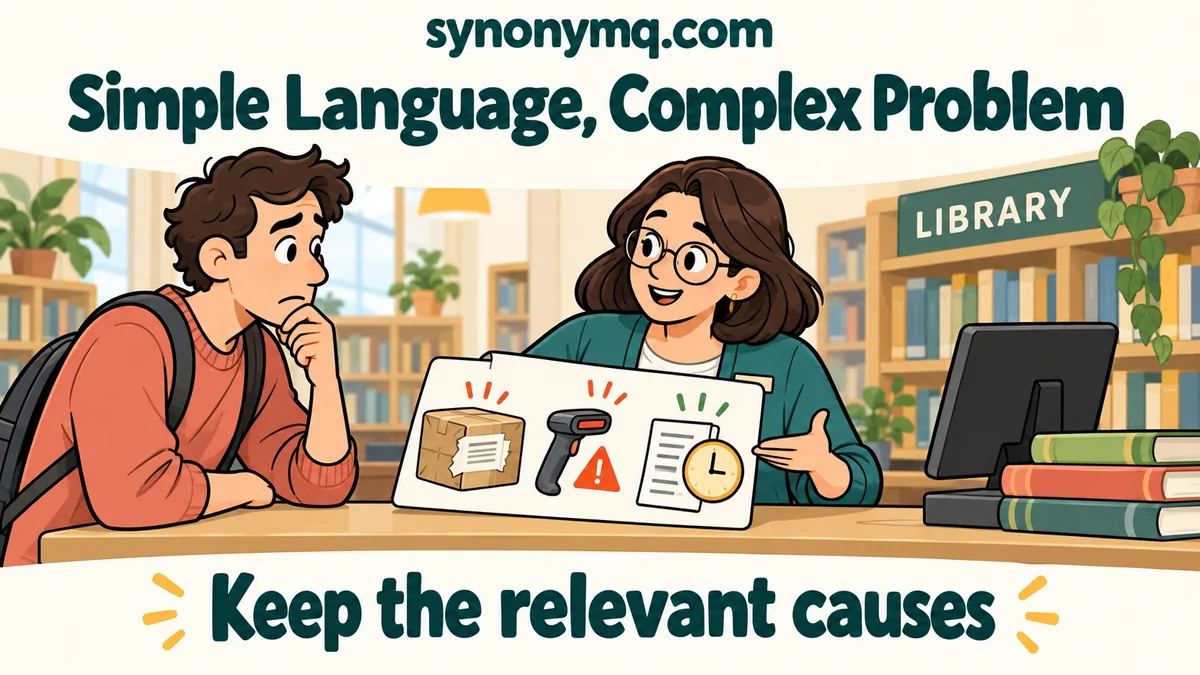
Suppose a fictional library’s delivery delays involve damaged labels, a faulty scanner and limited collection times. A short explanation can name all three without describing every event in the delivery log.
“The deliveries are late because the labels, scanner and collection schedule all need attention” gives readers a usable overview. Saying “The staff are just slow” may be simplistic if it disregards those other causes.
For an accessible account of a complex problem, use simple explanation. Use simplistic explanation when you are criticising the account for concealing or overlooking relevant complexity.
Complexity is not proof of quality either. A complicated account may be confusing or mistaken. Judge whether the explanation serves its purpose and preserves what readers need to know.
SynonymQ’s guide to alternatives for complex helps with the separate choice of how to describe the problem itself.
Simplified, Simplicity and the Comparative Forms
Simplified describes something made less complicated. Simplistic usually adds the objection that the simplification has gone too far. A simplified account can still be appropriate for its audience.
Simplicity is a noun; simple and simplistic are adjectives in the uses discussed here. Compare “the simplicity of the instructions” with “the instructions are simple.”
“The instructions are simplistic” makes a different judgment: their treatment is inadequate. To name that problem as a noun, oversimplification is useful. A direct swap for simplicity would change the meaning.
Oxford lists simpler and simplest, and also allows more simple and most simple. “Please make the explanation simpler” asks for reduced complexity; it does not ask the writer to remove essential facts.
How This Page Was Checked
Definitions and usage notes were checked against Merriam-Webster, Oxford Learner’s Dictionaries and the American Heritage Dictionary. The board game, workplace and library examples are original illustrations.
The replacement advice applies those definitions to particular sentences. A dictionary’s recorded neutral use is distinguished from the recommendation to use simple for unambiguous praise.
Frequently Asked Questions
Is “too simplistic” redundant?
No. Simplistic already suggests excessive simplification, but too can stress that the treatment is inadequate for a particular purpose. Use the extra emphasis when it helps explain your objection.
Is a simple sentence necessarily short?
No. Simple sentence is a grammatical label based on clause structure, not word count. A simple sentence can be long. Simplistic describes an oversimplified treatment; it is not a sentence-structure category.
How do you use simplistically in a sentence?
Simplistically is the adverb. Example: “The report explains the delay simplistically, blaming staff while ignoring the broken scanner.” It describes how the explanation was given and usually carries the criticism associated with simplistic.

Naveed Akhtar writes every guide on SynonymQ. He is an SEO content writer with ten years of article-writing experience, working on the question a thesaurus never answers: which of these words belongs in this sentence, for this reader. Every page cites the dictionary entries it draws on and the date they were read.