
Practical vs Practicable: 4 Easy Checks Before You Swap
Practical vs practicable: practical can mean useful, sensible or hands-on. Practicable means feasible, workable or doable. Use practical for usefulness or experience, and practicable for an action’s feasibility. The meanings may overlap for some plans.
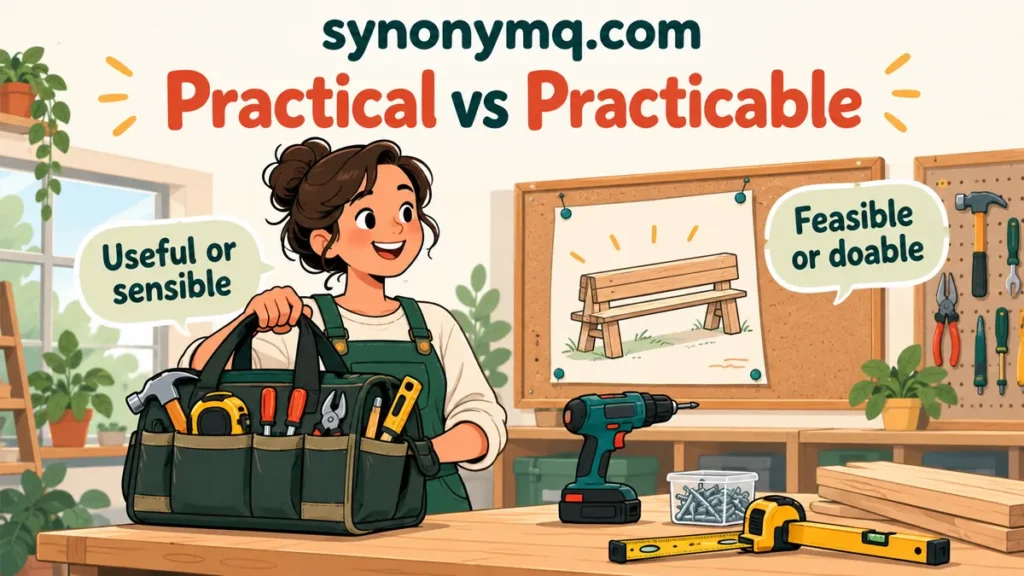
Practical vs Practicable: Useful, Doable and the Overlap
Imagine moving a shelf of books across a room. Carrying one book at a time is doable. Using a trolley saves trips. The first method may be practicable, while the trolley is the more practical choice.
That contrast helps, but it is not an absolute rule. Practical has several meanings, including sensible and likely to work. A plan can be both practical and practicable.
Oxford Learner’s Dictionaries records uses of practical for useful things, sensible people and experience involving real situations rather than theory.
Merriam-Webster’s entry for practicable centres on whether something can be done. Its usage note draws attention to available means and current conditions.
| Intended meaning | Usual choice | Example |
|---|---|---|
| Useful or suitable | Practical | “The trolley is practical for moving books.” |
| Capable of being carried out | Practicable | “The move is practicable with two volunteers.” |
| Sensible about real problems | Practical | “Leena is practical about the storage problem.” |
| Experience gained by doing | Practical | “The volunteers gained practical experience.” |
For whether a proposal can be carried out with the resources available, use practicable. For whether it is a sensible choice, use practical. Say which resources matter if the distinction affects a decision.
A practicable method need not be your preferred method. In the book-moving example, taking many small trips is possible, but that does not make it the best use of the volunteers’ afternoon.

Four Checks Before You Change the Word
1. Are you judging usefulness or feasibility?
“This is a practical storage system” praises its usefulness. “This is a practicable storage system” focuses on whether it can be put into use. Neither sentence tells the reader every reason behind the judgment.
If a proposal needs equipment you do not have, write: “The proposal is not practicable with our current equipment.” If the equipment exists but the method wastes time, explain why it is impractical.
Keep practical when it already expresses your point clearly. Changing a natural word to the more formal practicable can shift the emphasis without improving the sentence.
2. Are you describing a person or something they can do?
A practical person deals sensibly with real problems. The word can also describe someone who is good at making or repairing things. Practicable does not normally describe those personal qualities.
Before: “We need a practicable colleague who can fix the display.”
After: “We need a practical colleague who can fix the display.”
For a person who is good at repairs, handy may be more specific. Reserve practicable for the proposed repair: “Replacing the hinge is practicable because we have the right part.”
3. Does practical contrast with theoretical?
Merriam-Webster records practical in connection with action and experience rather than theory. This is the meaning in practical training, practical work and practical experience.
Before: “The course gave me practicable experience repairing chairs.”
After: “The course gave me practical experience repairing chairs.”
The revised sentence says that you learned by doing. “The training programme is practicable” makes a different claim: the programme can be carried out. It does not tell us what kind of learning it offers.
4. Is the plan sensible as well as achievable?
Both adjectives can work with plan, method or solution. Their emphasis may differ, but treating one as always correct and the other as always wrong misses the overlap in their meanings.
“The plan is practicable with the staff available” makes feasibility explicit. “The plan is practical because it avoids repeated trips” explains the benefit. Choose the sentence that answers the reader’s actual question.
If both points matter, write both: “We can carry out the move with two volunteers, and using the trolley will save time.” This rewrite is clearer than asking one adjective to carry the whole assessment.
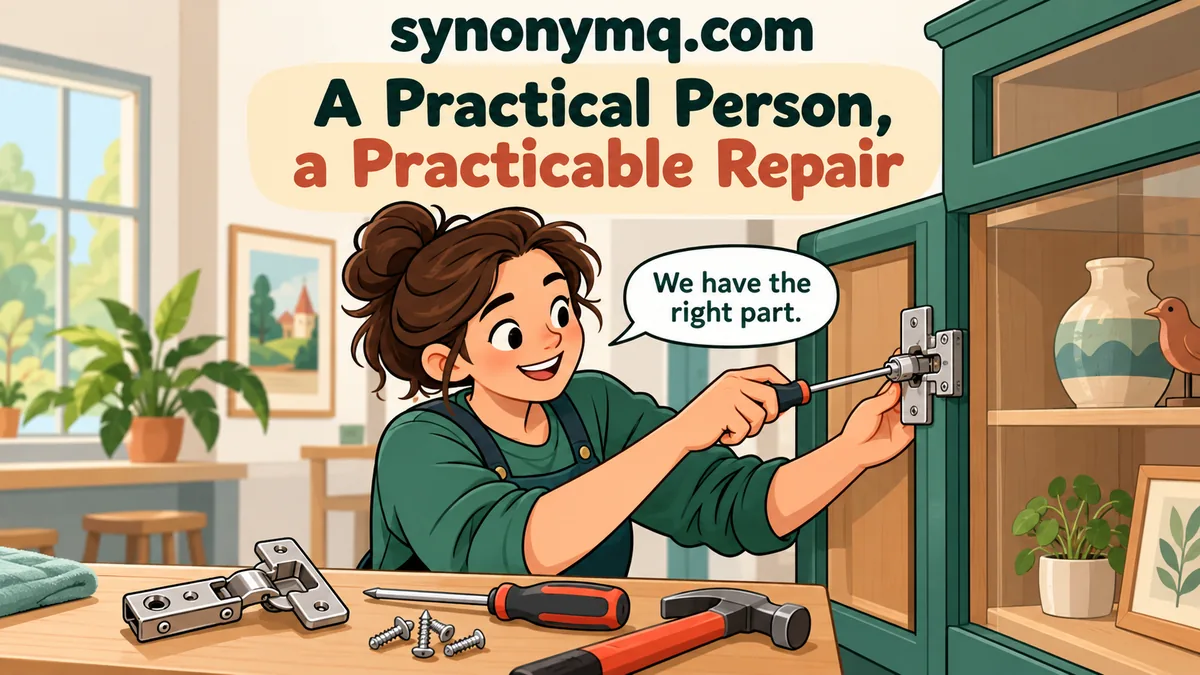
Which Alternatives Fit Your Sentence?
A replacement should preserve the meaning you need. Useful fits a practical object; feasible fits a practicable proposal. Neither belongs in every sentence containing the original adjective.
In this table, Direct Swap means that the replacement fits the grammar of the stated example. The notes explain changes in emphasis; the label is not a promise of complete interchangeability.
| Original | Alternative and relationship | Substitution | Sentence test and limit |
|---|---|---|---|
| practical | useful Near-Synonym | Direct Swap | “This is a practical/useful bag.” Useful stresses its value for a purpose. |
| practical | sensible Near-Synonym | Direct Swap | “That is a practical/sensible decision.” Sensible stresses good judgment. |
| practical | hands-on Near-Synonym | Direct Swap | “The course offers practical/hands-on training.” This fits learning through direct participation. |
| practical | pragmatic Near-Synonym | Direct Swap | “We need a practical/pragmatic approach.” Pragmatic emphasises dealing with the situation rather than insisting on fixed ideas. |
| practical | handy Near-Synonym | Direct Swap | “She is practical/handy when things need fixing.” Handy specifies making or fixing things, rather than sensible judgment generally. |
| practicable | feasible Near-Synonym | Direct Swap | “The proposal is practicable/feasible.” Both concern whether it can work; explain the conditions. |
| practicable | workable Near-Synonym | Direct Swap | “This is a practicable/workable arrangement.” Workable focuses on an arrangement that can function successfully. |
| practicable | doable Near-Synonym | Direct Swap | “The task is practicable/doable.” Doable is a plain alternative; retain an established term in formal documents. |
| practicable | possible to carry out Contextual Alternative | Swap With Adjustment | “The proposal is practicable” becomes “The proposal is possible to carry out.” Include the infinitive phrase to keep the feasibility meaning. |
| practicable | we can carry out Contextual Alternative | Requires Rewrite | “This is a practicable proposal” becomes “We can carry out this proposal.” The new structure names who can do it. |
Oxford marks practicable formal and lists feasible and workable as alternatives. Use the table’s examples to test a choice, rather than swapping words across unrelated meanings.
For an ordinary message about a task, “We can do it with the tools we have” may be clearer than “It is practicable.” In a document using a defined term, clarity includes preserving that term’s exact wording.
As Soon as Practicable: Choose the Phrase or Set a Date
As soon as practicable means as soon as the action can be carried out. Oxford records this phrase in its practicable entry. It is a natural choice when feasibility is the intended meaning.
As soon as practical can also make sense when you mean as soon as it is sensible or suitable. It is not automatically a spelling or grammar error. The question is whether that is the condition you intend.
Less precise: “We will dispatch the parcel as soon as practical.”
Feasibility stated: “We will dispatch the parcel as soon as practicable, once you confirm the address.”
In this example, the missing address explains what prevents dispatch. For everyday customer communication, “We will dispatch the parcel once you confirm the address” gives the same useful information more directly.
Neither phrase gives a calendar deadline. If the reader needs a date, supply one you can meet: “If you confirm the address today, we will dispatch the parcel by Thursday.” Do not promise a date merely to make the wording sound decisive.
For a message about whether a schedule is tight or ambitious, SynonymQ’s guide to alternatives for “aggressive timeline” explains what those descriptions signal.
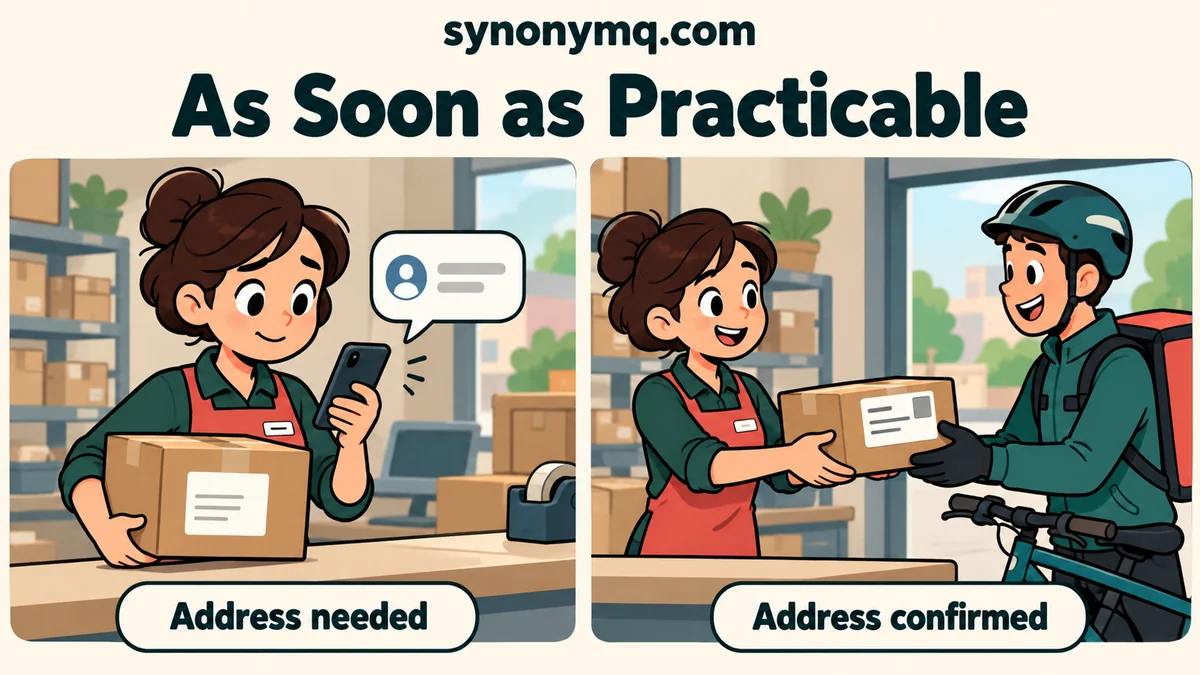
Reasonably Practicable: Keep the Established Term
Reasonably practicable has an established role in health and safety language. The Health and Safety Executive’s risk guidance uses that exact phrase.
HSE explains it by referring to the balance between risk and the measures needed to control it, including money, time or trouble. The term does more work than “reasonably convenient.”
When quoting guidance or using a term defined in a document, keep reasonably practicable. Avoid changing it to reasonably practical simply to make it shorter; the substitution may lose the established meaning.
A vocabulary comparison does not determine what a particular policy requires. Read the definition and context in the document you are working with instead of treating an ordinary synonym as a replacement for a technical term.
Pragmatic, Possible and the Negative Forms
Oxford defines pragmatic through sensible problem-solving rather than adherence to fixed ideas or theories. It suits an approach or attitude, but it does not mean the same thing as practicable.
A pragmatic organiser might accept a workable compromise. A practicable arrangement is one that can be carried out. One description concerns how the organiser approaches the problem; the other concerns the arrangement.
Possible is broader than a claim about present resources. Merriam-Webster’s usage discussion distinguishes possibility under appropriate conditions from practicability with the means currently available.
A meeting with everyone in one room may be possible in principle. It may not be practicable this week if several participants cannot travel. Naming the constraint is more useful than arguing over the adjective alone.
Impractical can describe an unwise or unsuitable choice. Impracticable focuses on inability to carry something out with the available means.
The negative forms overlap too: Merriam-Webster includes impracticable among the senses of impractical. Avoid teaching “impractical always means possible but unwise” as a strict rule.
Pronunciation and Related Word Forms
Oxford’s learner’s dictionary gives the IPA below. The stress falls at the beginning. The respellings are a reading aid, not a second phonetic transcription.
| Word | Oxford IPA | Reading aid |
|---|---|---|
| practical | /ˈpræktɪkl/ | PRAK-ti-kuhl |
| practicable | /ˈpræktɪkəbl/ | PRAK-ti-kuh-buhl |
The related nouns are practicality and practicability. Compare “the practicality of carrying a trolley upstairs” with “the practicability of completing the move before closing.” Keep the sentence’s intended meaning in view.
Practicle is not the standard spelling of practical. If you mean “able to be carried out,” the word is practicable. Check which idea you intend before correcting an unfamiliar-looking word.
How This Page Was Checked
Definitions, usage labels, word forms and pronunciation were checked against Oxford Learner’s Dictionaries and Merriam-Webster. The health and safety phrase was checked against HSE’s own risk guidance.
The moving, repair and parcel examples are original illustrations. Each suggested replacement was tested in its stated sentence; the advice does not claim that the words are interchangeable in every context.
Frequently Asked Questions
What is the difference between practical and practicable?
Practical can mean useful, sensible or based on experience. Practicable means capable of being carried out. Their meanings can overlap for plans and solutions.
Is it as soon as practical or as soon as practicable?
Use as soon as practicable for feasibility. As soon as practical can mean when sensible or suitable. Preserve defined wording.
What is the difference between practicum and practical?
Practicum names supervised study applying theory. Practical usually describes usefulness or experience; as a noun, it can name a skills examination.
What is the difference between practical and impractical?
Practical describes something useful, sensible or suited to its purpose. Impractical can describe an unsuitable, unwise or unworkable choice. Context determines the contrast.

Naveed Akhtar writes every guide on SynonymQ. He is an SEO content writer with ten years of article-writing experience, working on the question a thesaurus never answers: which of these words belongs in this sentence, for this reader. Every page cites the dictionary entries it draws on and the date they were read.