
Advice vs Advise: 4 Sentence Patterns That Make It Clear
Advice is the guidance you give or receive; advise means to give that guidance. For advice vs advise, check the sentence: “I need your advice” names something, while “Can you advise me?” asks someone to act. Use some advice, but please advise.
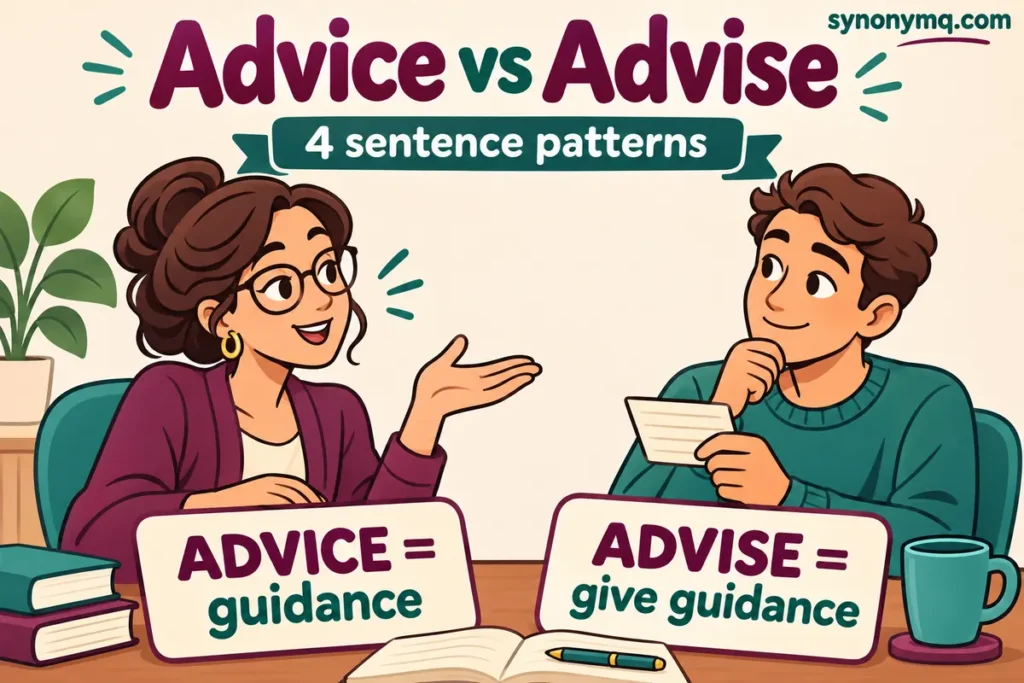
Advice vs Advise Starts With the Sentence Pattern
You do not have to start by memorising a grammar label. Look at the words around the gap. “Your ___” asks for a thing; “can you ___ me?” asks for an action. The four patterns below cover those choices and two useful ways to extend them.
| Pattern | Complete sentence | Why it works |
|---|---|---|
| 1. Your / some / useful + advice | I need your advice about the workshop. | Advice names the guidance being requested. |
| 2. Can you / please + advise | Can you advise me on the venue? | Advise describes what the other person should do. |
| 3. Give / offer / ask for + advice | Maya offered advice on the timetable. | Offered is already the verb; advice is what she offered. |
| 4. Advise + person + to + verb | Maya advised us to allow a longer break. | The sentence identifies who receives the recommendation and what they should do. |
These are useful patterns, not a rule that every word after your must be advice. Read the whole phrase: “your advice” names guidance, but “your adviser” names a person. The intended meaning still matters.

For the doctor example, compare “I followed the doctor’s advice” with “The doctor advised me.” The possessive phrase points to the guidance in the first sentence. The second describes the doctor’s action.
Cambridge’s grammar guide identifies advice as a noun and advise as a verb. That distinction explains why swapping one letter alone cannot turn “give advice” into “give advise.”
Please Advise Is Correct, but Name the Decision
Write please advise when asking someone to respond with guidance. “Please advice” uses the noun where the request needs a verb. Merriam-Webster also records please advise as a request that can stand without a direct object.
Correct spelling does not tell your reader what answer you need. If the email already explains the problem, a short closing may work. Otherwise, add the decision, the topic or the information you want.
Ask for help choosing
“Could you advise me on which room would suit a small workshop?” makes the choice explicit. The reader knows you want a recommendation about the venue, rather than confirmation that they received your message.
Ask for comments on a plan
“Could you give me some advice on the draft timetable?” invites guidance. You have changed the sentence structure: give is the verb, so advice is now the correct noun after some.
Ask for information directly
“Please let me know when the room is available” fits an availability question. Advise can mean formally inform, as the Government of Canada’s usage guide explains. Here, let me know makes the request plainer.

Choosing a more explicit request is editorial guidance about clarity, not a rule that please advise is always rude. Tone depends on the surrounding message and the relationship. For follow-ups, see alternatives to per my last email.
Use Some Advice, or Count the Pieces
For ordinary suggestions and guidance, advice is uncountable. Write “some advice” or “a piece of advice,” rather than “an advice.” To count separate suggestions, use “two pieces of advice.”
Collins explains this countability distinction. It affects the surrounding grammar as well: “Her advice was useful” takes was, even if she made several suggestions.
Compare “Her two suggestions were useful.” Suggestions is plural, so were fits. You cannot replace advice with suggestions and leave every other word unchanged. A synonym can require a change elsewhere in the sentence.

For a thank-you message, “Thanks for your advice” is natural whether you received one suggestion or several. “Thanks for your advices” is not the ordinary guidance form. There is no need to add an s to express gratitude for several points.
Advised Changes the Tense; Adviser Names a Person
The verb family keeps the s: advise, advises, advised, advising. Write “She advises new volunteers” for a regular activity, “She advised us yesterday” for the past, and “She is advising the team” for an activity in progress.
Adviced is not the standard past tense of advise. Advice stays the noun in “She gave useful advice yesterday”; gave carries the past tense. This is why adding d to advice does not produce the verb you need.
An adviser, also spelled advisor, is a person who gives advice. “Our adviser advised us” may sound repetitive, but both words have a clear job. Neither can replace advice in “We appreciated the advice.”
After advise, check how the next action is introduced. “I advise you to wait” names a person before to. “I advise waiting” works without that person. Cambridge’s advise entry records both patterns.
Replace the Meaning and Check the Grammar
Advice and advise are related words, not interchangeable synonyms. If you want an alternative, first decide whether you are naming guidance, recommending an action or formally giving information.
| Original | Alternative | Relationship and adjustment |
|---|---|---|
| We need advice on the process. | We need guidance on the process. | Near-Synonym; Direct Swap here. Guidance can suggest broader help with the process. |
| I advise waiting for the reply. | I recommend waiting for the reply. | Near-Synonym; Direct Swap in this pattern. |
| I advise you to wait. | I recommend that you wait. | Near-Synonym; Swap With Adjustment. The example uses a that-clause. |
Cambridge’s recommend guidance supports recommend followed by an -ing form or a clause. Do not turn “I advise waiting” into “I recommend to wait.” Matching the meaning is only half the substitution.
In a formal notification, inform may fit advise instead. That is a different sense from recommending a choice. Keep advice and advise when they already express your meaning clearly; variety alone is not a reason to replace them.
The Final Sound Separates the Words
Advice ends with an s sound, like ice. Advise ends with a z sound, like eyes. Merriam-Webster’s usage guide confirms this distinction. The words look similar, but the standard pronunciations do not end alike.
Say “useful advice” and “please advise” aloud, then return to the grammar check when writing. A spelling choice must fit the sentence even if you cannot hear the difference confidently. This noun–verb distinction applies in both UK and US usage.
For other pairs, use the test that suits their particular difference. SynonymQ’s commonly confused words guide groups different kinds of confusion instead of treating every pair as the same spelling problem.
How This Page Was Checked
The noun–verb distinction, verb patterns, pronunciation and word forms were checked against Cambridge, Merriam-Webster, Collins and the Government of Canada. Examples were written for this guide. Email clarity recommendations are editorial judgments.
Frequently Asked Questions
When should we use advice and advise?
Use advice for guidance: “Your advice helped.” Use advise for the action: “Please advise the team.” Choose according to the word’s job in the sentence.
Can you advice me or advise me?
Write “Can you advise me?” Can you needs a verb here. With the noun, write “Can you give me some advice?”
Which is correct, please advice or advise?
Please advise is correct because the request needs a verb. Add a topic when useful: “Please advise me on the next step.”
Can I give you some advice or advise?
Write “Can I give you some advice?” Give is the verb, and advice names what you are offering. Some advise is incorrect in this sentence.

Naveed Akhtar writes every guide on SynonymQ. He is an SEO content writer with ten years of article-writing experience, working on the question a thesaurus never answers: which of these words belongs in this sentence, for this reader. Every page cites the dictionary entries it draws on and the date they were read.