
Assure vs Ensure vs Insure: 3 Overlaps the Guides Skip
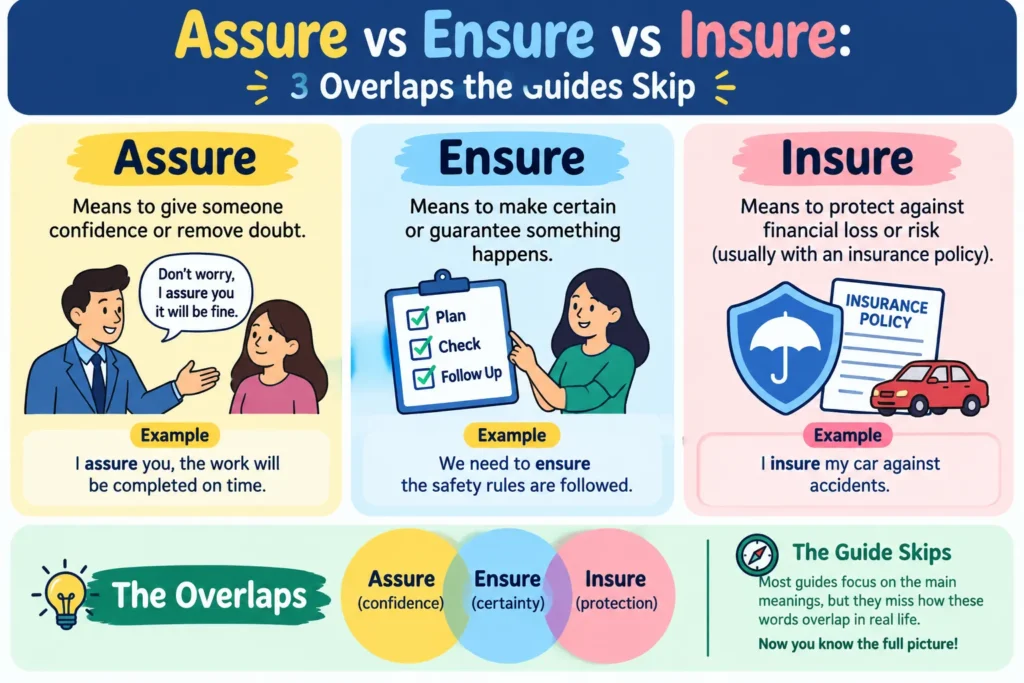
Assure vs ensure vs insure has a clean core: assure a person, ensure an outcome, insure a risk. But Oxford records three further senses in which one of them does another’s job, and only ensure stays entirely in its own lane.
Written by Naveed Akhtar, an SEO content writer with 10 years of article-writing experience. About 8 minutes to read.
The Core Three, and They Are Worth Keeping
Start with the distinction every guide teaches, because it is useful and this page is not an argument against it.
| Word | Core job | What follows it |
|---|---|---|
| assure | Remove somebody’s doubt | A person: I assured her the room was booked |
| ensure | Make an outcome certain | A thing or a clause: Ensure the room is booked |
| insure | Cover a risk with a policy | A thing or a person insured: We insured the car |
Keep that. In careful writing it is the right default, and a reader who learns only this table will be right most of the time.
Assure vs Ensure vs Insure: Where the Three Overlap
Oxford Learner’s gives each of these words more than one sense. Lay the extra senses side by side and the relationship stops looking like a triangle with three clean corners.
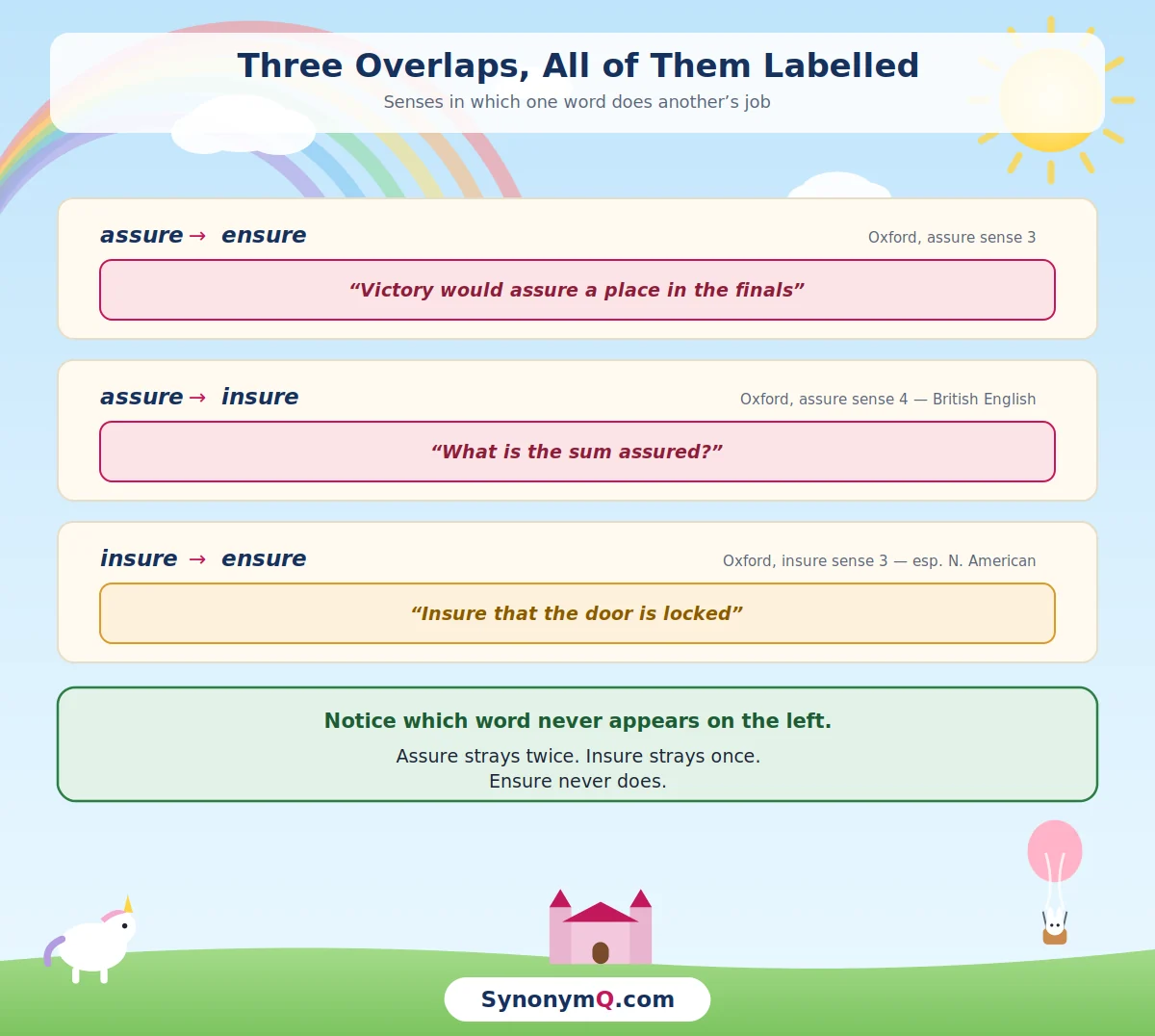
| Overlap | Where it is recorded | Example |
|---|---|---|
| assure doing ensure’s job | Oxford, assure sense 3: “to make something certain to happen” | Victory would assure a place in the finals |
| assure doing insure’s job | Oxford, assure sense 4, marked British English | What is the sum assured? |
| insure doing ensure’s job | Oxford, insure sense 3, marked especially North American English | Insure that the door is locked |
Three overlaps, all labelled, none of them an error. And notice which word is missing from the left column entirely.
Assure Does Two Other Jobs
The rule most guides give is that assure needs a person. Oxford lists four senses, and only the first two work that way.
| Sense | Definition | Pattern |
|---|---|---|
| 1 | “to tell somebody that something is definitely true” | assure somebody (that)… |
| 2 | “(formal) to make yourself certain about something” | assure yourself that… |
| 3 | “to make something certain to happen” | assure something |
| 4 | “(British English) to insure something, especially against somebody’s death” | assure something |
Sense 3 takes a plain object and means what ensure means. Sense 4 is why British insurers sell life assurance while everything else is insurance.
So the person test is a good rule of thumb and a poor rule of grammar. Half of what assure can do needs no person at all.
Grammar patterns settling a word choice before meaning gets a vote is the same mechanism at work in eager vs excited, where the preposition decides it.
Insure Can Mean Ensure, Especially in America
This is the overlap with the most practical consequences, and it is the one the top of the search results handles worst.
Oxford gives insure three senses. The third reads: “(especially North American English) (also ensure British and North American English) to make sure that something happens or is definite.”
Its entry for ensure says the same thing from the other side, noting at the top that the word is “also insure especially in North American English.”
Now compare what the three most visible pages on this query tell that same writer.
| Source | What it says |
|---|---|
| Scribbr | Nothing. The three are presented as distinct and non-overlapping |
| Grammarly | “Some sources note that people use assure, ensure, and insure interchangeably.” No region, no label |
| Dictionary.com | Puts it in the past: insure “developed as a spelling variant of ensure… Essentially, they were the same word!” |
| Oxford | A current, labelled sense of insure meaning ensure |
Dictionary.com is closest to the truth and stops one step short. The two words did not drift together over time. They never fully separated in the first place, and in American English the separation is still incomplete.
Ensure Is the Only One That Stays Put
Look back at the overlap table and count which words appear in the left column. Assure twice, insure once, ensure never.
Oxford gives ensure a single definition, “to make sure that something happens or is definite,” with patterns ensure something, ensure somebody something, ensure something for somebody and ensure (that)…
There is no doubt-removing sense and no insurance sense. It does one job.
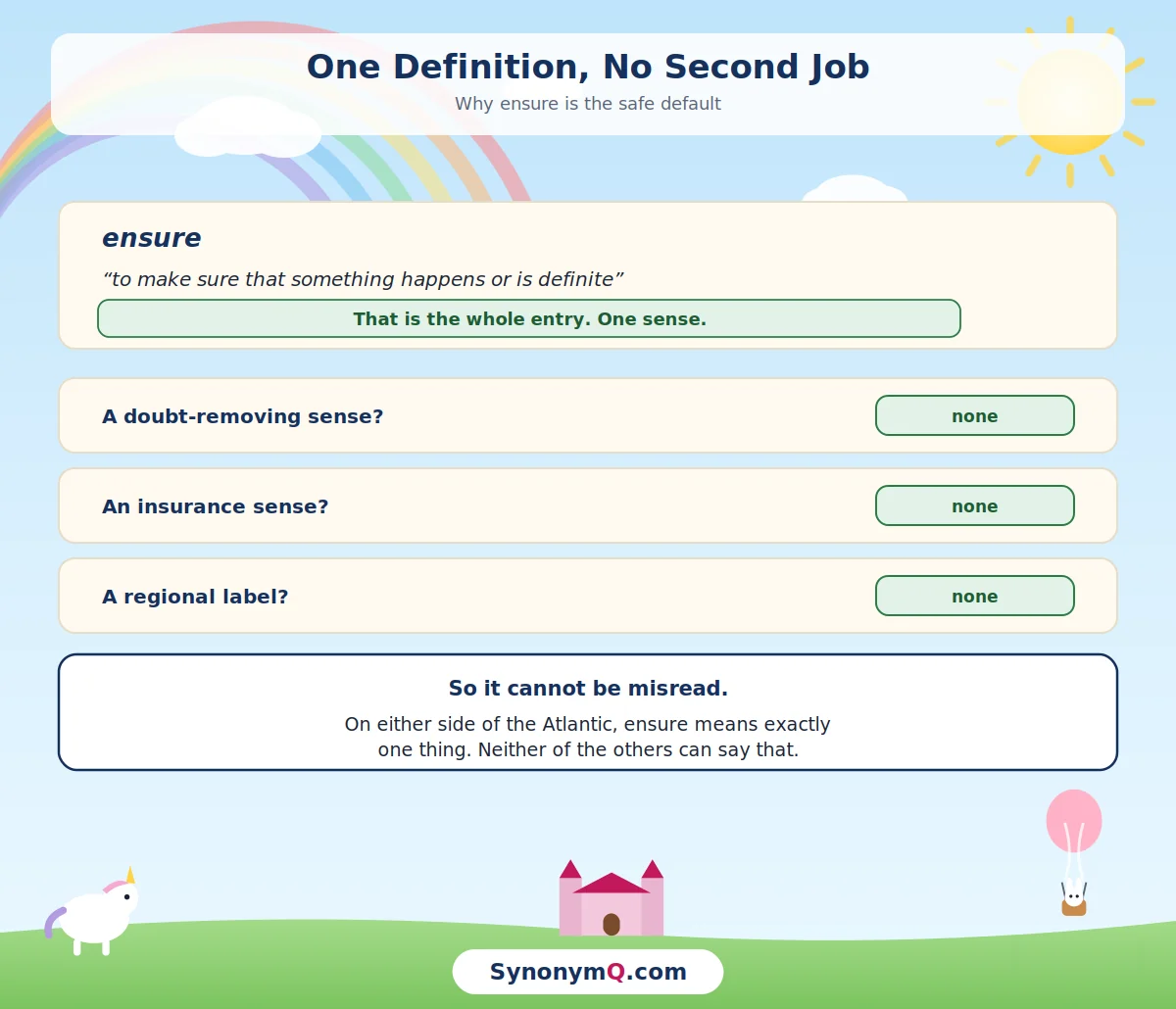
That makes ensure the safe default whenever the sentence is about making an outcome certain. It is the only one of the three that cannot be misread as something else, on either side of the Atlantic.
Choosing the word that cannot be misread, rather than the one that is merely defensible, is the same instinct that settles historic vs historical.
Reassure Is the Fourth Word
Your search almost certainly started with three words, but a fourth turns up constantly and none of the main guides on this query gives it a heading.
Reassure is not a stronger assure. The prefix does real work: it means the doubt was already there, and you are removing it a second time.
| Sentence | What it implies |
|---|---|
| I assured him the figures were checked. | He may or may not have been worried. You stated it. |
| I reassured him the figures were checked. | He was worried. You addressed the worry. |
Use reassure only when there was something to calm. Used where no doubt existed, it invents one, which is an odd thing to do in a status update.
Choosing in a Real Sentence
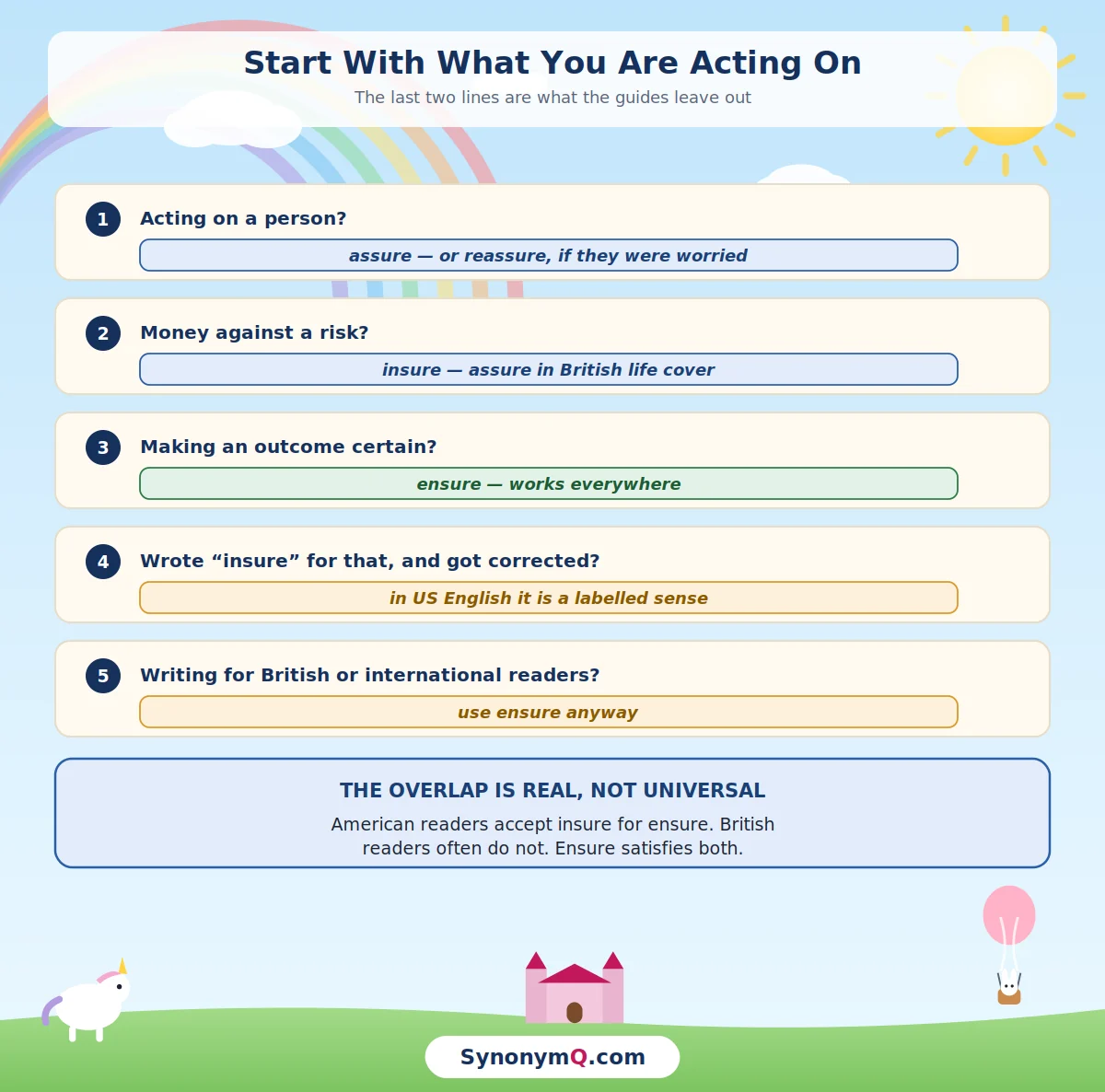
Work down this list and stop at the first line that matches.
- Is a person the thing you are acting on? Use assure. If that person was already anxious, use reassure.
- Is money changing hands against a risk? Use insure. In British English about a death benefit, assure is also correct.
- Are you making an outcome certain? Use ensure. It works everywhere and cannot be misread.
- Did you write insure for that and someone called it wrong? In American English it is a labelled dictionary sense. You are not wrong.
- Writing for an international or British reader? Use ensure anyway. The overlap is real but it is not universal.
And the answer to the question underneath all of this: can you swap them?
| Where | Verdict | Why |
|---|---|---|
| insure and ensure, outcome sense, American English | Direct Swap | Oxford lists them as alternates for that sense |
| The same pair, British or international writing | Swap With Adjustment | Legal, but ensure is the one that reads as intended everywhere |
| Anything involving assure and a person | Requires Rewrite | The object changes from a person to an outcome, so the sentence is about something else |
Words that look like variants of each other but have quietly taken separate jobs are the same problem as comprised vs compromised, except that here the separation never quite finished.
Frequently Asked Questions
Is ensure the same as assure?
No. Assure acts on a person, removing their doubt. Ensure acts on an outcome. Oxford does give assure a third sense meaning “to make something certain to happen,” but that sense takes a plain object, never a person.
Is it “I assure you” or “I ensure you”?
I assure you. The pattern assure somebody is Oxford’s first sense. Ensure has no pattern in which the person is the thing being made certain, so I ensure you is not English.
Which is correct, “I want to ensure” or “I want to insure”?
Both, depending on meaning and region. For making an outcome certain, ensure is correct everywhere and insure is a labelled North American alternative. For buying a policy, only insure works.
Is “I assure you” correct?
Yes, and it is the most standard use of the word. Oxford’s patterns are assure somebody (that)…, assure somebody of something and assure somebody followed by speech.
Why do British insurers say “life assurance”?
Because Oxford records a British sense of assure meaning “to insure something, especially against somebody’s death.” Life assurance pays on an event that is certain to happen eventually, which is the distinction the older word preserved.
How This Page Was Checked
Read from the sources attributed, on 26 September 2026:
- Oxford Learner’s Dictionaries, assure: all four senses and their grammar patterns, including sense 3 and the British sense 4.
- Oxford Learner’s Dictionaries, ensure: the single definition, the four patterns, and the note that the word is “also insure especially in North American English.”
- Oxford Learner’s Dictionaries, insure: the three senses, and the labelling of sense 3.
- Grammarly, “Assure vs. Ensure vs. Insure”: the person rule and the sentence about interchangeable use, quoted in the comparison table.
- Scribbr, “Insure vs. Ensure vs. Assure”: read in full; it records no overlap between the three.
- Dictionary.com, “Insure vs. Ensure vs. Assure”: the historical point that insure began as a spelling variant of ensure.

Naveed Akhtar writes every guide on SynonymQ. He is an SEO content writer with ten years of article-writing experience, working on the question a thesaurus never answers: which of these words belongs in this sentence, for this reader. Every page cites the dictionary entries it draws on and the date they were read.