
Historic vs Historical: 2 Senses That Break the Rule
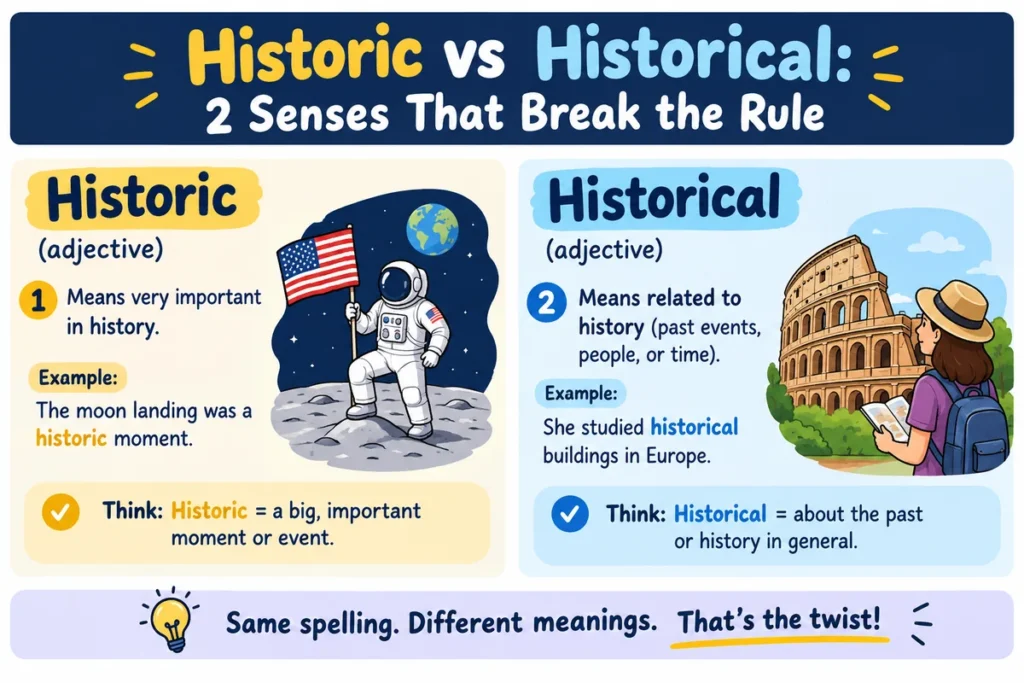
Historic vs historical splits cleanly most of the time: historic means important in history, historical means connected with the past. But Oxford records three senses of historic, and only the first one means important. The other two just mean old.
Written by Naveed Akhtar, an SEO content writer with 10 years of article-writing experience. About 8 minutes to read.
The Rule Everyone Teaches, and It Is Mostly Right
Start by giving the rule its due, because it is not a myth and it is not going away. Oxford Learner’s prints it in its own usage note, and it settles the large majority of sentences you will ever write.
| Word | What it signals | Typical phrases |
|---|---|---|
| historic | Important enough to be remembered | a historic occasion, a historic landmark, a historic victory |
| historical | Connected with the past, or with the study of it | historical research, historical fiction, a historical figure |
So a historic building is one worth preserving, and a historical building is just a building that existed. Most guides stop here, and for everyday writing that is a fair place to stop.
Historic vs Historical: The Two Senses Nobody Mentions
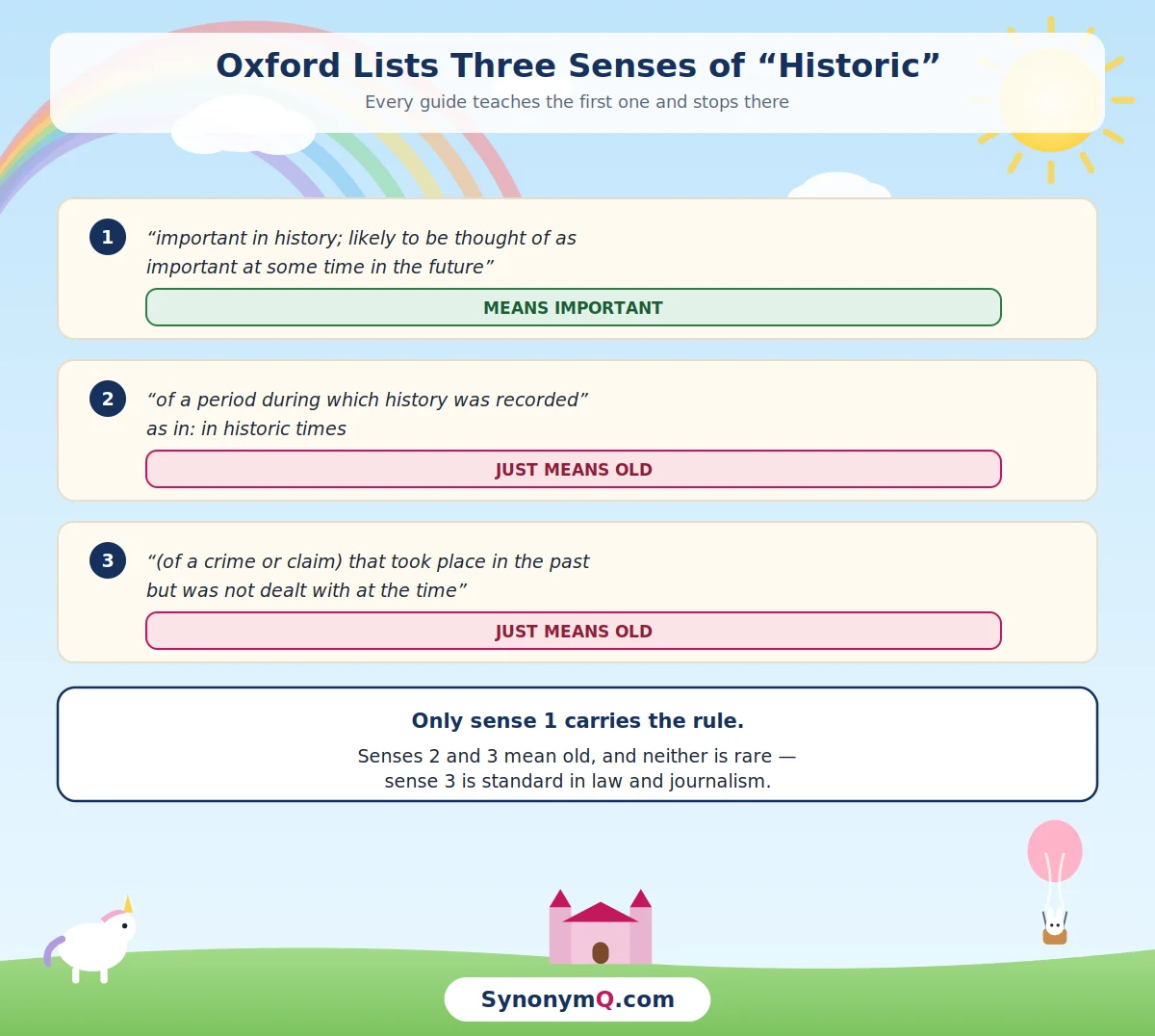
Almost every page on historic vs historical quotes Oxford’s first sense of historic and stops there. Oxford lists three. Here are all of them.
| Sense | Definition | Does it mean “important”? |
|---|---|---|
| 1 | “important in history; likely to be thought of as important at some time in the future” | Yes |
| 2 | “of a period during which history was recorded” | No |
| 3 | “(of a crime or claim) that took place in the past but was not dealt with at the time” | No |
Two of the three senses of historic do not mean important. They mean old, or they mean belonging to the recorded period. Neither is an error and neither is rare.
“A Historic Claim” Does Not Mean an Important Claim
Sense 3 is the one that will actually catch you out, because it is standard in law reporting, journalism and public inquiries, and it means the opposite of what the rule predicts.
Oxford’s own example is historic claims dating back to 1840. Those claims are not being called important. They are being called old, and specifically old and still unresolved.
| Phrase | What it actually means |
|---|---|
| a historic claim | A claim arising from something that happened long ago and was never settled |
| a historical claim | A claim about history, of the kind a scholar makes and defends |
Those are two different things, and a writer who knows only the rule will quietly convert the first into the second while thinking they are fixing a mistake.
The same reasoning applies to historic injustice, which Oxford also gives. It names a wrong done long ago that has not been put right. Historical injustice would suggest a topic in a seminar.
Why “Historic Times” Is Not a Compliment
Sense 2 is quieter and older, and it survives because of the word that sits opposite it.
Oxford defines prehistoric as “connected with the time in history before information was written down.” So historic times are simply the times we have written records for. No praise is being handed out.
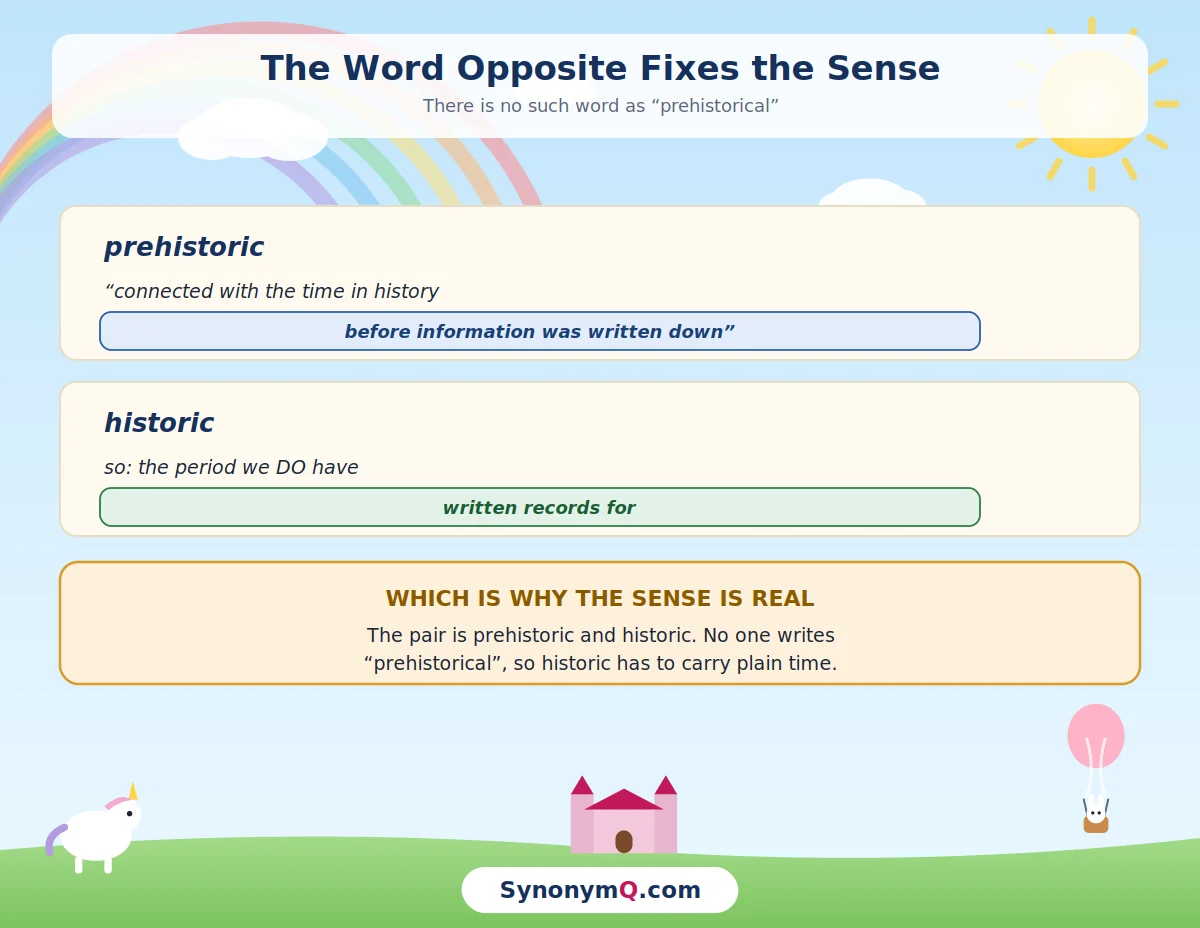
This is also the cleanest proof that the sense is real rather than sloppy. There is no such word as prehistorical in ordinary use. The pair is prehistoric and historic, which means historic has to carry a plain chronological sense.
The same -ic against -ical shape decides several other pairs on this site, including classic vs classical and economic vs economical, and in each one the two endings have drifted apart rather than staying variants of one word.
Historical Data, Historical Records, Historical Fiction
Now the direction that trips up far more writers, and the one with real money attached: a set of phrases where historical is simply fixed, and historic is not an option.
| Phrase | Field | What historic would imply instead |
|---|---|---|
| historical data | Analytics, finance, engineering | Data that is itself famous |
| historical records | Archives, genealogy | Records that made history |
| historical fiction | Publishing | A novel that changed the world |
| historical cost | Accounting | A legendary price |
Write historic data in a report and a careful reader stops, because you appear to be saying the spreadsheet is a landmark. It is a small error that lands in exactly the documents where you can least afford one.
The traffic runs both ways. A second set of phrases is fixed on historic, and these are the ones behind most of the building and city questions people ask about historic vs historical.
| Phrase | Why historic holds |
|---|---|
| historic site | The designation exists because the place is judged important |
| historic district | Same: a protected area, not merely an old one |
| historic preservation | You preserve what is worth keeping |
| historic city centre | Claims significance, not just age |
Notice that this set does not break the rule. It depends on it. These phrases settled on historic precisely because sense 1 is doing the work: each one is a judgement that the place matters.
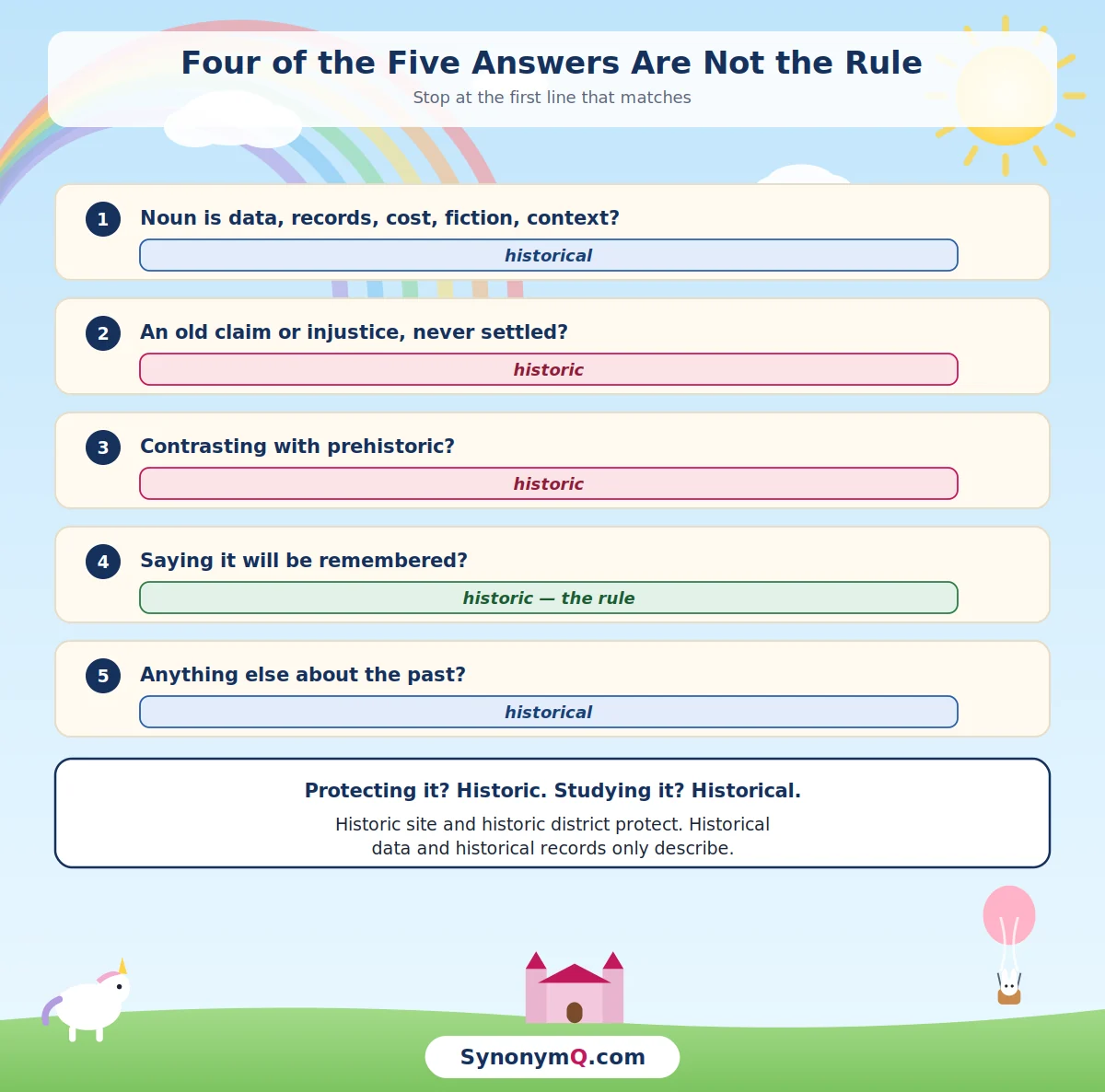
Which gives you a useful shortcut. If the phrase involves protecting something, it is historic. If it involves recording or studying something, it is historical.
Fixed phrases deciding a choice before meaning gets a say is the same mechanism at work in eager vs excited, where the preposition settles the word.
Which leaves one question worth answering directly: can you ever simply swap the two words and leave the sentence alone?
| Where | Verdict | Why |
|---|---|---|
| Anywhere at all | Direct Swap: none | There is no context where these two are interchangeable without changing what the sentence claims |
| a historic event, figure, moment | Swap With Adjustment | Both are grammatical, so you are choosing between “will be remembered” and “happened in the past” |
| Fixed phrases, either direction | Requires Rewrite | Historical data to historic data does not soften the tone; it changes the subject |
That first row is the honest answer, and it is unusual. Most confusable pairs have at least one sentence where either word will do. This one does not.
Is It “A Historic” or “An Historic”?
This is the third most asked question about the pair and it has a short answer.
Oxford notes that some speakers do not pronounce the initial h and therefore say an historic, but records that this “now sounds old-fashioned.”
So the test is your own mouth. If you pronounce the h in historic, which nearly everyone now does, write a historic. An historic is not wrong, it is simply dated.
Choosing Between Them in a Real Sentence
Work down this list and stop at the first line that matches.
- Is the noun data, records, cost, fiction or context? Use historical. The phrase is fixed and meaning does not get a vote.
- Is it a claim, an allegation or an injustice from long ago? Use historic, in the sense of unresolved rather than important.
- Are you contrasting with prehistoric? Use historic, meaning the recorded period.
- Are you saying this will be remembered? Use historic. This is the sense the rule is built on.
- Anything else to do with the past or its study? Use historical, which is the safer default.
A word quietly upgrading something you meant to describe neutrally is the same hazard covered at notable vs noteworthy, and the -ic ending does it here.
Frequently Asked Questions
Is historic the same as historical?
No. In the sense most people mean, historic says something is important enough to be remembered and historical says it is connected with the past. But Oxford records two further senses of historic that simply mean old.
Which is correct, a historic event or a historical event?
Both, and they mean different things. A historic event is one that will be remembered. A historical event is one that happened in the past, with no judgement about its importance attached.
Is it historic data or historical data?
Historical data, always, in analytics, finance and engineering. The phrase is fixed. Historic data reads as data that is itself famous, which is almost never what a report means.
Why do people write “an historic”?
Because some speakers do not pronounce the initial h, which makes an the natural article. Oxford records that this now sounds old-fashioned, so a historic is the safer choice in current writing.
Is a historic building the same as a historical building?
No. A historic building is one considered important enough to protect. A historical building only says the building belongs to the past, which is true of most buildings and therefore says very little.
How This Page Was Checked
Read from the sources attributed, on 25 September 2026:
- Oxford Learner’s Dictionaries, historic: all three senses quoted above, the example historic claims dating back to 1840, the historic injustice example, and the note that an historic now sounds old-fashioned.
- Oxford Learner’s Dictionaries, historical: the three senses, and the usage note stating the rule as given in the first section.
- Oxford Learner’s Dictionaries, prehistoric: “connected with the time in history before information was written down.”
Two Merriam-Webster pages and two Collins entries were attempted and could not be retrieved. Nothing on this page rests on them, and no claim here has been sourced to a page that was not read.

Naveed Akhtar writes every guide on SynonymQ. He is an SEO content writer with ten years of article-writing experience, working on the question a thesaurus never answers: which of these words belongs in this sentence, for this reader. Every page cites the dictionary entries it draws on and the date they were read.